
Holy Trinity Church Greek Orthodox Church
Publish Date: 2026-08-30
Bulletin Contents

Organization Icon
Holy Trinity Church Greek Orthodox Church

General Information

  • Phone:
  • (706) 724-1087
  • Fax:
  • (706) 724-3621
  • Street Address:

  • 953 Telfair Street

  • Augusta, GA 30901


Contact Information


Services Schedule

SUNDAY SERVICES ORTHROS 9AM

DIVINE LITURGY 10AM

Weekly Services begin at 9:00 AM


Past Bulletins


THE VOICE OF THE HOLY TRINITY/WEEKLY ENEWS/ BULLETIN

    Sunday Bulletin

    Sunday Bulletin

    August 31- Saint Cyprian was born of pagan parents in Carthage of Roman Africa about the year 190. An eloquent teacher of rhetoric, he was converted and baptized late in life, and his conversion from a proud man of learning to a humble servant of Christ was complete; he sold his great possessions and gave them to the poor, and because of his zeal and virtue, was ordained presbyter in 247, then Bishop of Carthage in 248. He was especially steadfast in defending the sanctity and uniqueness of the Baptism of the Church of Christ against the confusion of those who would allow some validity to the ministrations of heretics; his writings continue to guide the Church even in our own day. Having survived the persecution of Decius about the year 250, he was beheaded in confession of the Faith during the persecution of Valerian in 258, on September 14; that day being the feast of the Exaltation of the Cross, his feast is kept today.


    September Calendar

    September Calendar

    We buy today’s child almost anything, and then we wonder why they no longer appreciate the value of things. Phones, clothes, toys, trips, pocket money—the only thing we fail to give them is our time. We pacify them with a screen because we are busy, yet a few years later, we complain that they no longer talk to us. But who taught them that a phone is more readily available than Mom and Dad? It is not technology that comes between parents and children on its own; often, we are the ones who open the door to it. A child needs more than just to be provided for; they need to be raised. They need to hear "no" and to learn about patience, hard work, prayer, respect, and boundaries. Granting every wish without shaping their character does them no favors. You are preparing them for a world where they will believe everyone owes them something. And when life delivers its first "no," they may well fall apart, having never learned at home how to cope with doing without.


    2026 Pledge Card/Stewardship

    2026 Pledge Card/Stewardship

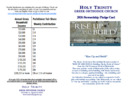
    Biblical stewardship means recognizing that everything belongs to God (the ultimate owner), and humans are managers (stewards) of His resources, including time, talents, money, people, and the Earth, to use for His glory and the betterment of creation


Hymns of the Day

Resurrectional Apolytikion in the Fourth Mode

Having learned the joyful proclamation of the Resurrection from the Angel, and having cast off the ancestral condemnation, the women disciples of the Lord spake to the Apostles exultantly: Death is despoiled and Christ God is risen, granting great mercy to the world.

Apolytikion for Apodosis of the Forerunner in the Second Mode

The memory of the just is celebrated with hymns of praise, but the Lord's testimony is sufficient for thee, O Forerunner; for thou hast proved to be truly even more venerable than the Prophets, since thou was granted to baptize in the running waters Him Whom they proclaimed. Wherefore, having contested for the truth, thou didst rejoice to announce the good tidings even to those in Hades: that God hath appeared in the flesh, taking away the sin of the world and granting us great mercy.

Seasonal Kontakion in the Fourth Mode

In your holy birth, Immaculate One, Joachim and Anna were rid of the shame of childlessness; Adam and Eve of the corruption of death. And so your people, free of the guilt of their sins, celebrate crying: "The barren one gives birth to the Theotokos, who nourishes our life."


Gospel and Epistle Readings

Matins Gospel Reading

Second Orthros Gospel
The Reading is from Mark 16:1-8

When the Sabbath was past, Mary Magdalene, and Mary the mother of James and Salome, bought spices, so that they might go and anoint Jesus. And very early on the first day of the week they went to the tomb when the sun had risen. And they were saying to one another, "Who will roll away the stone for us from the door of the tomb?" And looking up, they saw that the stone was rolled back - it was very large. And entering the tomb, they saw a young man sitting on the right side, dressed in a white robe; and they were amazed. And he said to them, "Do not be amazed; you seek Jesus of Nazareth, who was crucified. He has risen, He is not here; see the place where they laid Him. But go, tell His disciples and Peter that He is going before you to Galilee; there you will see Him, as He told you." And they went out and fled from the tomb, for trembling and astonishment had come upon them; and they said nothing to anyone, for they were afraid.


Epistle Reading

Prokeimenon. Fourth Mode. Psalm 103.24,1.
O Lord, how manifold are your works. You have made all things in wisdom.
Verse: Bless the Lord, O my soul.

The reading is from St. Paul's First Letter to the Corinthians 16:13-24.

Brethren, be watchful, stand firm in your faith, be courageous, be strong. Let all that you do be done in love. Now, brethren, you know that the household of Stephanas were the first converts in Achaia, and they have devoted themselves to the service of the saints; I urge you to be subject to such men and to every fellow worker and laborer. I rejoice at the coming of Stephanas and Fortunatus and Achaicos, because they have made up for your absence; for they refreshed my spirit as well as yours. Give recognition to such men. The churches of Asia send greetings. Aquila and Prisca, together with the church in their house, send you hearty greetings in the Lord. All the brethren send greetings. Greet one another with a holy kiss. I, Paul, write this greeting with my own hand. If any one has no love for the Lord, let him be accursed. Our Lord, come! The grace of the Lord Jesus be with you. My love be with you all in Christ Jesus. Amen.


Gospel Reading

13th Sunday of Matthew
The Reading is from Matthew 21:33-42

The Lord said this parable, "There was a householder who planted a vineyard, and set a hedge around it, and dug a wine press in it, and built a tower, and let it out to tenants, and went into another country. When the season of fruit drew near, he sent his servants to the tenants, to get his fruit; and the tenants took his servants and beat one, killed another, and stoned another. Again he sent other servants, more than the first; and they did the same to them. Afterward he sent his son to them, saying 'They will respect my son.' But when the tenants saw the son, they said to themselves, 'This is the heir; come, let us kill him and have his inheritance.' And they took him and cast him out of the vineyard and killed him. When therefore the owner of the vineyard comes, what will he do to those tenants?" They said to him, "He will put those wretches to a miserable death, and let out the vineyard to other tenants who will give him the fruits in their seasons." Jesus said to them, "Have you never read in the scriptures: 'The very stone which the builders rejected has become the head of the corner; this was the Lord's doing, and it is marvelous in our eyes?'"


Wisdom of the Fathers

Many things does He intimate by this parable, God's providence, which had been exercised towards them from the first; their murderous disposition from the beginning; that nothing had been omitted of whatever pertained to a heedful care of them;...
St. John Chrysostom
Homily 68 on Matthew 21, 4th Century

And observe also both His great care, and the excessive idleness of these men for what pertained to the husbandmen, He Himself did ... and He left little for them to do; to take care of what was there, and to preserve what was given to them.
St. John Chrysostom
Homily 68 on Matthew 21, 4th Century


Saints and Feasts

August 30

13th Sunday of Matthew


August 30

Apodosis of the Feast of the Forerunner


August 30

Alexander, John, and Paul the New, Patriarchs of Constantinople

Saint Alexander was sent to the First Ecumenical Council in Nicaea as the delegate of Saint Metrophanes, Bishop of Constantinople (see June 4), to whose throne he succeeded in the year 325. When Arius had deceitfully professed allegiance to the Council of Nicaea, Saint Alexander, knowing his guile, refused to receive him into communion; Arius' powerful partisans threatened that they would use force to bring Arius into the communion of the Church the following day. Saint Alexander prayed fervently that God might spare the Church; and as Arius was in a privy place relieving nature, his bowels gushed forth with an effusion of blood, and the arch-heresiarch died the death of Judas. Saint Alexander was Bishop from 325 until 337, when he was succeeded by Saint Paul the Confessor, who died a martyr's death at the hands of the Arians (see Nov. 6). The Saint John commemorated here appears to be the one who was Patriarch during the years 562-577, surnamed Scholasticus, who is also commemorated on February 21. He was from Antioch, where he had been a lawyer (scholasticus); he was made presbyter, then was sent to Constantinople as representative (apocrisiarius) of the Patriarch of Antioch, and was appointed Patriarch of Constantinople by the Emperor Justinian. Saint Paul was Bishop of Constantinople during the years 687 - 693, in the reign of Emperor Justinian II, and presided over the Quinisext Council in 692.


Ecumenical Patriarchate News

Archbishop Elpidophoros prayerfully joins Ecumenical Patriarch Bartholomew for Divine Liturgy at Monastery of Panagia Phaneromeni

08/23/2026

CYZICUS, TR – His Eminence Archbishop Elpidophoros of America joined His All-Holiness Ecumenical Patriarch Bartholomew on Sunday, August 23, 2026, for the celebration of the Divine Liturgy at the historic ruins of the Patriarchal and Stavropegial Monastery of Panagia Phaneromeni in Cyzicus, on the occasion of the Apodosis, or Leave-taking, of the Feast of the Dormition of the Theotokos.

His All-Holiness presided over the Divine Liturgy, concelebrating with His Eminence Metropolitan Bartholomew of Smyrna and His Grace Bishop Nicholas of Amathus of the Church of Cyprus. His Eminence Archbishop Elpidophoros of America prayerfully attended the Divine Liturgy together with His Eminence Elder Metropolitan Emmanuel of Chalcedon and His Eminence Metropolitan Maximos of Selyvria, as well as clergy, monastics, Archons of the Ecumenical Patriarchate, descendants of refugees from Artaki, and pilgrims from Constantinople, Imbros, Greece, and elsewhere.

Photo by Ecumenical Patriarchate/Nikos Papachristou

The celebration at the ancient monastery was especially poignant, recalling the centuries during which Panagia Phaneromeni served as a beloved center of Orthodox Christian faith and pilgrimage for the faithful of Artaki, the peninsula of Cyzicus, and the wider region of the Sea of Marmara. Following the tragic events of 1922, the Divine Liturgy was celebrated again at the monastery in 2015, after 93 years of silence.

Speaking after the Divine Liturgy, His All-Holiness reflected with visible emotion upon returning once again to this sacred place, describing the monastery’s ruins as living witnesses to generations of faith, prayer, and devotion to the Most Holy Theotokos.

“And today, once again, we are here,” His All-Holiness proclaimed, giving thanks to God for the opportunity to celebrate the Leave-taking of the Dormition at the historic monastery. He recalled that the wonderworking icon of Panagia Phaneromeni, transferred from the monastery approximately a century ago, is preserved to this day at the Ecumenical Patriarchate in the Phanar, located opposite the Patriarchal Throne, where she continues to receive the prayers and supplicates on behalf, the Ecumenical Patriarch, the Mother Church of Constantinople, and all the faithful.

Photo by Ecumenical Patriarchate/Nikos Papachristou

At the conclusion of the service, His All-Holiness offered a Trisagion for the repose of the soul of the late Ecumenical Patriarch Joachim III, who established the monastery as a Patriarchal Stavropegion in 1903, and for the souls of all those who served and sanctified this historic place through their prayer and ministry.

Following the Divine Liturgy, His Eminence Archbishop Elpidophoros offered a luncheon in honor of His All-Holiness Ecumenical Patriarch Bartholomew and the members of the Patriarchal delegation. The gathering provided an opportunity for fellowship following the deeply moving pilgrimage and celebration and was an expression of His Eminence’s filial love and profound respect for His All-Holiness. 

The significance of this sacred pilgrimage extends beyond the historic shores of Cyzicus. As Archbishop Elpidophoros prepares to return to the United States, he carries with him the venerable Patriarchal blessing of His All-Holiness, the living spirit of the Mother Church of Constantinople, and the prayerful intercessions offered before Panagia Phaneromeni, whose presence has sustained generations of the faithful through times of both joy and trial.

In returning to the Sacred Archdiocese, His Eminence brings these spiritual gifts to the dedicated clergy and faithful of America, renewing the bonds that unite them to the Ecumenical Patriarchate and to the sacred inheritance which continues to exude blessing, strength, and unwaning witness.

The post Archbishop Elpidophoros prayerfully joins Ecumenical Patriarch Bartholomew for Divine Liturgy at Monastery of Panagia Phaneromeni appeared first on Orthodox Observer.

CYZICUS, TR – His Eminence Archbishop Elpidophoros of America joined His All-Holiness Ecumenical Patriarch Bartholomew on Sunday, August 23, 2026, for the celebration of the Divine Liturgy at the historic ruins of the Patriarchal and […]

The post Archbishop Elpidophoros prayerfully joins Ecumenical Patriarch Bartholomew for Divine Liturgy at Monastery of Panagia Phaneromeni appeared first on Orthodox Observer.


Diakonia Newsletter

BACK TO TOP