August 23

Holy Trinity Church Greek Orthodox Church
Publish Date: 2026-08-23
Bulletin Contents
THE VOICE OF THE HOLY TRINITY/WEEKLY ENEWS/ BULLETIN
Monthly Calendar
Hymns of the Day
Gospel and Epistle Readings
Wisdom of the Fathers
Saints and Feasts
Ecumenical Patriarchate News
Assembly of Bishops News
Diakonia Newsletter


Holy Trinity Church Greek Orthodox Church
General Information
- Phone:
- (706) 724-1087
- Fax:
- (706) 724-3621
- Email:
- [email protected]
- Street Address:
- 953 Telfair Street
- Augusta, GA 30901
Contact Information
Services Schedule
SUNDAY SERVICES ORTHROS 9AM
DIVINE LITURGY 10AM
Weekly Services begin at 9:00 AM
Past Bulletins
- Publish Date:
- 2026-10-11
- Publish Date:
- 2026-09-27
- Publish Date:
- 2026-09-20
- Publish Date:
- 2026-09-13
- Publish Date:
- 2026-08-30
- Publish Date:
- 2026-08-09
THE VOICE OF THE HOLY TRINITY/WEEKLY ENEWS/ BULLETIN
Sunday Bulletin
The Holy Hieromartyr Irenaeus was born in Asia Minor about the year 120, and in his youth was a disciple of Saint Polycarp, Bishop of Smyrna. Saint Irenaeus was sent to Lyons in Gaul, to be a fellow labourer of Pothinus, Bishop of Lyons (celebrated June 2), who had also been a disciple of Saint Polycarp. After the martyrdom of Saint Pothinus, Saint Irenaeus succeeded him as Bishop of Lyons. Besides the assaults of paganism, Irenaeus found himself compelled to do battle with many Gnostic heresies, against which he wrote his greatest work, A Refutation and Overthrow of Knowledge Falsely So Called . He was also a peace-maker within the Church. When Victor, Bishop of Rome, was prepared to excommunicate the Christians of Asia Minor for following a different tradition celebrating Pascha, Irenaeus persuaded him to moderate his zeal, and mediated peace. He made Lyons an illustrious bastion of Orthodoxy and a school of piety, and sealed his confession with martyrdom about the year 202, during the reign of Septimius Severus. He is not to be confused with Saint Irenaeus, Bishop of Sirmium, also celebrated today, who was beheaded and cast into a river in 304 under Diocletian.
AUGUST CALENDAR
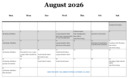
Concerning the Dormition of the Theotokos, this is what the Church has received from ancient times from the tradition of the Fathers. When the time drew nigh that our Savior was well-pleased to take His Mother to Himself, He declared unto her through an Angel that three days hence, He would translate her from this temporal life to eternity and bliss. On hearing this, she went up with haste to the Mount of Olives, where she prayed continuously. Giving thanks to God, she returned to her house and prepared whatever was necessary for her burial. While these things were taking place, clouds caught up the Apostles from the ends of the earth, where each one happened to be preaching, and brought them at once to the house of the Mother of God, who informed them of the cause of their sudden gathering. As a mother, she consoled them in their affliction as was meet, and then raised her hands to Heaven and prayed for the peace of the world. She blessed the Apostles, and, reclining upon her bed with seemliness, gave up her all-holy spirit into the hands of her Son and God. With reverence and many lights, and chanting burial hymns, the Apostles took up that God-receiving body and brought it to the sepulchre, while the Angels from Heaven chanted with them, and sent forth her who is higher than the Cherubim. But one Jew, moved by malice, audaciously stretched forth his hand upon the bed and immediately received from divine judgment the wages of his audacity. Those daring hands were severed by an invisible blow. But when he repented and asked forgiveness, his hands were restored. When they had reached the place called Gethsemane, they buried there with honor the all-immaculate body of the Theotokos, which was the source of Life. But on the third day after the burial, when they were eating together, and raised up the artos (bread) in Jesus' Name, as was their custom, the Theotokos appeared in the air, saying "Rejoice" to them. From this they learned concerning the bodily translation of the Theotokos into the Heavens. These things has the Church received from the traditions of the Fathers, who have composed many hymns out of reverence, to the glory of the Mother of our God (see Oct. 3 and 4).
SUNDAY SCHOOL REGISTRATION
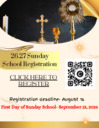
**Dear Parents,** We warmly invite you to REGISTER your children to **Orthodox Sunday School**, where they can grow in their faith, learn about God's love, and build lasting friendships in our church family. Sunday School is a wonderful opportunity for children to explore the teachings of the Orthodox Church through Bible lessons, prayers, activities, and fellowship in a caring and supportive environment. By attending regularly, children develop a stronger relationship with Christ and a deeper understanding of our Orthodox faith that will guide them throughout their lives. We look forward to welcoming your family each Sunday. Together, let us help our children grow "in wisdom and stature, and in favor with God and man" (Luke 2:52). **We can't wait to see you and your children in Sunday School!**
2026 Pledge Card/Stewardship
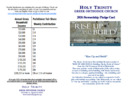
Biblical stewardship means recognizing that everything belongs to God (the ultimate owner), and humans are managers (stewards) of His resources, including time, talents, money, people, and the Earth, to use for His glory and the betterment of creation
Hymns of the Day
Resurrectional Apolytikion in the Third Mode
Let the Heavens rejoice; let earthly things be glad; for the Lord hath wrought might with His arm, He hath trampled upon death by death. The first-born of the dead hath He become. From the belly of Hades hath He delivered us, and hath granted great mercy to the world.
Apolytikion for Apodosis of the Dormition in the First Mode
In giving birth, thou didst preserve thy virginity; in thy dormition, thou didst not forsake the world, O Theotokos. Thou wast translated unto life, since thou art the Mother of Life; and by thine intercessions dost thou redeem our souls from death.
Seasonal Kontakion in the Second Mode
Neither the grave nor death could contain the Theotokos, the unshakable hope, ever vigilant in intercession and protection. As Mother of life, He who dwelt in the ever-virginal womb transposed her to life.
The translations of hymns are under copyright and used by permission. All rights reserved. These works may not be further reproduced, in print or on other websites or in any other form, without the prior written authorization of the copyright holder:
Gospel and Epistle Readings
Matins Gospel Reading
First Orthros Gospel
The Reading is from Matthew 28:16-20
At that time, the eleven disciples went to Galilee, to the mountain to which Jesus had directed them. And when they saw Him they worshiped Him; but some doubted. And Jesus came and said to them, "All authority in heaven and on earth has been given to Me. Go therefore and make disciples of all nations, baptizing them in the name of the Father and the Son and the Holy Spirit, teaching them to observe all that I have commanded you; and lo, I am with you always, to the close of the age. Amen."
Epistle Reading
Prokeimenon. Third Mode. Psalm 46.6,1.
Sing praises to our God, sing praises.
Verse: Clap your hands, all you nations.
The reading is from St. Paul's First Letter to the Corinthians 15:1-11.
Brethren, I would remind you in what terms I preached to you the gospel, which you received, in which you stand, by which you are saved, if you hold it fast -- unless you believed in vain. For I delivered to you as of first importance what I also received, that Christ died for our sins in accordance with the scriptures, that he was buried, that he was raised on the third day in accordance with the scriptures, and that he appeared to Cephas, then to the twelve. Then he appeared to more than five hundred brethren at one time, most of whom are still alive, though some have fallen asleep. Then he appeared to James, then to all the apostles. Last of all, as to one untimely born, he appeared also to me. For I am the least of the apostles, unfit to be called an apostle, because I persecuted the church of God. But by the grace of God I am what I am, and his grace toward me was not in vain. On the contrary, I worked harder than any of them, though it was not I, but the grace of God which is with me. Whether then it was I or they, so we preach and so you believed.
Gospel Reading
12th Sunday of Matthew
The Reading is from Matthew 19:16-26
At that time, a young man came up to Jesus, kneeling and saying, "Good Teacher, what good deed must I do, to have eternal life?" And he said to him, "Why do you call me good? One there is who is good. If you would enter life, keep the commandments." He said to him, "Which?" And Jesus said, "You shall not kill, You shall not commit adultery, You shall not steal, You shall not bear false witness, Honor your father and mother, and You shall love your neighbor as yourself." The young man said to him, "All these I have observed; what do I still lack?" Jesus said to him, "If you would be perfect, go, sell what you possess and give to the poor, and you will have treasure in heaven; and come, follow me." When the young man heard this he went away sorrowful; for he had great possessions.
And Jesus said to his disciples, "Truly, I say to you, it will be hard for a rich man to enter the kingdom of heaven. Again I tell you, it is easier for a camel to go through the eye of a needle than for a rich man to enter the kingdom of God." When the disciples heard this they were greatly astonished, saying, "Who then can be saved?" But Jesus looked at them and said to them, "With men this is impossible, but with God all things are possible."
Wisdom of the Fathers
Rise from love of the world and love of pleasure. Put care aside, strip your mind, refuse your body. Prayer, after all, is a turning away from the world, visible and invisible. What have I in heaven? Nothing except simply to cling always to You in undistracted prayer. Wealth pleases some, glory others, possessions others, but what I want is to cling to God and to put the hopes of my dispassion in Him (cf. Ps. 72:25, 28).
Ladder of Divine Ascent, Step 28: On Prayer; Paulist Press pg. 277, 6th century
Spiritual delight is not enjoyment found in things that exists outside the soul.
Unknown, 7th century
Saints and Feasts


August 23
Apodosis of the Dormition of our Most Holy Lady the Theotokos and Ever Virgin Mary
Concerning the Dormition of the Theotokos, this is what the Church has received from ancient times from the tradition of the Fathers. When the time drew nigh that our Savior was well-pleased to take His Mother to Himself, He declared unto her through an Angel that three days hence, He would translate her from this temporal life to eternity and bliss. On hearing this, she went up with haste to the Mount of Olives, where she prayed continuously. Giving thanks to God, she returned to her house and prepared whatever was necessary for her burial. While these things were taking place, clouds caught up the Apostles from the ends of the earth, where each one happened to be preaching, and brought them at once to the house of the Mother of God, who informed them of the cause of their sudden gathering. As a mother, she consoled them in their affliction as was meet, and then raised her hands to Heaven and prayed for the peace of the world. She blessed the Apostles, and, reclining upon her bed with seemliness, gave up her all-holy spirit into the hands of her Son and God.
With reverence and many lights, and chanting burial hymns, the Apostles took up that God-receiving body and brought it to the sepulchre, while the Angels from Heaven chanted with them, and sent forth her who is higher than the Cherubim. But one Jew, moved by malice, audaciously stretched forth his hand upon the bed and immediately received from divine judgment the wages of his audacity. Those daring hands were severed by an invisible blow. But when he repented and asked forgiveness, his hands were restored. When they had reached the place called Gethsemane, they buried there with honor the all-immaculate body of the Theotokos, which was the source of Life. But on the third day after the burial, when they were eating together, and raised up the artos (bread) in Jesus' Name, as was their custom, the Theotokos appeared in the air, saying "Rejoice" to them. From this they learned concerning the bodily translation of the Theotokos into the Heavens.
These things has the Church received from the traditions of the Fathers, who have composed many hymns out of reverence, to the glory of the Mother of our God (see Oct. 3 and 4).

August 23
Our Holy Father Irenaeus, Bishop of Lyons
The Holy Hieromartyr Irenaeus was born in Asia Minor about the year 120, and in his youth was a disciple of Saint Polycarp, Bishop of Smyrna. Saint Irenaeus was sent to Lyons in Gaul, to be a fellow labourer of Pothinus, Bishop of Lyons (celebrated June 2), who had also been a disciple of Saint Polycarp. After the martyrdom of Saint Pothinus, Saint Irenaeus succeeded him as Bishop of Lyons. Besides the assaults of paganism, Irenaeus found himself compelled to do battle with many Gnostic heresies, against which he wrote his greatest work, A Refutation and Overthrow of Knowledge Falsely So Called . He was also a peace-maker within the Church. When Victor, Bishop of Rome, was prepared to excommunicate the Christians of Asia Minor for following a different tradition celebrating Pascha, Irenaeus persuaded him to moderate his zeal, and mediated peace. He made Lyons an illustrious bastion of Orthodoxy and a school of piety, and sealed his confession with martyrdom about the year 202, during the reign of Septimius Severus. He is not to be confused with Saint Irenaeus, Bishop of Sirmium, also celebrated today, who was beheaded and cast into a river in 304 under Diocletian.
Diakonia Newsletter
Read the latest Diakonia Newsletter for this Sunday
https://bulletinbuilder.org/diakonia-newsletter/2026-08-23?source=bulletin_web
August 23, 2026