Sunday of St Luke the Evangelist, 18 October 9:00 AM: Orthros (Matins & Lauds), followed by 10:00 AM: DIVINE LITURGY & Memorial Service, Sunday School
Fasting this Week:
Wed: Strict Fasting; Fri: Wine & Oil Allowed;All Other Days: No Fasting
Upcoming Calendar
Parish Calendar
October 18 to November 1, 2026
Sunday, October 18
Apostle & Evangelist Luke
9:00AM Orthros (Matins+Lauds)
10:00AM Divine Liturgy
Sunday, November 1
6:00PM Installation of Father Griffing, by Met Methodios
Announcements & Future Events
Memorial Service:this morning's 5-year Memorial is offered for SOTIRIOS Bouras, the beloved father of Presvytera Mari. May his memory be eternal!
Birthday Cake: there will be a special cake served this morning to honor our former priest, Fr Bob Athas.
Hymns of the Day
Resurrectional Apolytikion in the Third Mode
Let the heavens rejoice; let the earth be glad, for the Lord has shown the mighty power of His arm. He trampled down death by death and became the firstborn of the dead. From the depths of Hades, He delivered us and granted to the world great mercy.
Apolytikion of Church of the Dormition in the First Mode
In giving birth you did retain your virginity. In your repose, you did not forsake the world, O Theotokos. You have passed into life, you that are the Mother of Life. And by your intercessions, you redeem our souls from death.
The protection of Christians unshameable, intercessor to our Holy Maker, unwavering, do not turn from the prayerful cries of those who are in sin; instead, come to us, for you are good; your loving help bring unto us, who are crying in faith to you: Hasten to intercession and speed now to supplication as a protection for all time, Theotokos, for those who honor you.
يا شَفيعَةَ المَسيحيينَ غَيْرَ الخازِيَة، الوَسيطَةَ لَدَى الخالِقِ غَيْرَ المَرْدُودة، لا تُعْرِضِي عَنْ أصْواتِ طَلِبَاتِنا نحْنُ الخَطَأَة، بَلْ تَدارَكينا بالمَعونَةِ بِما أنَّكِ صالِحَة، نحْنُ الصارِخِينَ إليْكِ بإيمانٍ: بادِرِي إلَى الشَفاعَةِ وأسْرِعِي في الطِلْبَةِ، يا والِدَةَ الإلَه، المُتَشَفِّعَةَ دائِمًا بِمُكَرِّمِيكِ.
Gospel and Epistle Readings
Epistle Reading
Prokeimenon. Plagal Fourth Mode. Psalm 18.4,1. Their voice has gone out into all the earth.
Verse: The heavens declare the glory of God.
The reading is from St. Paul's Letter to the Colossians 4:5-11, 14-18.
Brethren, conduct yourselves wisely toward outsiders, making the most of the time. Let your speech always be gracious, seasoned with salt, so that you may know how you ought to answer every one. Tychicos will tell you all about my affairs; he is a beloved brother and faithful minister and fellow servant in the Lord. I have sent him to you for this very purpose, that you may know how we are and that he may encourage your hearts, and with him Onesimos, the faithful and beloved brother, who is one of yourselves. They will tell you of everything that has taken place. Aristarchos my fellow prisoner greets you, and Mark the cousin of Barnabas (concerning whom you have received instructions if he comes to you, receive him), and Jesus who is called Justos. These are the only men of the circumcision among my fellow workers for the kingdom of God, and they have been a comfort to me. Luke the beloved physician and Demas greet you. Give my greetings to the brethren at Laodicea, and to Nympha and the church in her house. And when this letter has been read among you, have it read also in the church of the Laodiceans; and see that you read also the letter from Laodicea. And say to Archippos, "See that you fulfill the ministry which you have received in the Lord." I, Paul, write this greeting with my own hand. Remember my fetters. Grace be with you. Amen.
البروكيمنون. Plagal Fourth Mode. مزمور 18: 4، 1. في كل الأرض خرج صوتهم
Verse: السموات تذيع بمجد الله
Luke the Evangelist
The Reading is from Luke 10:16-21
The Lord said to his disciples, "He who hears you hears me, and he who rejects you rejects me, and he who rejects me rejects him who sent me." The seventy returned with joy, saying, "Lord, even the demons are subject to us in your name!" And he said to them, "I saw Satan fall like lightning from heaven. Behold, I have given you authority to tread upon serpents and scorpions, and over all the power of the enemy; and nothing shall hurt you. Nevertheless do not rejoice in this, that the spirits are subject to you; but rejoice that your names are written in heaven." In that same hour he rejoiced in the Holy Spirit and said, "I thank you, Father, Lord of heaven and earth, that you have hidden these things from the wise and understanding and revealed them to babes; yes, Father, for such was your gracious will."
This Apostle was an Antiochean, a physician by trade, and a disciple and companion of Paul. He wrote his Gospel in Greek after Matthew and Mark, after which he wrote the Acts of the Apostles, and dedicated both works to Theophilus, who, according to some, was Governor of Achaia. He lived some eighty-six years and died in Achaia, perhaps in Patras, the capital of this district. His emblem is the calf, the third symbolical beast mentioned by Ezekiel (1:10), which is a symbol of Christ's sacrificial and priestly office, as Saint Irenaeus says.
October 19
John of Rilas
Saint John of Rilas founded the renowned monastery of that name in Bulgaria in the tenth century. Over the centuries, great and wondrous healings have flowed from his holy relics.
October 19
Joel the Prophet
The Prophet Joel, whose name means "Yah is God," was of the tribe of Reuben, the son of Bathuel, and lived from 810 to 750 B.C. (but some say in the 7th century B.C.). His book is divided into three chapters, and is the second in order of the minor Prophets. He foretold the coming of the Holy Spirit on the day of Pentecost (Joel 2:28, and quoted by the Apostle Peter in Acts 2:17), and the saving power of the Name of our Lord Jesus Christ (Joel 2:32).
October 19
John the Wonderworker of Kronstadt
Saint John of Kronstadt was a married priest, who lived with his wife in virginity. Through his untiring labours in his priestly duties and love for the poor and sinners, he was granted by our Lord great gifts of clairvoyance and miracle-working, to such a degree that in the last years of his life miracles of healing--both of body and soul--were performed countless times each day through his prayers, often for people who had only written to him asking his help. During his lifetime he was known throughout Russia, as well as in the Western world. He has left us his diary My Life in Christ as a spiritual treasure for Christians of every age; simple in language, it expounds the deepest mysteries of our Faith with that wisdom which is given only to a heart purified by the grace of the Holy Spirit. Foreseeing as a true prophet the Revolution of 1917, he unsparingly rebuked the growing apostasy among the people; he foretold that the very name of Russia would be changed. As the darkness of unbelief grew thicker, he shone forth as a beacon of unquenchable piety, comforting the faithful through the many miracles that he worked and the fatherly love and simplicity with which he received all. Saint John reposed in peace in 1908.
October 20
Gerasimos of Cephalonia
Saint Gerasimus was from the Peloponnesus, the son of Demetrius and Kale, of the family of Notaras. He was reared in piety by them and studied the Sacred writings. He left his country and went throughout various lands, and finally came to Cephalonia, where he restored a certain old church and built a convent around it, where it stands to this day at the place called Omala. He finished the course of his life there in asceticism in the year 1570. His sacred relics, which remain incorrupt, are kept there for the sanctification of the faithful.
October 22
Seven Holy Martyred Youths of Ephesus
The Seven Youths hid themselves in a certain cave near Ephesus in the year 250, to escape the persecution of Decius. By divine grace, a sleep came upon them and they slept for 184 years, until the reign of Saint Theodosius the Younger, when the doctrine of the resurrection was being assailed by heretics. They then awoke, that is, were resurrected, confirming in the sight of all the bodily resurrection; and again after a short time, by divine command, they reposed in the Lord in the year 434.
October 23
James the Apostle, brother of Our Lord
According to some, this Saint was a son of Joseph the Betrothed, born of the wife that the latter had before he was betrothed to the Ever-virgin. Hence he was the brother of the Lord, Who was also thought to be the son of Joseph (Matt. 13: 55). But some say that he was a nephew of Joseph, and the son of his brother Cleopas, who was also called Alphaeus and Mary his wife, who was the first cousin of the Theotokos. But even according to this genealogy, he was still called, according to the idiom of the Scriptures, the Lord's brother because of their kinship.
This Iakovos is called the Less (Mark 15:40) by the Evangelists to distinguish him from Iakovos, the son of Zebedee, who was called the Great. He became the first Bishop of Jerusalem, elevated to this episcopal rank by the Apostles, according to Eusebius (Eccl. Hist., Book II: 23), and was called Obliah, that is, the Just, because of his great holiness and righteousness. Having ascended the crest of the Temple on the day of the Passover at the prompting of all, he bore testimony from there concerning his belief in Jesus, and he proclaimed with a great voice that Jesus sits at the right hand of the great power of God and shall come again upon the clouds of heaven. On hearing this testimony, many of those present cried, "Hosanna to the Son of David." But the Scribes and Pharisees cried, "So, even the just one hath been led astray," and at the command of Ananias the high priest, the Apostle was cast down headlong from thence, then was stoned, and while he prayed for his slayers, his head was crushed by the wooden club wielded by a certain scribe. The first of the Catholic (General) Epistles written to the Jews in the Diaspora who believed in Christ was written by this Iakovos.
Archdiocese News
Olympic leadership calls Greek Americans a source of strength for Team Hellas
10/15/2026
His Eminence Archbishop Elpidophoros of America welcomed Hellenic Olympic Committee President Isidoros Kouvelos and former Greek Foreign Minister Dora Bakoyannis to the Archdiocese headquarters on October 14 for a luncheon held in their honor, as Greece’s Olympic leadership looks ahead to the 2028 Summer Games in Los Angeles.
“For us, meeting the Greek American community is always deeply meaningful. You have built lives, institutions and communities here, while keeping a strong bond with Greece,” Kouvelos said. “And this bond was kept alive through faith, through our Church.”
Hellenic Olympic Committee President Isidoros Kouvelos addresses guests at a luncheon in his honor at the Greek Orthodox Archdiocese of America headquarters in New York on Oct. 14, 2026. Photo by Orthodox Observer/Yannis Malevitis
He credited that relationship to faith, citing “the strength of God and the protection of Christ and the Panagia.” “In every corner of the world where Greeks travelled, struggled and created, the Church became a home, a refuge and a point of unity. It kept the Diaspora together, gave courage in difficult times, and helped Hellenism rise and prosper in distant lands, remaining faithful to its roots.”
That connection, he said, can now become a source of strength for Team Hellas on the road to Los Angeles. “When our athletes arrive in California, they will carry with them the history of Greece, the pride of a nation, and the hopes of a new generation,” Kouvelos said. “And here, on American soil, they will meet another part of Greece.”
He noted that the Olympic flame, lit at ancient Olympia, will again travel to the United States to open the Games. “This light comes from our homeland but belongs to the whole of humanity,” Kouvelos said. “Every Olympic journey, wherever it takes place, is connected forever with Greece.”
Support Long Before the Applause
During their meeting, Kouvelos briefed His Eminence on the Committee’s preparations for the road to LA 2028 and on the projects the Hellenic Olympic Committee has undertaken under his presidency. These include the restoration of the Olympic Rowing Centre in Schinias and the historic swimming facility in Athens, as well as the restoration of the Panathenaic Stadium, the “Kallimarmaro,” for the first time in 130 years. The Committee is also working toward a new Athletes’ Residence, a true home for the athletes preparing to represent Greece at the Olympic Games. The projects share one vision, Kouvelos said: to turn Olympic heritage into living support for the next generation.
“Behind every Olympic appearance, there are years of work and sacrifice,” he said. “Our responsibility is to support them long before the applause begins.”
Kouvelos recalled that Greek Americans supported the Greek team when the Games came to the United States, in St. Louis in 1904 and Los Angeles in 1932, at times even competing as part of it. To carry that support forward, the Committee has established a 501(c)(3) structure in the United States so that friends and supporters of Team Hellas can contribute with confidence, clarity and trust.
Closing his remarks, Kouvelos turned to the Archbishop: “Your Eminence, your name carries a beautiful meaning: hope,” he said, a reference to the name Elpidophoros, “bearer of hope.” “And hope is also at the heart of Team Hellas.”
His Eminence Archbishop Elpidophoros of America offers a closing prayer after a luncheon honoring Greek Olympic leadership at the Greek Orthodox Archdiocese of America headquarters in New York on Oct. 14, 2026. Photo by Orthodox Observer/Yannis Malevitis
His Grace Bishop Nektarios of Diokleia, Chancellor of the Archdiocese, opened the luncheon, which brought together members of the Archdiocesan Council and leaders of the Greek-American community. Among them were John Catsimatidis, Vice Chairman of the Archdiocesan Council; Dr. Anthony J. Limberakis, National Commander of the Order of Saint Andrew the Apostle, Archons of the Ecumenical Patriarchate; philanthropist C. Dean Metropoulos; the Hon. B. Theodore Bozonelis, National Vice Commander of the Order; and Anita Kartalopoulos, First Vice President of the National Ladies Philoptochos Society. Also in attendance was Fr. Alexander Karloutsos, Grand Protopresbyter of the Ecumenical Patriarchate and Spiritual Advisor to the Archons.
In his remarks, Archbishop Elpidophoros began by acknowledging minister Bakoyannis and thanking her for standing with the Ecumenical Patriarchate and the Archdiocese in difficult times.
He credited her with an initiative, pursued during her tenure as Greek Foreign Minister, that allowed hierarchs of the Ecumenical Patriarchate serving outside Türkiye to apply for Turkish citizenship. The Turkish government extended that offer in 2010, enabling those hierarchs to serve on the Holy and Sacred Synod, whose members Türkiye has required to be Turkish citizens.
“She had the idea, not only the idea, but she implemented it. She’s a doer,” Archbishop Elpidophoros said. “We owe this to you, Your Excellency, and we thank you for that.”
The Archbishop said the approach of 2028 is raising interest in “all things Greek” across the country. “Greece will never go out of style, or out of relevance,” Archbishop Elpidophoros said.
He noted that the Ecumenical Patriarch, now in his 35th year on the Ecumenical Throne, has called on the world to observe the Olympic truce, the Εκεχειρία. “Violence is diametrically opposed to the contest and the spirit of the Olympics,” Archbishop Elpidophoros said.
His Eminence Archbishop Elpidophoros of America welcomed Hellenic Olympic Committee President Isidoros Kouvelos and former Greek Foreign Minister Dora Bakoyannis to the Archdiocese headquarters on October 14 for a luncheon held in their honor, as […]
Archdiocesan Psaltic Art Library launches with new Funeral Service book
10/14/2026
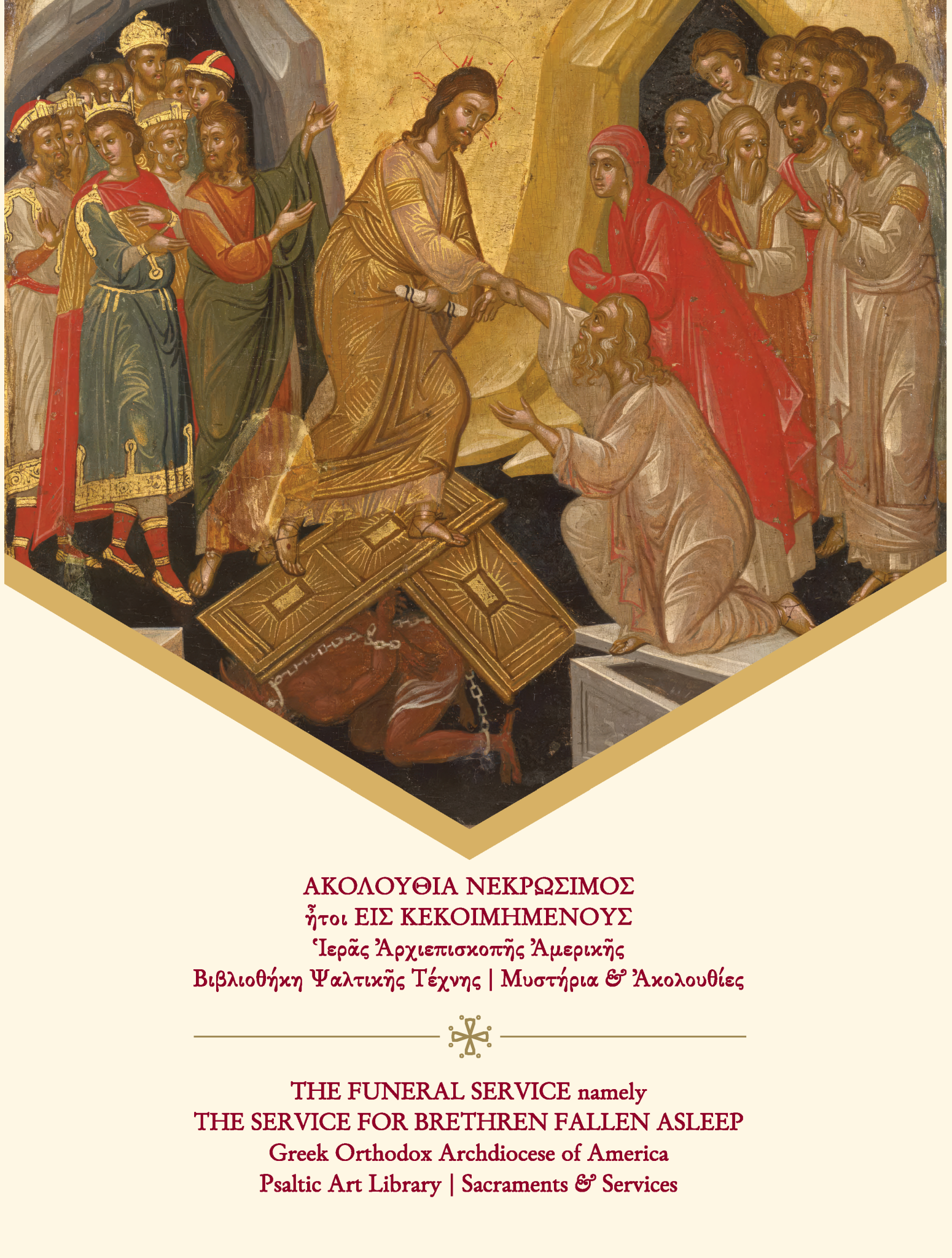
The School of Byzantine Music, a national ministry of the Greek Orthodox Archdiocese of America, is proud to announce the publication of The Funeral Service (Service for Brethren Fallen Asleep), the first volume of the Archdiocese’s new Psaltic Art Library. The beautiful hardcover edition is available immediately for $60 (US) at www.orthodoxmarketplace.com/the-funeral-service.
With the generous support of Leadership 100, the initiative of the Psaltic Art Library embodies His Eminence Archbishop Elpidophoros of America’s vision to equip ministry leaders and workers for building up the Body of Christ. The Psaltic Art Library will bring together service books and educational texts for all Sacraments and major services of the Church in handsome editions. Each edition will be paired with professional audio recordings that will be available on all major streaming platforms worldwide.
The English hymns in the Funeral Service translation, approved by the Holy Eparchial Synod, are metered to match the original Greek. The book is made for parish choirs, cantors, clergy, seminarians, Byzantine Music schools, and students of the Psaltic Art. This edition promotes the sacred art of Byzantine chant and makes the Church’s liturgical treasury more accessible to contemporary generations. Audio recordings of the Funeral Service are planned for launch on major streaming services worldwide by early 2027.
The Funeral Service and the Psaltic Art Library build on the successful launch of the School of Byzantine Music’s Sunday Orthros albums (www.goarch.org/orthros). Archbishop Elpidophoros announced the Sunday Orthros during his keynote address at the Clergy-Laity Congress in Cleveland. The 16 albums, eight in English and eight in Greek and covering all eight modes, have been a major success, capturing more than 40,000 streams on Spotify from July through October 2026.
The School of Byzantine Music, a national ministry of the Greek Orthodox Archdiocese of America, is proud to announce the publication of The Funeral Service (Service for Brethren Fallen Asleep), the first volume of the […]
National Philoptochos Grant brings comfort to families at Ronald McDonald House Mobile
10/13/2026
MOBILE, AL — October 8, 2026 — National Philoptochos is proud to support Ronald McDonald House Mobile with a $91,351 grant establishing the Family Care Van, a new transportation program serving families whose children are receiving medical care in the Mobile, Alabama area.
The grant made possible the purchase of a new 15-passenger van, two car seats, and a wheelchair-accessible conversion, along with the first year of a part-time driver. Through this program, families will have daily transportation between Ronald McDonald House Mobile and USA Health Children’s & Women’s Hospital, as well as rides to other area hospitals, medical appointments, pharmacies, and, when needed, work. Twice-weekly shopping trips and occasional outings will help families care for their everyday needs while they are far from home.
RMHM van donation by the Greek Orthodox Ladies Philoptochos Society on Thursday, Oct. 8, 2026, in Mobile, Alabama. Photo by Mike Kittrell/RMHC Mobile, AL
For several years, families returning home from Ronald McDonald House Mobile have named transportation as the service they need most. For parents already carrying the weight of a child’s illness or injury, something as simple as a ride can mean being present at a child’s bedside, receiving their own medical care, or bringing home a needed prescription.
To celebrate this milestone, National Philoptochos President Debbie George traveled to Mobile alongside Metropolis of Atlanta Philoptochos President Effie Moraitakis, who were joined by Sarah Kalaris and Despina Koulianos. Together, they were welcomed by the Ronald McDonald House Mobile team to see the Family Care Van firsthand and celebrate the difference it will make for the families who call the House home during their time of need.
Speaking at the celebration, President George reflected on the meaning behind the organization’s name and the families at the center of this work.
“Philoptochos means ‘friend of the poor,’ and for nearly a century, the women of our organization have tried to live up to that name: showing up for families in the moments when they need it most,” said President George. “And there are few moments that ask more of a family than when a child is sick.”
National Philoptochos President Debbie George speaks at the RMHM van donation by the Greek Orthodox Ladies Philoptochos Society on Thursday, Oct. 8, 2026, in Mobile, Alabama. Photo by Mike Kittrell/RMHC Mobile, AL
Recalling the moment the grant was first awarded, she shared how seeing the van in person brought its purpose to life.
“At the time, it was a number on a page and a hope for what it could become. Standing here today, seeing it in person, it feels like so much more than that,” she said. “Because this van isn’t just a vehicle. It’s a ride to a treatment that can’t be missed. It’s one less thing for a tired parent to worry about. It’s a few quiet minutes together on the way to the hospital, and maybe, someday, the drive home.”
President George also extended her gratitude to the staff, volunteers, and supporters of Ronald McDonald House Mobile, thanking them for creating a place where families can feel held during the hardest chapters of their lives.
This grant is a testament to the devotion of Philoptochos members at the local level, who recognized the need in their own community and guided the application through the National Philoptochos grants process. Paul Giardina, Executive Director of Ronald McDonald House Mobile, shared his gratitude for their efforts, noting that the advocacy, generosity, and compassion of local members helped turn an idea into a service that will benefit families for years to come.
In closing, President George spoke directly to the women whose service made the day possible.
“To our Philoptochos sisters, here in Alabama and across the country, this is your love in motion,” she said. “Every gift, every fundraiser, every act of service made this day possible.”
The Greek Orthodox Ladies Philoptochos Society, Inc. is the philanthropic arm of the Greek Orthodox Archdiocese of America. With over 90 years of experience, Philoptochos has served communities in need through fundraising and charitable programs. The Society includes more than 400 active chapters nationwide. Learn more at www.philoptochos.org.
MOBILE, AL — October 8, 2026 — National Philoptochos is proud to support Ronald McDonald House Mobile with a $91,351 grant establishing the Family Care Van, a new transportation program serving families whose children are […]
Historic translation of the sacred relics of the Venerable Gerasimos, Bishop of Abydos, at HCHC
10/10/2026
BROOKLINE, MA — October 10, 2026 — In an extraordinary and historic moment in the life of the Greek Orthodox Archdiocese of America, hundreds of faithful, together with the entire student body of Hellenic College Holy Cross Greek Orthodox School of Theology, gathered in prayer and profound reverence for the solemn translation of the sacred relics of our Venerable Father Gerasimos, Bishop of Abydos. More than three decades after his blessed repose on June 12, 1995, the Feast of the Holy Spirit, the beloved hierarch, teacher, and spiritual father was brought from his place of burial into Holy Cross Chapel, where his sacred relics were offered for public veneration for the first time. Presided over by His Eminence Archbishop Elpidophoros of America, joined by His Eminence Metropolitan Savas of Pittsburgh, this momentous occasion marked a new chapter in the spiritual history of the School and a profound expression of the Church’s recognition of the holiness and enduring spiritual legacy of a shepherd whose light continues to illuminate generations of Orthodox Christians.
The historic observance represents a local recognition of the holiness and saintly character of the Venerable Bishop Gerasimos, whose life of prayer, humility, pastoral love, and dedication to theological education continues to inspire generations of clergy and faithful. This recognition does not constitute a formal canonization or universal proclamation of sainthood, which remains the sacred prerogative of the Holy and Sacred Synod of the Ecumenical Patriarchate, the Mother Church of Constantinople.
Archbishop Elpidophoros stands over the relic of the Venerable Gerasimos, Bishop of Abydos, beside a flower-adorned icon of the Elder, as clergy and seminarians gather for the Trisagion before the translation. Photo by Orthodox Observer.
The commemorative observances began on Friday evening with a special panel discussion dedicated to the life, ministry, and enduring spiritual legacy of Bishop Gerasimos.
The panel brought together clergy who had served as his teaching assistants, former students who had lived alongside him on the campus of Hellenic College Holy Cross, and members of a younger generation of seminarians who never knew him personally but whose priestly formation and theological education have nevertheless been profoundly shaped by his example.
Through personal recollections and moving testimonies, participants reflected upon a hierarch whose influence extended far beyond the classroom. For those who knew him, Bishop Gerasimos was not simply a professor of Holy Scripture, but a living example of the Gospel he taught, particularly the Gospel according to Saint John, which occupied a special place in his teaching and spiritual life.
The participation of students who never encountered him during his earthly life offered a particularly powerful testimony: more than three decades after his repose, his spiritual legacy remains a living presence within the School and continues to form those preparing to serve the Church.
Saturday morning’s sacred observances began at the gravesite of Bishop Gerasimos, where Archbishop Elpidophoros and Metropolitan Savas and the entire community offered a Trisagion, the memorial prayers, or the repose of the venerable hierarch.
The presence of Metropolitan Savas carried particular personal and spiritual significance. His Eminence was the priest who administered Holy Communion to Bishop Gerasimos shortly before his blessed repose in 1995, and now, more than thirty years later, stood alongside the Archbishop to honor his memory and participate in the translation of his sacred relic.
Following the Trisagion, the incorrupt relic was reverently transferred into Holy Cross Chapel, the spiritual heart of the campus to which Bishop Gerasimos had devoted so much of his life and ministry. Adding to the profound significance of this historic occasion, the translation of the sacred relic took place on what would have been the 116th birthday of the venerable Elder, lending an especially poignant and providential dimension to a day.
In the Holy Cross Chapel, the intact sacred relic was cared for and vested in new hierarchical vestments by Archbishop Elpidophoros and Metropolitan Savas, assisted by clergy who had been Bishop Gerasimos’ colleagues, spiritual children, and close acquaintances, including the Reverend Protopresbyters Nicholas Triantafilou, Alkiviadis Calivas, Theodore Stephanopoulos, and Peter Chamberas.
The vesting was an especially poignant expression of reverence and gratitude, as those who had known and loved the venerable hierarch personally were afforded the blessing of participating in this sacred moment.
The relic was then carried in solemn yet panegyric procession around Holy Cross Chapel, amid the prayers and hymns of the Church and in the presence of hundreds of faithful and the entire student body.
At the conclusion of the procession, the sacred relic was presented for public veneration for the first time, allowing clergy, seminarians, and faithful to approach with reverence and prayer.
His Eminence Metropolitan Savas of Pittsburgh joined in the veneration of the relic of the Venerable Gerasimos, Bishop of Abydos, at Holy Cross Chapel, where it was offered for public veneration for the first time following the translation. Photo by Orthodox Observer.
In his remarks reflecting upon the significance of the occasion, Archbishop Elpidophoros drew upon the words of Christ in the Sermon on the Mount:
“No one lights a lamp and puts it under a bushel; but on a lampstand, to shine its light on everyone in the house.”
His Eminence compared the translation of the relic to the unveiling of a light that had never ceased to shine, even while hidden beneath the earth.
“Today the lamp comes out from beneath the bushel – in this case, the very earth itself,” the Archbishop proclaimed. “For the light that shined in life as Bishop Gerasimos of Abydos, has never been extinguished, because it partakes of the light of Christ, Who is Himself the Light of the world.”
Reflecting upon the spiritual significance of the day, His Eminence continued: “Today is surely the Day which the Lord has made, and the Visitation by our venerable father Gerasimos, Bishop of Abydos, is a clear and clarion call for us to follow in his footsteps, for they followed Christ.”
The Archbishop recalled Bishop Gerasimos as a shepherd whose ministry was characterized by peace, patience, and pastoral tenderness, and whose love for Hellenic College Holy Cross was expressed not only through his teaching but through the daily witness of his life.
“Our saintly Bishop was not only a Shepherd of flocks within this Archdiocese, but he was a pastoral, peaceful, and patient presence on this Campus, which he loved with all his heart,” His Eminence observed.
The Archbishop also reflected upon the recognition of holiness within the life of the Church, emphasizing that such moments unfold according to God’s providence and in His appointed time.
Concluding his remarks, His Eminence declared:
“Therefore, beloved Brethren in the Lord, we have taken away the covering of the earthen bushel which housed and protected this Sacred Relic. It is time for it to shine.”
The Archbishop then invited the assembled faithful to chant, for the first time, the Apolytikion honoring the Venerable Gerasimos, Bishop of Abydos.
The translation of the sacred relic marks a new chapter in the spiritual history of Hellenic College Holy Cross, where Bishop Gerasimos spent so many years teaching, mentoring, and guiding future priests and servants of the Church.
His presence within Holy Cross Chapel now offers a visible and enduring reminder that theological education is not merely the acquisition of knowledge, but the formation of lives dedicated to Christ, His Church, and the service of others.
For the generations who knew Bishop Gerasimos, the occasion was one of profound gratitude and remembrance. For the students who know him only through his legacy, it was an invitation to encounter the same spirit of humility, compassion, and holiness that distinguished his earthly ministry.
Above all, this historic day bore witness to the Church’s conviction that the lives of those who have faithfully followed Christ continue to illuminate and inspire the faithful long after their earthly repose.
As Archbishop Elpidophoros concluded in prayer: “Through his fervent intercessions, may we all attain to the perfections of love and compassion, and fulfill the purpose and meaning of our own lives.”
Through the prayers of our Venerable Father Gerasimos, Bishop of Abydos, may the Lord have mercy upon us and save us. Amen.
Apolytikion – Mode pl. 1
God-inspired professor and teacher of the Faith and the spiritual life to the Orthodox who live in America, O grace-filled Gerasimos, we salute you as a Christ-centered, humble hierarch who loved the all-holy Gospel. We pray, implore Christ our Savior to have mercy and to save us all.
BROOKLINE, MA — October 10, 2026 — In an extraordinary and historic moment in the life of the Greek Orthodox Archdiocese of America, hundreds of faithful, together with the entire student body of Hellenic College […]
St. Photios Shrine announces ‘Journey to Freedom: Florida’s Untold Minorcan Story’ program
10/09/2026
In March 2027, communities across Florida’s First Coast will commemorate one of the state’s most dramatic—and least known—stories of survival, perseverance, faith and freedom. This program is Journey to Freedom: Florida’s Untold Minorcan Story.
This 8-day program is a commemoration of the end of the Turnbull settlement in New Smyrna Beach when over 600 Minorcan, Greek, Italian, and Corsican indentured laborers walked to freedom in St. Augustine. The 250th anniversary program is brought to the public through a unique collaboration of organizations dedicated to preserving and sharing this important history. These organizations include the New Smyrna Museum of History, St. Photios Greek Orthodox National Shrine, The Minorcan Experience, and the Menorcan Cultural Society, along with additional regional partners.
The eight-day event will begin in New Smyrna Beach, and end in the historic town of St. Augustine, through programs, services, educational opportunities, commemorative experiences and activities. The commemoration will explore the lives, struggles, sacrifices, faith and legacy of the Mediterranean people who became part of Britain’s largest agricultural settlement in Colonial Florida.
More than simply a historical commemoration, Journey to Freedom will offer visitors a chance to travel through Florida’s history while experiencing two of the state’s most beautiful, distinctive and historic coastal communities.
In March 2027, communities across Florida’s First Coast will commemorate one of the state’s most dramatic—and least known—stories of survival, perseverance, faith and freedom. This program is Journey to Freedom: Florida’s Untold Minorcan Story. This […]
‘I’ll start with the Greeks’: Judge Singas on heritage, public service, and opportunity
10/09/2026
When Judge Madeline Singas ’91 took her seat on the New York Court of Appeals in 2021, the highest appellate court in New York, she made history as the first Greek American to serve on New York’s highest court. Five years later, she returned to Fordham Law School, where her legal career began, to reflect on the path that brought her to the bench.
On October 7, 2026 Fordham Law held “First to the Bench: A Fireside Chat with Hon. Madeline Singas ’91,” Associate Judge of the New York Court of Appeals. Hosted by Fordham Law School’s Center for Judicial Events & Clerkships, the Fordham First Generation Law Students Group, and co-sponsored by the Hellenic Lawyers Association, the event featured a conversation between Judge Singas and Fordham’s Assistant Dean Suzanne Endrizzi.
The daughter of Greek immigrants, Judge Singas grew up in Astoria, Queens. She described her upbringing as a first-generation American, assisting her parents navigate a country that was completely foreign to them. Judge Singas’s parents relied on her and her sister to take them to doctor appointments, go to government offices, and check the mail–serving as Greek-English translators.
Judge Singas’s Hellenic heritage and Orthodox faith was honored during her investiture to the Court of Appeals. His Eminence Archbishop Elpidophoros of America provided an invocation for the investiture of Judges Singas, Cannataro, and Troutman.
Judge Singas is a graduate of the Bronx High School of Science, Barnard College of Columbia University, and Fordham University School of Law. Though her family came from humble beginnings she lovingly recounted how they always encouraged her to dream big.
“My parents gave me a home that was full of love and support. Education was the great equalizer from when I was young. All they would say is study and get your degrees. They believed in the American dream, and if you worked hard, you would succeed. I wanted to succeed for them for all the sacrifices they made for us,” she said.
Judge Singas’ path to the bench began in the courtroom. After graduating from Fordham Law School in 1991, she began her legal career as an assistant district attorney in Queens County. In 2006, she joined the Nassau County District Attorney’s Office. Here, she established and led the county’s first Special Victims Bureau, serving children, the elderly, and victims of domestic and sexual abuse.
Judge Singas described her experience as an Assistant District Attorney as a position where she was meeting people on the worst day of their life, whether they were a victim or a defendant. It was important to her to ensure defendants received fair trials and were not wrongly accused and that victims were treated with dignity and respect.
“It blew me away to learn people were living with such abuse, then going to work the next day. I just wanted to help them stand up to their abuser, who was probably never stood up to before,” she said.
Judge Singas was twice elected Nassau County District Attorney, overseeing an office serving nearly 1.4 million residents. During her tenure, violent crime fell by more than 22%, while her office expanded specialized programs for adolescent offenders, veterans, and individuals experiencing mental illness or drug addiction.
Judge Singas emphasized the importance of not simply dismissing cases involving young offenders, but providing them with opportunities to envision a different future. She recalled asking young adults about their interests and aspirations. When one young man expressed an interest in becoming a chef, she contacted a local business owner to arrange for him to work there for a week. She explained that she was dismissing his case but wanted to provide him with an opportunity to pursue his interests. The business owner agreed. Similarly, when another young man expressed his dream of becoming a basketball player, Judge Singas contacted Hofstra University’s basketball coach, who agreed to let him practice with the team.
Through these examples, Judge Singas illustrated how meaningful opportunities can arise simply by connecting people with the right resources. She emphasized that people are often willing to help, but may never have been asked.
She also established new units focused on hate crimes and crimes against immigrants and the elderly, as well as Nassau County’s first Family Justice Center. Family Justice Centers provide free and confidential support for survivors of domestic and gender-based violence, including sexual violence, human trafficking, stalking, and intimate partner violence.
Nearly 80 percent of rapes and sexual assaults go unreported. It is extremely common for sexual assault survivors, typically women, to decline to report the offense to police.
“I wanted to create a place where women felt safe and could report crimes,” Judge Singas said. “Victims of sexual violence are under a scrutiny unlike victims of other crimes.”
Additionally, Judge Singas was motivated to uplift female prosecutors. She established the first maternity leave program in Nassau County. To this day, it is the only prosecutor’s office on Long Island with maternity leave. She also sought to promote more women to managerial positions. Judge Singas noted that to this day most prosecutor’s offices are male-dominated. During her tenure as District Attorney, 70% of managing roles were held by women.
Before running for District Attorney, Judge Singas had no experience in the political realm and was unfamiliar with the process of fundraising. She was told she would need to raise at least $200,000 to throw her hat in the ring. When asked where she would begin, she responded, “I’ll start with the Greeks.” She credits the Greek community as being her primary supporters, church friends of her parents, grammar school friends, neighbors, fellow Greek Americans writing checks without hesitation.
She remained Nassau county’s top prosecutor until 2021, when she was nominated to the New York Court of Appeals. The New York State Senate confirmed her appointment on June 8, 2021, making Singas the first Greek American and the first female Fordham Law graduate to serve on New York State’s highest court.
Throughout her career, Judge Singas has advocated for women in the legal professions. In 2018, she was appointed special prosecutor to investigate sexual assault allegations against New York’s then-Attorney General.
While serving on the Court of Appeals, Judge Singas continued seeking ways to make a positive impact beyond the courtroom. After learning about Afghan women judges, attorneys, and other legal professionals who had been killed by the Taliban, she was determined to find a way to help those who had escaped persecution. Many of these women had fled to the United States, where they were working as cashiers and grocery store employees despite their legal backgrounds and professional experience. Judge Singas sought to provide these women with employment opportunities within New York’s Office of Court Administration (OCA), allowing them to return to work in the legal field. The program also offered a pathway toward earning an L.L.M. degree and potentially resuming their careers as attorneys in the United States. The program later expanded to include Afghan male legal professionals.
Judge Singas serves as an inspiration to young women, Greek Americans, and all first-generation professionals, demonstrating the importance of representation and creating opportunities for future generations. Her fireside chat was especially meaningful given the presence of the Greek Orthodox Archdiocese of America’s United Nations Girl Delegates, who attended the event as part of their New York City program commemorating the International Day of the Girl. The program was founded and is directed by Niki Devaris-Morgulis, a Fordham Law graduate who serves as a Senior Court Attorney in the Law Department of the New York Supreme Court, Civil Term.
Judge Madeline Singas with the Archdiocese’s Girl Delegates to the United Nations. Photo by Orthodox Observer
Judge Singas encouraged the Girl Delegates to follow their passions, believe in themselves, and remain confident in their ability to make a difference, leaving them with the words her parents relayed to her “You can do whatever you want to do.”
When Judge Madeline Singas ’91 took her seat on the New York Court of Appeals in 2021, the highest appellate court in New York, she made history as the first Greek American to serve on […]
Ecumenical Patriarch Bartholomew explains spiritual significance of pilgrimage
10/15/2026
At the Phanar on Friday, September 11, 2026, His All-Holiness Ecumenical Patriarch Bartholomew welcomed a group of pilgrims who were journeying to Prousa and Nicaea as well as Constantinople, and elucidated for them the often-overlooked spiritual value and importance of making pilgrimages to holy sites.
“We believe,” His All-Holiness said, “that healthy religious tourism is never merely a leisure trip.” Pilgrims are not primarily tourists, and are not engaged in simple sightseeing: “The monuments themselves, which visitors enter,” His All-Holiness explained, “do not allow for that.”
His All-Holiness explained that such places do not allow for casual visiting, or draw the casual visitor into a more profound experience than he or she may have expected, because of the spiritual character of these sites, which remains uneffaced even in ruined churches and monasteries. The Orthodox attentiveness to the importance of creating a sacred space makes the experience of visiting these sites far more than just another tourist stop.
“The sanctity of the space of the churches and monasteries,” said the Ecumenical Patriarch, “the works of doxological art, the whole ethos and spirit of the place that houses or once housed a life dedicated to God — all of these transform the visitor into a pilgrim. Quickly, the superficial acquaintance with the monuments becomes a desire to partake in the truth of things, in the historical adventures of the Nation, which are inextricably bound to its Orthodox Christian identity, a participation in our wonderful traditions.”
His All-Holiness pointed out that “it is impossible to imagine that an Orthodox Christian enters a monastery without feeling the ‘good transformation,’ a spiritual upheaval, without sensing that he is in a sanctified place.”
This is because, he continued, “the monuments of our faith are not mere sights. They are places of divine presence, of prayer and supplication, of spiritual and psychic uplift. Everything there exhales a spiritual fragrance, creates compunction, radiates a mystical light, proclaims the beneficent presence and grace of the God of love. All our monuments and pilgrimage sites form a theological and cultural language that reveals the intangible heritage of the Nation, the Orthodox mindset, the truth of art, the priority of relationship, the ‘culture of the person.’”
Addressing the pilgrims, His All-Holiness charged them to be spiritually attentive as they continued on their journey: “On this pilgrimage journey of yours, you too will encounter this same ethos, this same spirit.” He explained why this was true even when the pilgrims visited ruins of ancient Christian sites: “Although the outward ‘grandeur’ of the Nation no longer exists among our monuments, the eternal present of Truth remains. And even if today we no longer find our once-flourishing communities in the sacred Asia Minor land, nor the charitable institutions, parishes, and monasteries, we find everywhere the imprint of Romiosyni, its indelible traces and its seal, bearing witness to and proclaiming a presence of centuries, and granting vital revelations to all pilgrims, however many times they come to this incomparable place.” Romiosyni, or “Romanness,” refers to the religion, culture, and indomitable spirit of the Greek-speaking Christian population of the Eastern Roman (Byzantine) Empire.
His All-Holiness spoke movingly about the spiritual power of these pilgrimage destinations: “It is characteristic that the footsteps of devout pilgrims are drawn to our monuments, as if pulled by a holy force. And when the pilgrims arrive, they taste the waters of eternity, hear unspeakable words, undergo an inner renewal, and feel as though, after a long absence in a foreign land, they have returned to their ancestral home. It is the grace of God, a living and life-giving presence, at work. And the icons that remain in our pilgrimage sites, even if defaced by a profane human hand, express intact the divine loving-kindness, our faith in its entirety, our hope unadulterated.”
Speaking personally, His All-Holiness added: “I declare, before you as well, that with the help of the all-merciful God, as long as I live and breathe, I will not cease to come as a humble suppliant and pilgrim to the divine dwelling-places of the Church and of the Nation in Asia Minor, Mother of Saints, in Pontus, in Eastern Thrace. When we celebrate the Holy Services in our restored or ruined churches, we feel that the souls of our devout ancestors, who rest in this holy soil and await the resurrection of the dead, leap and rejoice together with us, chanting together ‘Christ is Risen’ and ‘Glory to God in the Highest.’ What the pilgrims feel here is not mere emotion and compunction. It is a revelation of divine majesty and compassion.”
His All-Holiness emphasized the responsibility of parents and teachers to impress upon youth the importance of Orthodox traditions: “When we address parents and teachers, we always urge them to teach the new generation the traditions and values of the Nation, so that it may not forget its roots and may feel proud of the most precious things it has inherited from its ancestors. We rejoice when we welcome, here in the City and in the unforgotten homelands, young men and women, always with the certainty that even those who came as visitors will become pilgrims, that the journey will become a sacred pilgrimage.”
May we feel the same pride in the precious gift of our Holy Orthodox Faith, and its foremost exponent today, our beloved Ecumenical Patriarch Bartholomew.
At the Phanar on Friday, September 11, 2026, His All-Holiness Ecumenical Patriarch Bartholomew welcomed a group of pilgrims who were journeying to Prousa and Nicaea as well as Constantinople, and elucidated for them the often-overlooked […]