Saturday, Apodosis of the Nativity, 12 September 10:00 AM: DIVINE LITURGY, at St Nicholas Church of Rutland, VT
Sunday before the Holy Cross, 13 September 9:00 AM: Orthros (Matins & Lauds), followed by 10:00 AM: DIVINE LITURGY
Monday, UNIVERSAL ELEVATION of the HOLY CROSS,14 September 9:00 AM: Orthros (Matins & Lauds), followed by 9:45 AM: Procession of the Cross & DIVINE LITURGY
Saturday, 19 September 5:00 PM: Great Vespers
Sunday after the Holy Cross, 20 September 9:00 AM: Orthros (Matins & Lauds), followed by 10:00 AM: DIVINE LITURGY
Fasting this Week:
Mon, Wed, Fri: Strict Fasting;All Other Days: No Fasting
Upcoming Calendar
Parish Calendar
September 13 to October 11, 2026
Sunday, September 13
Sunday before the Elevation
9:00AM Orthros (Matins+Lauds)
10:00AM Divine Liturgy
Monday, September 14
Elevation of the Holy Cross
9:00AM Orthros (Matins+Lauds)
9:45AM Procession & Divine Liturgy
Saturday, September 19
5:00PM Great Vespers
Sunday, September 20
Sunday after the Elevation
9:00AM Orthros (Matins+Lauds)
10:00AM Divine Liturgy
Saturday, September 26
5:00PM Great Vespers
Sunday, September 27
1st Sunday of Luke
9:00AM Orthros (Matins+Lauds)
10:00AM Divine Liturgy
Saturday, October 3
10:00AM Rutland Divine Liturgy
5:00PM Great Vespers
Sunday, October 4
2nd Sunday of Luke
9:00AM Orthros (Matins+Lauds)
10:00AM Divine Liturgy
Saturday, October 10
5:00PM Great Vespers
Sunday, October 11
Sunday of the 7th Ecumenical Council
9:00AM Orthros (Matins+Lauds)
10:00AM Divine Liturgy
Announcements & Future Events
Start Time Reminder: as previously announced, starting this Sunday, the Service of Orthros begins at 9:00 AM, followed immediately by the Divine Liturgy at (approximately) 10:00 AM.
Holy Cross Day: we will need donations of Vasiliko(Basil plants) to decorate the Cross for the Service of the Elevation of the Holy Cross on Monday, 14 September. Please drop off at the church this Sunday morning.
Hymns of the Day
Resurrectional Apolytikion in the Plagal Second Mode
Angelic powers appeared at Your tomb, and those guarding it became like dead, and at Your grave Mary was standing, seeking Your most pure body. You plundered Hades, not being tempted by it; You encountered the virgin, granting life. O Lord, who rose from the dead, glory to You!
Apolytikion for Forefeast of the Exaltation in the Second Mode
O benevolent Lord, as an intercessor we present to You the life-giving Cross of Your goodness, which we the unworthy have as a gift from You. Save our leaders and our nation and keep them in peace, through the Theotokos.
Apolytikion for Temple of the Resurrection in the Fourth Mode
You have made the earthly beauty of the holy tabernacle of Your glory to be like the majesty of the firmament on high, O Lord. Make it strong forever and ever, and accept our supplications that we unceasingly bring to You there, at the intercession of the Theotokos. For You are the life and resurrection of all.
Ως τού άνω στερεώματος τήν ευπρέπειαν, καί τήν κάτω συναπέδειξας ωραιότητα, τού αγίου σκηνώματος τής δόξης σου Κύριε, Κραταίωσον αυτό εις αιώνα αιώνος, καί πρόσδεξαι ημών, τάς εν αυτώ απαύστως προσαγομένας σοι δεήσεις, πρεσβείαις τής Θεοτόκου, η πάντων ζωή καί ανάστασις.
Apolytikion of Church of the Dormition in the First Mode
In giving birth you did retain your virginity. In your repose, you did not forsake the world, O Theotokos. You have passed into life, you that are the Mother of Life. And by your intercessions, you redeem our souls from death.
Lord, Your Church appears to us * to be like heaven * full of light, and guides with light * all who believe in You, O Christ. * And we who stand in it cry to You: * Savior, establish forever this holy house.
Ουρανός πολύφωτος η Εκκλησία, ανεδείχθη άπαντας, φωταγωγούσα τούς πιστούς, εν ώ εστώτες κραυγάζομεν, Τούτον τόν οίκον, στερέωσον Κύριε.
Gospel and Epistle Readings
Epistle Reading
Prokeimenon. Plagal Second Mode. Psalm 27.9,1. O Lord, save your people and bless your inheritance.
Verse: To you, O Lord, I have cried, O my God.
The reading is from St. Paul's Letter to the Galatians 6:11-18.
Brethren, see with what large letters I am writing to you with my own hand. It is those who want to make a good showing in the flesh that would compel you to be circumcised, and only in order that they may not be persecuted for the cross of Christ. For even those who receive circumcision do not themselves keep the law, but they desire to have you circumcised that they may glory in your flesh. But far be it from me to glory except in the cross of our Lord Jesus Christ, by which the world has been crucified to me, and I to the world. For neither circumcision counts for anything, nor uncircumcision, but a new creation. Peace and mercy be upon all who walk by this rule, upon the Israel of God. Henceforth let no man trouble me; for I bear on my body the marks of Jesus. The grace of our Lord Jesus Christ be with your spirit, brethren. Amen.
Sunday before Holy Cross
The Reading is from John 3:13-17
The Lord said, "No one has ascended into heaven but he who descended from heaven, the Son of man who is in heaven. And as Moses lifted up the serpent in the wilderness, so must the Son of man be lifted up, that whoever believes in him may have eternal life.
"For God so loved the world that he gave his only Son, that whoever believes in him should not perish but have eternal life. For God sent the Son into the world, not to condemn the world, but that the world might be saved through him."
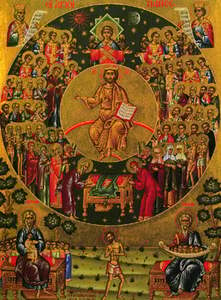
The Consecration of the Church of the Holy Resurrection (Holy Sepulchre)
The church that is honoured far above all others is that of the Holy Resurrection, which Saint Constantine the Great constructed at the place of Golgotha, where our Saviour was crucified and buried. For a long time this place had been purposely buried beneath the earth by the Jews and heathen; furthermore, during the reign of Hadrian (117-138), a temple dedicated to Aphrodite was built over the site so that this sacred place might be even further desecrated and fall into utter oblivion. It was here that the Cross was hidden. However, at the command of the pious Emperor Constantine, excavations were made and the tokens of the saving Passion were found. It was here, then, that the very great and magnificent temple named in honour of Christ God's Resurrection-the Anastasis-was built under the supervision of the blessed Helen, while Dracilian was Eparch of Palestine and Macarius was Archbishop of Jerusalem. It was the latter, also, who exalted the venerable Cross and performed the consecration of this temple in the year 336.
September 13
Cornelius the Centurion & Martyr
Saint Cornelius was a Roman by race, a pagan by religion, a centurion in rank, an inhabitant of Caesarea of Palestine, a man pious and God-fearing who gave many alms to the people and prayed continually unto God. In accordance with an angelic vision granted to him, he sent to Joppa that they might bring the Apostle Peter. Saint Peter catechized him in the Faith of Christ and baptized all his household (Acts, ch.10). This became the beginning and the first fruits of the calling of the nations. It is said that, after this, he became a bishop, as some say, of Caesarea; but others say of Scepsis, which is not far from Troas; and that he died as a martyr.
September 14
The Elevation of the Venerable and Life-Giving Cross
Saint Helen, the mother of Saint Constantine the Great, when she was already advanced in years, undertook, in her great piety, the hardships of a journey to Jerusalem in search of the cross, about the year 325. A temple to Aphrodite had been raised up by the Emperor Hadrian upon Golgotha, to defile and cover with oblivion the place where the saving Passion had been suffered. The venerable Helen had the statue of Aphrodite destroyed, and the earth removed, revealing the Tomb of our Lord, and three crosses. Of these, it was believed that one must be that of our Lord, the other two of the thieves crucified with Him; but Saint Helen was at a loss which one might be the Wood of our salvation. At the inspiration of Saint Macarius, Archbishop of Jerusalem, a lady of Jerusalem, who was already at the point of death from a certain disease, was brought to touch the crosses, and as soon as she came near to the Cross of our Lord, she was made perfectly whole. Consequently, the precious Cross was lifted on high by Archbishop Macarius of Jerusalem; as he stood on the ambo, and when the people beheld it, they cried out, "Lord have mercy." It should be noted that after its discovery, a portion of the venerable Cross was taken to Constantinople as a blessing. The rest was left in Jerusalem in the magnificent church built by Saint Helen, until the year 614. At that time, the Persians plundered Palestine and took the Cross to their own country (see Jan. 22, Saint Anastasius the Persian). Late, in the year 628, Emperor Heraclius set out on a military campaign, retrieved the Cross, and after bringing it to Constantinople, himself escorted it back to Jerusalem, where he restored it to its place.
Rest from labour. A Fast is observed today, whatever day of the week it may be.
September 15
Nikitas the Great Martyr
This Saint was of high birth among the Goths beyond the Danube River. He was taken by Athanaric, pagan ruler of the Goths, and after being tortured, was burned to death for his confession of Christ. According to some, this took place during the reign of Saint Constantine the Great; according to others, under the Emperor Gratian.
September 16
Euphemia the Great Martyr
Saint Euphemia was from Chalcedon and lived in virginity. According to some, she suffered martyrdom during the reign of Diocletian, in 303; according to others, in 307. Her sacred relics are preserved in the Patriarchate in Constantinople.
September 16
Ninian the Enlightener of Scotland
Saint Ninian was born in Cumberland in Britain around the year 360, about a half century after the Emperor Constantius Chlorus died in the British city of York, and his son Constantine, who was with him when he died, was proclaimed Emperor. Ninian was born of Christian parents of noble lineage, at a time when paganism was still strong in his native land. As a young man he went to Rome, where he spent many years in study and ascetical struggles. At Rome, Saint Ninian was consecrated some time after the death of Pope Damasus in 384, and was sent back to his native island about the end of the fourth century. On his return journey, it is likely that he passed through Tours and met Saint Martin; what is certain is that many churches and cells associated with Saint Ninian, including his own cathedral in Whithorn, were named in honour of Saint Martin. When Saint Ninian returned to Cumberland, he established monasteries that fostered both the life of prayer and missionary labours. By his preaching, his godly life, and his miracles, he ministered to his own countrymen, the Britons, and also converted many of the pagan Picts, who inhabited the northern regions (in today's Scotland). He reposed in peace at his see of Whithorn in Galloway in 432.
September 17
Sophia & her three daughters: Faith, Hope, and Love
These Saints were from Italy and contested for the Faith about the year 126, during the reign of the Emperor Hadrian. Faith was twelve years old, Hope, ten, and Love, nine; each was tormented and then beheaded, from the eldest to the youngest. Their mother Sophia mourned at their grave for three days, where she also fell asleep in peace; because of her courageous endurance in the face of her daughters' sufferings, she is also counted a martyr. The name Sophia means "wisdom" in Greek; as for her daughters' names, Faith, Hope, and Love (Charity), they are Pistis, Elpis, and Agape in Greek, and Vera, Nadezhda, and Lyubov in Russian.
Wisdom of the Fathers
Our Redeemer and Maker, Who was Son of God before the ages, became Son of Man at the end of ages. Thus the One Who, through the power of His divinity, had created us to enjoy the happiness of everlasting life, might Himself restore us, through the weakness of our humanity, to recover the life we had lost.
St. Bede the Venerable
Homilies on the Gospels, 2.18. 7th Century. Taken from: Ancient Christian Commentary on Scripture. Vol: John 1-10. Intervarsity Press, 2006, p. 126.
For since Nicodemus had said, "We know that Thou art a teacher come from God," on this very point He sets him right, all but saying, "Think Me not a teacher in such manner as were the many of the prophets who were of earth, for I have come from heaven (but) now. None of the prophets hath ascended up thither, but I dwell there."
St. John Chrysostom
Homily 27 on John 3, 4th Century
Here Christ speaks concisely, because His discourse was directed to Nicodemus, but still in a more significant manner ... He shows the great strength of His love ... He, the immortal, who is without beginning, the Infinite Majesty, they but dust and ashes, full of ten thousand sins, who, ungrateful, have at all times offended Him; and these He "loved."
St. John Chrysostom
Homily 27 on John 3, 4th Century
Archdiocese News
Op-Ed | St. Nicholas Church and National Shrine is a bridge from tragedy to hope
09/10/2026
“Agape mou” … my love.
Those are the words my brother John would whisper whenever he hugged me. It has been more than two decades since I last heard them.
John was killed on September 11, 2001, while working on the 104th floor of the World Trade Center. Like so many families, ours was forever changed. I miss him every day.
But through that loss, I have also found comfort, faith, and hope at St. Nicholas Greek Orthodox Church and National Shrine. The rebuilding of St. Nicholas has been, for me, a bridge from tragedy to hope. This ground is sacred. It is where my brother and thousands of other innocent souls were lost, including the site of the original St. Nicholas Church, where John would often stop before or after work to light a candle, say a prayer, attend a service—or perhaps meet a pretty girl.
John was known as “Johnny Bodacious”—adventurous, funny, fearless, and always the life of the party. He loved to dance, and he had a larger-than-life personality. But beneath that joyful spirit was a deep faith and an extraordinary light that I was blessed to experience for 31 years.
Although I can no longer hug my brother, I still feel his presence at St. Nicholas—in the prayers offered each day, in the candles that are lit, and in the people who enter carrying burdens and leave with renewed hope.
September 11th Memorial Service at St. Nicholas Greek Orthodox Church and National Shrine, 2024. Photo by Orthodox Observer/Brittainy Newman
What was destroyed was resurrected. What represented grief became a source of healing. And St. Nicholas has become part of some of my happiest memories. In 2023, I had my wedding service there. In the very place that once represented unimaginable loss, God blessed me with new life, new joy, and a new beginning.
That is the power of St. Nicholas. It is a Greek Orthodox church, but it is also a National Shrine open to everyone—people of every faith, people of no faith, those carrying grief, those seeking peace, and anyone looking for a place to pray, reflect, heal, or simply breathe. As our nation commemorates the 25th anniversary of September 11th, St. Nicholas carries an especially powerful message. It reminds us that even after our darkest days, we can rise with faith, courage, and hope. Faith can overcome fear. Light can overcome darkness. Love can overcome hate. Every day, people from across our nation and around the world walk through the doors of St. Nicholas and discover that sense of peace and hope. Since opening in December 2022, over 650,000 visitors have had that experience, made possible because of faithful supporters who believe in its mission. That is why I am asking you to become a National Supporter of St. Nicholas. Your generosity will help preserve a spiritual home for worshippers, a place of remembrance for families like mine, and mission driven ministries for the community at large.
Become a National Supporter of St. Nicholas today with your $100 gift. Please click here for more information. Let’s keep the light of St. Nicholas shining brightly in memory of loved ones, for the future of our nation, and the world.
Anthoula and John Katsimatides. Photo courtesy of Anthoula KatsimatidesAnthoula and John Katsimatides. Photo courtesy of Anthoula Katsimatides
“Agape mou” … my love. Those are the words my brother John would whisper whenever he hugged me. It has been more than two decades since I last heard them. John was killed on September […]
Archbishop-elect Apostolos of Canada honored at farewell banquet
09/09/2026
Last night, His Eminence Archbishop Elpidophoros of America and the Metropolis of New Jersey hosted a farewell banquet honoring the ministry of His Eminence Apostolos, newly-elected Archbishop of Canada and former Metropolitan of New Jersey.
The event was held at the Venetian in Garfield, New Jersey.
Archbishop-elect Apostolos offered a farewell address, expressing gratitude to God for giving him the strength and energy to serve the Metropolis of New Jersey. He closed his remarks with a message to the faithful:
“I will never forget my ministry in the New Jersey Metropolis,”Archbishop-elect Apostolos said. “You’re amazing people … Don’t lose your faith. Keep your faith strong and your ministry visible to everyone in this beautiful Metropolis. I love you and I pray for you.”
Archbishop Elpidophoros and the Metropolis of New Jersey hosted a farewell banquet honoring His Eminence Apostolos, newly-elected Archbishop of Canada. Photo by Orthodox Observer/Dimitrios Panagos
Archbishop Elpidophoros also offered remarks, thanking Archbishop-elect Apostolos for his service to the Archdiocese of America and wishing him prayers for his ministry in the Archdiocese of Canada.
“We all send with Your Eminence our fervent and heartfelt prayers for your every success–both spiritual and material–in your coming Archpastoral Ministry in Canada,” Archbishop Elpidophoros said. “But in sending with you our prayers and best wishes, we also ask that you not forget us, for your six-year ministry in this Metropolis was fruitful, and the seeds that you planted will continue, by God’s mercy and grace, to grow and to thrive.”
The event featured a special video presentation, and Archbishop Elpidophoros also presented him with gifts of a hierarchical staff and an engolpion.
Additional speakers included the Honorable Iphigenia Kanara, Consul General of Greece in New York; the Honorable Kyriakos Pogiatzis, Consul General of Cyprus in New York; Fr. Peter Delvizis, Representative of the Metropolis Clergy Syndesmos; John Vasilioiu, President of the Federation of Hellenic-American Societies of Philadelphia and the Greater Delaware Valley; Dr. Panos Stavrianidis, President of the Hellenic Federation of New Jersey; Eleni Constantinides, President of the Metropolis of New Jersey Philoptochos; and the Honorable H. James Polos, who served as Master of Ceremonies.
Archbishop-elect Apostolos’s enthronement will take place on Saturday, 19 September 2026, at the Greek Orthodox Cathedral of St. Nicholas in Toronto, Ontario. His Eminence Archbishop Nikitas of Thyateira and Great Britain will preside at the enthronement.
Last night, His Eminence Archbishop Elpidophoros of America and the Metropolis of New Jersey hosted a farewell banquet honoring the ministry of His Eminence Apostolos, newly-elected Archbishop of Canada and former Metropolitan of New Jersey. […]
Opinion | Carrying the Clergy-Laity Congress forward
09/09/2026
Several months ago, I wrote on this site about the vision for the 2026 Clergy-Laity Congress and our hope that this year’s gathering would be different. Now, having returned from Cleveland earlier this summer, I believe we can say with confidence that something important happened there. More than 2,000 faithful from across the Greek Orthodox Archdiocese of America came together under the theme “Rise & Build,”inspired by Nehemiah’s words. They came together to pray, to learn, to listen, to deliberate, to reconnect with old friends, to make new ones, and, most importantly, to strengthen the Church they love.
The success of this Congress was not simply measured by attendance or by the number of sessions offered. Its success was found in a renewed understanding of what the Clergy-Laity Congress can actually be. Certainly, the Congress has a responsibility to conduct the business of our Archdiocese. Budgets must be reviewed, resolutions must be considered, reports must be presented, and decisions must be made. That administrative responsibility is important and should never be diminished. But the Church is so much more than its business.
The Clergy-Laity Congress should be a gathering of the πλήρωμα τῆς Ἐκκλησίας, the fullness of the Church.
His Eminence Archbishop Elpidophoros of America speaks at the 48th Biennial Clergy-Laity Congress in Cleveland, Ohio. Photo by Orthodox Observer/Brittainy Newman
That means creating a place where the clergy and laity who make up our parishes can come together not only to govern the national Church, but to learn how to better serve the local Church. It means recognizing that the people sitting in those seats are not simply delegates with votes. They are Sunday School teachers, parish council members, youth workers, musicians, stewardship leaders, educators, parents, young adults, ministry leaders, priests, presvyteres, and volunteers who go home and make the life of our parishes possible.
Cleveland showed us the tremendous potential that exists when we bring those people together.
Oun National Ministries were not simply invited to present their work or display their resources. They were given a central role in educating and equipping the people of our parishes. The Ministry Pavilion brought Archdiocesan departments, institutions, partners, and organizations together with the people they serve. But even more importantly, the Congress offered specialized educational opportunities, including dedicated tracks for Sunday School teachers and church musicians. These were not simply opportunities to hear about what someone else is doing. They were opportunities to learn, to develop skills, to exchange ideas, and to take something practical home.
That is an important distinction.
Our goal should not simply be to tell our parishes what the Archdiocese is doing. Our goal should be to help our parishes do more.
A Sunday School teacher should be able to return home with a new idea that can make a difference in the classroom. A church musician should return with something new to bring to the worshipping life of the community. A youth worker should discover a resource or a relationship that can help engage young people. A parish leader should encounter another parish that has found a solution to a challenge they are facing. A priest should be able to return home renewed by the fellowship and experience of his brother clergy.
When that happens, the Clergy-Laity Congress becomes more than an event. It becomes an investment in every parish represented.
This is what I believe Cleveland demonstrated so clearly: the Congress of the future must be both a place where we strengthen our administrative unity and a place where we strengthen the people who make up our parishes. We need both. We need the serious work of governance, and we need the practical work of ministry. We need to make decisions together, but we also need to learn together. We need to deliberate together, but we also need to grow together.
Hierarchs at the Divine Liturgy during the 48th Biennial Clergy-Laity Congress in Cleveland, Ohio. Photo by Orthodox Observer/Brittainy Newman
The new plenary model was part of that same vision. By moving the reports of Archdiocesan departments, ministries, institutions, and organizations into digital formats, we created an opportunity for those ministries to tell their stories more fully, using video and other resources, while allowing the Plenary Session to concentrate on the business that actually required the attention of the Congress. Participants could review reports and presentations before, during, and after the Congress, rather than trying to absorb them in a few minutes from a podium.
The same philosophy guided the new approach to the financial process. Before coming to Cleveland, clergy and lay leaders had opportunities to review financial information through online presentations and participate in question-and-answer sessions. Full financial statements, proposed budgets, and other materials were made available for review. Then, at the Congress, the Finance Committee presented its report and the delegates had the opportunity for discussion and deliberation before voting.
This is what greater transparency should look like. It is not simply about putting documents online. It is about giving people the opportunity to understand, ask questions, participate, and ultimately take responsibility for the decisions of their Church.
The CARA Survey was an important part of this process as well. Thousands of faithful throughout our Archdiocese took the time to tell us what they see, what they need, and what they believe should be our priorities. Those voices helped inform the direction of the proposed national budget. The result is a stronger connection between what our people are telling us in our parishes and the priorities we establish at the national level.
That is conciliar life.
We listen to one another. We learn from one another. We disagree at times, but we remain together. We deliberate. We pray. And then we move forward together.
Not everyone saw what happened in Cleveland that way. In the days surrounding the Congress, some commentary suggested that little of substance took place. It is difficult, however, to understand how one could reach that conclusion without actually being there. The Congress was not simply something to observe from a distance. It was something to experience.
More than 2,000 people traveled to Cleveland. Hundreds of volunteers gave their time. Clergy and lay leaders spent hours in workshops and discussions. Ministries shared their resources. Parish leaders exchanged ideas. Delegates participated in the formal work of the Archdiocese. Priests prayed together. Families gathered. Old friendships were renewed and new relationships were formed.
It is easy to criticize something from the outside. It is much harder to give of your time, to sit in a room with people who may have different opinions, to listen to one another, to find common ground, and to do the sometimes difficult work of building up the Church.
It is easy to throw stones from the outside; it is much more challenging to pick one up and help build. That is what the people who came to Cleveland chose to do.
And perhaps that is the greatest lesson of this year’s Congress. The real measure of its success will not ultimately be found in what happened during those three days in Cleveland. It will be found in what happens afterward.
When a parish council uses something it learned in a workshop, the Congress continues.
When a Sunday School teacher starts teaching from the new curriculum, the Congress continues.
When a youth ministry launches a new initiative because of an idea shared in Cleveland, the Congress continues.
When a priest calls another priest for advice because of a relationship formed at the Congress, the Congress continues.
When a parish becomes stronger, more welcoming, more engaged, and more capable of sharing the Gospel because someone came home from Cleveland with a new tool or a renewed sense of purpose, then the Congress has accomplished what it was intended to accomplish.
That is why I believe the 2026 Clergy-Laity Congress was not simply one of our most successful Congresses. It provided a model for what our Congresses can become moving forward.
We should continue to conduct the important business of our national Church. We should continue to strengthen our administrative unity, improve our transparency, exercise responsible stewardship, and make decisions together. But we should also recognize the extraordinary opportunity we have when thousands of faithful people gather in one place.
Those days are precious.
We have to use them to educate. To equip. To inspire. To connect. To build relationships. To share resources. To strengthen ministries. To give our people practical tools they can take home and use immediately in the life of their parish.
Because the Clergy-Laity Congress is not simply a meeting of representatives.
It is the gathering of the Church, it is the πλήρωμα τῆς Ἐκκλησίας coming together.
And when the fullness of the Church gathers, we should leave better equipped to serve the Church we love.
Cleveland reminded us that we are capable of doing this. It showed us that our clergy and laity want to learn. They want to participate. They want to serve. They want their parishes to thrive. And they want an Archdiocese that supports them in that work.
So now, the question is not whether we can do it again.
The question is how much further we can take it.
The work of Cleveland does not end with the closing of the Congress. It begins when everyone goes home.
The tools are in our hands. The relationships have been formed. The ideas have been shared. The challenge has been placed before us.
Now we have to build.
Together.
Rise & Build.
This article is published as part of the America at 250: Orthodoxy in a New Homeland media initiative co-organized by the Orthodox Observer and the Department of Inter-Orthodox, Ecumenical, and Interfaith Relations of the Greek Orthodox Archdiocese of America to honor the contributions and experience of Orthodox Christianity in America and celebrate 250th anniversary of America’s founding.
Several months ago, I wrote on this site about the vision for the 2026 Clergy-Laity Congress and our hope that this year’s gathering would be different. Now, having returned from Cleveland earlier this summer, I […]
Today, His Eminence Archbishop Elpidophoros of America marked Labor Day with the following social media post:
On this Labor Day, I am reminded that everything around us was built by someone’s hands. The road, the harvest, the meal, the machine. I am also reminded that the ordinary protections of a working day, its hours and its safety, are the outcome of the pursuit of countless men and women who struggled. We honor all who labor: in the field and the factory, in the kitchen and the hospital ward, at the desk and behind the wheel, and in the home where the work never ends. Our Lord Himself worked with His own hands in the carpenter’s shop before He spoke a word in public.
May the Lord our God, Who sanctified human labor by the work of His own hands, bless the work of your hands, minds, and hearts. We offer this prayer as work itself is being remade. Artificial intelligence and robotics are entering the field, the clinic and the office, and no tool arrives innocent; each carries the purposes of those who built it and decided where it would be used. Let these technologies lighten the burden of human labor. Let them never become the reason a person is treated as a cog to be discarded, nor the pretext for handing to an algorithm a judgment that requires a conscience. The human person is created in the image and likeness of the living God and must never be reduced to something expendable.
Today, His Eminence Archbishop Elpidophoros of America marked Labor Day with the following social media post: On this Labor Day, I am reminded that everything around us was built by someone’s hands. The road, the […]