Prokeimenon. Plagal Fourth Mode. Psalm 67.35,26. God is wonderful among his saints.
Verse: Bless God in the congregations.
The reading is from St. Paul's Letter to the Hebrews 11:33-40; 12:1-2.
Brethren, all the saints through faith conquered kingdoms, enforced justice, received promises, stopped the mouths of lions, quenched raging fire, escaped the edge of the sword, won strength out of weakness, became mighty in war, put foreign armies to flight. Women received their dead by resurrection. Some were tortured, refusing to accept release, that they might rise again to a better life. Others suffered mocking and scourging, and even chains and imprisonment. They were stoned, they were sawn in two, they were tempted, they were killed with the sword; they went about in skins of sheep and goats, destitute, afflicted, ill-treated - of whom the world was not worthy - wandering over deserts and mountains and in dens and caves of the earth. And all these, though well attested by their faith, did not receive what was promised, since God had foreseen something better for us, that apart from us they should not be made perfect. Therefore, since we are surrounded by so great a cloud of witnesses, let us also lay aside every weight, and sin which clings so closely, and let us run with perseverance the race that is set before us, looking to Jesus the pioneer and perfecter of our faith.
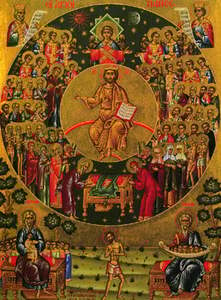
The Sunday of All Saints
The Reading is from Matthew 10:32-33; 37-38; 19:27-30
The Lord said to his disciples, "Every one who acknowledges me before men, I also will acknowledge before my Father who is in heaven; but whoever denies me before men, I also will deny him before my Father who is in heaven. He who loves father or mother more than me is not worthy of me; and he who loves son or daughter more than me is not worthy of me; and he who does not take his cross and follow me is not worthy of me." Then Peter said in reply, "Lo, we have left everything and followed you. What then shall we have?" Jesus said to them, "Truly, I say to you, in the new world, when the Son of man shall sit on his glorious throne, you who have followed me will also sit on twelve thrones, judging the twelve tribes of Israel. And every one who has left houses or brothers or sisters or father or mother or children or lands, for my name's sake, will receive a hundredfold, and inherit eternal life. But many that are first will be last, and the last first."
The Sunday of All Saints
Κατὰ Ματθαῖον 10:32-33, 37-38, 19:27-30
Resurrectional Apolytikion in the Plagal Fourth Mode
From on high You descended, Most Merciful; for us You condescended to a threeday burial to set us free from the passions. O Lord, our Resurrection and our Life, glory to You!
Your Church is arrayed in the holy blood of Your Martyrs who witnessed throughout the world, as though in purple and fine linen. Through them she cries to You, Christ our God, “Send down to Your people Your tender love, grant peace from above to Your commonwealth, and to our souls Your great mercy.”
O Planter of creation, Lord, to You does the entire world bring as an offering the God-bearing martyr Saints, as being nature's first fruits. At their earnest entreaties, keep Your Church in a state of profoundest peace, through the Theotokos, O Lord abundantly merciful.
Honouring the friends of God with much reverence, the Prophet-King David says, "But to me, exceedingly honourable are Thy friends, O Lord" (Ps. 138:16). And the divine Apostle, recounting the achievements of the Saints, and setting forth their memorial as an example that we might turn away from earthly things and from sin, and emulate their patience and courage in the struggles for virtue, says, "Wherefore seeing we also are compassed about with so great a cloud of witnesses, let us lay aside every burden, and the sin which doth so easily beset us, and let us run with patience the race that is set before us" (Heb. 12:1).
This commemoration began as the Sunday (Synaxis) of All Martyrs; to them were added all the ranks of Saints who bore witness (the meaning of "Martyr" in Greek) to Christ in manifold ways, even if occasion did not require the shedding of their blood.
Therefore, guided by the teaching of the Divine Scriptures and Apostolic Tradition, we the pious honour all the Saints, the friends of God, for they are keepers of God's commandments, shining examples of virtue, and benefactors of mankind. Of course, we honour the known Saints especially on their own day of the year, as is evident in the Menologion. But since many Saints are unknown, and their number has increased with time, and will continue to increase until the end of time, the Church has appointed that once a year a common commemoration be made of all the Saints. This is the feast that we celebrate today. It is the harvest of the coming of the Holy Spirit into the world; it is the "much fruit" brought forth by that "Grain of wheat that fell into the earth and died" (John 12:24); it is the glorification of the Saints as "the foundation of the Church, the perfection of the Gospel, they who fulfilled in deed the sayings of the Saviour" (Sunday of All Saints, Doxasticon of Vespers).
In this celebration, then, we reverently honour and call blessed all the Righteous, the Prophets, Apostles, Martyrs, Confessors, Shepherds, Teachers, and Holy Monastics, both men and women alike, known and unknown, who have been added to the choirs of the Saints and shall be added, from the time of Adam until the end of the world, who have been perfected in piety and have glorified God by their holy lives. All these, as well as the orders of the Angels, and especially our most holy Lady and Queen, the Ever-virgin Theotokos Mary, do we honour today, setting their life before us as an example of virtue, and entreating them to intercede in our behalf with God, Whose grace and boundless mercy be with us all. Amen.
June 07
The Holy Martyr Theodotus of Ancyra
This Martyr contested in Ancyra during the reign of Diocletian (284-305), when Theotecnus was Proconsul. After the martyrdom of the virgin Tecusa and her seven companions (the virgins Alexandria, Claudia, Phaeina, Euphrasia, Matrona, Julia, and Theodota; they are celebrated on May 18), Saint Theodotus recovered their holy relics and buried them. For this, he was seized by Theotecnus, tormented, and beheaded.
June 08
Melania the Righteous
Saint Melania was a lady of noble birth, most wealthy and renowned, a descendant of Roman consuls, and of Spanish origin. When her husband and two of her children died, she departed for Egypt to visit the monks living at Mount Nitria. She distributed her wealth to those that were in need there, as well as to the confessors of the Faith who were being persecuted by the Arians. In three days alone, she fed some 5,000. Then, when these Orthodox Christians were exiled to Palestine, she also went to Jerusalem. There, at her own expense, she built a convent for virgins, and reposed therein in holiness about the year 410. Her granddaughter Melania the Younger is celebrated on December 31.
June 09
Righteous Father Columba of Iona
After he established a number of monasteries and churches in his native Ireland, Saint Columba founded the renowned monastery of Iona, off the coast of Scotland. Having guided many in the path of salvation, reposed in peace in 597.
June 10
The Holy Martyrs of China
The Holy Martyrs of China were native Chinese Orthodox Christians brought up in piety at the Russian Orthodox Mission in Peking, which had been founded in 1685. During the Boxer Rebellion of 1900 against the foreign powers occupying China, native Chinese Christians were commanded by the Boxers to renounce Christianity or be tortured to death. Two hundred and twenty-two members of the Peking Mission, led by their priest Metrophanes Tsi-Chung and his family, refused to deny Christ, and were deemed worthy of a martyric death.
The commemoration date of the Chinese Martyrs varies between June 10th and June 11th in Orthodox practice throughout the world.
June 11
Bartholomew and Barnabas the Holy Apostles
Saint Bartholomew was one of the Twelve Apostles, and had Galilee as his homeland; this is all that is known of him for certain according to the history of the Gospels. Concerning his apostolic work, certain say that he preached in Arabia and Persia, and especially in India, bringing to them the Gospel written by Saint Matthew, which had been written originally in Hebrew, and which was found there one hundred years later by Pantaenus, formerly a stoic philosopher and later an illustrious teacher of the Christian school in Alexandria (see Eusebius, Eccl. Hist., 5: 10). Other accounts say that he went to Armenia. According to some, he ended his life by being crucified, or by being flayed alive, in Albanopolis (Urbanopolis) of Armenia. This also confirms an ancient tradition preserved by the Armenians. According to some, Bartholomew and Nathanael are the same person, because the Evangelists who mention Bartholomew do not mention Nathanael; and John, who alone mentions Nathanael as one of the Twelve, says nothing of Bartholomew. Indeed, Bartholomew is a patronymic, "son of Talmai," which means "bold, spirited" (see also Jesus of Navi 15:14; II Kings 3:3), and Nathanael could have had this as a surname. According to the Synaxarion of the Menaion on April 22, however, it is Simon the Zealot and Nathanael who are the same; the Evangelists who mention Simon the Zealot (or "the Canaanite") do not mention Nathanael.
June 12
Peter the Athonite
Saint Peter was born of noble parents in Constantinople in the ninth century. Sent forth with the Roman army against the Saracens, he was taken captive and shut up in the prison of Samarra in Syria; this is no doubt the same prison in which the Forty-Two Martyrs of Amorion were kept (see Mar. 6). Released from prison through the prayers of Saint Nicholas of Myra and Saint Symeon the God-receiver, he fled to Rome, where he became a monk, and later came to the peninsula of Athos, where he lived in a cave as a solitary, suffering many temptations from the evil one, but also enjoying the manifest help of the most holy Theotokos. After many years, he reposed in peace.
Wisdom of the Fathers
For in a contest there is much labor needed--and after the contest victory falls to some, to others disgrace. Is the palm ever given or the crown granted before the course is finished? ... Therefore no one can receive a reward, unless he has striven lawfully; nor is the victory a glorious one, unless the contest also has been toilsome.
St. Ambrose of Milan
Chapter 15, Three Books on the Duties of the Clergy, 4th century
Moses... was himself saved by means of wood and water before the Law was given, when he was exposed to the Nile's currents, hidden away in an Ark (Exod. 2:3-10). And by means of wood and water he saved the people of Israel, revealing the Cross by the wood, Holy Baptism by water (Exod. 14:15-31). Paul, who had looked upon the mysteries, says openly, 'They were all baptized unto Moses in the cloud' (I Cor. 10:2). He also bears witness that, even before the events concerning the sea and his staff, Moses willingly endured Christ's Cross, 'Esteeming', he says, 'the reproach of Christ greater riches than the treasures of Egypt' (Heb. 11:26). For the Cross is the reproach of Christ from the standpoint of foolish men. As Paul himself says of Christ, 'He endured the cross, despising the shame' (Heb. 12:2).
St. Gregory Palamas
Homilies Vol. 1, Homily Eleven para. 14; Saint Tikhon's Seminary Press pg. 123, 14th century
Peter ... put to Him this question in behalf of all the world ... For He had required of the rich man these two things, to give that he had to the poor, and to follow Him. ... For the forsaking was done for the sake of following, and the following was rendered easier by the forsaking.
St. John Chrysostom
Homily 64 on Matthew 19, 4th Century
Announcements & Future Events
Archdiocese News
Boston celebrates Greek Heritage Night at Fenway Park
06/04/2026
The Alpha Omega Council proudly hosted its annual Greek Heritage Night with the Boston Red Sox on Tuesday, June 2nd, at Fenway Park, bringing together nearly 3,000 members of the Greek-American community for an evening celebrating Hellenic culture, philanthropy, and community spirit as the Red Sox faced the Baltimore Orioles.
The event held special significance this year as it coincided with the Alpha Omega Council’s Golden 50th Anniversary, marking five decades of service, fellowship, and cultural preservation throughout New England.
Now in its ninth year under the stewardship of the Alpha Omega Council, Greek Heritage Night has grown into one of the largest Greek cultural celebrations in the region, uniting families, organizations, and supporters while raising awareness and funds for charitable initiatives supported by the Council, including the Metropolis of Boston Camp.
Prior to first pitch, Fenway Park came alive with Hellenic pride during a Heritage Pregame Ceremony featuring members of the local Greek community and performances by renowned Greek dance groups, including senior and junior groups of the Metropolis of Boston Dance Group, Sons & Daughters of Alexander the Great, and Paradosi Dancers of Brockton, who delighted attendees with traditional Greek dances.
Members of the Alpha Omega Council and distinguished representatives of the Greek-American community were recognized on the field prior to the game. Introduced behind the pitcher’s mound were Alpha Omega Council President Harry Vlachos, Chairperson John Mokas, Assistant Chair Charles Lavrentios, and honorees Diamantis (Adam) Zervos and Evangeline Zervos for their contributions to the community and the preservation of Hellenic heritage. Joining them were Fr. Ted Barbas, representing the Greek Orthodox Metropolis of Boston, and Symeon Tegos, Consul General of Greece in Boston. The ceremony also featured the Presentation of the Colors led by flag bearers Evan Meltsakos, Harry Theodore, and Billy Manning, Paul Tsiomplikas, Constantin Coclin and Christopher Chronopoulos highlighting the enduring spirit, pride, and traditions of the Greek-American community as thousands gathered to celebrate Greek Heritage Night at Fenway Park.
The evening’s ceremonial festivities featured the singing of the National Anthem by Peter Costarakis, the ceremonial first pitch thrown by Dream Hospitality Group founder George Karavias, and the official “Play Ball!” declaration delivered by Erietta Tegos, daughter of Consul General of Greece in Boston, Symeon Tegos.
Throughout the evening, several distinguished members of the Greek-American community were recognized for their contributions. Boston-area author Adam Zervos, author of Baseball’s Golden Greeks, and his wife Evangeline Zervos, book Editor, were honored for his work documenting the stories of Greek professional baseball players from 1934–1974. The Hellenic Women’s Benevolent Association, represented by Dr. Sophia Pasedis and Mrs. Rena Gyftopoulos, received the Red Sox “Hats Off to Heroes” recognition in honor of its longstanding commitment to the healthcare needs of the community.
“Greek Heritage Night continues to be a cornerstone event for the Alpha Omega Council,” said Chairperson John Mokas. “Celebrating our 50th anniversary at Fenway Park alongside thousands of members of our community made this year’s event especially meaningful. The evening reflected the strength, pride, and unity of Hellenism while supporting important charitable causes that make a difference throughout New England.”
The successful event follows the Alpha Omega Council’s annual Boston Marathon Wreath Ceremony held in April and serves as a precursor to the organization’s upcoming 50th Anniversary Weekend (October 2-4, 2026), which will include the Annual Honors Gala on October 2 and the Konstantinos Argiros concert at Agganis Arena on October 3, for which the Alpha Omega Council will serve as local host in partnership with concert promoter Dream Hospitality Group.
The Alpha Omega Council extends its gratitude to the Boston Red Sox organization, event sponsors, volunteers, performers, and the thousands of attendees whose participation helped make the 2026 Greek Heritage Night a memorable celebration of culture, heritage, and community.
The Alpha Omega Council Greek Heritage Night Planning Committee included Chairperson John Mokas, Co-Chair Chuck Lavrentios, Alpha Omega Council President Harry Vlachos, Paul Tsitsopoulos, Costa Sideridis, Teddy Demetriades, Nick Rizos, Fotios Stamos, George Karalis, Tom Gatzunis, John Pappas, and George Antonopoulos.
For more information on Alpha Omega Council, please visit www.AlphaOmegaCouncil.org and for more information on the 2026 Greek Heritage Night with Boston Red Sox, please visit GreekHeritageNight.com.
About Alpha Omega Council:
Celebrating its 50th Anniversary, the Alpha Omega Council is a Boston-based nonprofit philanthropic organization dedicated to promoting patriotism to the United States and cultivating the ideals of Hellenism. Its mission is advanced through support of scholarly, athletic, medical, charitable, scientific, literary, religious, and educational initiatives throughout New England and the United States. Comprised of Americans of Hellenic ancestry across diverse professional fields – including business, education, academia, medicine, law, politics, and science – the organization has contributed over $2,000,000 to philanthropic causes since its inception, in addition to supporting the annual Peter Agris Memorial Journalism Scholarship Awards. Signature annual events include the Boston Marathon Wreath Ceremony, Greek Heritage Night, Golf Classic, and Honors Gala. For more information, please visit alphaomegacouncil.org or stay tuned for updates on Instagram, Facebook or LinkedIn.
The Alpha Omega Council proudly hosted its annual Greek Heritage Night with the Boston Red Sox on Tuesday, June 2nd, at Fenway Park, bringing together nearly 3,000 members of the Greek-American community for an evening […]
What can we learn from America’s first Orthodox bishop?
06/04/2026
“I am an Arab by birth, Greek by primary education, American by residence, Russian at heart, and Slav in soul.”
— St. Raphael of Brooklyn
Many saintly, dedicated, and faithful servants helped plant the seeds of Orthodoxy in America, but few wereas well-prepared for such labor as St. Raphael of Brooklyn. As the quotation above suggests, St. Raphael embodied the evangelical and missionary spirit needed in his own time which isall the more needed in oursas we mark the 250th anniversary of our nation.
Before reflecting further on St. Raphael and his example, I would like to mention a photograph that struck me in the hall of our St. Nicholas Cathedral in Brooklyn, NY. Taken at the consecration of our current Cathedral on State Street in 1920, the photograph shows a massive crowd gathered outside. What covered the cathedral’s façade was not, as one might expect today, a mix of American flags and those of the immigrants’ countries of origin. Rather, the façade was completely draped in the flags of the United States of America alone. That image left a profound impression on me and speaks volumes to the mindset of those early immigrants. They loved the cities, villages, and families they had left behind, yet they knew they were here to stay in America. They desired to be full participants in their adopted land while preserving their ancient faith and traditions. It was into this context that St. Raphael, then Archimandrite Raphael Hawaweeny, arrived to New York in 1895.
St. Nicholas Antiochian Orthodox Cathedral in Brooklyn, 1920. Photo courtesy of St. Nicholas Cathedral archive
Prior to arriving in the United States, St. Raphael lived in several centers of Orthodoxy, from his native Damascus, to Constantinople and the island of Halki where he studied, and to Kiev and Moscow. It is in this way that, through his extensive travels and his acquisition of multiple languages in both colloquial and liturgical contexts,St. Raphael, by God’s providence, was well-prepared to undertakehis mission in this new land: to help establish parishes for newly-arrived Orthodox immigrants of various ethnic backgrounds. Although his primary calling was to serve Arabic-speaking immigrants from Greater Syria—that is, modern-day Syria and Lebanon—through the newly-formed Syro-Arab Mission of the Russian Orthodox Church, St. Raphael became a respected and beloved figure among Orthodox immigrants more broadly, especially in the New York area. His tireless missionary efforts took him across the United States, Canada, and even Mexico, where he baptized, married, and served memorials for faithful people living in remote areas. In each locale, he also encouraged the faithful to found parishes and promised them priests once they committed themselves to this holy task.
As the mission grew, the then-head of the Russian Orthodox diocese in North America, St. Tikhon of Moscow, recognizedthat St. Raphael should be made a bishop to oversee theyoungmission parishes throughout the United States expanding work, with the agreement of both the Patriarch of Moscow and the Patriarch of Antioch. On March 13, 1904, St. Raphael was elevated to the episcopacy at St. Nicholas Cathedral in Brooklyn, New York, becoming the first Orthodox bishop of any background to be consecrated on American soil. Without his missionary zeal and steadfast dedication to serving the faithful, many Orthodox immigrants might well have been religiously assimilated as they pursued the American dream in their new homeland.
St. Raphael’s ability to move between cultures and to draw on the best of Orthodox customs makes him a model for our own time. He could speak to people in their own language and understood their traditions because of his life experiences, while also encouraging them to adapt to their new homeland. He upheld the teachings of the Church with vigor and protected his flock from ravenous wolves,while adapting to the realities and norms of the American experience without compromising the faith.
What, then, can we learn from St. Raphael’s life as we celebrate 250 years of the American democratic experiment? We should be deeply grateful for figures like St. Raphael who cultivated the seeds of Orthodoxy in America. Just as American citizens look to the founding fathers of our nation and to the sacrifices they made to build a stronger and better country, so too should we should look to our own “founding fathers,” of Orthodoxy in America, learn from their witness, and make it our own. We must continue to nurture what has grown from their early labors, even as we welcome those who now embrace the Holy Orthodox Faith by choice.
Just as America has been called “the great melting pot,” so too does the Orthodox faith gather into one those who seek to embrace Jesus Christ within the ark of the Church, where “There is neither Jew nor Greek, there is neither slave nor free, there is neither male nor female; for you are all one in Christ Jesus.” (Galatians 3:28). To Him be all glory and honorforever and ever.
This article is published as part of the America at 250: Orthodoxy in a New Homeland media initiative co-organized by the Orthodox Observer and the Department of Inter-Orthodox, Ecumenical, and Interfaith Relations of the Greek Orthodox Archdiocese of America to honor the contributions and experience of Orthodox Christianity in America and celebrate 250th anniversary of America’s founding.
“I am an Arab by birth, Greek by primary education, American by residence, Russian at heart, and Slav in soul.” — St. Raphael of Brooklyn Many saintly, dedicated, and faithful servants helped plant the seeds […]
NEW YORK, NY — Upon returning from his visit to the Ecumenical Patriarchate of Constantinople and Mount Athos, His Eminence Archbishop Elpidophoros of America reviewed the results of the recently concluded investigation concerning allegations involving Rev. Fr. Chrysostomos Gilbert.
Following his review of the investigative findings, Archbishop Elpidophoros has directed that a Spiritual Court be convened on June 8, 2026, in accordance with the Holy Canons and Regulations of the Greek Orthodox Archdiocese of America.
The Spiritual Court will be presided over by His Grace Bishop Nektarios of Diokleia, National Chancellor of the Greek Orthodox Archdiocese of America.
The members of the Spiritual Court are:
Rev. Protopresbyter of the Ecumenical Throne Elias Villis, Chancellor of the Archdiocesan District
Very Rev. Archimandrite Chrysostom Panos
Rev. Protopresbyter of the Ecumenical Throne Peter Orfanakos
Rev. Protopresbyter Nicholas Dassouras
Rev. Protopresbyter Nikoforos Fakinos
The Spiritual Court will consider the matters referred to it and conduct its proceedings in accordance with the ecclesiastical procedures of the Greek Orthodox Archdiocese of America.
As this matter is now before the Spiritual Court, the Archdiocese will have no further comment pending the conclusion of those proceedings.
NEW YORK, NY — Upon returning from his visit to the Ecumenical Patriarchate of Constantinople and Mount Athos, His Eminence Archbishop Elpidophoros of America reviewed the results of the recently concluded investigation concerning allegations involving […]
The revolutionary fathers of two nations: Adamantios Korais and Thomas Jefferson | Op-Ed
06/03/2026
The great classical scholar Adamantios Korais might well be thought of as the Greek Thomas Jefferson. Like Thomas Jefferson—the author of the Declaration of Independence, the most influential of the founders of the American republic, and the country’s third president—Adamantios Korais—the architect of the intellectual foundations of the Greek struggle for independence, sometimes referred to as the “Teacher of the Nation”—was a revolutionary who believed that nations were entitled to independence and self-rule, just as individuals were entitled to liberty and inalienable rights. Like Jefferson, Korais worked to establish the social and political ideals of the Enlightenment in his emerging nation. Both of these men were the veritable authors of their respective nation’s respective revolutions. It is a testament to their remarkably similar, vital roles in the lives of their respective nations that circumstances would bring these two men together to form a connection which would have lasting significance for both America and Greece.
Statue of Adamantios Korais at the University of Athens, by Georgios Vroutos, 1875. Photo courtesy of Wikimedia Commons
Korais was born in Asia Minor’s great historic Greek port city of Smyrna in 1748, five years after Jefferson was born in Virginia. Adamantios was born to Ioannis Korais, a Chiot by origin and leading Smyrniot entrepreneur, and Thomaida Rysia, a native Smyrniot and daughter of Adamantios Rysios, a wealthy businessman and devotee of Greek letters. At a very early age, Adamantios showed signs of genius and an insatiable love of learning which were encouraged by his parents. Although Ioannis Korais, like most Greeks living under Ottoman rule, had been deprived of an education, he was an avid admirer of learning and eagerly provided Adamantios with the resources for formal schooling and private teachers. The most influential of these teachers was a Dutch pastor, Bernhard Keun, who taught Adamantios Latin and Dutch, while Adamantios also began his eventual mastery of English, French, Hebrew, and Italian. Adamantios also benefited significantly from the legacy of his maternal grandfather, whose rare, personal library became a treasure trove for Korais’ intellectual curiosity.
As a young man, Korais worked alongside his father in their family’s silk business, but he soon found commercial life unsatisfying, intruding as it did on his true love—study. Nonetheless, in 1772, at the age of 24, Adamantios was sent by his father to establish a branch of the family business in Amsterdam, the then preeminent center of international commerce and trade. The next six years Korais spent in Amsterdam changed his life forever.
When he was not engaged in trade, Korais immersed himself in the vibrant intellectual and cultural life of Amsterdam, deepening his studies of languages and philosophy. Korais’ experience of freedom and education in Holland, which stood in stark contrast to the tyranny and ignorance which his countrymen endured under Ottoman rule, bred in him a deep conviction that the Greek people must free themselves from Turkish oppression. Korais also concluded that before the Greeks could liberate themselves from Turkish rule and establish an independent national state, they would have to emancipate themselves through education and moral regeneration. In other words, they would have to eliminate from their cultural life the corrupting Ottoman influences that had penetrated and subverted the Greeks’ lay and especially religious leadership, institutions, and attitudes. Korais saw education, expressed through a revival of the Greeks’ classical heritage, as the means by which a moral, enlightened Greek people should achieve their freedom and return to the fulfillment of their greatness as a nation. In Korais’ view, a moral rejuvenation, predicated upon intellectual reawakening, would have to precede the inevitable political revolution against Turkish tyranny. Only in this way would the Greek people, degraded as they were after centuries of Ottoman occupation, become adequately prepared and equipped to succeed in their goal of creating not only an independent Greek state, but a happy, just, and moral Greek society.
Korais’ ideas and subsequent work were next influenced by his move to France. After repatriating from Amsterdam to Smyrna for four years, Korais, who could no longer tolerate the humiliation of life under Turkish rule, returned to Europe in 1782 and trained as a physician for six years at France’s most prestigious school of medicine, the University of Montpelier. Driven by his boundless intellect, while Korais pursued his medical training, he also resumed his study of languages and philosophy, began publishing scholarly works, and was soon recognized as one of Europe’s leading authorities of classical studies.
In 1788, upon completion of his medical training, Korais settled in Paris. Within a year of his arrival, the French Revolution began, and, instead of a career in medicine, Korais was swept up in the radical political changes which shook France, becoming a man of letters and the preeminent literary harbinger of Greek revolution. Seeing firsthand how the spread of education in France gave birth to the love of liberty, Korais resolved to work to the best of his abilities as a writer and scholar for the education of his fellow Greeks.
Rigas Velestinlis and Adamantios Korais help Greece stand on its feet (1911); by Theofilos (Kefalas-Hatzimichail). Collection of Alexandros Xydis, Macedonian Museum of Contemporary Art, Thessaloniki, Greece
Korais undertook to remake his countrymen, to awaken them to the significance of their heritage, to elevate their cultural and historical knowledge, to prepare them for freedom and self-rule. With the financial support of wealthy diaspora Greeks, the French revolutionary government, and later Napoleon, Korais edited, among other important works, the celebrated “Hellenic Library,” a highly influential series of the classics in Modern Greek translation, published between 1805 and 1827 in sixteen primary volumes and thirteen secondary volumes. After the completion of this colossal project, he published the first Modern Greek dictionary. Korais was one of Europe’s first intellectuals to recognize the crucial connection between a literary language and nationhood. This awareness led Korais to place language at the center of his efforts for Greek enlightenment. Consequently, he was a strong proponent of a standardized written language, “katharevousa,” cleansed of foreign elements, as close to Classical Greek as possible, and balanced between elegance and precision to overcome the parochial divisions and deficiencies of vernacular Greek. Although Korais’ advocacy of “katharevousa” would produce its share of problems, his linguistic innovations would have an enormous and constructive influence on Modern Greek language.
Korais’ efforts were not limited to influencing only his countrymen. He made use of his scholarly connections and the respect that he enjoyed as an accomplished classicist to promote the Greek cause among Western Philhellenes. This fact may explain why Adamantios Korais and Thomas Jefferson met in Paris while the former—Korais—already by that time a renowned classical scholar, was studying medicine in Montpelier, and the latter—Jefferson—was serving as the United States ambassador to France, a post he held from 1784 to 1789.
Jefferson and Korais met in 1785. Little is known about this private encounter or a subsequent meeting and shared dinner, other than the fact that both men attributed their acquaintance to a mutual friend, John Paradise (Ioannis Paradisis). A Greek expatriate entrepreneur with residences in London and Paris, John Paradise, whose wife, Lucy Ludwell Paradise was an American from Jefferson’s native Virginia, enjoyed a close friendship with Thomas Jefferson. This friendship, evidenced in a substantial correspondence of some eighty letters, both delighted and enlightened Jefferson, who learned pronunciation of Modern Greek from Paradise.
Jefferson’s interest in Greek, Classical and Modern, was a life-long fascination. Jefferson’s childhood education imbued him with a deep reverence for Greek language and civilization. Peter Jefferson, Thomas’ father, helped shape his son’s interest in classical studies and Philhellenism. At his father’s encouragement, Thomas, at the age of nine, began studying Greek and Latin. As a Classics student at the College of William and Mary, Jefferson was known to carry his beloved Greek grammar everywhere he went. Jefferson’s admiration of Greek thought and democratic ideas increased as their brilliance and value became more and more evident to him in the years leading to the outbreak of the American Revolution and the Declaration of Independence. Indeed, he viewed Greek philosophy, literature, and history as the foremost sources of moral and political guidance, as matchless practical preparation for good government and civic life.
Although it is impossible to divine with any certainty the content of their conversations in Paris, it is reasonable to posit, given Jefferson’s and Korais’ mutual admiration and common interests, that these two students of Classical Greece, gentlemen of the Enlightenment, and democratic revolutionaries, must have discussed their political and philosophical thoughts about the Greek world. What is clear is that nearly forty years after their first meeting, Jefferson and Korais engaged in a brief, yet weighty, exchange of letters about Greece’s political future.
In the summer of 1823, two years after the start of the Greek Revolution, Korais wrote his first letter, penned in French, which would be followed by two more letters and gifts of books, to Jefferson. Now in his seventies, Korais was too old to join the revolutionaries fighting for independence from the Turks, but he continued to work tirelessly from Paris to raise international awareness of, and support for, the Greek cause. After the provisional revolutionary Greek government turned to Korais for advice, he wrote to Jefferson for his counsel on how best to organize a future Greek state. Korais had great admiration for the establishment of the American republic, which he saw as the closest modern realization of the ancient Greeks’ ideal of democracy, and he regarded his old acquaintance Jefferson as the chief author of the American political miracle. Korais, in his letter, also appealed to Jefferson to lend his public stature and influence for the Greek cause by publicly expressing his political support for the Greek Revolution and urging American intervention on behalf of the Greeks.
Jefferson responded to Korais in the fall of 1823. In a letter written in English and dated October 31, Jefferson propounded that although the world owed Greece an eternal debt of gratitude, and despite Americans’ great sympathy for the Greeks’ struggle, the United States government could not interfere in European affairs. Expressing both support for the Greek cause of liberty and restraint against direct involvement in the Greek revolt, Jefferson wrote the following:
“No people sympathize more feelingly than ours with the sufferings of your countrymen, none offer more sincere and ardent prayers to heaven for their success, and nothing indeed but the fundamental principles of our government never to entangle us with Europe could restrain our generous youth from taking some part in this holy cause. Possessing ourselves the combined blessings of liberty and order, we wish the same to other countries and to none more than yours, which, the first of civilized nations, presented examples of what man should be.”
In the same letter, Jefferson discussed in considerable length the central principles of the American constitution and the organization and function of the federal and state systems, emphasizing the importance of the separation and balance of powers across government.
Albeit earnest, there was considerable irony in Jefferson’s sage exhortations. After all, Jefferson’s basic premises of government were essentially modern adaptations of ancient Greek principles that Korais knew well and had, in fact, elaborated on in his introduction to Aristotle’s “Ethics,” one of the volumes in the “Hellenic Library” series, a copy of which was sent to Monticello with Korais’ first letter. It should not surprise us that Jefferson, immersed throughout his life in classical studies was deeply influenced by Greek thought, which he looked to for practical political guidance and statecraft. Despite the conventional view that Jefferson was influenced primarily by Enlightenment thinkers such as Diderot, Rousseau, and Voltaire, his writings do not contain a single quotation from these French writers. Instead, his writings emphasize and draw extensively from Greek philosophers. Jefferson’s seemingly original, seismic concept of the pursuit of happiness, for instance, which in the Declaration of Independence he identified as a fundamental, unalienable human right, is merely a reflection of Epicurean philosophy tempered by Aristotle’s earlier writings, not a modern American innovation, but an ancient Greek idea.
Nevertheless, Jefferson’s commentaries on American constitutional democracy had a profound influence on Korais’ thinking, affirming by practical example his already well-formed political ideals. Jefferson’s specific observations on rule of law, representational government, restraint of state power, fundamental rights, individual liberty, and other lessons from American democracy were clearly evident in Korais’ subsequent writings. Korais’ commanding presence as the Greek Revolution’s preeminent intellectual ensured that his ideas would not be ignored as Greece’s emerging new order took shape. Indeed, through Korais’ influence many of the principles of American democracy were enunciated in the Greek Constitution of 1827, a document of magisterial scope and conceptual brilliance.
In 1976, concurrent with the bicentennial of the American Declaration of Independence and the approaching 150th anniversary of the Greek Constitution of 1827, Professor Andrew S. Horton of George Mason University observed the following about Jefferson, Korais, and the American and Greek Constitutions:
“Had Jefferson lived another year he would have seen the realization of his desire to be of help to the Greek constitutional committees. Korais’ influence on many of the members of these committees was quite strong. That he often urged the delegates to study Jefferson’s ideas and the American constitutions was not empty praise for a distant acquaintance. The direct triumph of many of Jefferson’s (and therefore America’s) principles was the Greek Constitution of 1827.
This most liberal…constitution affirms the right of democratic sovereignty and the creation of a legislature independent of the executive but elected by the people. The Bill of Rights, closely modelled on the American document, guaranteed all of the familiar rights suggested by Jefferson as well as the illegality of slavery and nobility.”
Albeit exemplary, the 1827 Constitution was never fully implemented before it was suspended by President Ioannis Capodistrias. Because of the breakdown of Greek society into violent factionalism and chaos in the midst of the Revolution, Capodistrias was forced to suspend the Constitution—events which seemed to confirm Korais’ fears that a political revolution would not secure the Greeks’ aspirations if it were not preceded by a cultural and moral revival sufficient to produce mature political leadership and a far-sighted citizenry. Moreover, the European Great Powers, who presided over the formalization of Greece’s independence in 1832, were hostile to democracy, imposed a foreign monarchy on newly independent Greece, and in so doing crushed any possibility of restoring the 1827 Constitution.
Unlike his friend Jefferson, Korais lived long enough to see the liberation of a small part of the Greek world from the Turks, and he also lived long enough to see the enormous difficulties that the newly independent state faced, not the least of which was an absolutist monarchy unrestrained by a national constitution. Nonetheless, the importance of the 1827 document was not erased. The political principles and philosophical concepts advanced by both Jefferson and Korais, manifested in the 1827 Constitution, would continue to resonate with, if not always be practiced by, Korais’ countrymen long after his death in 1833.
On October 9, 2022, at the Holy Trinity Greek Orthodox Cathedral of New York, Dr. Kyrou was invested as an Archon of the Ecumenical Patriarchate. From left to right: Dr. Kyrou, His Eminence Archbishop Elpidophoros of America, and His Beatitude Pope and Patriarch of Alexandria and All Africa, Theodoros II. Photo courtesy of Dr. Kyrou
Dr. Alexandros K. Kyrou is an Archon of the Ecumenical Patriarchate and Professor of History at Salem State University, in Salem, Massachusetts, where he teaches on the Balkans, Byzantium, and the Ottoman Empire. He has authored multiple book chapters, journal articles, and review essays that focus on famine relief in Axis-occupied Greece, Greek America and Balkan Diasporas, Orthodox Christianity and the origins of international humanitarianism, war and peace in Byzantium, and US foreign policy in Southeastern Europe.
The great classical scholar Adamantios Korais might well be thought of as the Greek Thomas Jefferson. Like Thomas Jefferson—the author of the Declaration of Independence, the most influential of the founders of the American republic, […]
Eastern, Oriental Orthodox Churches move toward unity after 1,600 years of separation
06/02/2026
Eastern Orthodox and Oriental Orthodox leaders took a major step toward healing a 1,600‑year division when Ecumenical Patriarch Bartholomew welcomed Pope Tawadros II of the Coptic Orthodox Church to the Phanar for a celebration of the Divine Liturgy on the Sunday of the Myrrh-Bearing Women at the Patriarchal Church of Saint George. Both hierarchs called for renewed commitment to unity between their traditions.
In his official address at the conclusion of the Divine Liturgy, His All-Holiness spoke about the relationship between the Eastern Orthodox and Oriental Orthodox Churches, saying that “the relationship between the Eastern Orthodox and the Oriental Orthodox Churches occupies a unique and privileged place within the broader ecumenical endeavor.” He detailed a path to the restoration of unity between the two Churches, and emphasized that “we have been called to move from agreement to reception, from dialogue to life, from theological convergence to sacramental and pastoral cooperation.”
The fact that the Oriental Orthodox Churches are commonly referred to as “Orthodox” causes a great deal of confusion. The unfortunate reality is that what are commonly known as the Eastern Orthodox and Oriental Orthodox Churches are not in communion with one another. The Coptic Church of Egypt, which is among the foremost of the Oriental Orthodox Churches, severed communion with the Patriarch of Constantinople (as well as with the Pope of Rome) in the latter half of the fifth century, after rejecting the Fourth Ecumenical Council of Chalcedon in 451.
Disagreement centered upon the precise understanding of the divine and human natures of our Lord Jesus Christ, and a schism ensued that persists to this day: the Coptic Orthodox Pope of Alexandria and Patriarch of All Africa is Tawadros II, while the Greek Orthodox Pope and Patriarch of Alexandria and All Africa is Theodore II. (Tawadros is the Arabic form of Theodore, but these are two different individuals!)
Since 1985, the Joint Commission of the Theological Dialogue Between the Eastern Orthodox Church and the Oriental Orthodox Church has pursued a common understanding and reconciliation between the two religious traditions, conducting dialogues whose goal, according to a 1985 statement of His Eminence Professor Metropolitan Chrysostomos of Myra of blessed memory and His Eminence Metropolitan Bishoy of Damietta of the Coptic Orthodox Church of blessed memory, “would be to rediscover our common grounds in Christology and ecclesiology.”
In accord with this goal, His All-Holiness said to Pope Tawadros: “Your presence among us is a true blessing, manifesting the abiding work of the Holy Spirit, who continues to guide our Churches toward the fullness of the apostolic faith and toward the restoration of that visible unity for which our Lord Himself prayed: ‘that they all may be one.’” (John 17:21) He emphasized that “through decades of patient and sincere theological dialogue, we have come to recognize with increasing clarity that our confession of the mystery of the Incarnation is, in its essence, one and the same. The divisions that have endured for centuries do not arise from a divergence of faith in Christ, but rather from historical circumstances, linguistic differences, and cultural misunderstandings.”
This was a momentous declaration after nearly sixteen hundred years of estrangement, and His All-Holiness continued: “This recognition is not merely an academic conclusion; it is a theological reality that must find expression in the life of the Church.” He declared that “the agreements reached by our theologians cannot remain confined to texts and commissions; they must be received, embodied, and lived within our Churches—both in our historic homelands and throughout the diaspora, where so many of our faithful share common challenges, aspirations, and hopes. For if these agreements remain unreceived, our continued separation risks bearing false witness to the very convictions we have jointly affirmed.”
His All-Holiness said to Pope Tawadros: “The significance of your visit today, dear brother in Christ, lies precisely here: that we have been called to move from agreement to reception, from dialogue to life, from theological convergence to sacramental and pastoral cooperation. For in the Orthodox understanding, theology is never abstract; it is inherently doxological, ecclesial, and incarnational. What we confess must also be what we celebrate; what we proclaim must become what we live.” As such, he added: “In this spirit, we reaffirm with conviction the urgency of deepening the reception of our theological dialogues within the context of the ecclesial heritage we share, as well as the distinct traditions entrusted to each of our Churches.”
Ecumenical Patriarch Bartholomew also noted that “we are called to overcome not only theological misunderstandings, but also the spiritual, historical, and emotional burdens that have accumulated over the centuries. This great undertaking requires humility, patience, and a sacrificial readiness to bear the weight of history in order to open the way to a future of communion.”
May his beautiful and inspiring counsel be heeded, and may this ancient schism be definitively healed.
Eastern Orthodox and Oriental Orthodox leaders took a major step toward healing a 1,600‑year division when Ecumenical Patriarch Bartholomew welcomed Pope Tawadros II of the Coptic Orthodox Church to the Phanar for a celebration of […]
Magnifica Humanitas teaches technology must not constrain mutual care
06/01/2026
Pope Leo’s Magnifica Humanitas (MH) recalls Catholic social teaching while reminding Christians everywhere that the dignity of humanity is God-given. Focusing on communal care for each other, MH highlights repeatedly that all people have a responsibility for mutual care, which must not be constrained or removed due to technological development. The document positions AI as both a valuable tool and an existential threat to being fully human, before recalling the foundational doctrines of the Catholic Church, including human dignity and human rights. Catholic social teaching, for Pope Leo, becomes a way to confront the inhumanity of AI.
Dr. Sarah Riccardi-Swartz presents at the Orthodox Observer’s conference on artificial intelligence and theology, “Do the Divine and Digital Intersect?,” October 2025. Photo by Orthodox Observer/Dimitrios Panagos
Central to this document is the idea that “every human being is created in the image of God and is part of a network of relationships that bind him or her to others, to specific populations and to creation” (point 73). This idea supports the advancement of Catholic social justice in the face of a technology (AI) that will only exacerbate human inequalities, create more environmental devastation, and change out notions of finitude and what is means to be human over time. In the face of AI’s growing power, Pope Leo reminds us that “More power does not necessarily imply something better” (point 93) and that advancements in technology require our discernment. This discernment is key since the use of AI over time can encourage people to lose their desire for human connections.
Crucial to His Holiness’s encyclical is the idea that “The use of AI is never a purely technical matter: when it enters processes that affect people’s lives, it touches on rights, opportunities, status and freedom” (point 102). AI is not morally neutral, and its use will have wide ranging impact on our generation and future generations, particular on conceptions of truth, hope, and social and ethical responsibilities.
Pope Leo encourages Catholics everywhere to do their part to responsibly engage with technology, sociality, and politics, building peaceful communities, societies, and civilizations through justice. The Pope acknowledges that social media and digital worlds bring with them a great deal of political polarization and emphasis on power rather than dialogue. To combat all of these issues the MH contends that “we must lay aside an individualistic and technical view of humanity” in order to cultivate an idea of the “human being as a creature embedded in a network of relationships with other living beings and with all of creation” (point 237).
The Magnifica Humanitas provides a bold Catholic vision of common good that recognizes the temptations and limitations of technology for social progress. It reminds Catholics that the goal of human life is not efficiency, technological innovation, and productivity but rather care for each other, human dignity, freedom, rights, and an overcoming of divisions.
Dr. Sarah Riccardi-Swartz is an assistant professor of religion and anthropology at Northeastern University.
Pope Leo’s Magnifica Humanitas (MH) recalls Catholic social teaching while reminding Christians everywhere that the dignity of humanity is God-given. Focusing on communal care for each other, MH highlights repeatedly that all people have a […]
Eastern, Oriental Orthodox Churches move toward unity after 1,600 years of separation
06/02/2026
Eastern Orthodox and Oriental Orthodox leaders took a major step toward healing a 1,600‑year division when Ecumenical Patriarch Bartholomew welcomed Pope Tawadros II of the Coptic Orthodox Church to the Phanar for a celebration of the Divine Liturgy on the Sunday of the Myrrh-Bearing Women at the Patriarchal Church of Saint George. Both hierarchs called for renewed commitment to unity between their traditions.
In his official address at the conclusion of the Divine Liturgy, His All-Holiness spoke about the relationship between the Eastern Orthodox and Oriental Orthodox Churches, saying that “the relationship between the Eastern Orthodox and the Oriental Orthodox Churches occupies a unique and privileged place within the broader ecumenical endeavor.” He detailed a path to the restoration of unity between the two Churches, and emphasized that “we have been called to move from agreement to reception, from dialogue to life, from theological convergence to sacramental and pastoral cooperation.”
The fact that the Oriental Orthodox Churches are commonly referred to as “Orthodox” causes a great deal of confusion. The unfortunate reality is that what are commonly known as the Eastern Orthodox and Oriental Orthodox Churches are not in communion with one another. The Coptic Church of Egypt, which is among the foremost of the Oriental Orthodox Churches, severed communion with the Patriarch of Constantinople (as well as with the Pope of Rome) in the latter half of the fifth century, after rejecting the Fourth Ecumenical Council of Chalcedon in 451.
Disagreement centered upon the precise understanding of the divine and human natures of our Lord Jesus Christ, and a schism ensued that persists to this day: the Coptic Orthodox Pope of Alexandria and Patriarch of All Africa is Tawadros II, while the Greek Orthodox Pope and Patriarch of Alexandria and All Africa is Theodore II. (Tawadros is the Arabic form of Theodore, but these are two different individuals!)
Since 1985, the Joint Commission of the Theological Dialogue Between the Eastern Orthodox Church and the Oriental Orthodox Church has pursued a common understanding and reconciliation between the two religious traditions, conducting dialogues whose goal, according to a 1985 statement of His Eminence Professor Metropolitan Chrysostomos of Myra of blessed memory and His Eminence Metropolitan Bishoy of Damietta of the Coptic Orthodox Church of blessed memory, “would be to rediscover our common grounds in Christology and ecclesiology.”
In accord with this goal, His All-Holiness said to Pope Tawadros: “Your presence among us is a true blessing, manifesting the abiding work of the Holy Spirit, who continues to guide our Churches toward the fullness of the apostolic faith and toward the restoration of that visible unity for which our Lord Himself prayed: ‘that they all may be one.’” (John 17:21) He emphasized that “through decades of patient and sincere theological dialogue, we have come to recognize with increasing clarity that our confession of the mystery of the Incarnation is, in its essence, one and the same. The divisions that have endured for centuries do not arise from a divergence of faith in Christ, but rather from historical circumstances, linguistic differences, and cultural misunderstandings.”
This was a momentous declaration after nearly sixteen hundred years of estrangement, and His All-Holiness continued: “This recognition is not merely an academic conclusion; it is a theological reality that must find expression in the life of the Church.” He declared that “the agreements reached by our theologians cannot remain confined to texts and commissions; they must be received, embodied, and lived within our Churches—both in our historic homelands and throughout the diaspora, where so many of our faithful share common challenges, aspirations, and hopes. For if these agreements remain unreceived, our continued separation risks bearing false witness to the very convictions we have jointly affirmed.”
His All-Holiness said to Pope Tawadros: “The significance of your visit today, dear brother in Christ, lies precisely here: that we have been called to move from agreement to reception, from dialogue to life, from theological convergence to sacramental and pastoral cooperation. For in the Orthodox understanding, theology is never abstract; it is inherently doxological, ecclesial, and incarnational. What we confess must also be what we celebrate; what we proclaim must become what we live.” As such, he added: “In this spirit, we reaffirm with conviction the urgency of deepening the reception of our theological dialogues within the context of the ecclesial heritage we share, as well as the distinct traditions entrusted to each of our Churches.”
Ecumenical Patriarch Bartholomew also noted that “we are called to overcome not only theological misunderstandings, but also the spiritual, historical, and emotional burdens that have accumulated over the centuries. This great undertaking requires humility, patience, and a sacrificial readiness to bear the weight of history in order to open the way to a future of communion.”
May his beautiful and inspiring counsel be heeded, and may this ancient schism be definitively healed.
Eastern Orthodox and Oriental Orthodox leaders took a major step toward healing a 1,600‑year division when Ecumenical Patriarch Bartholomew welcomed Pope Tawadros II of the Coptic Orthodox Church to the Phanar for a celebration of […]