Fourteenth Sunday of Matthew, 6 September 8:30 AM: Orthros (Matins & Lauds), followed by 9:30 AM: DIVINE LITURGY
Tuesday, NATIVITY of the THEOTOKOS,8 September 9:30 AM: DIVINE LITURGY
Saturday, Apodosis of the Nativity, 12 September 10:00 AM: DIVINE LITURGY, at St Nicholas Church of Rutland, VT
Sunday before the Holy Cross, 13 September 9:00 AM: Orthros (Matins & Lauds), followed by 10:00 AM: DIVINE LITURGY
Fasting this Week:
Wed: Wine & Oil Allowed;Fri: Strict Fasting;All Other Days: No Fasting
Upcoming Calendar
Parish Calendar
September 6 to October 4, 2026
Sunday, September 6
14th Sunday of Matthew
8:30AM Orthros (Matins+Lauds)
9:30AM Divine Liturgy
Tuesday, September 8
Nativity of the Theotokos
9:30AM Divine Liturgy
Saturday, September 12
10:00AM Rutland Divine Liturgy
Sunday, September 13
Sunday before the Elevation
9:00AM Orthros (Matins+Lauds)
10:00AM Divine Liturgy
Monday, September 14
Elevation of the Holy Cross
9:00AM Orthros (Matins+Lauds)
9:45AM Procession & Divine Liturgy
Saturday, September 19
5:00PM Great Vespers
Sunday, September 20
Sunday after the Elevation
9:00AM Orthros (Matins+Lauds)
10:00AM Divine Liturgy
Saturday, September 26
5:00PM Great Vespers
Sunday, September 27
1st Sunday of Luke
9:00AM Orthros (Matins+Lauds)
10:00AM Divine Liturgy
Saturday, October 3
10:00AM Rutland Divine Liturgy
5:00PM Great Vespers
Sunday, October 4
2nd Sunday of Luke
9:00AM Orthros (Matins+Lauds)
10:00AM Divine Liturgy
Gospel and Epistle Readings
Epistle Reading
Prokeimenon. Plagal First Mode. Psalm 11.7,1. You, O Lord, shall keep us and preserve us.
Verse: Save me, O Lord, for the godly man has failed.
The reading is from St. Paul's Second Letter to the Corinthians 1:21-24; 2:1-4.
Brethren, it is God who establishes us with you in Christ, and has commissioned us; he has put his seal upon us and given us his Spirit in our hearts as a guarantee.
But I call God to witness against me - it was to spare you that I refrained from coming to Corinth. Not that we lord it over your faith; we work with you for your joy, for you stand firm in your faith. For I made up my mind not to make you another painful visit. For if I cause you pain, who is there to make me glad but the one whom I have pained? And I wrote as I did, so that when I came I might not suffer pain from those who should have made me rejoice, for I felt sure of all of you, that my joy would be the joy of you all. For I wrote you out of much affliction and anguish of heart and with many tears, not to cause you pain but to let you know the abundant love that I have for you.
14th Sunday of Matthew
The Reading is from Matthew 22:2-14
The Lord said this parable, "The kingdom of heaven may be compared to a king who gave a marriage feast for his son, and sent his servants to call those who were invited to the marriage feast; but they would not come. Again he sent other servants, saying, 'Tell those who are invited, Behold, I have made ready my dinner, my oxen and my fat calves are killed, and everything is ready; come to the marriage feast.' But they made light of it and went off, one to his farm, another to his business, while the rest seized his servants, treated them shamefully, and killed them. The king was angry, and he sent his troops and destroyed those murderers and burned their city. Then he said to his servants, 'The wedding is ready, but those invited were not worthy. Go therefore to the thoroughfares, and invite to the marriage feast as many as you find.' And those servants went out into the streets and gathered all whom they found, both bad and good; so the wedding hall was filled with guests.
But when the king came in to look at the guests, he saw there a man who had no wedding garment; and he said to him, 'Friend, how did you get in here without a wedding garment?' And he was speechless. Then the king said to the attendants, 'Bind him hand and foot, and cast him into the outer darkness; there men will weep and gnash their teeth.' For many are called, but few are chosen."
Resurrectional Apolytikion in the Plagal First Mode
Let us the faithful give praise and worship to the Logos, coeternal with the Father and the Spirit, born of the Virgin for our salvation; for of His own goodwill he consented to ascend the cross in the flesh and endured death and raised the dead by His glorious resurrection.
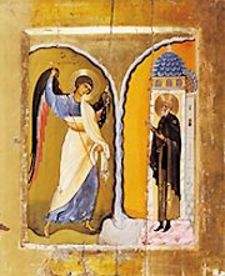
Apolytikion for Miracle of Michael in Colossae in the Fourth Mode
O Chief Commander of the heavenly armies, * we the unworthy now entreat you in earnest, * to fortify us by your supplications to the Lord, * and shelter us beneath the wings of your spiritual glory, * guarding us who run to you and fervently entreat you: * As the Commanders of the hosts on high, * rescue us faithful from dangers of every kind.
Joachim and Anna were released from the reproach of childlessness, and Adam and Eve delivered from death and destruction, through your holy childbirth, O immaculate Virgin. We, your people, now redeemed from the guilt of transgressions, celebrate your holy birth as we sing to you: “The barren one bears the Theotokos, the nurturer of our Life.”
Ιωακείμ καί Άννα όνειδισμού ατεκνίας, καί Αδάμ καί Εύα, εκ τής φθοράς τού θανάτου, ηλευθερώθησαν, Άχραντε, εν τή αγία γεννήσει σου, αυτήν εορτάζει καί ο λαός σου, ενοχής τών πταισμάτων, λυτρωθείς εν τώ κράζειν σοι, Η στείρα τίκτει τήν Θεοτόκον, καί τροφόν τής ζωής ημών.
Saints and Feasts
September 06
The Commemoration of the Miracle Wrought by Archangel Michael in Colossae (Chonae)
The feast today in honour of the Archangel Michael commemorates the great miracle he wrought when he delivered from destruction a church and holy spring named for him. The pagans, moved by malice, sought to destroy the aforesaid church and holy spring by turning the course of two rivers against them. But the Archangel appeared and, by means of the Cross and a great earthquake that shook the entire area, diverted the waters into an underground course. Henceforth, the name of that place changed from Colossae to Chonae, which means "funnels" in Greek.
September 08
The Nativity of Our Most Holy Lady the Theotokos and Ever-Virgin Mary
According to the ancient tradition of the Church, the Theotokos was born of barren and aged parents, Joachim and Anna, about the year 16 or 17 before the birth of Christ. Joachim was descended from the royal line of David, of the tribe of Judah. Anna was of the priestly tribe of Levi, a daughter of the priest Matthan and Mary, his wife.
September 09
The Holy & Righteous Ancestors of God, Joachim and Anna
Today, the day following the Nativity of the most holy Theotokos, we celebrate the synaxis of Saints Joachim and Anna, honouring them as her parents.
September 10
Menodora, Metrodora, & Nymphodora the Martyrs
These Martyrs, sisters according to the flesh, were from Bithynia. They lived in virginity on a mountain near the Pythian hot springs of Bithynia, devoting themselves to asceticism and prayer. Betrayed to the local governor, Fronto, they were subjected to frightful tortures, and so gave up their holy souls into the hands of God. They contested for the Faith during the reign of Maximian, in the year 304.
September 11
Theodora the Martyr of Alexandria
This saint lived in the fifth century. Out of remorse for the adultery that she committed with another man, she fled from her husband's house, renamed herself Theodore, clothed herself as a man, and pretending to be a eunuch, entered a monastery of men. Her identity as a woman was discovered only after her death.
Archdiocese News
V. Rev. Arch. Stephanos enthroned as the Holy Monastery of Saint Nektarios’s new abbot
09/04/2026
ROSCOE, NY – His Eminence Archbishop Elpidophoros of America presided over the Divine Liturgy and the Enthronement of the Very Reverend Archimandrite Stephanos as Abbot and Elder of the Holy Monastery of Saint Nektarios in Roscoe, New York, opening a new chapter for the monastery and marking a significant moment for Orthodox monasticism in the United States.
The Archbishop was joined by His Eminence Metropolitan Savas of Pittsburgh, His Grace Bishop Athenagoras of Nazianzos, and His Grace Bishop Nektarios of Diokleia. Also present were numerous abbots, abbesses, monks, and nuns from monasteries throughout the United States and Canada, together with clergy, pilgrims, benefactors, and faithful.
Photo by Orthodox Observer/Yannis Malevitis
The two days of prayer and celebration unfolded within the joy of the Feast of the Translation of the Holy Relics of Saint Nektarios the Wonderworker, the heavenly patron and protector of the Monastery. The feast was marked by a solemn Vigil, during which Great Vespers and Orthros were celebrated. The divine services were adorned by the beautiful chanting of the monastic choirs, whose prayerful voices filled the katholikon and gave expression to the profound spiritual character of the occasion. Thus, the tonsure and enthronement of the new Abbot were embraced by the liturgical life of the Church and placed beneath the intercessions of Saint Nektarios, whose presence and protection have accompanied the Monastery throughout its life and ministry.
The brotherhood of Saint Nektarios elected Archimandrite Stephanos to succeed its founder and first Abbot, the ever-memorable Elder Joseph, who fell asleep in the Lord earlier this year. The election carries profound meaning within the life of a monastic brotherhood. Every monk who entered Saint Nektarios Monastery had personally received Elder Joseph as his Abbot and spiritual father, entrusting to him his spiritual life and obedience. Following his repose, and after a period of mourning, prayer, and discernment, the fathers chose Father Stephanos as the one to whom they would now entrust that same spiritual care and obedience.
The events surrounding the enthronement began on Wednesday, September 2, when Archbishop Elpidophoros tonsured Fr. Stephanos to the Great and Angelic Schema, the fullness of the monastic profession in the Orthodox Church. The Great Schema expresses the monastic’s complete dedication to Christ through prayer, obedience, repentance, and ascetic struggle, together with a renewed embrace of the Cross at the heart of the monastic vocation.
Its celebration immediately before the enthronement carried particular significance: before Fr. Stephanos received the obedience of his brotherhood and responsibility for its spiritual care, he first renewed his own offering and obedience to Christ. The service also marked the first time in the history of the Greek Orthodox Archdiocese of America that an Archbishop of America presided over a tonsure to the Great and Angelic Schema.
Photo by Orthodox Observer/Yannis Malevitis
The enthronement represents an important point of transition for the monasteries established under the spiritual guidance of the ever-memorable Elder Ephraim of Arizona. Elder Ephraim contributed profoundly to the growth of Orthodox monasticism throughout North America, establishing monasteries and appointing the first generation of Abbots and Abbesses entrusted with their spiritual direction.
Elder Joseph was among that generation. He founded Saint Nektarios Monastery in 1999 and served as its first Abbot, carrying with him the spiritual inheritance of Mount Athos. His ministry was devoted to establishing the monastery and forming its brotherhood, while offering prayer, Confession, spiritual counsel, and consolation to the countless faithful who came to its doors.
With the election of Fr. Stephanos, the monastery now enters a new generation of spiritual leadership while remaining firmly rooted in the inheritance it received. As Archbishop Elpidophoros observed in his remarks, “The first generation planted. Now another generation is called to cultivate.”
Addressing the newly-enthroned Abbot, His Eminence emphasized the spiritual weight of the brotherhood’s choice.
“By their vote, they have not simply chosen someone to occupy the Abbot’s throne,” the Archbishop said. “They have said to you: ‘Be our Elder. Be our spiritual father. Guide us. Correct us. Pray for us. Walk before us on the road that leads to Christ.’ They have freely chosen to place their obedience in your hands.”
In his own remarks, Fr. Stephanos spoke with particular gratitude of the relationship between the monastery and the Archbishop, emphasizing that Orthodox monastic life is never separated from the canonical and sacramental life of the Church.
“A monastery is not outside the Church. It is within the Church,” Fr. Stephanos said. “It is the heart within the body of the Church, and the heart cannot live separated from the body.”
Addressing Archbishop Elpidophoros directly, the new Abbot noted the particular significance of receiving the blessing of a hierarch who himself has known the responsibilities of monastic leadership through his former service as Abbot of the Holy Trinity Monastery of Halki.
“You served as the Abbot at the Holy Monastery of Holy Trinity in Halki; you know what it means to carry a brotherhood in your heart,” Fr. Stephanos said, thanking His Eminence for his paternal care of Saint Nektarios Monastery, his pastoral presence, and the confidence he has placed in its brotherhood.
Fr. Stephanos further pledged that the monastery would continue to live faithfully within the canonical order of the Church, “with obedience, sincerity, and trust toward its canonical Shepherd,” adding: “Obedience is not a chain. It is freedom. And ecclesiastical order does not restrict the monastery. It protects it.”
The Archbishop likewise emphasized that the continuity represented by the enthronement is not simply institutional, but deeply spiritual: the preservation of a living monastic inheritance within the life and order of the Church, passed from spiritual father to spiritual son and received anew by each generation.
His Eminence encouraged Fr. Stephanos and the brotherhood to carry forward the prayer, ascetical life, spiritual ministry, and work begun by Elder Joseph, trusting that their departed Elder’s prayers and blessing remain with them.
A particular emphasis of the Archbishop’s remarks was the monastery’s vocation to remain a place of spiritual refuge for those burdened by the pressures and restlessness of contemporary life.
“Let this monastery always be a refuge for the human person,” His Eminence said. “Let the pilgrim who enters Saint Nektarios feel that he has stepped out of the turbulence of the world and into a place where eternity has come a little closer.”
Fr. Stephanos echoed this understanding of the monastery’s mission, describing monasteries as “the spiritual lungs of the Church,” places where the prayer of the monastic community continues even when the world sleeps and where the invocation, “Lord Jesus Christ, have mercy on me,” remains at the heart of monastic life.
He also spoke movingly of the spiritual inheritance entrusted to the brotherhood, from Saint Joseph the Hesychast, through Elder Ephraim of Arizona of blessed memory, and through the ever-memorable Elder Joseph, and expressed his desire not simply to occupy the place of his predecessor, but to continue his love for the brotherhood and his ministry to the faithful.
Turning directly to the fathers of Saint Nektarios, Fr. Stephanos asked them to help him remain first and foremost a monk and a servant of his brothers. “I do not want to be above you,” he said. “I want to be with you and, if God gives me strength, to be before you only when it is necessary to carry the cross first.”
The gathering of hierarchs, monastic superiors, monastics, clergy, spiritual children, and faithful from throughout the United States and Canada reflected the significance of the occasion for Saint Nektarios Monastery and for the wider Church.
At the conclusion of his remarks, Archbishop Elpidophoros charged the new Abbot:
“Receive this brotherhood. Become their father. Guard their unity. Carry their burdens. Open the doors of this monastery to the weary. Preserve the inheritance you have received. And lead this sacred community, not toward yourself, not simply toward the memory of any human person, however holy or beloved, but always and only toward Christ,” His Eminence said.
Taken together, the Great Schema tonsure and the enthronement expressed both continuity and renewal: the personal offering of a monk more completely to Christ, the entrusting of a brotherhood to its new spiritual father, and the continuation of a monastic inheritance lived faithfully within the canonical life of the Church.
The celebration concluded with the joyful proclamation: ΑΞΙΟΣ! He is Worthy!
ROSCOE, NY – His Eminence Archbishop Elpidophoros of America presided over the Divine Liturgy and the Enthronement of the Very Reverend Archimandrite Stephanos as Abbot and Elder of the Holy Monastery of Saint Nektarios in […]
After moving to Athens when I was 15, I found myself surrounded by graffiti on a scale I had not seen in New York, covering entire walls of neighborhoods, highways and even monuments. This made me wonder what impulse leads people throughout history to mark surfaces and leave a trace? Now, graffiti is illegal and considered damage to public and private property, yet it continues. My interest in graffiti on the streets of Athens intensified and brought me to the Iviron Monastery library at Mount Athos.
Delving into “Silk Road Graffiti” by Dale Johnson, a Syriac Orthodox monk and linguist who documented writings at the margins of ancient scrolls (marginalia) was illuminating. He described marks of children practicing their letters, travelers leaving messages that were sometimes answered decades later, as well as doodles and notes accumulated over hundreds of years. It irked me that historians often treat marginalia as secondary, even distracting. The more I researched, the more I realized the margin is often where the reader becomes present, visible, uncertain, and curious. And marginalia are also the graffiti which cover the walls of Athens today.
In December 2025, I made the long trek to the Holy Monastery of Iviron on Mount Athos to look for marginalia in medieval manuscripts. Coming from Greece’s mainland. I arrived at Mount Athos as a pilgrim would: slowly and tired but with intention. Once there, my visit was a medieval experience: Time moved differently even though church bells rang loudly to mark the functions of the day. The architecture, the communal life of the monks, and the natural setting were more vivid than I had expected.
View of Iviron library. Photo courtesy of Ari Antelman
A dark doorway took me into the library, a vaulted space with brick arches and ceiling-high shelves on either side. From there I saw a series of corridors lined with more wooden shelves and glass cabinets. Monk Theologos Iverites, the librarian, guided me through the collection.
Manuscript cloth casing with the ink drawing of the insect that infested the manuscript. Photo courtesy of Ari Antelman
The wrapping of the manuscripts struck me first. Most volumes were covered with white cloth cases to protect the books from insects. Each had a small,inked symbol alongside a number followed by geometric marks, below which a beetle or other bug had been drawn. This was toindicate which type of insect had infested that manuscript.
Deteriorated manuscripts destroyed by insects. Photo courtesy of Ari Antelman
It saddened me to see so many of the shelved manuscripts with disintegrating bindings and covers, due to infestation. Entire collections are disappearing slowly, eaten away.I closed one book as carefully as if it were an eggshell that could crack, yet a small cloud of dust rose from the eroding pages. The earthy smell of the old paper made me feel I was on an archeological dig. It moved me to holding a book from the 9th century.
Ari handling manuscripts at Iviron Library. Photo courtesy of Ari Antelman
Monk Theologos Iverites has spent years scanning manuscripts before they are all lost. As I assisted him in this preservation work, he helped me identify and translate the marginalia we came across in the many layers that exist in a single manuscript. The notes on the Ottoman invasion to Greece,historical remarks, signatures, drawings, and senseless doodles captivated me. On the inside cover of one manuscript, multiple writers had left their marks across centuries, with crosses, names, and dates all crowded together, each person annotating the previous message. In another manuscript, I spotted a blank end leaf with just two series of a strange, code-like text. In some volumes, I saw signatures rewritten, layers of the same names. The impulse that Johnson had documented was not specific to one culture nor one road but omnipresent in a world of readers. It thrilled me to find that each manuscript had at least three stories or layers: the literal meaning of its text, the journey it has taken over centuries, and the notes and marks in its margins. I had become part of a chain of people discovering them and then helping to restore these unique books before passing them on. The manuscripts have survived Ottoman invasions, insect damage, centuries of handling and I want them to live on.
My dyslexic mind leads me to read around edges before focusing on centers. To me, the margins are the most honest part of the page. The text of a book conveys what is required and expected while the marginsexpress the irrepressible. This understanding took me from New York City and then Athens to one of the most sacred libraries of Orthodox Christianity in Northern Greece. What looked like peripheral noise near the main event became a valuable archive. The margin is not an accidental holding bin butan oasis for scribes in need of more space.
Ari Antelman is a senior at Moraitis School in Athens. He grew up in New York City and is currently conducting independent research on language and memory in Greek American communities.
After moving to Athens when I was 15, I found myself surrounded by graffiti on a scale I had not seen in New York, covering entire walls of neighborhoods, highways and even monuments. This made […]
Archbishop Elpidophoros approves ordinations to the diaconate, priesthood
09/01/2026
In his sacred responsibility as described in the Charter of our Sacred Archdiocese, and in his pastoral oversight and fatherly care, His Eminence Archbishop Elpidophoros of America has approved the following ordinations:
Mr. Douglas Kasten to the Holy Diaconate, whom he assigned to serve at Saint Catherine Church in Greenwood Village, Colorado, in the Holy Metropolis of Denver.
Mr. Savvas Eleftheriou Savvidis to the Holy Diaconate, whom he assigned to serve in the Holy Metropolis of Atlanta.
Mr. Nicholas Schwarz to the Holy Diaconate, whom he assigned to serve in the Holy Metropolis of New Jersey.
The Rev. Deacon Andreas Constantinou to the Holy Priesthood, whom he assigned to serve at Saint Vasilios Church in Peabody, Massachusetts, in the Holy Metropolis of Boston.
The Rev. Deacon George Miller to the Holy Priesthood, whom he assigned to serve at the Assumption of the Theotokos Church in Scottsdale, Arizona, in the Holy Metropolis of San Francisco.
In his sacred responsibility as described in the Charter of our Sacred Archdiocese, and in his pastoral oversight and fatherly care, His Eminence Archbishop Elpidophoros of America has approved the following ordinations: Mr. Douglas Kasten […]
Read Archbishop Elpidophoros’s message for the New Ecclesiastical Year
09/01/2026
This morning, His Eminence Archbishop Elpidophoros of America marked the Feast of the Indiction, the New Ecclesiastical Year, and the Day of Prayers for the Protection of the Natural Environment with the following social media post:
Marking the New Ecclesiastical Year, September 1st, is a most significant day for our Church and the entirety of humanity. Our Ecumenical Patriarchate, and especially His All-Holiness Bartholomew, for decades have been emphasizing our relationship with the Earth and all creation, as the God-given environment in which the human family is called to serve as stewards of creation. This contains all that we hold dear on our “Big, Blue Marble” – the land and the seas, the air we breathe, the water we drink, and the creatures with whom we share this planet.
We are indeed blessed that we have a “Green” Patriarch who understands the sacred nature of creation, which we celebrate and acknowledge in every icon fashioned for the sanctification of the Faithful. His All-Holiness has been leading the way for a truly Patristic and theological ecology that applies not only across the Christian world in all its diversity, but throughout the interfaith and interspiritual communities as well.
The devastating fires across North America and the recent tragedy in Nepal, where a glacial collapse unleashed a catastrophic cascade of ice, rock, mud, and floodwaters, are stark reminders of the intensifying consequences of climate change, the fragility of our common home, and our sacred responsibility to care for it.
As we commence this New Ecclesiastical Year, may we each pause for a moment to remember the created order with which God has graced our lives, and may we each, in our own way, commit to protecting, enhancing, restoring, and safeguarding the precious gift of the created universe, beginning with our Mother Earth, above whom “the heavens declare the glory of God, and the sky above proclaims the work of His hands” (Psalm 18:1 LXX).
This morning, His Eminence Archbishop Elpidophoros of America marked the Feast of the Indiction, the New Ecclesiastical Year, and the Day of Prayers for the Protection of the Natural Environment with the following social media […]
Ecumenical Patriarch Bartholomew reflects upon 65 years of ministry
09/03/2026
During the Holy Fast for the Dormition of the Most Holy Mother of God, His All-Holiness Ecumenical Patriarch Bartholomew, in the company of His Beatitude Pope and Patriarch Theodore II of Alexandria and All Africa and His Beatitude Archbishop Ioannis of Tirana, Durrës and All Albania, traveled back to the island of Imvros, where he was born on February 29, 1940. On Thursday, August 13, 2026, His All-Holiness observed the 65th anniversary of his ordination to the diaconate and offered a series of reflections on his remarkable lifetime of service to Almighty God and His Holy Church.
Before the dismissal of the Patriarchal Divine Liturgy, over which he presided at the Metropolitan Church of the Dormition of the Theotokos, Ecumenical Patriarch Bartholomew celebrated a Trisagion for the repose of his elder and benefactor of blessed memory, Metropolitan Meliton of Chalcedon. 65 years ago, on August 13, 1961, His Eminence Meliton, then the Metropolitan of Imvros and Tenedos, ordained the 21-year-old Dimitrios Archontonis to the sacred diaconate, and gave him the ecclesiastical name Bartholomew.
Recalling his ordination to the diaconate, His All-Holiness stated that he remembered in particular the words “Jesus only,” from the account of the Transfiguration in the Gospels: “And when they lifted up their eyes, they saw no one but Jesus only” (Matthew 17:8). These words, he explained, have guided him throughout his lengthy and remarkable lifetime of diakonia.
According to Orthodox Times, the Ecumenical Patriarch “spoke warmly of the formative influence of both Imbros and the Theological School of Halki, where his faith, love of learning and appreciation for Orthodox liturgical and theological tradition were cultivated. He also paid tribute to the people of Imbros who remained on the island through difficult decades and preserved its churches, language and identity. Expressing optimism about the island’s future, he encouraged younger generations to contribute actively to maintaining a sustainable Greek Orthodox presence there.”
His All-Holiness spent eight years as a deacon; Metropolitan Meliton ordained him to the holy priesthood on October 19, 1969, and Ecumenical Patriarch Demetrios of blessed ministry consecrated him as a bishop on the Feast of the Nativity of the Lord Jesus Christ, December 25, 1973. On October 22, 1991, the Holy and Sacred Synod unanimously elected him as the 270th Archbishop of Constantinople-New Rome and Ecumenical Patriarch. He was enthroned on November 2, 1991.
On Imvros on August 13, His All-Holiness gave thanks to God for the “supreme gift of the priesthood.” He noted that in his service to the Holy Orthodox Church, his efforts had been “devoted to pan-Orthodox cooperation, inter-Christian and interreligious dialogue, peace and solidarity, the protection of the natural environment, and engagement between the Church and the contemporary world.”
The Ecumenical Patriarch stated: “My entire journey has been a ‘life in dialogue.’” He stressed “that he has always regarded introversion, isolation, self-sufficiency and ‘sterile monologue’ as incompatible with the Orthodox faith.” He explained that as Ecumenical Patriarch, he had always emphasized that Orthodoxy is “fundamentally a call to communion, encounter with others, solidarity and peaceful coexistence.” He added that these convictions “have inspired initiatives aimed at fostering cooperation in addressing the major challenges of the contemporary world.”
The extraordinary 35-year ministry of His All-Holiness as Ecumenical Patriarch has indeed been marked by remarkable initiatives to in building bridges with Christians of other faith traditions, as well as with non-Christians. In his address, His All-Holiness “also emphasized the wider mission of the Ecumenical Patriarchate, insisting that the Church cannot remain detached from the challenges facing humanity.” Throughout his tenure as Ecumenical Patriarch, His All-Holiness has consistently and courageously raised a prophetic voice to meet those challenges, calling upon humanity to care for the natural environment, and to recognize that war causes incalculable loss of lives and property while solving nothing.
His All-Holiness said that “the Ecumenical Patriarchate has never been a spectator of the course of human affairs,” while “rejecting the notion that engagement with the world necessarily leads to the secularization of the Church.”
His All-Holiness also recalled the Lord’s words, “You are the salt of the earth; but if salt has lost its taste, how shall its saltness be restored? It is no longer good for anything except to be thrown out and trodden under foot by men. You are the light of the world. A city set on a hill cannot be hid.” (Matthew 5:13-14). He declared: “We cannot journey toward God while turning our backs on our fellow human beings.”
That is the ethos that has characterized this holy man’s selfless 65 years of service to the Holy Orthodox Church. We are immensely blessed that his ministry continues. Eis polla eti, Despota!
During the Holy Fast for the Dormition of the Most Holy Mother of God, His All-Holiness Ecumenical Patriarch Bartholomew, in the company of His Beatitude Pope and Patriarch Theodore II of Alexandria and All Africa […]
Read His All-Holiness’s message for the Ecclesiastical New Year, Day of Prayers for the Natural Environment
08/31/2026
His All-Holiness Ecumenical Patriarch Bartholomew issued the following message on the occasion of the Beginning of the Ecclesiastical Year and the Day of Prayers for Natural Environment, September 1, 2026. See the original message here.
† B A R T H O L O M E W
BY THE MERCY OF GOD
ARCHBISHOP OF CONSTANTINOPLE–NEW ROME AND ECUMENICAL PATRIARCH
GRACE, PEACE, AND MERCY UNTO THE ENTIRE PLENITUDE OF THE CHURCH FROM THE FASHIONER OF ALL CREATION
OUR LORD AND GOD AND SAVIOUR JESUS CHRIST
Most Reverend and Right Reverend Brother Hierarchs, and blessed children in the Lord,
By the grace of God, the giver of all good things, we enter today into the new ecclesiastical year, honouring and celebrating at its commencement, in psalms and hymns and spiritual songs, the “Day of Prayer for the Protection of the Natural Environment.”
The multidimensional contemporary ecological crisis is a crisis of human freedom, of our religion and philosophy, of our ethos and our culture. What comes first is the “harmful alteration” of our freedom — our severance and alienation from the Source of Life; what follows is conduct destructive of the natural environment. We feel profound gratitude that the pioneering initiatives and interventions of the Ecumenical Patriarchate, carried out without interruption since 1989 have not only revealed the spiritual aspects of the ecological problem, but have also opened new paths and prospects for addressing it. The ecological symposia, the related inter-Christian and interreligious dialogues, the specific recommendations of the Great Church concerning environmental matters, the emphasis placed upon the social dimensions and consequences of the ecological crisis, and other such efforts together constitute a robust environmental proposal, which emphasizes the imperative need for a “Copernican Turn” in our understanding of the idea of progress and in humanity’s attitude towards nature, as well as in the actions of those engaged in political, economic, and social life, of the Churches and religions, of science and technology, and of those responsible for the education of the younger generation.
We shall continue, in word and deed, to promote the ecological vision of the Holy Great Church of Christ and the eco-friendly dynamism of the eucharistic, ascetic, and doxological relationship with creation, always underscoring that careful theological work is needed for the elucidation of the authentic ecological message of our Orthodox faith and tradition, for the benefit of creation, which is “very good.”
We are convinced that highlighting the religious and ethical dimensions of the ecological threat will lead to an awareness of the pivotal importance of “ecological responsibility.” Humanity must at last cease acting as though it does not know and definitively cast aside the illusion that planet Earth can in perpetuity withstand the burdens and destruction caused by human activity, or that nature has the power to renew itself of its own accord. The ethos of responsibility for the protection of the natural environment must find expression at the global, national, local, and personal levels. We reiterate once again that the cultivation of ecological responsibility is a “categorical imperative” for humanity as it confronts the greatest threat it has ever been called to face throughout the entire course of its history.
It is abundantly clear that, so long as the dominant anthropological model is represented by the “foolish rich man” of the Gospel (Luke 12:17–21), with his declaration, “I will pull down my barns and build greater; and there I will store all my crops and my goods,” and his words, “Soul, you have many goods laid up for many years; take your ease, eat, drink, and be merry,” humanity will continue to undermine its future and annihilate its own “home.” The “sins of modernity” have created—and continue to create—new divisions and ruptures between humanity and nature. The contemporary “man-god” persists in geocide, disregarding every measure and limit in the name of geopolitical designs and economic interests, of consumerism and of the satisfaction of essentially insatiable needs, but also, on a deeper level, because of an overturning of inner lived experience and values. The consequences of the global dominance of the desire to manipulate, instrumentalize, and exploit nature will prove to be tragic for life on our planet.
The growing acceptance and official establishment of 1 September as the Day for the Protection of the Natural Environment throughout the Christian world bears particular significance today as a symbol and practical promotion of the unity of Christians. Moreover, the glorification of the “Fashioner of all creation” at the beginning of the Indiction in our liturgical tradition constitutes a precious inheritance, as an invitation and exhortation to respect creation, which suffers the consequences of an unseemly, human-caused assault.
Most Honourable Brethren and dearly beloved children,
Respect for the core pillars of ecological civilization can restrain environmentally destructive tendencies and open the “sole ecological path,” that of sustainable development. More broadly, humanity needs to reach agreement upon a body of common fundamental values which, in a world marked by conflict and polarization, will serve as a compass for the journey towards the future. We regard the principle of solidarity as the central axis of this body of values: solidarity as a source of shared responsibility, dialogue, and sincere reciprocity, together with collective responsibility for the protection of the natural environment. Respect in practice for the sacredness of the human person and care for the integrity of creation are, from a Christian perspective, vital manifestations of the eucharistic realisation of the Church and of human being’s call to become the “priest” of creation.
In this spirit, as we pray that the new ecclesiastical year may be favourable and fruitful in works that are good and pleasing to God, we invoke upon all of you, through the intercessions and mediation of the Most-Holy Theotokos Pammakaristos—whose most sacred icon we reverently keep in the Venerable Patriarchal Church and embrace “with mouth and heart and will”—the grace and mercy of our Lord and God and Saviour Jesus Christ, Whose All-Holy Name be blessed and glorified, now and ever, and unto the endless ages. Amen!
His All-Holiness Ecumenical Patriarch Bartholomew issued the following message on the occasion of the Beginning of the Ecclesiastical Year and the Day of Prayers for Natural Environment, September 1, 2026. See the original message here. […]