Resurrectional Apolytikion in the Plagal First Mode
Let us the faithful give praise and worship to the Logos, coeternal with the Father and the Spirit, born of the Virgin for our salvation; for of His own goodwill he consented to ascend the cross in the flesh and endured death and raised the dead by His glorious resurrection.
Apolytikion of the Annunciation in the Fourth Mode
Today is the crowning of our salvation * And the revealing of the age-old mystery * The Son of God becomes the Son of the Virgin * And Gabriel announces the amazing grace * Therefore let us cry out with him to the most blessed Theotokos * Rejoice, O highly favored one, the Lord is with you!
Seasonal Kontakion in the Second Mode
The protection of Christians unshameable, intercessor to our Holy Maker, unwavering, do not turn from the prayerful cries of those who are in sin; instead, come to us, for you are good; your loving help bring unto us, who are crying in faith to you: Hasten to intercession and speed now to supplication as a protection for all time, Theotokos, for those who honor you.
Cosmas and Damian the Holy Unmercenaries of Asia, and their mother Theodota
These Saints were from Asia (that is, Asia Minor). After the death of their father, their Christ-loving mother Theodota reared them in piety and in all manner of virtue, and had them instructed in every science, especially that of medicine. This became their vocation, and they went about healing every illness and malady, bestowing healing freely on both men and beasts alike; because of this, they are called "Unmercenaries." And thus, having completed the course of their life, they reposed in peace.
November 06
Paul the Confessor, Patriarch of Constantinople
Saint Paul was from Thessalonica. He became the secretary of Alexander, Patriarch of Constantinople (see Aug. 30), a deacon, and then the successor of Saint Alexander in about 337. Because of his virtue, his eloquence in teaching, and his zeal for Orthodoxy, the Arians hated and feared him. When the Arian Emperor Constantius, who was in Antioch, learned of Paul's election, he exiled Paul and proclaimed the Arian Eusebius Patriarch. Saint Paul went to Rome, where he found Saint Athanasius the Great also in exile. Provided with letters by Pope Julius, Paul returned to Constantinople, and after the death of Eusebius in 342, ascended again his rightful throne; the Arians meanwhile elected Macedonius, because he rejected the Son's con-substantiality with the Father (and the divinity of the Holy Spirit besides). When Constantius, yet at Antioch, learned of Paul's return, he sent troops to Constantinople to drive Paul out. The Saint returned to Rome, where Saint Athanasius also was again in exile. Constans, Emperor of the West, Constantius' brother, but Orthodox, wrote to Constantius that if Athanasius and Paul were not allowed to return to their sees, he would come with troops to restore them him-self. So Paul again returned to his throne. After the death of Constans, however, Constantius had Paul deposed. Because of the love of the people for Saint Paul, Philip the Prefect, who was sent for him, was compelled to arrest him secretly to avoid a sedition. Paul was banished to Cucusus, on the borders of Cilicia and Armenia; a town through which his most illustrious successor, Saint John Chrysostom would also pass on his way to Comana in his last exile. In Cucusus, about the year 350, as Saint Paul was celebrating the Divine Liturgy in the little house where he was a prisoner, the Arians strangled him with his own omophorion, so much did they fear him even in exile. His holy relics were brought back to Constantinople with honour by the Emperor Theodosius the Great.
November 07
Lazarus the Wonderworker
Our righteous Father Lazarus was born in 967 in Magnesia of Asia Minor, and passed through various regions of the East, visiting monasteries. He was tonsured a monk, and then ordained priest, at the Monastery of Mar Sabbas in Palestine. In 1005 he returned to his homeland, and beginning in the year 1012, he built the monasteries that are on Mount Galesion. He raised up a pillar, on which he lived as a stylite for many years, enduring unspeakable hardships for the love of Christ, and reposed in the Lord in deep old age in the year 1053, during the reign of Constantine Monomachus (1042-1055).
Gospel and Epistle Readings
Epistle Reading
Prokeimenon. Fourth Mode. Psalm 15.3,8. Among the saints who are in his land, the Lord has been wondrous.
Verse: I see the Lord before me continually.
The reading is from St. Paul's First Letter to the Corinthians 12:27-31; 13:1-8.
Brethren, you are the body of Christ and individually members of it. And God has appointed in the church first apostles, second prophets, third teachers, then workers of miracles, then healers, helpers, administrators, speakers in various kinds of tongues. Are all apostles? Are all prophets? Are all teachers? Do all work miracles? Do all possess gifts of healing? Do all speak with tongues? Do all interpret? But earnestly desire the higher gifts. And I will show you a still more excellent way. If I speak in the tongues of men and of angels, but have not love, I am a noisy gong or a clanging cymbal. And if I have prophetic powers, and understand all mysteries and all knowledge, and if I have all faith, so as to remove mountains, but have not love, I am nothing. If I give away all I have, and if I deliver my body to be burned, but have not love, I gain nothing. Love is patient and kind; love is not jealous or boastful; it is not arrogant or rude. Love does not insist on its own way; it is not irritable or resentful; it does not rejoice at wrong, but rejoices in the right. Love bears all things, believes all things, hopes all things, endures all things. Love never ends.
5th Sunday of Luke
The Reading is from Luke 16:19-31
The Lord said, "There was a rich man, who was clothed in purple and fine linen and who feasted sumptuously every day. And at his gate lay a poor man named Lazaros, full of sores, who desired to be fed with what fell from the rich man's table; moreover the dogs came and licked his sores. The poor man died and was carried by the angels to Abraham's bosom. The rich man also died and was buried; and in Hades, being in torment, he lifted up his eyes, and saw Abraham far off and Lazaros in his bosom. And he called out, 'Father Abraham, have mercy upon me, and send Lazaros to dip the end of his finger in water and cool my tongue; for I am in anguish in this flame.' But Abraham said, 'Son, remember that you in your lifetime received your good things, and Lazaros in like manner evil things; but now he is comforted here, and you are in anguish. And besides all this, between us and you a great chasm has been fixed, in order that those who would pass from here to you may not be able, and none may cross from there to us.' And he said, 'Then I beg you, father, to send him to my father's house, for I have five brothers, so that he may warn them, lest they also come into this place of torment.' But Abraham said, 'They have Moses, and the prophets; let them hear them.' And he said, 'No, father Abraham; but if some one goes to them from the dead, they will repent.' He said to them, 'If they do not hear Moses and the prophets, neither will they be convinced if some one should rise from the dead.'"
Pleasepray for our brothers and sisters:Christina, Malina, Athena, Ivana, Deborah, Christine, Charlie, Cornelia, Marianna, Dimitra, Beverly, Maria, Alis, Vasiliki, Adam, Raymond, Philippe, Mario, Mason, James, Steven, Efrosine, Andrew. We will keep the names for about six months unless the situation is resolved.
What is the Church? - a study of the book of Acts lead jointly by Fr. Costin and dr. Bruce Beck will continue Monday, November 2 at 7pm (every other week). Please read chapters 3 and 4 of the book of Acts. Everybody is welcome to join!
Epistle readers - a sign up sheet will be provided in the narthex for those who want to read the epistle in English or (on selected Sundays) in Greek. Please prepare the reading ahead of time by consulting https://www.goarch.org/chapel/calendar. If this is your first time reading, please check in with Fr. Costin for liturgical instructions.
GLAS Meeting Sunday, Nov 8th - The next Greek Ladies Aid Society meeeting will be held Sunday, November 8th in the Klidaras Conference Room following Divine Liturgy. Grab a coffee and a treat and join us to discuss year end and early 2027 activities.
GLAS Pastry Sale - GLAS is sponsoring a pre-order Pastry Sale featuring Baklava, Kourabiedes, and Koulourakia. Please place your orders by November 18th and pick them up on Sunday, November 22nd from 11am - 1pm at the church. See the flyer for more details and QR code to place your order.
Bakers Needed!St. Basil’s is looking for bakers who would be willing to select a Monday to provide a dessert for their guests. This is a great opportunity to get involved in a wonderful ministry. To be put on the dessert schedule or if you have questions, please contact Daphne Tikellis at 978-270-6089.
Liturgical Ministry
Thursday Morning service and chant classat 8:45am and 9:15am respectively. Anyone who wants to learn to chant is welcome, as well as those who want to learn more about services and participation by reading or serving in the altar.
Proforo Schedule for November: Nov 1 -Melinda Patrick, Nov 8 - Evie Taylor, Nov 15 - Andrea Jones, Nov 22 - Elaine Kevgas, Nov 29 - Christos Patrinos. Thank you to our dedicated Prosforo Bakers.
Diakonia Newsletter
“Love is Patient, Love is Kind…But the Corinthians were neither.” — Reflections From Today’s Reading – I Corinthians 12:27-31; 13:1-8
Fr. George Parsenios (HCHC ’96)
"Love is Patient; love is kind.” So says St. Paul in today’s epistle reading, taken from First Corinthians 13. These well-known verses are famously printed on posters and plaques—even refrigerator magnets—and they are often read at Protestant and Catholic weddings all over America. Everyone knows the verses and everyone loves them. But few understand them. Far from being a sentimental meditation on romantic love, these famous lines are a rhetorically powerful rebuke to a divided church. Love may be patient and kind, but the Corinthians were neither. They battled against one another over who had more wealth, who had more knowledge of God, or who had deeper spiritual experiences. Paul told the Corinthians that “love is not jealous or boastful” because he had to correct them a few chapters earlier for jealous striving (3:3), and for boasting about spiritual gifts (4:7). He told them that love is slow to judge (13:5) because he commanded them previously to stop dragging each other before pagan judges in public courts (6:1-11). And he said that love hopes all things (13:7), because the Corinthians had a shaky hope in the Resurrection of the dead (15:13). When he wrote that “love is patient and kind,” St. Paul was not poetically reflecting on love with pretty words. He was admonishing a strife-ridden community and confronting their arrogance. We are correct, therefore, to associate these verses with weddings and family concord, not because of how they make us feel, but because of how they make us act. Not sentimental emotions, but real self-sacrifice is the cornerstone of a strong marriage, a firm friendship and any lasting relationship. Husbands and wives, brothers and sisters, clergy and laity show their love for one another not by what they say, but by what they do.
Fr. George Parsenios is Professor of New Testament at Holy Cross Greek Orthodox School of Theology. www.hchc.edu
The Ten Commandments: A Document of Divine Guidance
The Ten Commandments, also known as the Decalogue (from the Greek deca, meaning ten, and logos, meaning word), form a foundational ethical code that guides humanity in worshiping the true God and in building a society that reflects God's will on earth. Preserved through the centuries as a treasure of Christian civilization, the Commandments have been embraced by the Christian Church as a basic moral standard governing people's responsibilities toward both God and one another. Few documents have exerted a greater influence on religion and morality.
Moses stands as one of the most significant figures of the Old Testament, renowned for his leadership and as a religious forerunner of Judaism. God called him to lead the people of Israel out of Egyptian bondage into the wilderness north of Mount Sinai, between Egypt and Palestine, where they would begin a new chapter of their history. Moses was familiar with this region, having spent forty years there in exile under the guidance of his father-in-law Jethro.
Three months after the Exodus, Moses sought God's guidance so that the Israelites might live faithfully and peacefully under divine protection. In response, God summoned Moses to Mount Sinai to receive His covenant and convey it to the people. The Israelites accepted God's word, declaring, “All that the Lord has spoken, we will do” (Exodus 19:8).
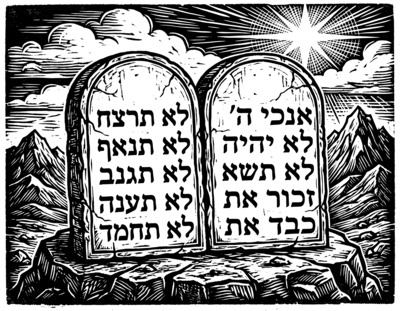
Moses remained with the Lord for forty days. At the end of that time, God gave him two stone tablets containing the divine commandments, written by the finger of God (Exodus 31:18). When Moses descended the mountain and witnessed the people's idolatry, he broke the tablets (Exodus 32:19). God later replaced them. (Exodus 34:1).
The text of the Ten Commandments is preserved in two Old Testament accounts: Exodus 20:1-17 and Deuteronomy 5:6-18. Aside from the prohibition concerning images and the command to observe the Sabbath, the Commandments contain moral principles shared by all humanity. Their meaning was further deepened by the teachings of Jesus Christ, especially in the Sermon on the Mount. Christ summarized the entire law in two commandments: to love God with all one's heart, soul, and strength, and to love one's neighbor as oneself (Mark 12:29-31; cf. Deuteronomy 6:4-5; Leviticus 19:18). In these two commandments, Jesus reveals the enduring purpose and fulfillment of the Ten Commandments.
Faith in Action
Choose one of the Ten Commandments and intentionally live it with greater purpose each day this week. Begin and end each day with prayer, asking God to help you grow in love for Him and for your neighbor.
Based on a longer article, The Ten Commandments: A Document of Divine Guidance, by Rev. George Mastrantonis, found on goarch.org (https://bit.ly/4ikvFtl)
What does “The Lord’s Day” mean? From The Original Greek: Kyriaki (Κυριακή)
Fr. George Parsenios (HCHC ’96)
The Greek word Κυριακή/Kyriaki is an adjective that can be translated as “belonging to the Lord,” or just “Lord’s,” and it holds a prominent place in Christian life. The adjective is derived from the Greek wordΚύριος/Kyrios, which means “Lord,” and which translates the Hebrew term for Lord, Adonai. Because Kyrios/Lord is a title that serves as a name for God in the Old Testament, the New Testament applies this name to Jesus in order to identify Jesus as God. If Jesus is “the Lord,” then He is God. Thus, when Jesus teaches His disciples to pray by saying, “Our Father, who art in heaven…” this famous prayer is called the “Lord’s Prayer” (Kyriaki Prosefchi). In the same vein, the first day of the week (which we call in English “Sunday,” i.e., the day of the Sun) is called “the Lord’s Day” (Kyriaki Hemera) in the Greek of the New Testament (Rev. 1:10). Christians would gather to celebrate the Eucharist on this day, because it was the day on which the Lord Jesus Christ had risen from the dead (John 20:1). The Greek word for the first day of the week continues to be Kyriaki, the Lord’s Day.
Fr. George Parsenios is Professor of New Testament at Holy Cross Greek Orthodox School of Theology. www.hchc.edu
Events for the following two weeks
Parish calendar
November 1 to November 15, 2026
Sunday, November 1
9:00AM Matins (Orthros)
10:00AM Divine Liturgy
Monday, November 2
11:30AM St. Basil Kitchen
7:00PM What is the church ? - a study of the Book of Acts
Thursday, November 5
8:45AM Morning Service
9:15AM Chant Rehearsal
Sunday, November 8
9:00AM Matins (Orthros)
10:00AM Divine Liturgy
11:30AM GLAS Monthly Meeting
Monday, November 9
11:30AM St. Basil Kitchen
Tuesday, November 10
10:30AM Metropolis Clergy brotherhood meeting
7:00PM In Person Finance Committee + Parish Council 2027 Budget Review
I am reluctant to admit that I begin each morning by snoozing my alarm a few too many times and mindlessly scrolling on TikTok. And once awake, school, work, socializing, and a workout always seem to fall into place effortlessly. So why doesn’t prayer?
While I make my σταυρό before every meal, and mumble Πάτερ ἡμῶν everynight before going to sleep, I didn’t establish a set prayer time each day until a month ago. The forty-five minutes I might dedicate to a pilates class had become more feasible, and I convinced myself that it is more worthwhile. I lived under the pretext that being busy was an excuse from establishing a set time with God. The Orthodox Church teaches the importance of a traditional worship: venerating icons, the seven sacraments and routine prayer. These rituals come naturally to me, yet I mostly practice them during services. I have never doubted my relationship with God, yet I have always struggled to pray. And while it may sound obvious, learning ‘how to pray’ is important and it is a conversation that is often shelved.
Recently, I’ve been observing the way in which my grandmother worships God in her daily life outside of Church. Her morning routine swaps scrolling for reading scripture, her afternoon walks do not require blaring music or a phone call to catch up with a friend, and her evenings end with silent prayer and reflection each night. Meals are introduced with a proper prayer and thanks to God, not a half-hearted and hastily done cross. She incorporates God into her routine, arguably gossiping to Him just as I would with friends. And while she is 83 and has more downtime, these habits are ones that anyone could emulate.
For much of my life I was truly uncomfortable in personal prayer; shifting in the silence, asking God for wants like some sort of genie, and eventually resorting to repeating familiar prayers because I was impatient. Our time spent together felt forced, ingenuine and painfully redundant. My screen time was an abjection and this summer, I admitted to myself that the restlessness in silence with God needed to change. Observing my grandmother required me to face my fears and accept the reality that nourishing an intimate relationship with God will require self reflection and this dreaded, uncomfortable silence. Yet acceptance was the easiest part; it has been putting it into practice for me that has proven to be most difficult, while dually the most fruitful.
Under the advice of my older brother, I reached out to my priest to speak about these feelings. During our conversation, he urged me to test out the ‘closet method’ wherein you set a timer and sit somewhere kept away from distraction -hence the closet- and dedicate a period of time to God. While this may seem a bit dramatic, it has changed the way I pray and I’ve grown increasingly comfortable in the silence that was formerly so daunting to me. Much like meditation, it reminded me that I need to relax my breath, set my mind and my intentions onto my goal: building my relationship with God. This approach to prayer has allowed me to focus my entire attention on God, weakened distraction and has translated into other moments of my day. The reward of knowing God intimately requires struggle and in just the few weeks I’ve put this advice into practice, I have begun to look forward to our conversations. I look for Him in my solitude and no longer feel the need to drown Him out with music, idle scrolling or former unfulfilling distractions. I shifted my perspective of God from not just my creator, but to my friend. And just like any strong friendship, it requires effort, listening and patience with both parties. Further, allocating time for God in the same way you would a workout, a healthy meal, or a good catch up with a friend is nourishing; it is a free and effective wellness supplement!
Mary Markis is a part-time writer for the Orthodox Observer. A Greek American and lifelong Orthodox Christian, she is currently pursuing a Bachelor of Art in Art History and Social Anthropology at the University of St. Andrews in Scotland.
I am reluctant to admit that I begin each morning by snoozing my alarm a few too many times and mindlessly scrolling on TikTok. And once awake, school, work, socializing, and a workout always seem […]
Columbus parish’s valet service opens doors for families with disabilities
10/26/2026
When Annunciation Greek Orthodox Cathedral in Columbus, Ohio set out to make Sunday mornings easier for families of children with disabilities, the first change was meeting them at the door.
Because the cathedral sits in downtown Columbus, where street parking is limited and the walk from available spaces can be difficult for those with mobility challenges, the parish implemented a valet parking service for faithful with disabilities and their families. Four parking spaces are now reserved specifically for those parishioners, removing what had been one of the most basic obstacles to attending liturgy.
The valet service is part of a broader set of accessibility improvements identified at the parish through their use ofAccessibility Assessments created by the Archdiocese’s On Behalf of All initiative. Targeted accessibility projects also include a separate entrance with a ramp and reserved seating areas within the sanctuary for parishioners who use wheelchairs, allowing them to worship alongside their families.
Helen Rankin, Parish Council President; Cathy Tela, educator and the parish’s liaison for the Archdiocese’s On Behalf of All pilot program; and Ruhel Ghebretnsae, the mother of a child with a disability, described the changes as the result of a ministry called St. Matrona Miracles of God, a support group for families with disabilities.
Founded by Presbytera Elaine Stavropoulos, the ministry takes its name from St. Matrona of Moscow, a Russian saint who was born blind, lost the ability to walk at age 17, and was known for the gift of healing despite those hardships and life under Soviet rule.
“It planted the initial seeds for us in terms of being aware that there were parishioners’ needs we hadn’t ministered to,” Rankin said.
Ghebretnsae said the changes have made a lasting difference for her family.
“There is no longer an excuse to skip liturgy or show up late,” she said. “We are encouraged by the community’s support, love and attention to our family. I’m grateful to be part of both and belong to a parish that continuously strives to provide endless support to the needs of my family and others. My children and I feel loved, protected, and respected. Glory to God.”
The parish has more accessibility projects underway. Parishioner David Betz, an architect, has provided preliminary plans for accessible family restrooms with an adult changing table, as well as for parking lot improvements, including additional van-accessible spaces. Parishioner William (Belisarios) Morris, MD, is designing and building an accessible icon stand for wheelchair users. Sensory bags are now available during services, and the parish also plans to install automatic door-openers.
The parish now has sensory bags available during services. Photo courtesy of Annunciation Cathedral
As a pilot parish in the Archdiocese’s initiativeOn Behalf of All: Toward an Accessible Divine Liturgy for Children with Disabilities, the church also has an On Behalf of All committee responsible for raising awareness and piloting best practices. The parish will also host a parish-wide retreat examining how “we can live the Gospel call to welcome, support, and include all members of the Body of Christ, including children with disabilities.”
Tela said the parish has worked to raise disability awareness in less visible ways as well, including through bulletin submissions and coffee-hour conversations where parishioners can share ideas, obstacles, and feedback.
“One of the greatest blessings of our ministry is how it has brought people together to share their talents with the entire church,” Tela said. “We continue to pray for God’s guidance as we work toward a church where all members of God’s creation can worship together.”
Tela said she hopes the parish’s example encourages other communities to take on similar work. “We hope it inspires other churches to tackle some of the challenges their parishioners may be facing,” she said.
Mary Markis is a part-time writer for the Orthodox Observer. A Greek American and lifelong Orthodox Christian, she is currently pursuing a Bachelor of Art in Art History and Social Anthropology at the University of St. Andrews in Scotland.
When Annunciation Greek Orthodox Cathedral in Columbus, Ohio set out to make Sunday mornings easier for families of children with disabilities, the first change was meeting them at the door. Because the cathedral sits in […]