September 06
Our Events
You can find the flyers of scheduled events here: https://flic.kr/s/aHBqjAv3Lz


SUNDAY MATINS/DIVINE LITURGY, 8:15 am
The translations of hymns are under copyright and used by permission. All rights reserved. These works may not be further reproduced, in print or on other websites or in any other form, without the prior written authorization of the copyright holder:
Third Orthros Gospel
The Reading is from Mark 16:9-20
When Jesus rose early on the first day of the week, He appeared first to Mary Magdalene, from whom He had cast out seven demons. She went and told those who had been with Him, as they mourned and wept. But when they heard that He was alive and had been seen by her, they would not believe it.
After this he appeared in another form to two of them, as they were walking into the country. And they went back and told the rest, but they did not believe them. After this He appeared to the eleven themselves as they sat at table and He upbraided them for their unbelief and hardness of heart, because they had not believed those who saw Him after He had risen. And He said to them, "Go into all the world and preach the gospel to the whole creation. He who believes and is baptized will be saved; but he who does not believe will be condemned. And these signs will accompany those who believe: in My name they will cast out demons; they will speak in new tongues; they will pick up serpents, and if they drink any deadly thing, it will not hurt them; they will lay their hands on the sick, and they will recover."
So then the Lord Jesus, after He had spoken to them, was taken up into heaven, and sat down at the right hand of God. And they went forth and preached everywhere, while the Lord worked with them and confirmed the message by the signs that attended it. Amen.
Third Orthros Gospel
Κατὰ Μᾶρκον 16:9-20
Ἀναστὰς ὁ Ἰησοῦς πρωῒ πρώτῃ Σαββάτου ἐφάνη πρῶτον Μαρίᾳ τῇ Μαγδαληνῇ, ἀφ' ἧς ἐκβεβλήκει ἑπτὰ δαιμόνια. Ἐκείνη πορευθεῖσα ἀπήγγειλε τοῖς μετ' αὐτοῦ γενομένοις, πενθοῦσι καὶ κλαίουσι. Κᾀκεῖνοι ἀκούσαντες ὅτι ζῇ καὶ ἐθεάθη ὑπ' αὐτῆς ἠπίστησαν. Μετὰ δὲ ταῦτα δυσὶν ἐξ αὐτῶν περιπατοῦσιν ἐφανερώθη ἐν ἑτέρᾳ μορφῇ, πορευομένοις, εἰς ἀγρόν. Κᾀκεῖνοι ἀπελθόντες ἀπήγγειλαν τοῖς λοιποῖς, οὐδὲ ἐκείνοις ἐπίστευσαν. Ὕστερον, ἀνακειμένοις αὐτοῖς τοῖς ἕνδεκα ἐφανερώθη, καὶ ὠνείδισε τὴν ἀπιστίαν αὐτῶν καὶ σκληροκαρδίαν, ὅτι τοῖς θεασαμένοις αὐτὸν ἐγηγερμένον, οὐκ ἐπίστευσαν. Καὶ εἶπεν αὐτοῖς· Πορευθέντες εἰς τὸν κόσμον ἅπαντα, κηρύξατε τὸ εὐαγγέλιον πάσῃ τῇ κτίσει. Ὁ πιστεύσας καὶ βαπτισθείς, σωθήσεται, ὁ δὲ ἀπιστήσας, κατακριθήσεται. Σημεῖα δὲ τοῖς πιστεύσασι ταῦτα παρακολουθήσει. Ἐν τῷ ὀνόματί μου δαιμόνια ἐκβαλοῦσι, γλώσσαις λαλήσουσι καιναῖς, ὄφεις ἀροῦσι, κἂν θανάσιμόν τι πίωσιν, οὐ μὴ αὐτοὺς βλάψει, ἐπὶ ἀῤῥώστους χεῖρας ἐπιθήσουσι, καὶ καλῶς ἕξουσιν. Ὁ μὲν οὖν Κύριος, μετὰ τὸ λαλῆσαι αὐτοῖς, ἀνελήφθη εἰς τὸν οὐρανόν, καὶ ἐκάθισεν ἐκ δεξιῶν τοῦ Θεοῦ. Ἐκεῖνοι δὲ ἐξελθόντες, ἐκήρυξαν πανταχοῦ, τοῦ Κυρίου συνεργοῦντος, καὶ τὸν λόγον βεβαιοῦντος, διὰ τῶν ἐπακολουθούντων σημείων. Ἀμήν.
Prokeimenon. Plagal First Mode. Psalm 11.7,1.
You, O Lord, shall keep us and preserve us.
Verse: Save me, O Lord, for the godly man has failed.
The reading is from St. Paul's Second Letter to the Corinthians 1:21-24; 2:1-4.
Brethren, it is God who establishes us with you in Christ, and has commissioned us; he has put his seal upon us and given us his Spirit in our hearts as a guarantee.
But I call God to witness against me - it was to spare you that I refrained from coming to Corinth. Not that we lord it over your faith; we work with you for your joy, for you stand firm in your faith. For I made up my mind not to make you another painful visit. For if I cause you pain, who is there to make me glad but the one whom I have pained? And I wrote as I did, so that when I came I might not suffer pain from those who should have made me rejoice, for I felt sure of all of you, that my joy would be the joy of you all. For I wrote you out of much affliction and anguish of heart and with many tears, not to cause you pain but to let you know the abundant love that I have for you.
Προκείμενον. Plagal First Mode. ΨΑΛΜΟΙ 11.7,1.
Σὺ Κύριε, φυλάξαις ἡμᾶς καὶ διατηρήσαις ἡμᾶς.
Στίχ. Σῶσον με, Κύριε, ὅτι ἐκλέλοιπεν ὅσιος.
τὸ Ἀνάγνωσμα Πρὸς Κορινθίους β' 1:21-24, 2:1-4.
Ἀδελφοί, ὁ βεβαιῶν ἡμᾶς σὺν ὑμῖν εἰς Χριστόν, καὶ χρίσας ἡμᾶς, θεός, ὁ καὶ σφραγισάμενος ἡμᾶς, καὶ δοὺς τὸν ἀρραβῶνα τοῦ πνεύματος ἐν ταῖς καρδίαις ἡμῶν. Ἐγὼ δὲ μάρτυρα τὸν θεὸν ἐπικαλοῦμαι ἐπὶ τὴν ἐμὴν ψυχήν, ὅτι φειδόμενος ὑμῶν οὐκέτι ἦλθον εἰς Κόρινθον. Οὐχ ὅτι κυριεύομεν ὑμῶν τῆς πίστεως, ἀλλὰ συνεργοί ἐσμεν τῆς χαρᾶς ὑμῶν· τῇ γὰρ πίστει ἑστήκατε. Ἔκρινα δὲ ἐμαυτῷ τοῦτο, τὸ μὴ πάλιν ἐν λύπῃ πρὸς ὑμᾶς ἐλθεῖν. Εἰ γὰρ ἐγὼ λυπῶ ὑμᾶς, καὶ τίς ἐστιν ὁ εὐφραίνων με, εἰ μὴ ὁ λυπούμενος ἐξ ἐμοῦ; Καὶ ἔγραψα ὑμῖν τοῦτο αὐτό, ἵνα μὴ ἐλθὼν λύπην ἔχω ἀφʼ ὧν ἔδει με χαίρειν, πεποιθὼς ἐπὶ πάντας ὑμᾶς, ὅτι ἡ ἐμὴ χαρὰ πάντων ὑμῶν ἐστίν. Ἐκ γὰρ πολλῆς θλίψεως καὶ συνοχῆς καρδίας ἔγραψα ὑμῖν διὰ πολλῶν δακρύων, οὐχ ἵνα λυπηθῆτε, ἀλλὰ τὴν ἀγάπην ἵνα γνῶτε ἣν ἔχω περισσοτέρως εἰς ὑμᾶς.
14th Sunday of Matthew
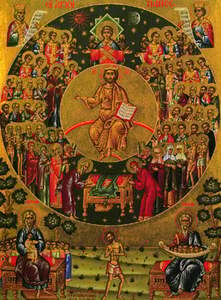
The Reading is from Matthew 22:2-14
The Lord said this parable, "The kingdom of heaven may be compared to a king who gave a marriage feast for his son, and sent his servants to call those who were invited to the marriage feast; but they would not come. Again he sent other servants, saying, 'Tell those who are invited, Behold, I have made ready my dinner, my oxen and my fat calves are killed, and everything is ready; come to the marriage feast.' But they made light of it and went off, one to his farm, another to his business, while the rest seized his servants, treated them shamefully, and killed them. The king was angry, and he sent his troops and destroyed those murderers and burned their city. Then he said to his servants, 'The wedding is ready, but those invited were not worthy. Go therefore to the thoroughfares, and invite to the marriage feast as many as you find.' And those servants went out into the streets and gathered all whom they found, both bad and good; so the wedding hall was filled with guests.
But when the king came in to look at the guests, he saw there a man who had no wedding garment; and he said to him, 'Friend, how did you get in here without a wedding garment?' And he was speechless. Then the king said to the attendants, 'Bind him hand and foot, and cast him into the outer darkness; there men will weep and gnash their teeth.' For many are called, but few are chosen."
14th Sunday of Matthew
Κατὰ Ματθαῖον 22:2-14
Εἶπεν ὁ Κύριος τὴν παραβολὴν ταύτην· Ὡμοιώθη ἡ βασιλεία τῶν οὐρανῶν ἀνθρώπῳ βασιλεῖ, ὅστις ἐποίησε γάμους τῷ υἱῷ αὐτοῦ. Καὶ ἀπέστειλε τοὺς δούλους αὐτοῦ καλέσαι τοὺς κεκλημένους εἰς τοὺς γάμους, καὶ οὐκ ἤθελον ἐλθεῖν. Πάλιν ἀπέστειλεν ἄλλους δούλους λέγων· Εἴπατε τοῖς κεκλημένοις· ἰδοὺ τὸ ἄριστόν μου ἡτοίμασα, οἱ ταῦροί μου καὶ τὰ σιτιστὰ τεθυμένα, καὶ πάντα ἕτοιμα· δεῦτε εἰς τοὺς γάμους. οἱ δὲ ἀμελήσαντες ἀπῆλθον, ὃς μὲν εἰς τὸν ἴδιον ἀγρόν, ὃς δὲ εἰς τὴν ἐμπορίαν αὐτοῦ· οἱ δὲ λοιποὶ κρατήσαντες τοὺς δούλους αὐτοῦ ὕβρισαν καὶ ἀπέκτειναν. Ἀκούσας δὲ ὁ βασιλεὺς ἐκεῖνος ὠργίσθη, καὶ πέμψας τὰ στρατεύματα αὐτοῦ ἀπώλεσε τοὺς φονεῖς ἐκείνους καὶ τὴν πόλιν αὐτῶν ἐνέπρησε. Τότε λέγει τοῖς δούλοις αὐτοῦ· ῾Ο μὲν γάμος ἕτοιμός ἐστιν, οἱ δὲ κεκλημένοι οὐκ ἦσαν ἄξιοι· πορεύεσθε οὖν ἐπὶ τὰς διεξόδους τῶν ὁδῶν, καὶ ὅσους ἐὰν εὕρητε καλέσατε εἰς τοὺς γάμους. Καὶ ἐξελθόντες οἱ δοῦλοι ἐκεῖνοι εἰς τὰς ὁδοὺς συνήγαγον πάντας ὅσους εὗρον, πονηρούς τε καὶ ἀγαθούς· καὶ ἐπλήσθη ὁ γάμος ἀνακειμένων. Εἰσελθὼν δὲ ὁ βασιλεὺς θεάσασθαι τοὺς ἀνακειμένους εἶδεν ἐκεῖ ἄνθρωπον οὐκ ἐνδεδυμένον ἔνδυμα γάμου, καὶ λέγει αὐτῷ· Ἐταῖρε, πῶς εἰσῆλθες ὧδε μὴ ἔχων ἔνδυμα γάμου; ῾Ο δὲ ἐφιμώθη. Τότε εἶπεν ὁ βασιλεὺς τοῖς διακόνοις· Δήσαντες αὐτοῦ πόδας καὶ χεῖρας ἄρατε αὐτὸν καὶ ἐκβάλετε εἰς τὸ σκότος τὸ ἐξώτερον· ἐκεῖ ἔσται ὁ κλαυθμὸς καὶ ὁ βρυγμὸς τῶν ὀδόντων. Πολλοὶ γάρ εἰσι κλητοὶ, ὀλίγοι δὲ ἐκλεκτοί.
You can find the flyers of scheduled events here: https://flic.kr/s/aHBqjAv3Lz
+Memorial: 40-Day John Dobogai
7:30AM Prosfora: Debbie Koutromanos
8:15AM +Matins
9:15AM +Divine Liturgy
11:00AM "Blessing of the Backpacks"
11:15AM Hospitality: Please bring something to share
11:30AM Sunday School Registration
Coming DEADLINE: The Vine announcements
8:00AM DIVINE LITURGY FOR NATIVITY OF THEOTOKOS
6:30PM Men's Ministry - Evening Meeting
Deadline: The Vine Announcements
10:30AM Bible Studies
3:00PM Rehearsal for Constantinos Copoulos and Tiffany Derynda
2:30PM Wedding for Constantinos Copoulos and Tiffany Derynda
+Memorial: 6-Year Apollon Limberatos
+Memorial: 40-Day Paraskevi "Vivian" Voula Limberatos
7:30AM Prosfora: Theodora Galanis
8:15AM +Matins
9:15AM +Divine Liturgy
11:15AM Hospitality: In Memory of Apollon & Voula Limberatos also, Degenhardt Family
11:30AM Sunday School Registration
12:00PM Altar Server Training and Lunch
+Memorial: 7-Year Angela Sfakianakis
Memorials not allowed today
8:00AM DIVINE LITURGY FOR EXALTATION OF THE HOLY CROSS -Bring Basil plants/cuttings
6:30PM Parish Council Meeting
10:30AM Bible Studies
7:30AM Prosfora: Peggy Gorgolis
8:00AM Matins and Liturgy for St. Evstathios
8:15AM +Matins
9:15AM Choir is singing Liturgy
9:15AM +Divine Liturgy
11:15AM Hospitality: Team J
11:30AM Sunday School
2:00PM Wedding for Dimitri Panagiotopoulos and Emily Masarik


The feast today in honour of the Archangel Michael commemorates the great miracle he wrought when he delivered from destruction a church and holy spring named for him. The pagans, moved by malice, sought to destroy the aforesaid church and holy spring by turning the course of two rivers against them. But the Archangel appeared and, by means of the Cross and a great earthquake that shook the entire area, diverted the waters into an underground course. Henceforth, the name of that place changed from Colossae to Chonae, which means "funnels" in Greek.
During the Holy Fast for the Dormition of the Most Holy Mother of God, His All-Holiness Ecumenical Patriarch Bartholomew, in the company of His Beatitude Pope and Patriarch Theodore II of Alexandria and All Africa and His Beatitude Archbishop Ioannis of Tirana, Durrës and All Albania, traveled back to the island of Imvros, where he was born on February 29, 1940. On Thursday, August 13, 2026, His All-Holiness observed the 65th anniversary of his ordination to the diaconate and offered a series of reflections on his remarkable lifetime of service to Almighty God and His Holy Church.
Before the dismissal of the Patriarchal Divine Liturgy, over which he presided at the Metropolitan Church of the Dormition of the Theotokos, Ecumenical Patriarch Bartholomew celebrated a Trisagion for the repose of his elder and benefactor of blessed memory, Metropolitan Meliton of Chalcedon. 65 years ago, on August 13, 1961, His Eminence Meliton, then the Metropolitan of Imvros and Tenedos, ordained the 21-year-old Dimitrios Archontonis to the sacred diaconate, and gave him the ecclesiastical name Bartholomew.
Recalling his ordination to the diaconate, His All-Holiness stated that he remembered in particular the words “Jesus only,” from the account of the Transfiguration in the Gospels: “And when they lifted up their eyes, they saw no one but Jesus only” (Matthew 17:8). These words, he explained, have guided him throughout his lengthy and remarkable lifetime of diakonia.
According to Orthodox Times, the Ecumenical Patriarch “spoke warmly of the formative influence of both Imbros and the Theological School of Halki, where his faith, love of learning and appreciation for Orthodox liturgical and theological tradition were cultivated. He also paid tribute to the people of Imbros who remained on the island through difficult decades and preserved its churches, language and identity. Expressing optimism about the island’s future, he encouraged younger generations to contribute actively to maintaining a sustainable Greek Orthodox presence there.”
His All-Holiness spent eight years as a deacon; Metropolitan Meliton ordained him to the holy priesthood on October 19, 1969, and Ecumenical Patriarch Demetrios of blessed ministry consecrated him as a bishop on the Feast of the Nativity of the Lord Jesus Christ, December 25, 1973. On October 22, 1991, the Holy and Sacred Synod unanimously elected him as the 270th Archbishop of Constantinople-New Rome and Ecumenical Patriarch. He was enthroned on November 2, 1991.
On Imvros on August 13, His All-Holiness gave thanks to God for the “supreme gift of the priesthood.” He noted that in his service to the Holy Orthodox Church, his efforts had been “devoted to pan-Orthodox cooperation, inter-Christian and interreligious dialogue, peace and solidarity, the protection of the natural environment, and engagement between the Church and the contemporary world.”
The Ecumenical Patriarch stated: “My entire journey has been a ‘life in dialogue.’” He stressed “that he has always regarded introversion, isolation, self-sufficiency and ‘sterile monologue’ as incompatible with the Orthodox faith.” He explained that as Ecumenical Patriarch, he had always emphasized that Orthodoxy is “fundamentally a call to communion, encounter with others, solidarity and peaceful coexistence.” He added that these convictions “have inspired initiatives aimed at fostering cooperation in addressing the major challenges of the contemporary world.”
The extraordinary 35-year ministry of His All-Holiness as Ecumenical Patriarch has indeed been marked by remarkable initiatives to in building bridges with Christians of other faith traditions, as well as with non-Christians. In his address, His All-Holiness “also emphasized the wider mission of the Ecumenical Patriarchate, insisting that the Church cannot remain detached from the challenges facing humanity.” Throughout his tenure as Ecumenical Patriarch, His All-Holiness has consistently and courageously raised a prophetic voice to meet those challenges, calling upon humanity to care for the natural environment, and to recognize that war causes incalculable loss of lives and property while solving nothing.
His All-Holiness said that “the Ecumenical Patriarchate has never been a spectator of the course of human affairs,” while “rejecting the notion that engagement with the world necessarily leads to the secularization of the Church.”
His All-Holiness also recalled the Lord’s words, “You are the salt of the earth; but if salt has lost its taste, how shall its saltness be restored? It is no longer good for anything except to be thrown out and trodden under foot by men. You are the light of the world. A city set on a hill cannot be hid.” (Matthew 5:13-14). He declared: “We cannot journey toward God while turning our backs on our fellow human beings.”
That is the ethos that has characterized this holy man’s selfless 65 years of service to the Holy Orthodox Church. We are immensely blessed that his ministry continues. Eis polla eti, Despota!
See the original article here.
The post Ecumenical Patriarch Bartholomew reflects upon 65 years of ministry appeared first on Orthodox Observer.
During the Holy Fast for the Dormition of the Most Holy Mother of God, His All-Holiness Ecumenical Patriarch Bartholomew, in the company of His Beatitude Pope and Patriarch Theodore II of Alexandria and All Africa […]
The post Ecumenical Patriarch Bartholomew reflects upon 65 years of ministry appeared first on Orthodox Observer.
After moving to Athens when I was 15, I found myself surrounded by graffiti on a scale I had not seen in New York, covering entire walls of neighborhoods, highways and even monuments. This made me wonder what impulse leads people throughout history to mark surfaces and leave a trace? Now, graffiti is illegal and considered damage to public and private property, yet it continues. My interest in graffiti on the streets of Athens intensified and brought me to the Iviron Monastery library at Mount Athos.
Delving into “Silk Road Graffiti” by Dale Johnson, a Syriac Orthodox monk and linguist who documented writings at the margins of ancient scrolls (marginalia) was illuminating. He described marks of children practicing their letters, travelers leaving messages that were sometimes answered decades later, as well as doodles and notes accumulated over hundreds of years. It irked me that historians often treat marginalia as secondary, even distracting. The more I researched, the more I realized the margin is often where the reader becomes present, visible, uncertain, and curious. And marginalia are also the graffiti which cover the walls of Athens today.
In December 2025, I made the long trek to the Holy Monastery of Iviron on Mount Athos to look for marginalia in medieval manuscripts. Coming from Greece’s mainland. I arrived at Mount Athos as a pilgrim would: slowly and tired but with intention. Once there, my visit was a medieval experience: Time moved differently even though church bells rang loudly to mark the functions of the day. The architecture, the communal life of the monks, and the natural setting were more vivid than I had expected.

A dark doorway took me into the library, a vaulted space with brick arches and ceiling-high shelves on either side. From there I saw a series of corridors lined with more wooden shelves and glass cabinets. Monk Theologos Iverites, the librarian, guided me through the collection.

The wrapping of the manuscripts struck me first. Most volumes were covered with white cloth cases to protect the books from insects. Each had a small, inked symbol alongside a number followed by geometric marks, below which a beetle or other bug had been drawn. This was to indicate which type of insect had infested that manuscript.

It saddened me to see so many of the shelved manuscripts with disintegrating bindings and covers, due to infestation. Entire collections are disappearing slowly, eaten away. I closed one book as carefully as if it were an eggshell that could crack, yet a small cloud of dust rose from the eroding pages. The earthy smell of the old paper made me feel I was on an archeological dig. It moved me to holding a book from the 9th century.

Monk Theologos Iverites has spent years scanning manuscripts before they are all lost. As I assisted him in this preservation work, he helped me identify and translate the marginalia we came across in the many layers that exist in a single manuscript. The notes on the Ottoman invasion to Greece, historical remarks, signatures, drawings, and senseless doodles captivated me. On the inside cover of one manuscript, multiple writers had left their marks across centuries, with crosses, names, and dates all crowded together, each person annotating the previous message. In another manuscript, I spotted a blank end leaf with just two series of a strange, code-like text. In some volumes, I saw signatures rewritten, layers of the same names. The impulse that Johnson had documented was not specific to one culture nor one road but omnipresent in a world of readers. It thrilled me to find that each manuscript had at least three stories or layers: the literal meaning of its text, the journey it has taken over centuries, and the notes and marks in its margins. I had become part of a chain of people discovering them and then helping to restore these unique books before passing them on. The manuscripts have survived Ottoman invasions, insect damage, centuries of handling and I want them to live on.
My dyslexic mind leads me to read around edges before focusing on centers. To me, the margins are the most honest part of the page. The text of a book conveys what is required and expected while the margins express the irrepressible. This understanding took me from New York City and then Athens to one of the most sacred libraries of Orthodox Christianity in Northern Greece. What looked like peripheral noise near the main event became a valuable archive. The margin is not an accidental holding bin but an oasis for scribes in need of more space.
Ari Antelman is a senior at Moraitis School in Athens. He grew up in New York City and is currently conducting independent research on language and memory in Greek American communities.
The post What graffiti taught me about ancient manuscripts appeared first on Orthodox Observer.
After moving to Athens when I was 15, I found myself surrounded by graffiti on a scale I had not seen in New York, covering entire walls of neighborhoods, highways and even monuments. This made […]
The post What graffiti taught me about ancient manuscripts appeared first on Orthodox Observer.
On the eve of the Feast of Indiction, the Service of Great Vespers for the Day of Prayer for the Protection of the Natural Environment was celebrated at St. Eleftherios Greek Orthodox Church in New York City by Fr. Nicolas Kazarian, St. Eleftherios parish priest and the Greek Orthodox Archdiocese of America’s Director of the Department of Inter-Orthodox, Ecumenical, and Interfaith Relations. The hymns for the Service of Great Vespers were chanted by Master Chanter of St. Nicholas National Shrine, Dimitrios Katsiklis.
Attended by faithful from the NYC area, the service was followed by dinner and an ecumenical panel discussion on the importance of environmental stewardship in the Christian life.
The Great Vespers for the Preservation of Creation was composed on Mount Athos by Monk Gerasimos of the Skete of Saint Anne—who was a hymnographer of the Great Church of Christ. The service, especially composed to celebrate the Day of Prayer for the Protection of the Natural Environment proclaimed in 1989, heavily integrates themes of repentance for humanity’s destruction of nature, cosmic renewal through Christ, and Old Testament readings (like Leviticus and Isaiah) that link human righteousness with the fertility of the earth.
> Previously: Cosmic worship, cosmic witness: Orthodox Vespers for the Preservation of Creation
“Put an end, O Savior, to the evil designs which are being devised against us by senseless intent, and turn aside from the earth every destructive action of the works of human hands which contrive corruption leading to perdition.”

This celebration of the Day of Prayer for Creation marked the start of the Archdiocese’s new Green Church Initiative. The initiative, managed by Lily Talmers within the Department of Inter-Orthodox, Ecumenical, and Interfaith Relations, will develop resources and programs to support efforts by parishes to embrace the environmental theology of the Orthodox Church and undertake steps to integrate environmental sustainability practices into parish life.
Following Great Vespers, a panel discussion was held in the community hall and featured three notable speakers—Dr. Chris Durante from St. Peter’s University; Lily Kerhualas, a Ph.D. candidate from Fordham University; and Christina Leano, the Associate Director of the Laudito Si Movement in New York. As Project Manager of the Green Church Initiative, Lily Talmers moderated the discussion.
The panelists examined the relationship between Christian faith and environmental stewardship, emphasizing the role of humanity as stewards called to care for God’s creation. They discussed the importance of appreciating and being connected to creation within the spiritual life and the responsibility of Christians to approach the natural world with gratitude and reverence.
“Our encounter with Christ has to lead us deeper into our relationship with creation,” Christina Leano said. “So to care for creation is not an extra thing, an add-on, but actually a constitutive dimension of what it means to follow Christ.”
The discussion also considered how the natural world alludes to God’s presence in the world and has long been the site of revelation.
“That takes us actually going outside and turning our attention towards the environment, to the natural world,” said Lily Kerhulas. “Thinking from a Christian standpoint opens up the possibility of revelation.”
The panelists also addressed the challenges in bridging the gap between public awareness and collective action around climate change and environmental degradation, particularly amid frequent reports of environmental disasters and growing feelings of hopelessness in mitigation pollution and environmental destruction.
Leano spoke of the importance of acknowledging the suffering associated with environmental degradation rather than becoming indifferent to it.
“We need to hold the suffering in our hearts,” Leano said. “We can’t ignore it. And that’s part of our work is to allow our hearts to be broken.”
Dr. Chris Durante approached environmental stewardship through the question of human flourishing, asking what conditions allow individuals, families, and communities to live well. He contrasted that understanding with a culture increasingly shaped by the pursuit of material accumulation and consumption.
“We want a life lived well, we want well-being, happiness, and prosperity for our kin and our children going into the future. Look towards the book of nature, towards what that flourishing actually is,” Durante said. “The good life in the terms of a holistic understanding that isn’t just buying into some corporation’s version of it they’re advertising to you.”
Kerhulas further connected the Christian pursuit of theosis with environmental stewardship, describing creation as a means through which humanity can enter into deeper communion with God. Leano encouraged an approach to environmental work rooted in gratitude, hope, and community, describing creation as a “joyful mystery to be contemplated.”
The post Ecumenical Department holds panel on environmental stewardship, announces new creation care initiative appeared first on Orthodox Observer.
On the eve of the Feast of Indiction, the Service of Great Vespers for the Day of Prayer for the Protection of the Natural Environment was celebrated at St. Eleftherios Greek Orthodox Church in New […]
The post Ecumenical Department holds panel on environmental stewardship, announces new creation care initiative appeared first on Orthodox Observer.
The National Forum of Greek Orthodox Church Musicians awarded the prestigious Saint Romanos the Melodist Medallion to two deserving individuals at the 2026 Clergy Laity Congress, with the award presented by the Archbishop of the Greek Orthodox Archdiocese of America.
As is tradition, the National Forum awards the medallion at each biennial Clergy Laity Congress. The medal is awarded to musicians in the Greek Orthodox Archdiocese of America who have made significant and exemplary national contributions to the Greek Orthodox Archdiocese of America and its music ministry.
We are pleased to announce the following recipients of the 2026 Saint Romanos the Melodist Medallion recipients:
Fr. Michael Palad has composed, arranged and published music for church choirs including an English Doxology, choral music for the Sacrament of Mariage in the Eastern Orthodox Church and has published the well-known Greek folk song “Snow on the Bell Tower”. In conjunction with Narthex Press, Father Michael started publishing weekly Sunday Orthros music supplements which also include audio recordings.
In 2018, Fr. Michael conceived the idea of gathering Orthodox musicians from all jurisdictions in the Phoenix, Arizona and beyond to sing and enjoy fellowship. Orthodox Christian Choral Fellowship (OCCF) was established and incorporated in 2018. The theme “One Day, One Hymn, One Church” was created and received with great enthusiasm and participation. This resulted in a video posted on social media for all to enjoy. OCCF created a website where the music could also be purchased. In 2020, during the COVID outbreak, “OCCF” went virtual which allowed participation to reach Orthodox musicians nationally and internationally.
He is a National Forum Honorary Life Member, has received the Patriarch Athenagoras Award for distinguished metropolis service, the San Francisco Federation St. John Damascus and St. Cosmas the Melodist awards and has received the Folk Dance and Choral Festival Director Award.
Fr. Michael has served and the Spiritual Leader of the San Francisco Church Musicians Federation and has led chant groups during federation conference Vespers and Orthros services. He currently serves as Presiding Priest at St. Haralambos Greek Orthodox Church in Peoria, Arizona where he has served for 32 years. Axios!

The medallion was also awarded to Nicholas (Nick) Chimitris. Nick has provided transformative national leadership through his service as National Forum of Greek Orthodox Church Musicians Chairman since 2020. His work has reshaped the infrastructure, visibility and national reach of Orthodox church music within the Greek Orthodox Archdiocese of America.
During his three terms as National Chairman, Nick has revitalized the National Forum, accomplishing numerous programmatic and organizational advancements. Under his leadership, the National Forum has become a 501C3 non-profit organization. He was instrumental in scheduling annual audiences for the National Forum Council of Presidents with His Eminence Archbishop Elpidophoros of America, increasing the National Forum’s national recognition and open communication with His Eminence. He is currently spearheading the National Forum’s Anastassiou project, publishing the Diatonic and Enharmonic liturgies in the approved English translation.
Another major program conceived by and being led by Nick is the Saint Romanos Church Music Festival, a national music competition and educational program for youth. This new youth initiative has been enthusiastically approved by the Holy Eparchial Synod for Archdiocesan implementation.
Nick has energized the Council of Presidents to implement his vision for the 50th Anniversary of the National Forum, aligning the National Forum as a full partner in the 2026 Clergy Laity Congress creating a National Forum musicians registration track.
Nick has championed the use of technology to reach church musicians, developing a ground breaking on-line training platform for clergy, church musicians and youth, the Parish Music Leadership Initiative or commonly known as the “MELI” project.
He has increased accessibility of the National Forum’s “Liturgical Guidebook” by creating and offering the option of either a digital or print format.
In 2003, Nick was awarded the Patriarch Athenagoras medal for his contributions to the Chicago Metropolis and the Chicago Metropolis Church Musicians Federation which he led as its longest-serving president for nine terms. He continues to serve on the Federation Board. Through various commendations and awards, his service has been recognized by His All-Holiness Ecumenical Patriarch Bartholomew; His Eminence Archbishop Elpidophoros of America; His Eminence Archbishop Demetrios, formerly of America; Metropolitan of Chicago Iakovos of blessed memory; and His Eminence Metropolitan Nathanael of Chicago.
Nick has been involved with church music for sixty years and served as choir director for over forty of those years. He is currently the choir director at Saint Demetrios Greek Orthodox Church in Hammond, Indiana. Axios!
The post St. Romanos the Melodist Medallion awarded at Clergy-Laity Congress appeared first on Orthodox Observer.
The National Forum of Greek Orthodox Church Musicians awarded the prestigious Saint Romanos the Melodist Medallion to two deserving individuals at the 2026 Clergy Laity Congress, with the award presented by the Archbishop of the […]
The post St. Romanos the Melodist Medallion awarded at Clergy-Laity Congress appeared first on Orthodox Observer.
In his sacred responsibility as described in the Charter of our Sacred Archdiocese, and in his pastoral oversight and fatherly care, His Eminence Archbishop Elpidophoros of America has approved the following ordinations:
The post Archbishop Elpidophoros approves ordinations to the diaconate, priesthood appeared first on Orthodox Observer.
In his sacred responsibility as described in the Charter of our Sacred Archdiocese, and in his pastoral oversight and fatherly care, His Eminence Archbishop Elpidophoros of America has approved the following ordinations: Mr. Douglas Kasten […]
The post Archbishop Elpidophoros approves ordinations to the diaconate, priesthood appeared first on Orthodox Observer.
This morning, His Eminence Archbishop Elpidophoros of America marked the Feast of the Indiction, the New Ecclesiastical Year, and the Day of Prayers for the Protection of the Natural Environment with the following social media post:
Marking the New Ecclesiastical Year, September 1st, is a most significant day for our Church and the entirety of humanity. Our Ecumenical Patriarchate, and especially His All-Holiness Bartholomew, for decades have been emphasizing our relationship with the Earth and all creation, as the God-given environment in which the human family is called to serve as stewards of creation. This contains all that we hold dear on our “Big, Blue Marble” – the land and the seas, the air we breathe, the water we drink, and the creatures with whom we share this planet.
We are indeed blessed that we have a “Green” Patriarch who understands the sacred nature of creation, which we celebrate and acknowledge in every icon fashioned for the sanctification of the Faithful. His All-Holiness has been leading the way for a truly Patristic and theological ecology that applies not only across the Christian world in all its diversity, but throughout the interfaith and interspiritual communities as well.
The devastating fires across North America and the recent tragedy in Nepal, where a glacial collapse unleashed a catastrophic cascade of ice, rock, mud, and floodwaters, are stark reminders of the intensifying consequences of climate change, the fragility of our common home, and our sacred responsibility to care for it.
As we commence this New Ecclesiastical Year, may we each pause for a moment to remember the created order with which God has graced our lives, and may we each, in our own way, commit to protecting, enhancing, restoring, and safeguarding the precious gift of the created universe, beginning with our Mother Earth, above whom “the heavens declare the glory of God, and the sky above proclaims the work of His hands” (Psalm 18:1 LXX).
See the original post on Facebook and Instagram.
The post Read Archbishop Elpidophoros’s message for the New Ecclesiastical Year appeared first on Orthodox Observer.
This morning, His Eminence Archbishop Elpidophoros of America marked the Feast of the Indiction, the New Ecclesiastical Year, and the Day of Prayers for the Protection of the Natural Environment with the following social media […]
The post Read Archbishop Elpidophoros’s message for the New Ecclesiastical Year appeared first on Orthodox Observer.
The community of Dormition of the Virgin Mary Cathedral in Southampton, NY had the honor of the visit to their Cathedral of His Eminence Archbishop Elpidophoros of America on Sunday, August 30, 2026. Welcoming the Archbishop were Grand Protopresbyter of the Ecumenical Throne Fr. Alexander Karloutsos and Rev. Fr. Constantine Lazarakis, parish council members and faithful of the community, including many altar boys.
Also attending the service was His Grace Bishop Athenagoras of Nazianzos, who read the Patriarchal Message for the Beginning of the Ecclesiastical Year and the Solemn Day of Prayers for Natural Environment, which is celebrated each year on September 1. In this year’s Message His All-Holiness Ecumenical Patriarch Bartholomew states, “We are convinced that highlighting the religious and ethical dimensions of the ecological threat will lead to an awareness of the pivotal importance of ‘ecological responsibility.’ Humanity must at last cease acting as though it does not know and definitively cast aside the illusion that planet Earth can in perpetuity withstand the burdens and destruction caused by human activity, or that nature has the power to renew itself of its own accord. The ethos of responsibility for the protection of the natural environment must find expression at the global, national, local, and personal levels. We reiterate once again that the cultivation of ecological responsibility is a ‘categorical imperative’ for humanity as it confronts the greatest threat it has ever been called to face throughout the entire course of its history.”
In his homily, Archbishop Elpidophoros recognized the Feast Day of St. Alexander by reflecting on the life and ministry of Fr. Alexander Karloutsos. Drawing a connection between Fr. Alex and his patron saint, St. Alexander, the first Archbishop of Constantinople, the Archbishop noted that Fr. Alex’s life has been deeply shaped by his love of Greek culture, language, traditions, and faith. He described Fr. Alex as embodying the best of Hellenic ideals, grounding his Orthodox Christian faith in the rich heritage of Hellenism that has sustained the Church throughout the centuries. Archbishop Elpidophoros further praised Fr. Alex’s lifelong sacrificial service to the Ecumenical Patriarchate and his devoted ministry to His All-Holiness Ecumenical Patriarch Bartholomew, calling his life’s work a testament to steadfast faith, service, and dedication to the Great Church of Christ.
The post Dormition Cathedral in Southampton, NY welcomes Archbishop Elpidophoros appeared first on Orthodox Observer.
The community of Dormition of the Virgin Mary Cathedral in Southampton, NY had the honor of the visit to their Cathedral of His Eminence Archbishop Elpidophoros of America on Sunday, August 30, 2026. Welcoming the […]
The post Dormition Cathedral in Southampton, NY welcomes Archbishop Elpidophoros appeared first on Orthodox Observer.
His All-Holiness Ecumenical Patriarch Bartholomew issued the following message on the occasion of the Beginning of the Ecclesiastical Year and the Day of Prayers for Natural Environment, September 1, 2026. See the original message here.
† B A R T H O L O M E W
BY THE MERCY OF GOD
ARCHBISHOP OF CONSTANTINOPLE–NEW ROME
AND ECUMENICAL PATRIARCH
GRACE, PEACE, AND MERCY
UNTO THE ENTIRE PLENITUDE OF THE CHURCH
FROM THE FASHIONER OF ALL CREATION
OUR LORD AND GOD AND SAVIOUR JESUS CHRIST
Most Reverend and Right Reverend Brother Hierarchs, and blessed children in the Lord,
By the grace of God, the giver of all good things, we enter today into the new ecclesiastical year, honouring and celebrating at its commencement, in psalms and hymns and spiritual songs, the “Day of Prayer for the Protection of the Natural Environment.”
The multidimensional contemporary ecological crisis is a crisis of human freedom, of our religion and philosophy, of our ethos and our culture. What comes first is the “harmful alteration” of our freedom — our severance and alienation from the Source of Life; what follows is conduct destructive of the natural environment. We feel profound gratitude that the pioneering initiatives and interventions of the Ecumenical Patriarchate, carried out without interruption since 1989 have not only revealed the spiritual aspects of the ecological problem, but have also opened new paths and prospects for addressing it. The ecological symposia, the related inter-Christian and interreligious dialogues, the specific recommendations of the Great Church concerning environmental matters, the emphasis placed upon the social dimensions and consequences of the ecological crisis, and other such efforts together constitute a robust environmental proposal, which emphasizes the imperative need for a “Copernican Turn” in our understanding of the idea of progress and in humanity’s attitude towards nature, as well as in the actions of those engaged in political, economic, and social life, of the Churches and religions, of science and technology, and of those responsible for the education of the younger generation.
We shall continue, in word and deed, to promote the ecological vision of the Holy Great Church of Christ and the eco-friendly dynamism of the eucharistic, ascetic, and doxological relationship with creation, always underscoring that careful theological work is needed for the elucidation of the authentic ecological message of our Orthodox faith and tradition, for the benefit of creation, which is “very good.”
We are convinced that highlighting the religious and ethical dimensions of the ecological threat will lead to an awareness of the pivotal importance of “ecological responsibility.” Humanity must at last cease acting as though it does not know and definitively cast aside the illusion that planet Earth can in perpetuity withstand the burdens and destruction caused by human activity, or that nature has the power to renew itself of its own accord. The ethos of responsibility for the protection of the natural environment must find expression at the global, national, local, and personal levels. We reiterate once again that the cultivation of ecological responsibility is a “categorical imperative” for humanity as it confronts the greatest threat it has ever been called to face throughout the entire course of its history.
It is abundantly clear that, so long as the dominant anthropological model is represented by the “foolish rich man” of the Gospel (Luke 12:17–21), with his declaration, “I will pull down my barns and build greater; and there I will store all my crops and my goods,” and his words, “Soul, you have many goods laid up for many years; take your ease, eat, drink, and be merry,” humanity will continue to undermine its future and annihilate its own “home.” The “sins of modernity” have created—and continue to create—new divisions and ruptures between humanity and nature. The contemporary “man-god” persists in geocide, disregarding every measure and limit in the name of geopolitical designs and economic interests, of consumerism and of the satisfaction of essentially insatiable needs, but also, on a deeper level, because of an overturning of inner lived experience and values. The consequences of the global dominance of the desire to manipulate, instrumentalize, and exploit nature will prove to be tragic for life on our planet.
The growing acceptance and official establishment of 1 September as the Day for the Protection of the Natural Environment throughout the Christian world bears particular significance today as a symbol and practical promotion of the unity of Christians. Moreover, the glorification of the “Fashioner of all creation” at the beginning of the Indiction in our liturgical tradition constitutes a precious inheritance, as an invitation and exhortation to respect creation, which suffers the consequences of an unseemly, human-caused assault.
Most Honourable Brethren and dearly beloved children,
Respect for the core pillars of ecological civilization can restrain environmentally destructive tendencies and open the “sole ecological path,” that of sustainable development. More broadly, humanity needs to reach agreement upon a body of common fundamental values which, in a world marked by conflict and polarization, will serve as a compass for the journey towards the future. We regard the principle of solidarity as the central axis of this body of values: solidarity as a source of shared responsibility, dialogue, and sincere reciprocity, together with collective responsibility for the protection of the natural environment. Respect in practice for the sacredness of the human person and care for the integrity of creation are, from a Christian perspective, vital manifestations of the eucharistic realisation of the Church and of human being’s call to become the “priest” of creation.
In this spirit, as we pray that the new ecclesiastical year may be favourable and fruitful in works that are good and pleasing to God, we invoke upon all of you, through the intercessions and mediation of the Most-Holy Theotokos Pammakaristos—whose most sacred icon we reverently keep in the Venerable Patriarchal Church and embrace “with mouth and heart and will”—the grace and mercy of our Lord and God and Saviour Jesus Christ, Whose All-Holy Name be blessed and glorified, now and ever, and unto the endless ages. Amen!
1 September 2026
† Bartholomew of Constantinople
Your fervent supplicant before God
The post Read His All-Holiness’s message for the Ecclesiastical New Year, Day of Prayers for the Natural Environment appeared first on Orthodox Observer.
His All-Holiness Ecumenical Patriarch Bartholomew issued the following message on the occasion of the Beginning of the Ecclesiastical Year and the Day of Prayers for Natural Environment, September 1, 2026. See the original message here. […]
The post Read His All-Holiness’s message for the Ecclesiastical New Year, Day of Prayers for the Natural Environment appeared first on Orthodox Observer.
Read the latest Diakonia Newsletter for this Sunday
https://bulletinbuilder.org/diakonia-newsletter/2026-09-06?source=bulletin_web
September 6, 2026