St. Spyridon Parish News, Events, Activities and Announcements
The Procession for the Feast Day of the Elevation of the Venerable Life-Giving Cross will be offered This Sunday, September 13th
For this year (2026), the Feast Day of The Elevation of the Holy Cross falls on Monday, the 14th. Thus, the procession with the Cross on a tray of fresh basil will be offered this Sunday the 13th so our Sunday School children, their teachers, their parents, and all those present can witness and experience this wonderful Tradition of the Church.
Parish Hall Roofing Renovation
In preparation for the Solar System Installation approved at the Spring 2025 General Assembly, the roofing on the Parish Hall is being replaced in the flat areas above the three areas that include the Youth Room, the Philoptochos Room, and the front entry foyer. The work commenced on September 8th and is expected to take three weeks to complete.
Sunday School
Students will meet in the Church Hall after receiving Holy Communion to prepare for the Procession of the Holy Cross.
Church Parking
We respectfully ask that you please adhere to these guidelines when using the church parking lot:
Please do not park in handicap spaces unless your vehicle displays a valid handicap placard or license plate.
Please ensure that no vehicles are blocked in from any side. Blocking someone in is not only a big inconvenience to them, but damage to your vehicle is very possible.
Please park only in marked spaces. If there is no line marking a parking spot, please do not park there.
To ensure Emergency Vehicle access, please do not park in the red-painted driveway onto Indiana Street.
Please ensure that no Entrances or Exits are blocked by your car.
Please be mindful not to mistakenly take up two spotswith your car.
Thank you for your cooperation and for helping to keep our parking area safe and accessible for all parishioners.
Philoptochos Tray Pass
Your Anthousa Philoptochos, along with Philoptochos chapters across the country, will have a special Tray Pass this Sunday, September 13th, after the Divine Liturgy. All collected donations will go directly towards the Hellenic College Holy Cross Scholarship Fund, providing tuition assistance for deserving students at HC/HC. Your donations will provide tuition scholarships for both men and women attending Hellenic College and Seminarians at Holy Cross. Cash or checks made out to Greek Orthodox Ladies Philoptochos Society will be greatly appreciated. Thank you for your generosity.
October 2026 Shepherd Newsletter Deadline
This Monday, September 14th. Email your content to [email protected].
Philoptochos Decorated Icons
Commemorate a Feast Day by offering a decorated icon to be venerated in the Narthex. The suggested donation is $85 to: Greek Orthodox Ladies Philoptochos Society. Call the church office at 619-297-4165 to reserve.
Icons available:
9/17: St. Sophia and her 3 Daughters: Hope, Faith and Love
10/18: St. Luke the Evangelist
10/23: St. James the Apostle
10/26: St. Demetrios the Myrrh-Streamer
Women of the Word Bible Study
Begins for the new year tomorrow, Saturday, September 12! For more information and registration visit: https://wowsandiego.carrd.co. You may also contact Kay Harkins at [email protected].
See the attached flyer in the Inserts & Flyers section below.
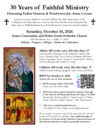
Centennial Celebration - Senior Storytelling Day
Saturday, October 3, Educational Building.
Below you’ll find some questions to help you with your interview. Keep it short and sweet. Memories should include special events and milestones, involving the whole community. Here are some ideas:
Name
Family Name
Year of Arrival
What are your first memories of 25th St. church, Park Blvd. church?
What are your fondest memories of priests, Sunday school, Greek school, picnics and church dances, etc.?
What would you like to see in the next 100 years for our church and community?
Greek Dance and Choral School
Schedule of practices for dance groups for Sunday, September 13th:
Ta Spyridonakia: 12:15 to 12:45 pm, Youth Room
Youth Choir: 12:30 to 1:10 pm; High School Girls Group: 1:10 to 1:25 pm, Choir Loft
Lunch break for Helios/Pelagos/Choir participants: 12:10 to 12:20 pm, Youth Room
Helios: 1:15 to 2:15 pm, Youth Room
Pelagos: 1:30 to 3:00 pm, Church Hall
Parea (High School Grads/Adults) dance group will meet on Sunday, September 20th at 6:00 pm in the Church Hall.
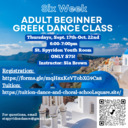
Beginner Adult Dance Classes (6-week program) will start on Thursday, September 17th at 6:00 pm. See the attached flyer for more information.
Registration forms for all classes are now available: https://forms.gle/mqH8xKeVTobXG9Ca8
See the attached flyer in the Inserts & Flyers section below.
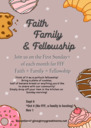
Fellowship and Coffee Hour
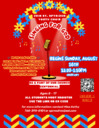
We invite you to consider offering a future Sunday Fellowship Hour with your family or friends by providing simple refreshments such as donuts or bagels, fruit, and juice. This is a meaningful way to honor a loved one or celebrate a special occasion. To sign up, please contact the Fellowship Coordinator, Olympia (Debbie) Kyriakidis at 619-507-6521 or[email protected].
Available Sundays:
September 27th
October 18th
With appreciation,
Anthousa Chapter of Philoptochos
See the attached flyer in the Inserts & Flyers section below.
Little Angels Playgroup
Next playgroup is September 16th from 9:45-11:00am. This is for babies and toddlers and parents! We play, sing songs, and do fun activities in our St. Spyridon Playroom (Lower Education Building). If you have any questions, please contact Julie Dennis, Youth Ministries Director, at [email protected].
HOPE and JOY
Holy Orthodox Primary Education (HOPE) and Junior Orthodox Youth (JOY) is returning to St. Spyridon! Our HOPE and JOY Youth Groups are for kids in grades Transitional Kindergarten through 5th grade. We will be kicking off the new school year with brand new programming from the Archdiocese! Save the date on September 26th for our HOPE and JOY kick-off activity! If you have a child in TK-5th grade and are not on our email list, email Julie Dennis, Youth Ministries Director, at [email protected].
Upcoming Memorials in September
9/20: Anastasios Miserlis - 40 days
9/20: Stamatela Avlonitou - 1 year
9/20: Christiana Harrison - 6 years
9/20: Reveka Kotselas - 2 years
9/20: Ioannis Kotselas - 20 years
9/20: Haralambos Panayiotou - 10 years
9/27: Marina Pegas - 1 year
9/27: Emmanuel Pegas - 4 years
Men’s Ministry
Meets on the 4th Thursday of each month in the Church Hall at 6:30 pm. We invite every man—young and old—to join us as we grow stronger in faith, love, and responsibility. During our meetings, we share specific Scripture and teachings from the Church Fathers, connecting the topics we discuss to how we should live in the world today. Our goal is to strengthen ourselves as: men, fathers, husbands, brothers, and, above all, how to better serve our Lord and our church community.
Each month, we average around 30 participants, with ages ranging from 18 to 90 - and we always welcome new faces. We look forward to seeing you at our next meeting! Questions? Contact: John Georges - jhgeorges58@gmail.com, text: 951-536-1217.
Young At Heart Seniors
Please consider sharing your cherished church memories for the YAH ministry’s sponsored video project in recognition of St. Spyridon’s Centennial Celebration. Video filming will be held on Saturday, October 3, from 10 am to 2 pm in the Hellenic Cultural Society Room (Lower Education Building). For more details, contact Connie Pappas at 484-553-8791.
Also, mark your calendar for our Temecula St. Nicholas Greek Festival trip on Saturday, October 17. Registration and the $10 fee must be paid by October 4th.
Cardiff Greek Festival 2026
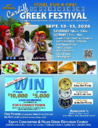
Tomorrow, Saturday, September 12th and Sunday, September 13th. Get ready for a weekend filled with authentic flavors, vibrant music, and unforgettable culture. For more information, please visit: https://www.cardiffgreekfestival.com/
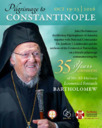
Pilgrimage to Constantinople - Save the Date
From Monday, October 19 through Friday, October 23, 2026, the faithful are invited to join His Eminence Archbishop Elpidophoros of America as he leads a historic pilgrimage commemorating the 35th anniversary of the enthronement of His All-Holiness Ecumenical Patriarch Bartholomew. Joined by National Commander Dr. Anthony J. Limberakis and the Archons of the Ecumenical Patriarchate. Plans for this special pilgrimage are currently being finalized, with additional details to be announced in the coming weeks.
See the attached flyer in the Inserts & Flyers section below.
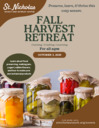
St. Nicholas Ranch Fall Harvest Retreat 2026
Ranch Fall Harvest Retreat - October 3, 2026: St. Nicholas Ranch & Retreat Center invites families, friends, and individuals of all ages to join us for a special day of hands-on learning, creativity, and fellowship as we celebrate the abundance of God’s creation. Participants will enjoy classes and demonstrations on making and canning jam, the science of yogurt making, growing and harvesting edible flowers, and creating beautiful botanical products, along with crafting, family games, and fellowship. Whether you are an experienced gardener or simply curious to learn something new, come enjoy a day of learning, creating, and celebrating the harvest in the beautiful Sierra Nevada foothills. Registration is now open and space is limited!Visitstnicholasranch.org and click on “Events” to register.
See the attached flyer in the Inserts & Flyers section below.
Orthodox Parish Leadership Monthly Webinar Series
Monday, September 21, 2026 • 5:00 p.m. Pacific. Conflict: Using the Right Approach and Strategy for Success. Conflict is an unavoidable part of life. This webinar equips participants with practical strategies for navigating conflict effectively while strengthening trust and collaboration across teams. Attendees will leave with the tools to manage conflict without personalizing it, apply practical conflict‑triage techniques, and approach difficult conversations with greater clarity and confidence.Register here: https://sanfran.goarch.org/events/orthodox-parish-leadership-2026-webinar-series-conflict-using-the-right-approach-and-strategy-for-success?date=2026-09-21
Strengthen Your Relationship withEight Dates
Join the Metropolis of San Francisco Family Wellness Ministry forEight Dates, a relationship series based on the book by Drs. John and Julie Gottman.
When:Thursdays at 6:30 PM (Pacific) via Zoom
Dates:September 10 – December 10.
Topics:Trust, Conflict, Intimacy, Family, Spirituality, and more!
See the attached flyer in the Inserts & Flyers section below.
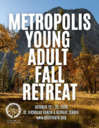
Metropolis Young Adult Fall Retreat: “Food as Medicine”
Registration is now open for the 2026 Metropolis Young Adult Fall Retreat, taking place October 22–25, 2026, at St. Nicholas Ranch & Retreat Center in Dunlap, California. Orthodox young adults ages 18–35 from all Orthodox jurisdictions—including those who are new to Orthodoxy or simply exploring the Orthodox faith—are warmly invited to join us for a weekend of prayer, fellowship, hiking, meaningful discussion, service, and spiritual renewal in the beautiful Sierra Nevada mountains. Register here: https://sanfran.goarch.org/events/2026-metropolis-young-adult-fall-retreat-food-as-medicine?date=2026-10-22
See the attached flyer in the Inserts & Flyers section below.
The Nursery and Cry Room
A nursery and cry room is available in the Narthex behind the candle box, offering a quiet space (with toys, books, changing table) for parents with young children. The room is equipped with both video and audio, allowing you to follow the Divine Liturgy. For assistance, please speak with a member of the Narthex Team.
Agape Meals
Our Philoptochos Agape Meal program provides meals to our St. Spyridon community members who may need help with a meal(s) during a time of need. If you are interested in preparing a home-cooked meal for our parishioners, please reach out to Marian Dougenis at[email protected] or mobile 619-520-3660. Thank you!
Your Legacy and Your Church
...to whom much is given; from them much more is required (Luke 12:48).
Please remember to include your Saint Spyridon parish in your estate plan and bequest.
Fourth Orthros Gospel
The Reading is from Luke 24:1-12
On the first day of the week at early dawn, the women went to the tomb, taking spices, which they had prepared. And they found the stone rolled away from the tomb, but when they went in they did not find the body of the Lord Jesus. While they were perplexed about this, behold, two men stood by them in dazzling apparel; and as they were frightened and bowed their faces to the ground, the men said to them, "Why do you seek the living among the dead? He is not here, but has risen. Remember how He told you, while He was still in Galilee, that the Son of Man must be delivered into the hands of sinful men, and be crucified, and on the third day rise." And they remembered His words and returning from the tomb they told all this to the eleven and to all the rest. Now it was Mary Magdalene and Joanna and Mary the mother of James and the other women with them who told this to the Apostles; but these words seemed to them an idle tale, and they did not believe them. But Peter rose and ran to the tomb; stooping and looking in, he saw the linen cloths by themselves; and he went home wondering at what had happened.
Epistle Reading
Prokeimenon. Plagal Second Mode. Psalm 27.9,1. O Lord, save your people and bless your inheritance.
Verse: To you, O Lord, I have cried, O my God.
The reading is from St. Paul's Letter to the Galatians 6:11-18.
Brethren, see with what large letters I am writing to you with my own hand. It is those who want to make a good showing in the flesh that would compel you to be circumcised, and only in order that they may not be persecuted for the cross of Christ. For even those who receive circumcision do not themselves keep the law, but they desire to have you circumcised that they may glory in your flesh. But far be it from me to glory except in the cross of our Lord Jesus Christ, by which the world has been crucified to me, and I to the world. For neither circumcision counts for anything, nor uncircumcision, but a new creation. Peace and mercy be upon all who walk by this rule, upon the Israel of God. Henceforth let no man trouble me; for I bear on my body the marks of Jesus. The grace of our Lord Jesus Christ be with your spirit, brethren. Amen.
Gospel Reading
Sunday before Holy Cross
The Reading is from John 3:13-17
The Lord said, "No one has ascended into heaven but he who descended from heaven, the Son of man who is in heaven. And as Moses lifted up the serpent in the wilderness, so must the Son of man be lifted up, that whoever believes in him may have eternal life.
"For God so loved the world that he gave his only Son, that whoever believes in him should not perish but have eternal life. For God sent the Son into the world, not to condemn the world, but that the world might be saved through him."
Diakonia Newsletter
Read the latest Diakonia Newsletter for this Sunday
Our Redeemer and Maker, Who was Son of God before the ages, became Son of Man at the end of ages. Thus the One Who, through the power of His divinity, had created us to enjoy the happiness of everlasting life, might Himself restore us, through the weakness of our humanity, to recover the life we had lost.
St. Bede the Venerable
Homilies on the Gospels, 2.18. 7th Century. Taken from: Ancient Christian Commentary on Scripture. Vol: John 1-10. Intervarsity Press, 2006, p. 126.
For since Nicodemus had said, "We know that Thou art a teacher come from God," on this very point He sets him right, all but saying, "Think Me not a teacher in such manner as were the many of the prophets who were of earth, for I have come from heaven (but) now. None of the prophets hath ascended up thither, but I dwell there."
St. John Chrysostom
Homily 27 on John 3, 4th Century
Archdiocese News
St. Nicholas Church and National Shrine is a bridge from tragedy to hope | Op-Ed
09/10/2026
“Agape mou” … my love.
Those are the words my brother John would whisper whenever he hugged me. It has been more than two decades since I last heard them.
John was killed on September 11, 2001, while working on the 104th floor of the World Trade Center. Like so many families, ours was forever changed. I miss him every day.
But through that loss, I have also found comfort, faith, and hope at St. Nicholas Greek Orthodox Church and National Shrine. The rebuilding of St. Nicholas has been, for me, a bridge from tragedy to hope. This ground is sacred. It is where my brother and thousands of other innocent souls were lost, including the site of the original St. Nicholas Church, where John would often stop before or after work to light a candle, say a prayer, attend a service—or perhaps meet a pretty girl.
John was known as “Johnny Bodacious”—adventurous, funny, fearless, and always the life of the party. He loved to dance, and he had a larger-than-life personality. But beneath that joyful spirit was a deep faith and an extraordinary light that I was blessed to experience for 31 years.
Although I can no longer hug my brother, I still feel his presence at St. Nicholas—in the prayers offered each day, in the candles that are lit, and in the people who enter carrying burdens and leave with renewed hope.
September 11th Memorial Service at St. Nicholas Greek Orthodox Church and National Shrine, 2024. Photo by Orthodox Observer/Brittainy Newman
What was destroyed was resurrected. What represented grief became a source of healing. And St. Nicholas has become part of some of my happiest memories. In 2023, I had my wedding service there. In the very place that once represented unimaginable loss, God blessed me with new life, new joy, and a new beginning.
That is the power of St. Nicholas. It is a Greek Orthodox church, but it is also a National Shrine open to everyone—people of every faith, people of no faith, those carrying grief, those seeking peace, and anyone looking for a place to pray, reflect, heal, or simply breathe. As our nation commemorates the 25th anniversary of September 11th, St. Nicholas carries an especially powerful message. It reminds us that even after our darkest days, we can rise with faith, courage, and hope. Faith can overcome fear. Light can overcome darkness. Love can overcome hate. Every day, people from across our nation and around the world walk through the doors of St. Nicholas and discover that sense of peace and hope. Since opening in December 2022, over 650,000 visitors have had that experience, made possible because of faithful supporters who believe in its mission. That is why I am asking you to become a National Supporter of St. Nicholas. Your generosity will help preserve a spiritual home for worshippers, a place of remembrance for families like mine, and mission driven ministries for the community at large.
Become a National Supporter of St. Nicholas today with your $100 gift. Please click here for more information. Let’s keep the light of St. Nicholas shining brightly in memory of loved ones, for the future of our nation, and the world.
Anthoula and John Katsimatides. Photo courtesy of Anthoula KatsimatidesAnthoula and John Katsimatides. Photo courtesy of Anthoula Katsimatides
“Agape mou” … my love. Those are the words my brother John would whisper whenever he hugged me. It has been more than two decades since I last heard them. John was killed on September […]
The art and iconography of Mount Athos comes to Cambridge, UK
09/10/2026
Sacred Orthodox art and iconography will be under the spotlight in Cambridge this October at a conference focusing on Greece’s Holy Mountain, Mount Athos. Organised by the UK-based charity, the Friends of Mount Athos (FoMA), the conference features a distinguished panel of experts on such themes as monumental, panel and icon painting in the past and present, the theology of the icon, and the influence of sacred art on the world today.
Held across the weekend of 16-18 October 2026 at Madingley Conference Centre, the conference will feature eight illustrated sessions aimed at a non-specialist audience, including a lecture and practical icon painting demonstration by the celebrated British iconographer and former Athonite Aidan Hart.
Speakers include the renowned Mount Athos iconographer and monk, Father Loukas of Xenophontas (online presentation); Markos Kampanis who currently serves as curator of the Mount Athos Art Archives of the monastery of Simonopetra; and Thanasis Semoglou (online presentation), a member of Greece’s UNESCO Memory of the World Committee, Associate President of the European Centre of Byzantine Monuments and a member of the Committee for the Preservation of the Athonite Heritage.
Joining the conference from the UK are Professor Marcus Plested, the 1643 Chair of Divinity at the University of St Andrews; and distinguished historian, Robin Cormack, Emeritus Professor in the History of Art at the Courtauld Institute of Art, University of London.
The conference is being co-chaired by the V. Rev. Archimandrite Maximos Constas, Distinguished Professor of the Humanities at the University of Austin, Texas, who himself was for many years a monk on Mount Athos; and author and publisher, Dr. Graham Speake, a founding member and former Chairman of FoMA.
Dr. Graham Speake said, “We’re delighted to be able to host such a distinguished and diverse set of speakers from Greece and Mount Athos, the US and the UK. We feel this will be a unique opportunity to learn not just about the age-old practice of icon writingbut the theological significance of Orthodox holy art and its influence on the wider world.”
Sacred Orthodox art and iconography will be under the spotlight in Cambridge this October at a conference focusing on Greece’s Holy Mountain, Mount Athos. Organised by the UK-based charity, the Friends of Mount Athos (FoMA), […]
Is ecumenism worthwhile? A seminarian’s reflection on NATI-RETI | Op-Ed
09/09/2026
Many Orthodox Christians are wary of ecumenical spaces. Some believe ecumenism is a great heresy, erroneously equating it with religious syncretism. Still others believe the project is completely pointless. In the early years of the ecumenical movement, many worked in joyful anticipation that, by God’s grace, the numerous fractures and schisms in Christianity might finally be healed. Now, however, the dream of full eucharistic communion between disparate Christian communities seems increasingly unrealizable. The upshot is that many Orthodox Christians struggle to see the value of ecumenism. Many ask, ‘Is ecumenism worthwhile?’
This question was at the forefront of my mind when Fr. Bartholomew Mercado, the chaplain at Hellenic College Holy Cross (HCHC), encouraged me to participate in a new ecumenical initiative. A program co-sponsored by the World Council of Churches, the Canadian Council of Churches, and the National Council of the Churches of Christ in the USA. The initiative I’m referring to is the North American-Turtle Island Regional Ecumenical Theological Institute (or NATI-RETI). The ambitious goal of this program was as follows. From August 3rd–16th, 2026 NATI-RETI would gather together a cohort of emerging theologians from various Christian communities in the United States and Canada. Phase one would take place in Detroit and phase two in Toronto. The participants would live in a tight-knit community for two weeks and undergo an intense, immersive study program focused on the overarching question, ‘Where Now for Visible Justice?’
I elected to attend NATI-RETI because I was intrigued by both the unique format of the program and the timely topics it would address. Importantly, I also hoped I might discover an answer to the vexing question posed above: ‘Is ecumenism worthwhile?’
After spending fourteen days fully immersed in an ecumenical space, rigorously exploring the most pressing social issues of our time, I have arrived at the following conclusion: ecumenism is, indeed, a worthwhile and absolutely vital endeavor. To understand why I think this, allow me to summarize some of my experiences at NATI-RETI.
During the training, we explored six pressing issues facing Christians living in North America: Climate Justice, Secularism and Laicity, Racism and Anti-Racism, Interfaith Dialogue, Solidarity with Indigenous Communities, and Wealth Disparity and Poverty. We explored these topics in a variety of creative ways. Numerous hours were dedicated to reading and discussing scholarly articles and books. Breaking up into smaller study groups, we analysed both Christian and non-Christian responses to these problems. We also attended multiple plenary sessions, led by leading academics.
Additionally, we participated in special exercises and site visits to supplement the academic activities. Notably, we visited the Freedom Dreams EcoVillage in Detroit and discovered how a small group of dedicated volunteers are transforming abandoned lots and piles of rubble into vibrant community gardens. We visited several historically significant destinations associated with the Underground Railroad, such as the Second Baptist Church of Detroit and Sandwich Baptist Church in Windsor and learned about their contribution to abolitionism. We visited the Toronto Bahá’i Center and engaged in complex interfaith dialogue. We walked through a former Mohawk residential school, now turned into a museum, and read first-hand accounts of survivors who had been ripped out of their homes and forced to undergo the most dehumanizing abuses and tortures imaginable.
These experiences helped me to identify four reasons why it’s vital for Orthodox Christians to remain involved in ecumenical work. First, we can learn a lot in ecumenical spaces. I learned how a small group of passionate Christians can slowly resurrect a dying community by teaching its young people carpentry and gardening skills and lovingly using these skills to transform a desolate neighborhood into a beautiful oasis. Imagine if Orthodox parishes invested in their communities in this way? I engaged in an in-depth discussion with members of the Bahá’i community and learned many practical ways we might better foster a sense of belonging in our churches. I learned from the lived experiences and perspectives of Indigenous people who continue to exemplify compassion, hope, and love despite the horrors of colonialism.
Second, we can share our rich theological and spiritual heritage in ecumenical spaces. Despite the rising number of inquirers flocking to our parishes, most people are still unfamiliar with Orthodoxy. At NATI-RETI, I got the chance to discuss the cosmological theology of St. Maximus the Confessor, the ecotheology of His All-Holiness Ecumenical Patriarch Bartholomew, and the inspiring (noncolonial) missionary efforts of St. Herman of Alaska. I was also able to introduce the members of my cohort to our spiritual and liturgical tradition by reading the Trisagian prayers in Greek, and teaching everyone how to sing a Byzantine hymn. Virtually none of my cohort had encountered Orthodoxy before meeting me.
Third, we can model Christian love by participating in ecumenical spaces. In an increasingly polarized world filled with profound injustices, the Church should be at the front lines, teaching society how to show love and respect to those with whom we disagree. Actions, as they say, speak louder than words. We can preach to others, imploring them to be quick to listen and slow to speak. But it’s far more effective to exemplify this behavior. Orthodox Christians can model this by personally connecting with and building genuine friendships with people of different faith backgrounds.
Finally, we can partner with non-Orthodox people to address societal problems. We shall never achieve visible justice without working alongside others. We may not agree with our neighbors on essential matters, such as church polity or biblical interpretation or dogma. But we can still work together to feed and cloth the homeless, to be a voice for the marginalized and persecuted, and to stand up to bigotry and hatred in all its nefarious forms.
NATI-RETI showed me that ecumenism is most certainly worthwhile.
Many Orthodox Christians are wary of ecumenical spaces. Some believe ecumenism is a great heresy, erroneously equating it with religious syncretism. Still others believe the project is completely pointless. In the early years of the […]
Moscow Patriarchate incorporates Russian state’s military narrative into religious life
09/09/2026
In a recent article for Carnegie Politika, historian Alexander Zanemonets examines the increasingly close relationship between the Russian Orthodox Church and the Kremlin’s war effort in Ukraine. He argues that the Moscow Patriarchate has progressively incorporated the Russian state’s military and patriotic narrative into its religious life, weakening the distinction between the Church’s spiritual mission and the political objectives of the state.
Zanemonets focuses on the recent uncovering of the relics of St. Dmitry Donskoy, the medieval prince celebrated for his military victories, and the decision to send a fragment of those relics to Russian forces fighting in Ukraine. He sees the episode as part of a broader effort to deploy Orthodox saints, relics, icons, prayers, and clergy in support of the war and to portray Russia’s military campaign as a defense of the homeland.
The article places this practice within a longer Russian tradition of using historical and religious figures as symbols of national struggle. Zanemonets draws parallels with the Soviet promotion of St. Alexander Nevsky during World War II and notes that Dmitry Donskoy himself became associated with wartime patriotism when a Soviet tank column financed by the Moscow Patriarchate was named after him in 1944.
The larger issue, according to Zanemonets, is the diminishing capacity of the Russian Orthodox Church to speak independently of state power. He argues that a Church should be able to remind political authorities of Christian moral principles—including the protection of civilians and prisoners, the rejection of looting and cruelty, and Christ’s call to peacemaking—even during wartime. Instead, he contends, the Moscow Patriarchate has increasingly reinforced the Kremlin’s interpretation of Russia, its history, and the war.
Zanemonets concludes that this convergence carries consequences for the Church itself. If its public message becomes largely indistinguishable from the patriotism and historical narrative promoted by the Russian state, he asks what distinctive spiritual role the Church continues to offer Russian society.
In a recent article for Carnegie Politika, historian Alexander Zanemonets examines the increasingly close relationship between the Russian Orthodox Church and the Kremlin’s war effort in Ukraine. He argues that the Moscow Patriarchate has progressively […]
Opinion | Carrying the Clergy-Laity Congress forward
09/09/2026
Several months ago, I wrote on this site about the vision for the 2026 Clergy-Laity Congress and our hope that this year’s gathering would be different. Now, having returned from Cleveland earlier this summer, I believe we can say with confidence that something important happened there. More than 2,000 faithful from across the Greek Orthodox Archdiocese of America came together under the theme “Rise & Build,”inspired by Nehemiah’s words. They came together to pray, to learn, to listen, to deliberate, to reconnect with old friends, to make new ones, and, most importantly, to strengthen the Church they love.
The success of this Congress was not simply measured by attendance or by the number of sessions offered. Its success was found in a renewed understanding of what the Clergy-Laity Congress can actually be. Certainly, the Congress has a responsibility to conduct the business of our Archdiocese. Budgets must be reviewed, resolutions must be considered, reports must be presented, and decisions must be made. That administrative responsibility is important and should never be diminished. But the Church is so much more than its business.
The Clergy-Laity Congress should be a gathering of the πλήρωμα τῆς Ἐκκλησίας, the fullness of the Church.
His Eminence Archbishop Elpidophoros of America speaks at the 48th Biennial Clergy-Laity Congress in Cleveland, Ohio. Photo by Orthodox Observer/Brittainy Newman
That means creating a place where the clergy and laity who make up our parishes can come together not only to govern the national Church, but to learn how to better serve the local Church. It means recognizing that the people sitting in those seats are not simply delegates with votes. They are Sunday School teachers, parish council members, youth workers, musicians, stewardship leaders, educators, parents, young adults, ministry leaders, priests, presvyteres, and volunteers who go home and make the life of our parishes possible.
Cleveland showed us the tremendous potential that exists when we bring those people together.
Oun National Ministries were not simply invited to present their work or display their resources. They were given a central role in educating and equipping the people of our parishes. The Ministry Pavilion brought Archdiocesan departments, institutions, partners, and organizations together with the people they serve. But even more importantly, the Congress offered specialized educational opportunities, including dedicated tracks for Sunday School teachers and church musicians. These were not simply opportunities to hear about what someone else is doing. They were opportunities to learn, to develop skills, to exchange ideas, and to take something practical home.
That is an important distinction.
Our goal should not simply be to tell our parishes what the Archdiocese is doing. Our goal should be to help our parishes do more.
A Sunday School teacher should be able to return home with a new idea that can make a difference in the classroom. A church musician should return with something new to bring to the worshipping life of the community. A youth worker should discover a resource or a relationship that can help engage young people. A parish leader should encounter another parish that has found a solution to a challenge they are facing. A priest should be able to return home renewed by the fellowship and experience of his brother clergy.
When that happens, the Clergy-Laity Congress becomes more than an event. It becomes an investment in every parish represented.
This is what I believe Cleveland demonstrated so clearly: the Congress of the future must be both a place where we strengthen our administrative unity and a place where we strengthen the people who make up our parishes. We need both. We need the serious work of governance, and we need the practical work of ministry. We need to make decisions together, but we also need to learn together. We need to deliberate together, but we also need to grow together.
Hierarchs at the Divine Liturgy during the 48th Biennial Clergy-Laity Congress in Cleveland, Ohio. Photo by Orthodox Observer/Brittainy Newman
The new plenary model was part of that same vision. By moving the reports of Archdiocesan departments, ministries, institutions, and organizations into digital formats, we created an opportunity for those ministries to tell their stories more fully, using video and other resources, while allowing the Plenary Session to concentrate on the business that actually required the attention of the Congress. Participants could review reports and presentations before, during, and after the Congress, rather than trying to absorb them in a few minutes from a podium.
The same philosophy guided the new approach to the financial process. Before coming to Cleveland, clergy and lay leaders had opportunities to review financial information through online presentations and participate in question-and-answer sessions. Full financial statements, proposed budgets, and other materials were made available for review. Then, at the Congress, the Finance Committee presented its report and the delegates had the opportunity for discussion and deliberation before voting.
This is what greater transparency should look like. It is not simply about putting documents online. It is about giving people the opportunity to understand, ask questions, participate, and ultimately take responsibility for the decisions of their Church.
The CARA Survey was an important part of this process as well. Thousands of faithful throughout our Archdiocese took the time to tell us what they see, what they need, and what they believe should be our priorities. Those voices helped inform the direction of the proposed national budget. The result is a stronger connection between what our people are telling us in our parishes and the priorities we establish at the national level.
That is conciliar life.
We listen to one another. We learn from one another. We disagree at times, but we remain together. We deliberate. We pray. And then we move forward together.
Not everyone saw what happened in Cleveland that way. In the days surrounding the Congress, some commentary suggested that little of substance took place. It is difficult, however, to understand how one could reach that conclusion without actually being there. The Congress was not simply something to observe from a distance. It was something to experience.
More than 2,000 people traveled to Cleveland. Hundreds of volunteers gave their time. Clergy and lay leaders spent hours in workshops and discussions. Ministries shared their resources. Parish leaders exchanged ideas. Delegates participated in the formal work of the Archdiocese. Priests prayed together. Families gathered. Old friendships were renewed and new relationships were formed.
It is easy to criticize something from the outside. It is much harder to give of your time, to sit in a room with people who may have different opinions, to listen to one another, to find common ground, and to do the sometimes difficult work of building up the Church.
It is easy to throw stones from the outside; it is much more challenging to pick one up and help build. That is what the people who came to Cleveland chose to do.
And perhaps that is the greatest lesson of this year’s Congress. The real measure of its success will not ultimately be found in what happened during those three days in Cleveland. It will be found in what happens afterward.
When a parish council uses something it learned in a workshop, the Congress continues.
When a Sunday School teacher starts teaching from the new curriculum, the Congress continues.
When a youth ministry launches a new initiative because of an idea shared in Cleveland, the Congress continues.
When a priest calls another priest for advice because of a relationship formed at the Congress, the Congress continues.
When a parish becomes stronger, more welcoming, more engaged, and more capable of sharing the Gospel because someone came home from Cleveland with a new tool or a renewed sense of purpose, then the Congress has accomplished what it was intended to accomplish.
That is why I believe the 2026 Clergy-Laity Congress was not simply one of our most successful Congresses. It provided a model for what our Congresses can become moving forward.
We should continue to conduct the important business of our national Church. We should continue to strengthen our administrative unity, improve our transparency, exercise responsible stewardship, and make decisions together. But we should also recognize the extraordinary opportunity we have when thousands of faithful people gather in one place.
Those days are precious.
We have to use them to educate. To equip. To inspire. To connect. To build relationships. To share resources. To strengthen ministries. To give our people practical tools they can take home and use immediately in the life of their parish.
Because the Clergy-Laity Congress is not simply a meeting of representatives.
It is the gathering of the Church, it is the πλήρωμα τῆς Ἐκκλησίας coming together.
And when the fullness of the Church gathers, we should leave better equipped to serve the Church we love.
Cleveland reminded us that we are capable of doing this. It showed us that our clergy and laity want to learn. They want to participate. They want to serve. They want their parishes to thrive. And they want an Archdiocese that supports them in that work.
So now, the question is not whether we can do it again.
The question is how much further we can take it.
The work of Cleveland does not end with the closing of the Congress. It begins when everyone goes home.
The tools are in our hands. The relationships have been formed. The ideas have been shared. The challenge has been placed before us.
Now we have to build.
Together.
Rise & Build.
This article is published as part of the America at 250: Orthodoxy in a New Homeland media initiative co-organized by the Orthodox Observer and the Department of Inter-Orthodox, Ecumenical, and Interfaith Relations of the Greek Orthodox Archdiocese of America to honor the contributions and experience of Orthodox Christianity in America and celebrate 250th anniversary of America’s founding.
Several months ago, I wrote on this site about the vision for the 2026 Clergy-Laity Congress and our hope that this year’s gathering would be different. Now, having returned from Cleveland earlier this summer, I […]
Archbishop Elpidophoros gives benediction at Port Authority Memorial dedication
09/08/2026
As the nation begins a week of remembrance marking the 25th anniversary of the September 11, 2001 terrorist attacks, His Eminence Archbishop Elpidophoros of America joined public officials, Port Authority police officers, and community leaders for the dedication of the new Port Authority Memorial in Lower Manhattan. The memorial stands beside the St. Nicholas Greek Orthodox Church and National Shrine, overlooking the 9/11 Memorial at Ground Zero.
Among those attending the ceremony were New York Governor Kathy Hochul, Port Authority Executive Director Kathryn Garcia, Port Authority Board Chairman Kevin O’Toole, Congressman Dan Goldman, State Senator Brian Kavanagh, Assemblymember Grace Lee, Manhattan Borough President Brad Hoylman-Sigal, World Trade Center Memorial Fund President Paul Iannacone, as well as current and retired Port Authority police officers, family members, friends, and supporters.
His Eminence Archbishop Elpidophoros joined New York Gov. Kathy Hochul in the dedication of the Port Authority Memorial at Saint Nicholas Shrine. (Photo by Orthodox Observer)
The ceremony opened with the Presentation of Colors and the singing of the National Anthem, followed by remarks from civic and community leaders. Several speakers reflected on the symbolic location of the memorial, situated beside St. Nicholas National Shrine, the only house of worship destroyed in the attacks of September 11, and overlooking the footprints of the former World Trade Center.
Speaking before hundreds gathered beneath a clear September sky, Archbishop Elpidophoros reflected on the lives lost that day and the enduring responsibility to honor their memory. He emphasized the courage of those who placed the safety of others above their own during the attacks and acknowledged the families who have carried the weight of loss for a quarter century.
At the dedication, speakers drew on the memory of the first responders who lost their lives on 9/11, as well as the 1993 World Trade Center Bombings. (Photo by Orthodox Observer/Tom Galanis)
“It is deeply meaningful that we gather here beside our Saint Nicholas National Shrine,” the Archbishop said. “This little church was itself lost on September 11. Today, it stands again overlooking Ground Zero, not as though the tragedy never happened, but precisely because it did.”
Drawing a connection between the rebuilding of St. Nicholas and the resilience of the city and nation, Archbishop Elpidophoros described the shrine as a powerful symbol of hope born from tragedy.
“Saint Nicholas stands here as a witness that destruction need not have the final word; that from the deepest wounds can come renewed purpose; and that remembrance, joined with faith, can become hope,” he said. “As we dedicate this memorial and prepare to mark twenty-five years since that terrible day, we remember the sacrifice of those who ran toward danger to save others, the lives that were forever changed, and the enduring spirit that continues to unite us. It is in that hope, and in that spirit of remembrance, that we now pray.”
The new memorial will serve as a permanent tribute to the Port Authority police officers and all those whose lives were affected by the attacks, ensuring that their sacrifice and service remain part of the nation’s collective memory for generations to come.
As the nation begins a week of remembrance marking the 25th anniversary of the September 11, 2001 terrorist attacks, His Eminence Archbishop Elpidophoros of America joined public officials, Port Authority police officers, and community leaders […]
Resurrectional Apolytikion in the Plagal Second Mode
The angelic powers appeared at your tomb, and those guarding it became as dead. Mary stood at your grave seeking your pure body. But you stripped the power of Hades, yet were not touched by corruption. You met the virgin and granted her life. O Lord, who
Apolytikion for Forefeast of the Exaltation in the Second Mode
We offer Thee in mediation the life-giving Cross which, of Thy goodness, Thou hast given unto us, the unworthy, O Lord. Save Thy hierarchs and Thy flock, and grant Thou peace through the Theotokos, O only friend of man.
Apolytikion for Temple of the Resurrection in the Fourth Mode
Thou hast shown the earthly beauty of the holy tabernacle of Thy glory to be like unto the splendour of the heavenly firmament, O Lord. Strengthen it for ever and ever, and accept our prayers which we unceasingly offer therein unto Thee, through the Theotokos, O Thou Who art the Life and Resurrection of all.
Seasonal Kontakion in the Fourth Mode
The Church is shown to be a many-lighted heaven that doth shine a guiding light upon all them that do believe; wherein while standing we cry aloud: Do Thou Thyself now establish this house, O Lord.
Saints and Feasts
September 13
Cornelius the Centurion & Martyr
Saint Cornelius was a Roman by race, a pagan by religion, a centurion in rank, an inhabitant of Caesarea of Palestine, a man pious and God-fearing who gave many alms to the people and prayed continually unto God. In accordance with an angelic vision granted to him, he sent to Joppa that they might bring the Apostle Peter. Saint Peter catechized him in the Faith of Christ and baptized all his household (Acts, ch.10). This became the beginning and the first fruits of the calling of the nations. It is said that, after this, he became a bishop, as some say, of Caesarea; but others say of Scepsis, which is not far from Troas; and that he died as a martyr.
September 14
The Elevation of the Venerable and Life-Giving Cross
Saint Helen, the mother of Saint Constantine the Great, when she was already advanced in years, undertook, in her great piety, the hardships of a journey to Jerusalem in search of the cross, about the year 325. A temple to Aphrodite had been raised up by the Emperor Hadrian upon Golgotha, to defile and cover with oblivion the place where the saving Passion had been suffered. The venerable Helen had the statue of Aphrodite destroyed, and the earth removed, revealing the Tomb of our Lord, and three crosses. Of these, it was believed that one must be that of our Lord, the other two of the thieves crucified with Him; but Saint Helen was at a loss which one might be the Wood of our salvation. At the inspiration of Saint Macarius, Archbishop of Jerusalem, a lady of Jerusalem, who was already at the point of death from a certain disease, was brought to touch the crosses, and as soon as she came near to the Cross of our Lord, she was made perfectly whole. Consequently, the precious Cross was lifted on high by Archbishop Macarius of Jerusalem; as he stood on the ambo, and when the people beheld it, they cried out, "Lord have mercy." It should be noted that after its discovery, a portion of the venerable Cross was taken to Constantinople as a blessing. The rest was left in Jerusalem in the magnificent church built by Saint Helen, until the year 614. At that time, the Persians plundered Palestine and took the Cross to their own country (see Jan. 22, Saint Anastasius the Persian). Late, in the year 628, Emperor Heraclius set out on a military campaign, retrieved the Cross, and after bringing it to Constantinople, himself escorted it back to Jerusalem, where he restored it to its place.
Rest from labour. A Fast is observed today, whatever day of the week it may be.
September 15
Nikitas the Great Martyr
This Saint was of high birth among the Goths beyond the Danube River. He was taken by Athanaric, pagan ruler of the Goths, and after being tortured, was burned to death for his confession of Christ. According to some, this took place during the reign of Saint Constantine the Great; according to others, under the Emperor Gratian.
September 16
Euphemia the Great Martyr
Saint Euphemia was from Chalcedon and lived in virginity. According to some, she suffered martyrdom during the reign of Diocletian, in 303; according to others, in 307. Her sacred relics are preserved in the Patriarchate in Constantinople.
September 17
Sophia & her three daughters: Faith, Hope, and Love
These Saints were from Italy and contested for the Faith about the year 126, during the reign of the Emperor Hadrian. Faith was twelve years old, Hope, ten, and Love, nine; each was tormented and then beheaded, from the eldest to the youngest. Their mother Sophia mourned at their grave for three days, where she also fell asleep in peace; because of her courageous endurance in the face of her daughters' sufferings, she is also counted a martyr. The name Sophia means "wisdom" in Greek; as for her daughters' names, Faith, Hope, and Love (Charity), they are Pistis, Elpis, and Agape in Greek, and Vera, Nadezhda, and Lyubov in Russian.
September 18
Eumenius the Wonderworker, Bishop of Gortynia
This Saint took up the monastic life from his youth, and later became Bishop of Gortynia in Crete. He travelled to Rome, and to Thebes in Upper Egypt, where through his prayers he ended a drought; there also, after working many miracles, he reposed in deep old age. His holy relics were returned to Gortynia and buried at the place called Raxos.
September 19
Trophimos, Sabbatios, & Dorymedon the Martyrs
In 278, during the reign of Probus, Saints Trophimus and Sabbatius came to Antioch, and seeing the city celebrating the festival of Apollo at Daphne lamented the blindness of the people, and presented themselves as Christians to Atticus the Governor. Saint Trophimus was stripped of his clothing, and was stretched out and beaten until the earth was red with his blood. Then he was hung up, scraped on his sides, and imprisoned in torments. Saint Sabbatius was tortured so savagely that he gave up his spirit in his sufferings. Trophimus was sent to Synnada, wearing iron shoes fitted with sharp iron nails within; he was further tormented without mercy, then cast into prison. Dorymedon, a counsellor, and a pagan, came to the prison and cared for Trophimus. When a certain feast came, Dorymedon was asked why he did not sacrifice to the idols; he proclaimed himself a Christian, for which he was imprisoned, pierced with heated spits, frightfully punished, and finally beheaded with Saint Trophimus.