August 09
 ☰
☰
Holy Trinity
Publish Date: 2026-08-09
Bulletin Contents
Hymns of the Day
Gospel and Epistle Readings
Saints and Feasts
HTGOC Tulsa Calendar
Community News and Info
Diakonia Newsletter

Holy Trinity
General Information
- Phone:
- (918) 583-2082
- Fax:
- na
- Street Address:
- 1222 S. Guthrie Ave.
- Tulsa, OK 74119
Contact Information
Services Schedule
Saturday Evening Vespers: 5:30 pm
Sunday Morning Orthros 8:30 AM
Sunday Morning Divine Liturgy 9:30 AM
Past Bulletins
- Publish Date:
- 2026-09-27
- Publish Date:
- 2026-09-20
- Publish Date:
- 2026-09-13
- Publish Date:
- 2026-08-30
- Publish Date:
- 2026-08-23
- Publish Date:
- 2026-08-16
Hymns of the Day
Resurrectional Apolytikion in the First Tone
Although the stone was sealed by the Jews, and the soldiers guarded Your most pure body, You arose on the third day, O Savior, giving life to the world. For this reason, the heavenly powers cried out to you, O Giver of Life: Glory to Your resurrection, O Christ! Glory to Your kingdom! Glory to Your dispensation, only Lover of Mankind!
Τοῦ λίθου σφραγισθέντος ὑπὸ τῶν Ἰουδαίων, καὶ στρατιωτῶν φυλασσόντων τὸ ἄχραντόν σου σῶμα, ἀνέστης τριήμερος Σωτήρ, δωρούμενος τῷ κόσμῳ τὴν ζωήν. Διὰ τοῦτο αἱ Δυνάμεις τῶν οὐρανῶν ἐβόων σοι Ζωοδότα· Δόξα τῇ ἀναστάσει σου Χριστέ, δόξα τῇ Βασιλείᾳ σου, δόξα τῇ οἰκονομίᾳ σου, μόνε Φιλάνθρωπε.
Apolytikion for Afterfeast of the Transfiguration in the Grave Tone
You were transfigured on the Mount, Christ God revealing Your glory to Your disciples, insofar as they could comprehend. Illuminate us sinners also with Your everlasting light, through the intercessions of the Theotokos. Giver of light, glory to You.
Μετεμορθώθης εν τώ όρει Χριστέ ο Θεός, δείξας τοίς Μαθηταίς σου τήν δόξαν σου, καθώς ήδυναντο, Λάμψον καί ημίν τοίς αμαρτωλοίς, τό φώς σου τό αϊδιον, πρεσβείαις τής Θεοτόκου, φωτοδότα δόξα σοι.
Seasonal Kontakion in the Grave Tone
You were transfigured upon the mount, O Christ our God, and Your disciples, in so far as they could bear, beheld Your glory. Thus, when they see You crucified, they may understand Your voluntary passion, and proclaim to the world that You are truly the effulgence of the Father.
Επί τού όρους μετεμορφώθης, καί ως εχώρουν οι Μαθηταί σου τήν δόξαν σου, Χριστέ ο Θεός εθεάσαντο, ίνα όταν σε ίδωσι σταυρούμενον, τό μέν πάθος νοήσωσιν εκούσιον, τώ δέ κόσμω κηρύξωσιν, ότι σύ υπάρχεις αληθώς, τού Πατρός τό απαύγασμα.
The translations of hymns are under copyright and used by permission. All rights reserved. These works may not be further reproduced, in print or on other websites or in any other form, without the prior written authorization of the copyright holder:
Gospel and Epistle Readings
Matins Gospel Reading
Tenth Orthros Gospel
The Reading is from John 21:1-14
At that time, Jesus revealed Himself again to the disciples by the Sea of Tiberias; and He revealed Himself in this way. Simon Peter, Thomas, called the Twin, Nathanael of Cana in Galilee, the sons of Zebedee, and two others of His disciples were together. Simon Peter said to them, "I am going fishing." They said to him, "We will go with you." They went out and got into the boat, but that night they caught nothing. Just as day was breaking, Jesus stood on the beach, yet the disciples did not know that it was Jesus. Jesus said to them, "Children, have you any fish?" They answered him, "No." He said to them, "Cast the net on the right side of the boat, and you will find some." So they cast it, and now they were not able to haul it in, for the quantity of fish. That disciple whom Jesus loved said to Peter, "It is the Lord!" When Simon Peter heard that it was the Lord, he put on his clothes, for he was stripped for work, and sprang into the sea. But the other disciples came in the boat, dragging the net full of fish, for they were not far from the land, but about a hundred yards off. When they got out on land, they saw a charcoal fire there with fish lying on it, and bread. Jesus said to them, "Bring some of the fish that you have just caught." So Simon Peter went aboard and hauled the net ashore, full of large fish, a hundred and fifty-three of them; and although there were so many, the net was not torn. Jesus said to them, "Come and have breakfast." Now none of the disciples dared ask Him, "Who are you?" They knew it was the Lord. Jesus came and took the bread and gave it to them, and so with the fish. This was now the third time that Jesus was revealed to the disciples after He was raised from the dead. .
Tenth Orthros Gospel
Κατὰ Ἰωάννην 21:1-14
Τῷ καιρῷ ἐκείνῳ, ἐφανέρωσεν ἑαυτὸν ὁ Ἰησοῦς τοῖς μαθηταῖς αὐτοῦ, ἐγερθεὶς ἐκ νεκρῶν, ἐπὶ τῆς θαλάσσης τῆς Τιβεριάδος, ἐφανέρωσε δὲ οὕτως· Ἦσαν ὁμοῦ Σίμων Πέτρος, καὶ Θωμᾶς ὁ λεγόμενος Δίδυμος, καὶ Ναθαναὴλ ὁ ἀπὸ Κανᾶ τῆς Γαλιλαίας, καὶ οἱ τοῦ Ζεβεδαίου, καὶ ἄλλοι ἐκ τῶν μαθητῶν αὐτοῦ δύο. Λέγει αὐτοῖς Σίμων Πέτρος· Ὑπάγω ἁλιεύειν. Λέγουσιν αὐτῷ· Ἐρχόμεθα καὶ ἡμεῖς σὺν σοί. Ἐξῆλθον καὶ ἀνέβησαν εἰς τὸ πλοῖον εὐθύς, καὶ ἐν ἐκείνῃ τῇ νυκτὶ ἐπίασαν οὐδέν. Πρωΐας δὲ ἤδη γενομένης ἔστη ὁ Ἰησοῦς εἰς τὸν αἰγιαλόν· οὐ μέντοι ᾔδεισαν οἱ μαθηταὶ ὅτι Ἰησοῦς ἐστι. Λέγει οὖν αὐτοῖς ὁ Ἰησοῦς· Παιδία, μή τι προσφάγιον ἔχετε; ἀπεκρίθησαν αὐτῷ· Οὔ· ὁ δὲ εἶπεν αὐτοῖς· Βάλετε εἰς τὰ δεξιὰ μέρη τοῦ πλοίου τὸ δίκτυον, καὶ εὑρήσετε. Ἔβαλον οὖν, καὶ οὐκέτι αὐτὸ ἑλκύσαι ἴσχυσαν ἀπὸ τοῦ πλήθους τῶν ἰχθύων. Λέγει οὖν ὁ μαθητὴς ἐκεῖνος ὃν ἠγάπα ὁ Ἰησοῦς τῷ Πέτρῳ· Ὁ Κύριός ἐστι. Σίμων οὖν Πέτρος, ἀκούσας ὅτι ὁ Κύριός ἐστι, τὸν ἐπενδύτην διεζώσατο - ἦν γὰρ γυμνὸς -, καὶ ἔβαλεν ἑαυτὸν εἰς τὴν θάλασσαν, οἱ δὲ ἄλλοι μαθηταὶ τῷ πλοιαρίῳ ἦλθον - οὐ γὰρ ἦσαν μακρὰν ἀπὸ τῆς γῆς, ἀλλ' ὡς ἀπὸ πηχῶν διακοσίων -, σύροντες τὸ δίκτυον τῶν ἰχθύων. Ὡς οὖν ἀπέβησαν εἰς τὴν γῆν, βλέπουσιν ἀνθρακιὰν κειμένην καὶ ὀψάριον ἐπικείμενον, καὶ ἄρτον. Λέγει αὐτοῖς ὁ Ἰησοῦς· Ἐνέγκατε ἀπὸ τῶν ὀψαρίων ὧν ἐπιάσατε νῦν. Ἀνέβη οὖν Σίμων Πέτρος, καὶ εἵλκυσε τὸ δίκτυον ἐπὶ τῆς γῆς, μεστὸν ἰχθύων μεγάλων ἑκατὸν πεντηκοντατριῶν, καὶ τοσούτων ὄντων, οὐκ ἐσχίσθη τὸ δίκτυον. Λέγει αὐτοῖς ὁ Ἰησοῦς· Δεῦτε ἀριστήσατε. Οὐδεὶς δὲ ἐτόλμα τῶν μαθητῶν ἐξετάσαι αὐτόν. Σὺ τίς εἶ; εἰδότες ὅτι ὁ Κύριός ἐστιν. Ἔρχεται οὖν ὁ Ἰησοῦς, καὶ λαμβάνει τὸν ἄρτον, καὶ δίδωσιν αὐτοῖς, καὶ τὸ ὀψάριον ὁμοίως. Τοῦτο ἤδη τρίτον ἐφανερώθη ὁ Ἰησοῦς τοῖς μαθηταῖς αὐτοῦ, ἐγερθεὶς ἐκ νεκρῶν.
Epistle Reading
Prokeimenon. First Tone. Psalm 32.22,1.
Let your mercy, O Lord, be upon us.
Verse: Rejoice in the Lord, O ye righteous.
The reading is from St. Paul's First Letter to the Corinthians 4:9-16.
Brethren, God has exhibited us apostles as last of all, like men sentenced to death; because we have become a spectacle to the world, to angels and to men. We are fools for Christ's sake, but you are wise in Christ. We are weak, but you are strong. You are held in honor, but we in disrepute. To the present hour we hunger and thirst, we are ill-clad and buffeted and homeless, and we labor, working with our own hands. When reviled, we bless; when persecuted, we endure; when slandered, we try to conciliate; we have become, and are now, as the refuse of the world, the off-scouring of all things. I do not write this to make you ashamed, but to admonish you as my beloved children. For though you have countless guides in Christ, you do not have many fathers. For I became your father in Christ Jesus through the gospel. I urge you, then, be imitators of me.
Προκείμενον. First Tone. ΨΑΛΜΟΙ 32.22,1.
Γένοιτο, Κύριε, τὸ ἔλεός σου ἐφ' ἡμᾶς.
Στίχ. Ἀγαλλιᾶσθε δίκαιοι ἐν Κυρίῳ
τὸ Ἀνάγνωσμα Πρὸς Κορινθίους α' 4:9-16.
Ἀδελφοί, ὁ θεὸς ἡμᾶς τοὺς ἀποστόλους ἐσχάτους ἀπέδειξεν ὡς ἐπιθανατίους· ὅτι θέατρον ἐγενήθημεν τῷ κόσμῳ, καὶ ἀγγέλοις, καὶ ἀνθρώποις. Ἡμεῖς μωροὶ διὰ Χριστόν, ὑμεῖς δὲ φρόνιμοι ἐν Χριστῷ· ἡμεῖς ἀσθενεῖς, ὑμεῖς δὲ ἰσχυροί· ὑμεῖς ἔνδοξοι, ἡμεῖς δὲ ἄτιμοι. Ἄχρι τῆς ἄρτι ὥρας καὶ πεινῶμεν, καὶ διψῶμεν, καὶ γυμνητεύομεν, καὶ κολαφιζόμεθα, καὶ ἀστατοῦμεν, καὶ κοπιῶμεν ἐργαζόμενοι ταῖς ἰδίαις χερσίν· λοιδορούμενοι εὐλογοῦμεν· διωκόμενοι ἀνεχόμεθα· βλασφημούμενοι παρακαλοῦμεν· ὡς περικαθάρματα τοῦ κόσμου ἐγενήθημεν, πάντων περίψημα ἕως ἄρτι. Οὐκ ἐντρέπων ὑμᾶς γράφω ταῦτα, ἀλλʼ ὡς τέκνα μου ἀγαπητὰ νουθετῶ. Ἐὰν γὰρ μυρίους παιδαγωγοὺς ἔχητε ἐν Χριστῷ, ἀλλʼ οὐ πολλοὺς πατέρας· ἐν γὰρ Χριστῷ Ἰησοῦ διὰ τοῦ εὐαγγελίου ἐγὼ ὑμᾶς ἐγέννησα. Παρακαλῶ οὖν ὑμᾶς, μιμηταί μου γίνεσθε.
Gospel Reading
10th Sunday of Matthew
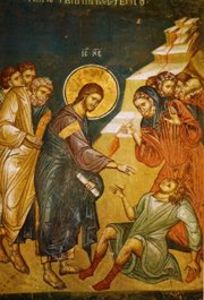
The Reading is from Matthew 17:14-23
At that time, a man came up to Jesus and kneeling before him said, "Lord, have mercy on my son, for he is an epileptic and he suffers terribly; for often he falls into the fire, and often into the water. And I brought him to your disciples, and they could not heal him." And Jesus answered, "O faithless and perverse generation, how long am I to be with you? How long am I to bear with you? Bring him here to me." And Jesus rebuked him, and the demon came out of him, and the boy was cured instantly. Then the disciples came to Jesus privately and said, "Why could we not cast it out?" He said to them, "Because of your little faith. For truly I say to you, if you have faith as a grain of mustard seed, you will say to this mountain, 'Move hence to yonder place,' and it will move; and nothing will be impossible to you. But this kind never comes out except by prayer and fasting." As they were gathering in Galilee, Jesus said to them, "The Son of man is to be delivered into the hands of men, and they will kill him, and he will be raised on the third day."
10th Sunday of Matthew
Κατὰ Ματθαῖον 17:14-23
Τῷ καιρῷ ἐκείνῳ, ἐλθόντων αὐτῶν πρὸς τὸν ὄχλον προσῆλθεν αὐτῷ ἄνθρωπος γονυπετῶν αὐτὸν καὶ λέγων· Κύριε, ἐλέησόν μου τὸν υἱόν, ὅτι σεληνιάζεται καὶ κακῶς πάσχει· πολλάκις γὰρ πίπτει εἰς τὸ πῦρ καὶ πολλάκις εἰς τὸ ὕδωρ. καὶ προσήνεγκα αὐτὸν τοῖς μαθηταῖς σου, καὶ οὐκ ἠδυνήθησαν αὐτὸν θεραπεῦσαι. ἀποκριθεὶς δὲ ὁ ᾿Ιησοῦς εἶπεν· ὦ γενεὰ ἄπιστος καὶ διεστραμμένη! ἕως πότε ἔσομαι μεθ᾿ ὑμῶν; ἕως πότε ἀνέξομαι ὑμῶν; φέρετέ μοι αὐτὸν ὧδε. καὶ ἐπετίμησεν αὐτῷ ὁ ᾿Ιησοῦς, καὶ ἐξῆλθεν ἀπ᾿ αὐτοῦ τὸ δαιμόνιον καὶ ἐθεραπεύθη ὁ παῖς ἀπὸ τῆς ὥρας ἐκείνης. Τότε προσελθόντες οἱ μαθηταὶ τῷ ᾿Ιησοῦ κατ᾿ ἰδίαν εἶπον· διατί ἡμεῖς οὐκ ἠδυνήθημεν ἐκβαλεῖν αὐτό; ὁ δὲ ᾿Ιησοῦς εἶπεν αὐτοῖς· διὰ τὴν ἀπιστίαν ὑμῶν. ἀμὴν γὰρ λέγω ὑμῖν, ἐὰν ἔχητε πίστιν ὡς κόκκον σινάπεως, ἐρεῖτε τῷ ὄρει τούτῳ, μετάβηθι ἐντεῦθεν ἐκεῖ, καὶ μεταβήσεται, καὶ οὐδὲν ἀδυνατήσει ὑμῖν. τοῦτο δὲ τὸ γένος οὐκ ἐκπορεύεται εἰ μὴ ἐν προσευχῇ καὶ νηστείᾳ. ᾿Αναστρεφομένων δὲ αὐτῶν εἰς τὴν Γαλιλαίαν εἶπεν αὐτοῖς ὁ ᾿Ιησοῦς· μέλλει ὁ υἱὸς τοῦ ἀνθρώπου παραδίδοσθαι εἰς χεῖρας ἀνθρώπων καὶ ἀποκτενοῦσιν αὐτόν, καὶ τῇ τρίτῃ ἡμέρᾳ ἐγερθήσεται. καὶ ἐλυπήθησαν σφόδρα.
Saints and Feasts


August 09
Herman the Wonderworker of Alaska & First Saint of America
Saint Herman (his name is a variant of Germanus) was born near Moscow in 1756. In his youth he became a monk, first at the Saint Sergius Hermitage near Saint Petersburg on the Gulf of Finland; while he dwelt there, the most holy Mother of God appeared to him, healing him of a grave malady. Afterwards he entered Valaam Monastery on Valiant Island in Lake Ladoga; he often withdrew into the wilderness to pray for days at a time. In 1794, answering a call for missionaries to preach the Gospel to the Aleuts, he came to the New World with the first Orthodox mission to Alaska. He settled on Spruce Island, which he called New Valaam, and here he persevered, even in the face of many grievous afflictions mostly at the hands of his own countrymen in the loving service of God and of his neighbour. Besides his many toils for the sake of the Aleuts, he subdued his flesh with great asceticism, wearing chains, sleeping little, fasting and praying much. He brought many people to Christ by the example of his life, his teaching, and his kindness and sanctity, and was granted the grace of working miracles and of prophetic insight. Since he was not a priest, Angels descended at Theophany to bless the waters in the bay; Saint Herman used this holy water to heal the sick. Because of his unwearying missionary labours, which were crowned by God with the salvation of countless souls, he is called the Enlightener of the Aleuts, and has likewise been renowned as a wonderworker since his repose in 1837.

August 09
The Holy Apostle Matthias
After Judas by transgression fell from his apostleship (Acts 1: 25), and hanging himself out of despair ended his life with a wretched and shameful death (Matt. 27: 5), then, that the number of the Twelve not be lacking, all the disciples gathered in one place after the Ascension of the Savior (the number of men and women being 120), and they chose two men from among them, Joseph, called Barsabas, who was also surnamed Justus, and Matthias, and they set them in the midst. Then they prayed to God and cast lots, "and the lot fell upon Matthias, and he was numbered with the eleven Apostles" (Acts 1: 15-26). And thus, having taken the place of Judas, Matthias fulfilled the work of apostleship and the prophecy concerning Judas, which the Holy Spirit foretold by the mouth of David: "And his bishopric let another take" (Ps. 108(109):8). After this, it is said, Matthias preached the Gospel in Ethiopia, and completed his life there in martyrdom.

August 09
Constantine, Patriarch of Constantinople
HTGOC Tulsa Calendar
-
HTGOC Calendar
August 9 to August 23, 2026
Sunday, August 98:30AM Orthros
9:30AM Divine Liturgy
6:30PM Adult Greek Dance Practice
Monday, August 1010:00AM Funeral
5:00PM Paraklesis
6:00PM Parish Council Meeting
Tuesday, August 116:30AM Men’s Study Group
12:00PM Paraklesis
Wednesday, August 125:00PM Paraklesis
6:00PM Young Olympians (Middle School/High School) Greek Dance Practice
Thursday, August 1312:00PM Paraklesis
Friday, August 145:00PM Vespers for Dormition of the Theotokos
Saturday, August 15Dormition of Theotokos
8:30AM Orthros followed by Divine Liturgy
12:00PM GOYA Pool Party
5:30PM CANCEL TONIGHT: Vespers
6:30PM Adult Greek Dance Practice
Sunday, August 168:30AM Orthros
9:30AM Divine Liturgy
11:00AM AHEPA Scholarship Awards
11:30AM Festival Meeting
Tuesday, August 186:30AM Men’s Study Group
Wednesday, August 199:00AM Festival Baking-Koulourakia
5:00PM Paraklesis
6:00PM Young Olympians (Middle School/High School) Greek Dance Practice
Friday, August 217:00PM Adult Greek Dance Practice
Saturday, August 225:30PM Vespers
Sunday, August 238:30AM Orthros
9:15AM 40 Day Mom/Baby Blessing
9:30AM Divine Liturgy
11:00AM Festival Kick Off
11:30AM Festival Meeting
Community News and Info
Note About the Alarm at Church
Before entering the church or hall, including the North Kitchen Door please confirm that the Alarm is Disarmed. There were multiple alarms (False Alarms) this past week.
Men's Group
Our men's group will meet at 6:30am this Tuesday, we hope to see you there.
Paraklesis Schedule This Week
During the first two weeks of August, in conjunciton with the Fast in preparing for the Feast of the Dormition of the Theotokos and Ever Virgin Mary; the schedule for Paraklesis this week will be as follows:
Monday, Wednesday ~ 5pm Paraklesis (Friday, August 14 we will have Vespers for the Feast of the Dormition of the Theotokos)
Tuesday, Thursday ~ noon Paraklesis
Young Olympians Greek Dance Practice
Our Young Olympians (middle school/high school ages) will have dance practice at 6pm on Wednesdays
AHEPA Scholarship Awards
Our AHEPA will present scholarship awards at the end of Divine Liturgy next Sunday, August 16. They will also be sponsoring the coffee hour.
August 15th GOYA Pool Party and Hang Out
We will get together after services for the Feast on August 15th. The Pool Party and Hang Out will be at Photios Boyaci's house
Diakonia Newsletter
“Be imitators of me…”—Reflections From Today’s Reading – I Corinthians 4:9-16
Fr. George Parsenios (HCHC ’96)
The phrase lands strangely on our ears. It doesn’t sound like something an apostle should say. When St. Paul tells us in today’s epistle reading to imitate him, he seems to be singing his own praises, to be putting himself on a pedestal. But he only seems to do this. He is actually doing the opposite. Far from elevating himself over others, St. Paul was lowering himself in order to correct the mistaken views that the Corinthians had regarding apostolic authority. The Corinthians had divided their Church into different factions associated with different apostles, and they defined their warring parties by boasting against each other, “I am of Paul! I am of Peter! I am of Apollos!” (1 Cor. 1:12). Paul wrote the first four chapters of 1 Corinthians in order to respond to this divisive and confused behavior, and today’s epistle reading is the climax of that argument. The apostles, he says, “are last of all people,” but the Corinthians are using apostolic connections to become first among the believers in Corinth. They invoke the names of apostles but do not live like apostles. With more than a little sarcasm, Paul separates the experience of the apostles even further from the behavior of the Corinthians by saying, “We are weak, but you are strong. You are held in honor, but we in disrepute.” The apostles do not elevate themselves arrogantly over others, but they bless when reviled, they endure when persecuted and they forgive when slandered. To be truly associated with the apostles, the Corinthians need to imitate the apostolic example. It is against this backdrop that Paul’s teaching can be understood more clearly. Far from arrogantly elevating himself, he is teaching a lesson in humility when he says, “be imitators of me.”
Fr. George Parsenios is Professor of New Testament at Holy Cross Greek Orthodox School of Theology. www.hchc.edu
What does “hermit” mean? From The Original Greek: erêmitês (ἐρημίτης)

Fr. George Parsenios (HCHC ’96)
Someone who lives alone is called in English a “hermit,” but the word “hermit” actually has a very specific meaning related to Christian monasticism. Our term “hermit” derives from the Greek word ἔρημος/erêmos which means “desert” or “wilderness,” because the Egyptian desert was the home of the earliest Christian monks. To understand why the word “hermit” or “desert dweller” (ἐρημίτης / erêmitês) came to be applied to monks, we need to say a word about the history of Christian monasticism. Prior to the 4th century AD, Christianity was an illegal religion, so Christians were barred from pursuing earthly glory and power. But when St. Constantine legalized the Christian faith, the cost of discipleship became cheaper, and being a Christian became a possible path to political prominence. The earliest monks followed the example of St. Anthony the Great by fleeing to the desert in order to reject what they saw as a compromised Christianity and to devote themselves exclusively to prayer and fasting. They were imitating Jesus who often retreated to the wilderness as a refuge for focused prayer (Luke 5:16). Because they inhabited the erêmos, or desert, they received the name of erêmitês, or “hermit.”
Fr. George Parsenios is Professor of New Testament at Holy Cross Greek Orthodox School of Theology. www.hchc.edu