
Transfiguration of Our Saviour Greek Orthodox Church
Publish Date: 2026-08-16
Bulletin Contents

Organization Icon
Transfiguration of Our Saviour Greek Orthodox Church

General Information

  • Phone:
  • (978) 458-4321
  • Street Address:

  • 25 Fr. John Sarantos Way

  • Lowell, MA 01854
  • Mailing Address:

  • 25 Fr. John Sarantos Way

  • Lowell, MA 01854


Contact Information


Services Schedule

Sunday Schedule:

Orthros: 8:30 a.m.
Divine Liturgy: 9:30 a.m.

Bible Study:

Wednesdays, 10:00 a.m. - 11:00 a.m. and 7:00 p.m - 8:00 p.m.


Past Bulletins


Announcements

FELLOWSHIP

Everyone is welcome to join us for Fellowship Coffee Hour following Liturgy in the Philoptochos room. 

FELLOWSHIP MINISTRY

Please support our Sunday morning Fellowship with a free-will offering to the Coffee Fellowship Fund.  We are thankful for your free-will offerings!

PHILOPTOCHOS THANK YOU
 
A big thank you to Daphne Easton, Georgia Dristiliaris and the Dristiliaris family for graciously hosting the Name Day Vespers reception on August 5th. This time-honored tradition was attended by clergy, parishioners and guests. 
 
We also thank our Philoptochos members for their help in preparing and hosting the reception following liturgy on August 6th.

GRECIAN FESTIVAL

After another successful festival, we are donating $5000 from our profits to two local charities. This amount will be split between the Merrimack Valley Food Bank and The Hope Project.

KITCHEN RENOVATION PROJECT UPDATE

The kitchen renovation project began on Monday, June 29th!  This exciting, and long-awaited start, does mean that there will be no access to the hall and kitchen area for the duration of the project.  The project is expected to last 4 months, however, as with all projects, we are also planning for the possibility of delay(s). We will continue to keep you updated periodically throughout the project.   


CAPITAL CAMPAIGN

Our successful CAPITAL – RESTORATION CAMPAIGN is winding down.  To celebrate our success, we will honor all donors via a large recognition icon in the lobby of the Fellowship Hall.  All donors, no matter the amount, will be recognized.  We would love to have all of our Transfiguration stewards recognized! Thank you to everyone who has helped to make this a success.  We will continue to accept donations for the next few weeks.


SAVE THE DATES *

Sep 11 – VCC/Family Fun Night – Pizza & Movie
Sep 18-20 – Transfiguration Family Retreat at the St. Methodios Faith & Heritage Center
Sep/Oct – Philoptochos Clothing Drive
Oct 26 - Transfiguration Golf Tournamnet
Nov 22 – Neighborhood Turkey distribution
Nov 1 – Parish Assembly
Dec 6 – Philoptochos Tea
Dec 13 – Christmas Concert
Jun 4-5-6 – Grecian Festival 2027

*Dates are subject to change.  Additional information will be provided as it becomes available.


STEWARDSHIP, CAPITAL CAMPAIGN AND MORE

If you are age 73 or older, a Qualified Charitable Distribution (QCD) allows you to make a direct gift from your IRA or 401K to the Church while satisfying all or part of your Required Minimum Distribution (RMD). A QCD can be a tax-efficient way to support our current Capital Campaign because the donated amount is excluded from your taxable income. By directing a portion of your RMD to the Church, you can fulfill your charitable goals, strengthen your parish community, and reduce your overall tax burden. Consult your financial or tax advisor to determine how a QCD may benefit your individual situation and how to properly make the donation.


Trinity votive candles (To Sponsor a Candle please call the Church Office.)

†Vigil Light at the Side Altar (Icon of the Theotokos):  In Loving Memory of William J. Tanguay – from his wife Mary and daughters Christina and Jennifer
†Vigil Light at the Icon of Christ: In Loving Memory of Deborah Victoria Skrekas, George and Avra Skrekas
†Vigil Light at the Theotokos: In Loving Memory of Ioannis "John" Zaralidis - from his family
†Vigil Light at the Theotokos (2nd): In Loving Memory of Andrew Spanos - from his daughters Sandra and JoAnne
†Vigil Light at the Icon of the Forerunner: In Loving Memory of Mary Koutsis 3 years and George Koutsis 6 years - from the Koutsis and Dobi families
†Vigil Light at the Foot of the Holy Cross: In Loving Memory of George Tsoukalas - from his family


Weekly Inserts


Weekly Calendar

Sunday, August 16  ELEVENTH SUNDAY OF MATTHEW 
†Orthros, 8:30 am
†Liturgy, 9:30 am


Sunday, August 23  TWELFTH SUNDAY OF MATTHEW 
†Orthros, 8:30 am
†Liturgy, 9:30 am
1 Year Memorial for Athena Letsou


TODAY’S PARISH COUNCIL:  Chris Tsaknopoulos, Peter Gavriil & Ian Longacre


UPCOMING EVENTS                

August 29                   
Beheading of John the Baptist – Liturgy, 9:30 am


August 30                   
Thirteenth Sunday of Matthew       


September 6   
Fourteenth Sunday of Matthew
40 Day Churching for Stephanie and baby Sofia

10 Year Memorial for Jack Mahoney
10 Year Memorial for Sophia Quinn

September 7   
Ecclesiastical New Year
Office Closed


September 8   
Nativity of the Theotokos                                      
†Orthros, 8:30 am                                      
†Divine Liturgy, 9:30 am                                      
Parish Council Meeting, 6:30 pm


September 11
VCC Family Movie Night, 5:00 pm – 8:00 pm


September 13
Sunday Before Holy Cross

September 14
The Elevation of the Holy Cross
†Orthros, 8:30 am
†Divine Liturgy, 9:30 am


Please Note:
Summer office hours for July and August are Tuesday through Friday 9 am to 1 pm.


Gospel and Epistle Readings

Epistle Reading

Prokeimenon. Second Mode. Psalm 117.14,18.
The Lord is my strength and my song.
Verse: The Lord has chastened me sorely.

The reading is from St. Paul's First Letter to the Corinthians 9:2-12.

Brethren, you are the seal of my apostleship in the Lord. This is my defense to those who would examine me. Do we not have the right to our food and drink? Do we not have the right to be accompanied by a wife, as the other apostles and the brothers of the Lord and Cephas? Or is it only Barnabas and I who have no right to refrain from working for a living? Who serves as a soldier at his own expense? Who plants a vineyard without eating any of its fruit? Who tends a flock without getting some of the milk? Do I say this on human authority? Does not the law say the same? For it is written in the law of Moses, "You shall not muzzle an ox when it is treading out the grain." Is it for oxen that God is concerned? Does he not speak entirely for our sake? It was written for our sake, because the plowman should plow in hope and the thresher thresh in hope of a share in the crop. If we have sown spiritual good among you, is it too much if we reap your material benefits? If others share this rightful claim upon you, do not we still more? Nevertheless, we have not made use of this right, but we endure anything rather than put an obstacle in the way of the gospel of Christ.


Gospel Reading

11th Sunday of Matthew
The Reading is from Matthew 18:23-35

The Lord said this parable: "The kingdom of heaven may be compared to a king who wished to settle accounts with his servants. When he began the reckoning, one was brought to him who owed him ten thousand talents; and as he could not pay, his lord ordered him to be sold, with his wife and children and all that he had, and payment to be made. So the servant fell on his knees, imploring him, 'Lord, have patience with me, and I will pay you everything.' And out of pity for him the lord of that servant released him and forgave him the debt. But that same servant, as he went out, came upon one of his fellow servants who owed him a hundred denarii; and seizing him by the throat he said, 'Pay what you owe.' So his fellow servant fell down and besought him, 'Have patience with me, and I will pay you.' He refused and went and put him in prison till he should pay the debt. When his fellow servants saw what had taken place, they were greatly distressed, and they went and reported to their lord all that had taken place. Then his lord summoned him and said to him, 'You wicked servant! I forgave you all that debt because you besought me; and should not you have had mercy on your fellow servant, as I had mercy on you?' And in anger his lord delivered him to the torturers, till he should pay all his debt. So also my heavenly Father will do to every one of you, if you do not forgive your brother from your heart."


Hymns of the Day

Resurrectional Apolytikion in the Second Mode

When you descended into death, Life immortal, you vanquished the pow'r of hell by your resplendent divinity and when you raised the dead from the depths of darkness, all the heavenly powers cried out triumphantly: O giver of life, Christ our God, glory to you.

Apolytikion for Holy Napkin in the Second Mode

We worship Thine immaculate icon, O Good One, asking the forgiveness of our failings, O Christ our God; for of Thine own will wast Thou well-pleased to ascend the Cross in the flesh, that Thou mightest deliver from slavery to the enemy those whom Thou hadst fashioned. Wherefore, we cry to Thee thankfully: Thou didst fill all things with joy, O our Saviour, when Thou camest to save the world.

Apolytikion for Afterfeast of the Dormition in the First Mode

In giving birth you remained a virgin, and in your dormition you did not forsake this world, O Theotokos. For as the Mother of Life, you have yourself passed into life, and by your prayers you deliver our souls from death.

Seasonal Kontakion in the Second Mode

She is our vigilant intercessor, the Theotokos, our sure hope and protection. Neither death nor tomb held any power over her, for as the Mother of Life, she was taken into life by that very one who deigned to dwell in her ever virgin womb.


Wisdom of the Fathers

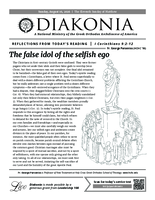
Do we forgive our neighbors their trespasses? God also forgives us in His mercy. Do we refuse to forgive? God, too, will refuse to forgive us. As we treat our neighbors, so also does God treat us. The forgiveness, then, of your sins or unforgiveness, and hence also your salvation or destruction, depend on you yourself, man. For without forgiveness of sins there is no salvation.
St. Tikhon of Zadonsk
Unknown, 18th century

Wherefore then did He not do this, nor forgive the debt before the account? Desiring to teach him, from how many obligations He is delivering him, that in this way at least he might become more mild towards his fellow servant .... He gave more than he asked, remission and forgiveness of the entire debt.
St. John Chrysostom
Homily 61 on Matthew 18, 4th Century


Saints and Feasts

August 16

Translation of the Image of Our Lord and God and Savior, Jesus Christ

When the fame of our Lord Jesus Christ came to Abgar, the ruler of Edessa, who was suffering from leprosy, Abgar sent a messenger named Ananias, through him asking the Savior to heal him of his disease, while bidding Ananias bring back a depiction of Him. When Ananias came to Jerusalem, and was unable to capture the likeness of our Lord, He, the Knower of hearts, asked for water, and having washed His immaculate and divine face, wiped it dry with a certain cloth, which He gave to Ananias to take to Abgar; the form of the Lord's face had been wondrously printed upon the cloth. As soon as Abgar received the cloth, which is called the Holy Napkin (Mandylion), he reverenced it with joy, and was healed of his leprosy; only his forehead remained afflicted. After the Lord's Death, Resurrection, and Ascension, the Apostle Thaddaeus (see Aug. 21) came to Edessa, and when he had baptized Abgar and all his men, Abgar's remaining leprosy also was healed. Abgar had the holy image of our Savior fixed to a board and placed at the city gate, commanding that all who entered the city reverence it as they passed through. Abgar's grandson, however, returned to the worship of the idols, and the Bishop of Edessa learned of his intention to replace the Holy Napkin with an idol. Since the place where it stood above the city gate was a rounded hollow, he set a burning lamp before the Holy Napkin, put a tile facing it, then bricked up the place and smoothed it over, so that the holy icon made without hands was no longer to be seen, and the ungodly ruler gave no further thought to it.

With the passage of time, the hidden icon was forgotten, until the year 615, when Chosroes II, King of Persia, was assaulting the cities of Asia, and besieged Edessa. The Bishop of Edessa, Eulabius, instructed by a divine revelation, opened the sealed chamber above the city gate and found the Holy Napkin complete and incorrupt, the lamp burning, and the tile bearing upon itself an identical copy of the image that was on the Holy Napkin. The Persians had built a huge fire outside the city wall; when the Bishop approached with the Holy Napkin, a violent wind fell upon the fire, turning it back upon the Persians, who fled in defeat. The Holy Napkin remained in Edessa, even after the Arabs conquered it, until the year 944, when it was brought with honor and triumph to Constantinople in the reign of Romanus I, when Theophylact was Ecumenical Patriarch. The Holy Napkin was enshrined in the Church of the most holy Theotokos called the Pharos. This is the translation that is celebrated today.


August 17

Myron the Martyr of Cyzicus

Saint Myron was a priest during the reign of Decius, when Antipater was ruler of Achaia. On the day of our Lord's Nativity, Antipater entered the church to seize the Christians and punish them. Saint Myron, kindled with holy zeal, roundly insulted Antipater, for which he was hung up and scraped, then cast into a raging furnace, but was preserved unharmed. When Myron refused to worship the idols, Antipater commanded that strips be cut in the Saint's flesh from his shoulders to his feet; the Saint took one of the strips of his flesh and flung it in the tyrant's face. He was beaten, and scraped again upon his beaten flesh; then he was thrown to wild beasts, but when Antipater saw them leaving off their fierce nature and protecting the Saint from harm, he was overcome with unbearable shame and slew himself. The Saint was then sent to Cyzicus, where the proconsul had him beheaded, about the year 250.


August 18

Floros & Lauros the Monk-martyrs of Illyria

These Martyrs were twin brothers, and stonemasons. After the martyrdom of their teachers Proclus and Maximus, they left Byzantium and came to the city of Ulpiana in Illyricum, where a certain Licinius hired them to build a temple for the idols. The wages he gave them, they distributed to the poor, and when the temple was built, Floros and Lauros gathered the paupers, and with their help put ropes about the necks of the idols, pulled them to the ground, and furnished the temple as a church. When Licinius learned of this, he had the paupers burned alive in a furnace. Floros and Lauros were tormented, then cast into a deep well, where they gave up their souls to the Lord. When their holy relics were recovered years later, they poured forth myrrh and worked many miracles; they were enshrined in Constantinople.


August 19

Andrew the General & Martyr & his 2,593 soldiers

During the reign of Maximian, about the year 289, Antiochus the Commander-in-Chief of the Roman forces sent Andrew with many other soldiers against the Persians, who had overrun the borders of the Roman dominion. Saint Andrew persuaded his men to call upon the Name of Christ, and when they had defeated the Persians with unexpected triumph, his soldiers believed in Christ with him. Antiochus, learning of this, had them brought before him. When they confessed Christ to be God, he had Andrew spread out upon a bed of iron heated fiery hot, and had the hands of his fellow soldiers nailed to blocks of wood. Antiochus then commanded some thousand soldiers to chase the Saints beyond the borders of the empire. Through the instructions of Saint Andrew, these soldiers also believed in Christ. At the command of Antiochus, they were all beheaded in the mountain passes of the Taurus mountains of Cilicia.


August 20

Samuel the Prophet

This most holy man, a Prophet of God from childhood, was the last judge of the Israelite people, and anointed the first two Kings of Israel. He was born in the twelfth century before Christ, in the city of Armathaim Sipha, from the tribe of Levi, the son of Elkanah and Hannah (Anna). He was the fruit of prayer, for his mother, being barren, conceived him only after she had supplicated the Lord with many tears; wherefore she called him Samuel, that is, "heard by God." As soon as Hannah had weaned him, she brought him to the city of Silom (Shiloh), where the Ark was kept, and she consecrated him, though yet a babe, to the service of God, giving thanks to Him with the hymn found in the Third Ode of the Psalter: "My heart hath been established in the Lord . . ." Samuel remained in Silom under the protection of Eli the priest. He served in the Tabernacle of God, and through his most venerable way of life became well-pleasing to God and man (I Kings 2: 26). While yet a child, sleeping in the tabernacle near the Ark of God, he heard the voice of God calling his name, and foretelling the downfall of Eli; for although Eli's two sons, Ophni and Phineas, were most lawless, and despisers of God, Eli did not correct them. Even after Samuel had told Eli of the divine warning, Eli did not properly chastise his sons, and afterwards, through various misfortunes, his whole house was blotted out in one day.

After these things came to pass, Samuel was chosen to be the protector of the people, and he judged them with holiness and righteousness. He became for them an example of all goodness, and their compassionate intercessor before God: "Far be it from me that I should sin against the Lord in ceasing to pray for you; yea, I will serve the Lord, and show you the good and the right way" (ibid. 12:23). When he asked them -- having God as witness -- if he ever wronged anyone, or took anyone's possessions, or any gift, even so much as a sandal, they answered with one voice: "Thou hast not defrauded us, nor oppressed us, nor afflicted us, neither hast thou taken anything from anyone's hand" (ibid. 12:4). When Samuel was old, the people asked him for a king, but he was displeased with this, knowing that God Himself was their King. But when they persisted, the Lord commanded him to anoint them a king, saying, "They have not rejected thee, but they have rejected Me from reigning over them" (ibid. 8:7); so Samuel anointed Saul. But Saul transgressed the command of God repeatedly, so Samuel anointed David. Yet, since Samuel was a man of God, full of tender mercy, when the Lord told him that He had rejected Saul, Samuel wept for him the whole night long (ibid. 15:11); and later, since he continued to grieve, the Lord said to him, "How long wilt thou mourn for Saul?" (ibid. 16:1). Having lived blamelessly some ninety-eight years, and become an example to all of a God-pleasing life, he reposed in the eleventh century before Christ. Many ascribe to him the authorship of the Books of judges, and of Ruth, and of the first twenty-four chapters of the First Book of Kings (I Samuel).


August 21

Thaddeus the Apostle of the 70

The Apostle Thaddaeus was from Edessa, a Jew by race. When he came to Jerusalem, he became a disciple of Christ, and after His Ascension he returned to Edessa. There he catechized and baptized Abgar (see Aug. 16). Having preached in Mesopotamia, he ended his life in martyrdom. Though some call him one of the Twelve, whom Matthew calls "Lebbaeus, whose surname was Thaddaeus" (Matt. 10:3), Eusebius says that he is one of the Seventy: "After [Christ's] Resurrection from the dead, and His ascent into Heaven, Thomas, one of the twelve Apostles, inspired by God, sent Thaddaeus, one of the seventy disciples of Christ, to Edessa as a preacher and evangelist of Christ's teaching" (Eccl. Hist. 1: 13).


August 22

Agathonikos the Martyr of Nicomedea & his Companion Martyrs

The Martyr Agathonicus, because he converted pagans to Christ, was seized in Nicomedia, violently beaten, haled about in bonds, and beheaded in Selyvria, during the reign of Maximian, in the year 298.


Diakonia Newsletter

BACK TO TOP