St. Alexis of Wilkes-Barre Orthodox Church
Publish Date: 2026-10-25
Bulletin Contents

Organization Icon
St. Alexis of Wilkes-Barre Orthodox Church

General Information

  • Phone:
  • 860-664-9434
  • Street Address:

  • PO Box 134, 108 E Main St

  • Clinton, CT 06413-0134


Contact Information


Services Schedule

Please see our online calendar for dates and times of Feast Day services.


Past Bulletins


Welcome

Jesus Christ teaches us to love and serve all people, regardless of their ethnicity or nationality. To understand this, we need to look no further than to the Parable of the Good Samaritan (Luke 10:25-37). Every time we celebrate the Divine Liturgy, it is offered "on behalf of all, and for all." As Orthodox Christians we stand against racism and bigotry. All human beings share one common identity as children of God. "There is neither Jew nor Greek, slave nor free, male nor female, for you are all one in Christ Jesus" (Galatian 3:28)

To Our Guests
Throughout our services, we use the more formal "thy" and "thou" or what is commonly referred to as King Jamesean English.  The Lord's Prayer is recited as follows:

Our Father, who art in heaven, hallowed be thy Name,
Thy Kingdom come, Thy Will be done, as on earth as it is in heaven,
Give us this day our daily bread, and forgive us our debts, as we forgive our debtors,
Lead us not into temptation but deliver us from the Evil One.

Please join us after Liturgy for refreshments and hospitality.

Pastoral Care - General Information

Emergency Sick Calls can be made at any time. Please call Fr Steven at (860) 322-2906, when a family member is admitted to the hospital.
Anointing in Sickness: The Sacrament of Unction is available in Church, the hospital, or your home, for anyone who is sick and suffering, however severe. 
Marriages and Baptisms require early planning, scheduling and selections of sponsors (crown bearers or godparents). See Father before booking dates and reception halls!
Funerals are celebrated for practicing Orthodox Christians. Please see Father for details. The Church opposes cremation; we cannot celebrate funerals for cremations.

Members of our Parish Council are:

Marlene Melesko - President
Sarah Senetcen - Member at Large
Boris Doph - Treasurer
Dierdre Cottergarfield - Vice President
Luba Martins - Secretary

Mission Statement
St. Alexis Orthodox Christian Church is a local English speaking community of the Orthodox Church in America (OCA) on the shoreline of Connecticut.

St. Alexis exists to:

  • Call all people to Christ
  • Worship as a community 
  • Experience the joy of Christ in our lives 
  • Share this joy with those around us 
  • Educate people about the Truth and Presence of Orthodoxy 
  • We offer the love of Christ to those in need, both in word and action.


Announcements

Reminder

There will be no Vespers on Saturday, Oct 24th.


Prayers, Intercessions and Commemorations

Again we pray that we may be made worthy of founding in our Diocese a monastery in honor
of our Most Holy Lady the Theotokos and Ever-Virgin Mary, let us pray to the Lord!

Pray for: All those confined to hospitals, nursing homes, and their own homes due to illness; for all those who serve in the armed forces; widows, orphans, prisoners, victims of violence, and refugees;

All those suffering chronic illness, financial hardship, loneliness, addictions, abuse, abandonment and despair; those who are homeless and dispossesed, those who are institutionalize, those who have no one to pray for them;

All Orthodox seminarians & families; all Orthodox monks and nuns, and all those considering monastic life; all Orthodox missionaries and their families.

All those who have perished due to hatred, intolerance, predjudice; pestilence and natural disaster; all those departed this life in the hope of the Resurrection.

Please let Fr. Steven know via email if you have more names for which to pray.

  • Departed:  
  • Clergy and their families: Fr Sergei B, Fr Vladimir, Fr Vladimir, Fr John, 
    Fr Alexander
  • ​Catechumen: Joshua Figueroa
  • Individuals and Families: Luba, Suzanne, Rosemary,  Daniel & Dayna, Kristen, Victor, Susan, Gregory, Nina
  • Birthdays and Name’s Days this Month: Vinny Melesko (B-10/8), Marlene Melesko (B-10/12), Victor Hohenbart (B-10/20), Greg Jankura (B-10/24), Joe Boruch (B-10/24),
  • Anniversaries this Month:  
  • Expecting and Newborn:  
  • ​Traveling: Dn Timothy & Maureen Skuby
  • ​Sick and those in distress: Nancy, Boris, Glenn, John, Joan, Sharon, William, Sharon, Alexander, Olga, Christine, Tatianna, Stormy, Maria, Blanche, Jeremy, Jenna, Eugenia

Today’s commemorated feasts and saints

21st SUNDAY AFTER PENTECOST — Tone 4. Martyrs Marcian and Martyrius, the Notaries of Constantinople (ca. 355). Ven. Martyrii (Martyrius) the Deacon, Recluse of the Kiev Caves (Far Caves—13th-14th c.). Martyr Athanasius the Fuller, at Salona in Dalmatia (3rd c.). St. Tabitha, the widow raised from the dead by the Apostle Peter (1st c.).

Again we pray for those who have lost their lives because of the wars in Ukraine and in the Middle East: that the Lord our God may look upon them with mercy, and give them rest where there is neither sickness, or sorrow, but life everlasting.

Again we pray for mercy, life, peace, health, salvation, for those who are suffering, wounded, grieving, or displaced because of the wars in Ukraine and in the Middle East.

Again we pray for a cessation of the hostilities against Ukraine and the Middle East, and that reconciliation and peace will flourish there, we pray thee, hearken and have mercy.

Again we pray thee, O Lord our God: We are all called to be the branches of the spiritual vine that grew from the seeds of the Orthodox Faith that our missionary fathers, Herman and Innocent and their companions, planted and nurtured among the native peoples of Alaska, a vine that bears fruit to this day throughout our land, as we imitate the virtues of those husbandmen, of the many saints known only to God, of the Martyr Peter the Aleut, and of our Mother Olga of Kwethluk; through their intercessions, O Lord, hear us and have mercy!

Again we pray thee, O God our Savior: Look with favor upon us, the families and spiritual children of the peoples who came to our land from the old world and brought with them the Orthodox Faith, which they held fast and nurtured in their labors in the mines and mills and on the farms of this new land, and among the challenges of its great cities; we pray thee, O Lord, hear us and have mercy!

Again we pray thee, O Lord our God: We have thy Mother as the Protectress of Orthodox Christians in our North American lands; as we joyfully celebrate her patronage and her miracles, we pray thee, O Lord, through her intercessions, in all our challenges, hear us and have mercy!


Parish Calendar

  • St Alexis Parish

    October 25 to November 2, 2026

    Sunday, October 25

    21st Sunday after Pentecost

    Victor & Gail Kuziak - A

    9:15AM 3rd Hour

    9:30AM Divine Liturgy

    Monday, October 26

    Greatmartyr Demetrius

    Tuesday, October 27

    Commemoration of the Flood

    Martyr Nestor of Thessalonica

    St Olga of Kwethluk

    8:30AM Daily Matins

    Wednesday, October 28

    Martyrs Terence, Neonila and Children; St Arsenius of Serbia; Rep. Ven. Job of Pochaev

    Nicholas Melesko - B

    Thursday, October 29

    Martyr Anastasia the Roman; Ven. Avram of Rostov

    8:30AM Daily Matins

    Friday, October 30

    Hieromartyr Zenobius and His Sister Zenobia

    Saturday, October 31

    Hieromartyr John Kochurov

    Martyrdom of St. John Kochurov

    Sunday, November 1

    +Joan Narvaro

    22nd Sunday after Pentecost

    9:15AM 3rd Hour

    9:30AM Divine Liturgy

    Monday, November 2

    Martyr Acindynus of Persia and Others


Saints and Feasts

October 25

The Holy Martyrs Marcian and Martyrius the Notaries

These Martyrs were disciples of Saint Paul the Confessor (see Nov. 6). Martyrius was a subdeacon, Marcian a chanter and reader. They were beheaded by the Arians in the year 346. Miracles were wrought at their tomb, and demons were cast out; Saint John Chrysostom began the building of the church in their honour in Constantinople, and it was completed by patriarch Sisinius.


October 25

Tabitha, who was raised from the dead by Peter the Apostle


October 26

Demetrios the Myrrh-streamer & Great Martyr of Thessaloniki

Saint Demetrius was a Thessalonian, a most pious son of pious and noble parents, and a teacher of the Faith of Christ. When Maximian first came to Thessalonica in 290, he raised the Saint to the rank of Duke of Thessaly. But when it was discovered that the Saint was a Christian, he was arrested and kept bound in a bath-house. While the games were under way in the city, Maximian was a spectator there. A certain friend of his, a barbarian who was a notable wrestler, Lyaeus by name, waxing haughty because of the height and strength of his body, boasted in the stadium and challenged the citizens to a contest with him. All that fought with him were defeated. Seeing this, a certain youth named Nestor, aquaintance of Demetrius', came to the Saint in the bath-house and asked his blessing to fight Lyaeus single-handed. Receiving this blessing and sealing himself with the sign of the precious Cross, he presented himself in the stadium, and said, "O God of Demetrius, help me!" and straightway he engaged Lyaeus in combat and smote him with a mortal blow to the heart, leaving the former boaster lifeless upon the earth. Maximian was sorely grieved over this, and when he learned who was the cause of this defeat, he commanded straightway and Demetrius was pierced with lances while he was yet in the bath-house, As for Nestor, Maximian commanded that he be slain with his own sword.


October 27

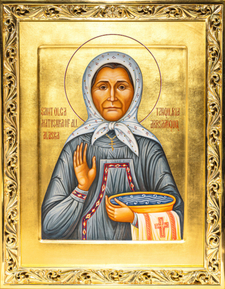
Righteous Mother Olga of Kwethluk–Tanqilria Arrsamquq–Wonderworker, Matushka of All Alaska

A Real Person in the Eyes of God and Man

In the wide stillness of the Alaskan tundra—where the sky stretches open like a prayer and the rivers flow between worlds—God planted a soul full of hidden beauty. On February 3, 1916 (January 21, Julian Calendar), in the village of Kwethluk, at the meeting of the Kwethluk and Kuskokwim rivers, a daughter was born to the Native Yup’ik people. Her name in the Yup’ik language was Arrsamquq, a name meaning lowly, hidden, or unadorned—like the seed sown quietly in the earth. It was a name that would prophetically mark her life, for she lived not in boastfulness or acclaim, but in humility, reverence, and love.

From childhood, she was formed both by the land and by the Church. Her hands learned the ancient skills of Yup’ik women—sewing, cooking, preparing food for winter, raising children, and keeping the home. But her soul was formed by the divine grace that had come to Alaska with the Orthodox missionaries from Russia. The faith of Saints Herman and Innocent had taken root in her village, and in her heart. Her home life, the seasons, and the services of the Church were woven together, creating in her a seamless garment of earthly service and heavenly longing.

As she matured, she married Nicolai Michael, the village storekeeper and postmaster, who would later be ordained to the holy priesthood. In time, she would become known not only as Olga, but as Matushka Olga—a mother to thirteen children of her own, and a spiritual mother to an entire village. Quiet, gentle, and strong, she became a pillar of warmth and grace in Kwethluk.

In Yup’ik culture, to be called a real person—ella tanqilria—is the highest praise. It means one who lives in harmony with the land and with others, who does not set themselves above others, but who listens deeply, works quietly, and carries the burdens of others as their own. Matushka Olga was just such a person. She did not preach. She did not boast. She simply lived with such goodness that the land, the people, and the Church would not forget her.

A Matushka in the Manner of the Saints

After her marriage to Nicolai Michael, Olga embraced not only the responsibilities of a wife and mother, but also the sacred calling of being a matushka—a priest’s wife, a helpmate not only to her husband but to the Church. When Nicolai was ordained and began serving as the priest of the Church of Saint Nicholas in Kwethluk, she became the quiet heart of that parish community.

She raised thirteen children of her own in modest means and with deep love. Her home was open; her heart was larger still. She offered hospitality not as a performance, but as a way of life. Whether sewing warm clothes for those in need, baking bread for the altar, or comforting a grieving neighbor, she did all things without self-importance. She was known never to raise her voice, and to teach—like many Yup’ik elders—not with scolding but by example. Those who came into her presence often found themselves stilled, as if by a quiet flame.

Her life bore resemblance to the holy women of the Scriptures. Like Tabitha (Dorcas) in the Acts of the Apostles, she was “full of good works and almsdeeds which she did,” and like the Most Pure Virgin Mother of God, she treasured the mysteries of life and of God in her heart. She clothed the naked, fed the hungry, and helped bring new life into the world. As a midwife, she accompanied women through the dangers and blessings of childbirth; as a counselor, she listened to those suffering in silence, especially women who had suffered abuse. Her presence was maternal, unjudging, and deeply healing.

Though she lived in a land of long winters and hardship, she herself was a source of warmth. Her daily life—marked by prayer, labor, and service—became a hidden offering to Christ. Her prosphora was kneaded with prayers, her garments sewn with intention, her silence filled with watchfulness and love.

Those who knew her remember her not for speeches or public deeds, but for the realness of her presence. She was always there—praying quietly in church, listening without interruption, carrying burdens without needing thanks.

In the eyes of the world, she was not great. But in the Kingdom of God, where humility is greatness and the last are first, she walked with the saints.

Her Suffering and Repose in the Lord

In 1978, Matushka Olga was diagnosed with cancer. By that time, she had already lived a full life of service and love. Yet, as with so many saints, her final chapter became her most luminous. She did not complain. She did not seek pity. She bore her affliction with the same humility and quiet strength that had defined her life.

When doctors could do no more, she did not despair. She continued to labor gently for those around her, even as her body grew weak. Her children and neighbors recall that she remained peaceful and kind, never bitter or afraid. Her illness became a cross, and she bore it without fanfare, entering more deeply into the sufferings of Christ.

On November 8, 1979, she reposed in the Lord, surrounded by her family in her home in Kwethluk. Her death, like her life, was not loud or dramatic—but it was accompanied by wondrous signs that revealed the hidden sanctity she had carried.

Though it was deep winter, and the land was locked in ice, the frozen river thawed, and the ice softened, allowing boats from nearby villages to arrive—a miracle of timing and temperature that no one could explain. Birds appeared in the sky, though they should have long since flown south. They circled above the village, as if bearing witness. Mourners gathered not only from Kwethluk, but from afar. The people knew—without being told—that a holy one had passed into eternal rest.

As the funeral began, there was a stillness in the air, the kind of sacred hush that often follows the repose of a saint. Those present wept, not with despair, but with awe. A mother, a matushka, a healer, a friend had been taken from them—but heaven received a quiet soul, adorned with the grace of her hidden love.

From the moment of her passing, the people of Kwethluk began to remember her not with mere affection, but with reverence. They spoke of her kindness with gratitude, and of her silence with wonder. Her name was whispered in prayer. And in time, those prayers began to be answered.

The Uncovering of Her Relics and the Spread of Her Veneration

In the decades after her repose, Matushka Olga’s memory did not fade. On the contrary, her presence deepened. Stories began to circulate—quietly at first, then more widely—of dreams, visions, and healings. Women in distress felt her nearness. Survivors of abuse spoke of being comforted in their sleep. Families troubled by sorrow found themselves praying to “Matushka Olga” as they would to a beloved elder or a wise grandmother. And she answered.

Many began to believe that she was not only a pious woman but a saint—that the Church had quietly received into heaven a protector of the suffering, a consoler of the afflicted, a mother to the motherless. Her picture began appearing in icon corners, and the faithful began to ask her intercessions in their time of need.

Then, in the year 2024, nearly forty-five years after her death, the Church undertook the uncovering of her relics. It was a sacred labor, carried out with prayer and reverence by clergy and faithful gathered in the village of Kwethluk. The day before, a blizzard had made travel nearly impossible. But on the morning of the uncovering, the skies cleared, the wind was stilled, and the sun broke through—as though creation itself made way.

As her coffin was raised from the frozen ground and reverently opened in the presence of Gospel readings, what was revealed became a quiet confirmation of sanctity. Her bones bore the golden, honey-colored hue often associated with the relics of the saints. Her headscarf, kasp’aq, and wedding veil—garments worn in prayer, in service, and in love—remained miraculously preserved. These sacred vestments stood as silent witnesses to a life clothed in humility and grace.

She was not found incorrupt in the full sense, but the presence of grace upon her relics was undeniable. Her sanctity was not in outward marvels but in the quiet transfiguration of a life lived entirely for God. She had not been exalted in the world, but now the Church beheld her as one glorified by heaven.

Pilgrims began to arrive. Prayers multiplied. Icons were painted. And the faithful across the land—from the tundra of Alaska to the deserts of Arizona, from the Orthodox heartlands of Ukraine to small mission chapels across North America and Canada—began to call upon her as Saint Olga Michael, the righteous mother and wonderworker of the North.

Signs and Testimonies of Her Intercession

As the Church has always taught, God glorifies His saints not only in life but also after death, working through them to comfort the sorrowful, heal the wounded, and guide the lost. So it is with Saint Olga of Kwethluk, whose prayers have brought light into the darkest places, especially to women who have suffered abuse, to mothers in labor, to the grieving, and to all those in need of maternal tenderness.

Her intercession is quiet, but her presence is unmistakable.

Comfort to the Grieving

One woman, originally from Kwethluk but living in Arizona, had a dream in which Matushka Olga appeared, telling her that her mother was being brought to a bright and joyful place. The woman awoke to news that her mother had been suddenly hospitalized and flown from the village to Anchorage. She traveled to be with her and was able to comfort her mother with the vision—and so the woman died in peace, free from fear, embraced by both her daughter and the hope that Saint Olga had brought.

Healing from Abuse

Another woman, a survivor of childhood abuse, saw Matushka Olga in a dream—not as a distant figure, but as a mother and midwife who labored with her soul. In the dream, Saint Olga embraced her, anointed her, and gently removed the pain that had festered for decades. The woman awoke healed of her spiritual torment, no longer afraid of love, no longer ashamed.

A survivor of clerical abuse shared a similar vision: Saint Olga appeared silently, offering no condemnation but only pure maternal compassion, restoring the woman’s faith and helping her begin again.

Miracles of Healing and Protection

  • A priest, present during his daughter’s difficult labor, witnessed Matushka Olga standing beside them. The pain ceased, and the child was born in peace.
  • A woman undergoing heart surgery reported a vision of Matushka Olga entering the room. She was filled with warmth and peace, and her recovery was swift.
  • A young boy, unjustly detained by legal authorities, was released after his family prayed to Saint Olga. Their trust in her intercession did not go unanswered.
  • A couple devastated by repeated miscarriages conceived and carried a healthy child to term after entrusting their sorrows to the prayers of the holy Matushka.
  • In Ukraine, a man who had long suffered from a painful affliction was instantly healed after calling on her name in desperation.

Dreams, Consolations, and Signs

  • A woman grieving on Christmas saw Saint Olga seated beside Christ at a riverside, full of silent love. She awoke comforted.
  • Another woman, plagued by traumatic nightmares, saw serpents tormenting her—until, in her dream, a woman appeared and they fled. When shown a picture of Saint Olga afterward, she recognized the face immediately, though she had never seen it before.

Reconciliation and Return

  • An Alaskan man, burdened for decades by shame after disobeying Matushka Olga as a child, found himself unable to hunt successfully ever since. After praying to her and asking forgiveness, he was reconciled—and his hunting, and spirit, were restored.

These are but a few of the countless stories whispered in homes and churches, written in journals, and shared among the faithful. They are not the loud wonders of empire or spectacle. They are the miracles of a true mother—small, profound, personal, and filled with grace.

Through her, the abused are comforted, the sick are healed, the lost are found, and the grieving are not left alone. She is a quiet flame in the northern land, a steady hand to the trembling, a living icon of maternal love transfigured by Christ.

A Saint for Alaska and for All the World

In every generation, God raises up His saints—those who live not for themselves, but for others, and whose lives are transfigured by love. Some are prophets. Some are martyrs. Some are ascetics or bishops or missionaries. And some, like Saint Olga of Kwethluk, are mothers whose holiness is woven through the fabric of everyday life: in quiet prayers, in bread baked with love, in garments sewn for the cold, in the simple, unseen acts of mercy that echo in eternity.

She lived in obscurity, yet now her name is spoken in cathedrals and chapels, in villages and homes, in whispered prayers and joyous hymns. She did not study theology, yet she embodied the theology of the Incarnation: that God has taken flesh and dwells among us, and that holiness is not reserved for the few, but shines in every person who lives in Christ.

She is a saint of the Alaskan land, yet her love has crossed every border. Her spirit walks where the Yup’ik drum once sounded and where Orthodox chant now rises. Her prayers accompany survivors, mothers, widows, children, and all who suffer in silence. To the broken, she is a healer. To the forgotten, she is a friend. To the despairing, she is a light in the long night of the soul.

The Yup’ik elders say: "A real person does not disappear, but remains in the hearts of those they have loved." In the Church, we say more: A real person in Christ becomes a saint, and the hearts they have loved, in communion with the Lord, become the Church, the living body of Christ in the world.

Saint Olga Michael of Kwethluk—Tanqilria Arrsamquq, the Quiet One—has not left us. She remains, as she always was: praying, watching, guiding.

Righteous Mother Olga, Matushka of all Alaska,
Refuge of the afflicted, comfort of the grieving,
Intercessor for women, protector of the pure,
Pray to Christ God for us, that our souls may be saved.


October 28

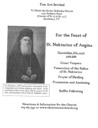
Our Righteous Father Steven the Sabbaite

Saint Steven passed his life in ascetical discipline in the Monastery of Saint Sabbas, from whence also he received the name Sabbaite. He was consecrated bishop and reposed about the year 790, bequeathing to the Church a number of melismatic troparia.


October 29

Anastasia the Martyr of Rome

Saint Anastasia, who was young in age and lived in a convent, was seized by the impious. Confessing Christ openly and with boldness and enduring manifold torments, she was beheaded in the year 256, during the reign of Valerian.


October 30

Zenobios & Zenobia the Martyrs

These Saints were from Aegae in Cilicia, brought up in piety by their parents. Zenobius was a physician, and healed many freely by the power of God; because of his virtue he was consecrated Bishop of Aegae. With his sister he was taken by Lysias the Governor, and after many tortures they were beheaded, about the year 290, during the reign of Diocletian.


Hymns of the Day

Tone 3 Troparion (Resurrection)
Let the heavens rejoice!
Let the earth be glad!
For the Lord has shown strength with His arm.
He has trampled down death by death.
He has become the first born of the dead.
He has delivered us from the depths of hell,
and has granted to the world//
great mercy.

Tone 5 Troparion (St. Luke)
Let us praise with sacred songs the holy Apostle Luke,
the recorder of the joyous Gospel of Christ
and the scribe of the Acts of the Apostles;
for his writings are a testimony of the Church of Christ.
He is the physician of human weaknesses and infirmities.
He heals the wounds of our souls,//
and constantly intercedes for our salvation.

Tone 3  Kontakion (Resurrection)
On this day Thou didst rise from the tomb, O Merciful One,
leading us from the gates of death.
On this day Adam exults as Eve rejoices;
with the Prophets and Patriarchs//
they unceasingly praise the divine majesty of Thy power.

Glory to the Father, and to the Son, and to the Holy Spirit

Tone 2 Kontakion (St.Luke)
Let us praise the godly Luke;
he is the true preacher of piety, 
the orator of ineffable mysteries
and the star of the Church,
for the Word, Who alone knows the hearts of men,//
chose him, with the wise Paul, to be a teacher of the Gentiles!

now and ever and unto ages of ages. Amen.

Tone 6 Kontakion (Steadfast Protectress)
Steadfast Protectress of Christians, 
Constant Advocate before the Creator; 
despise not the entreating cries of us sinners, 
but in your goodness come speedily to help us who call on you in faith. 
Hasten to hear our petition and to intercede for us, 
O Theotokos, for you always protect those who honor you!

COMMUNION HYMN
Praise the Lord from the heavens, praise Him in the highest! 
Their proclamation has gone out into all the earth, and their words to the ends of 
the universe. Alleluia (3X)


Gospel and Epistle Readings

Epistle Reading

Prokeimenon. 4th Tone. Psalm 103.24,1.
O Lord, how manifold are your works. You have made all things in wisdom.
Verse: Bless the Lord, O my soul.

The reading is from St. Paul's Letter to the Galatians 2:16-20.

Brethren, knowing that a man is not justified by works of the law but through faith in Jesus Christ, even we have believed in Christ Jesus, in order to be justified by faith in Christ, and not by works of the law, because by works of the law shall no one be justified. But if, in our endeavor to be justified in Christ, we ourselves were found to be sinners, is Christ then an agent of sin? Certainly not! But if I build up again those things which I tore down, then I prove myself a transgressor. For I through the law died to the law, that I might live to God. I have been crucified with Christ; it is no longer I who live, but Christ who lives in me; and the life I now live in the flesh I live by faith in the Son of God, who loved me and gave himself for me.


Gospel Reading

The Reading is from Luke 16:19-31

The Lord said, "There was a rich man, who was clothed in purple and fine linen and who feasted sumptuously every day. And at his gate lay a poor man named Lazaros, full of sores, who desired to be fed with what fell from the rich man's table; moreover the dogs came and licked his sores. The poor man died and was carried by the angels to Abraham's bosom. The rich man also died and was buried; and in Hades, being in torment, he lifted up his eyes, and saw Abraham far off and Lazaros in his bosom. And he called out, 'Father Abraham, have mercy upon me, and send Lazaros to dip the end of his finger in water and cool my tongue; for I am in anguish in this flame.' But Abraham said, 'Son, remember that you in your lifetime received your good things, and Lazaros in like manner evil things; but now he is comforted here, and you are in anguish. And besides all this, between us and you a great chasm has been fixed, in order that those who would pass from here to you may not be able, and none may cross from there to us.' And he said, 'Then I beg you, father, to send him to my father's house, for I have five brothers, so that he may warn them, lest they also come into this place of torment.' But Abraham said, 'They have Moses, and the prophets; let them hear them.' And he said, 'No, father Abraham; but if some one goes to them from the dead, they will repent.' He said to them, 'If they do not hear Moses and the prophets, neither will they be convinced if some one should rise from the dead.'"


Wisdom of the Fathers

For if we, going about on the earth which is familiar and well known to us, being encompassed with a body, when we are journeying in a strange road, know not which way to go unless we have some one to lead us; how should the soul, being rent away from the body, and having gone out from all her accustomed region, know where to walk without one to show her the way?
St. John Chrysostom
Homily 28 on Matthew 8, 4th Century

Some say, 'Why do they [demons] possess people?' I answer those who wish to have this explained that the reason of these things is very deep. Somewhere one of His saints addressed God by saying, 'Your judgments are a vast abyss.' As long as we bear this in mind, we will perhaps not miss the mark.
St. Cyril of Alexandria
Commentary on Luke, Homily 44. (Ancient Christian Commentary on Scripture; vol 3: Luke, Intervarsity Press)


Beyond the Sermon

The following is Book 5 of the Ancient Practices series.

Summary of Tithing: Test Me in This by Douglas LeBlanc
Tithing: Test Me in This (2010) is a nonfiction Christian book in the Ancient Practices series in which journalist Douglas LeBlanc explores the spiritual discipline of tithing—the practice of giving a tenth of one's income to God’s work. Rather than presenting a theological argument alone, LeBlanc tells the stories of real people from diverse Christian traditions (and even Jewish perspectives) who have made tithing a central part of their lives.

Main Theme
The book argues that tithing is not primarily about money; it is about trusting God, cultivating generosity, and freeing oneself from the grip of materialism. LeBlanc presents tithing as a spiritual practice that shapes character and deepens faith rather than as a burdensome religious obligation.

What the Book Covers
Through interviews and profiles, LeBlanc examines:
* People who tithe despite financial hardship.

* Church leaders who view tithing as an act of worship.

* Christians who use their resources to support missions, community development, and disaster relief.

* Believers from different denominations who have experienced greater joy, purpose, and dependence on God through consistent giving. A recurring biblical foundation is Malachi 3:10 (“Test me in this”), which the author uses to frame the challenge of trusting God through generous giving.


Key Lessons
1. Tithing is an act of faith. Giving regularly requires trusting God with one’s finances.

2. Generosity transforms the giver. The people profiled often describe increased contentment and freedom from greed.

3. Tithing builds community. Financial giving supports churches, ministries, and people in need.

4. The real blessing is spiritual. While some contributors report tangible benefits, the book emphasizes spiritual growth, joy, and compassion rather than a “prosperity gospel” promise of wealth.


Overall Impression
LeBlanc writes more like a reporter than a preacher. The book is largely a collection of personal stories and interviews that illustrate how tithing works in everyday life. Its purpose is to encourage readers to consider generosity as a lifelong spiritual discipline and to see tithing as a practical expression of faith, gratitude, and stewardship. In one sentence: The book portrays tithing as a transformative spiritual practice that helps believers trust God, live generously, and find deeper joy in serving others.


A Little Extra