St. Alexis of Wilkes-Barre Orthodox Church
Publish Date: 2026-09-06
Bulletin Contents

Organization Icon
St. Alexis of Wilkes-Barre Orthodox Church

General Information

  • Phone:
  • 860-664-9434
  • Street Address:

  • PO Box 134, 108 E Main St

  • Clinton, CT 06413-0134


Contact Information


Services Schedule

Please see our online calendar for dates and times of Feast Day services.


Past Bulletins


Welcome

Jesus Christ teaches us to love and serve all people, regardless of their ethnicity or nationality. To understand this, we need to look no further than to the Parable of the Good Samaritan (Luke 10:25-37). Every time we celebrate the Divine Liturgy, it is offered "on behalf of all, and for all." As Orthodox Christians we stand against racism and bigotry. All human beings share one common identity as children of God. "There is neither Jew nor Greek, slave nor free, male nor female, for you are all one in Christ Jesus" (Galatian 3:28)

To Our Guests
Throughout our services, we use the more formal "thy" and "thou" or what is commonly referred to as King Jamesean English.  The Lord's Prayer is recited as follows:

Our Father, who art in heaven, hallowed be thy Name,
Thy Kingdom come, Thy Will be done, as on earth as it is in heaven,
Give us this day our daily bread, and forgive us our debts, as we forgive our debtors,
Lead us not into temptation but deliver us from the Evil One.

Please join us after Liturgy for refreshments and hospitality.

Pastoral Care - General Information

Emergency Sick Calls can be made at any time. Please call Fr Steven at (860) 322-2906, when a family member is admitted to the hospital.
Anointing in Sickness: The Sacrament of Unction is available in Church, the hospital, or your home, for anyone who is sick and suffering, however severe. 
Marriages and Baptisms require early planning, scheduling and selections of sponsors (crown bearers or godparents). See Father before booking dates and reception halls!
Funerals are celebrated for practicing Orthodox Christians. Please see Father for details. The Church opposes cremation; we cannot celebrate funerals for cremations.

Members of our Parish Council are:

Marlene Melesko - President
Sarah Senetcen - Member at Large
Boris Doph - Treasurer
Dierdre Cottergarfield - Vice President
Luba Martins - Secretary

Mission Statement
St. Alexis Orthodox Christian Church is a local English speaking community of the Orthodox Church in America (OCA) on the shoreline of Connecticut.

St. Alexis exists to:

  • Call all people to Christ
  • Worship as a community 
  • Experience the joy of Christ in our lives 
  • Share this joy with those around us 
  • Educate people about the Truth and Presence of Orthodoxy 
  • We offer the love of Christ to those in need, both in word and action.


Announcements

Tag Sale

We are planning on a Tag Sale for Saturday, Sept 19th. There are sign up sheets on the back candle desk. Thank you to those who have already signed up. A detail email will becoming out within the next few days from Stasia PenkoffLedbeck, in which she will describe the kind of help we will be needing. Please note that we will not be accepting electronics and large furniture. If you do bring large-ish items for donation, and they are not "sold", we ask that you be responsible for taking care of these items during the clean-up.

Exaltation of the Cross

While this Feast is commemorated the 14th of this month, it being a Monday; instead we will celebrate the Elevation of the Cross on the Sunday the 13th. This means that Vespers on Saturday (the 12th) and Liturgy will be dedicated to the Cross.

AED Use

Video instructions for the use of the Automated Electronic Defibulators can be found here:

https://drive.google.com/open?id=1Qas3q7O3mletF8ceJOq9g4uQzReii8GG&usp=drive_fs

Filesharing

https://sites.google.com/stalexischurch.net/parish/home

If you are asked to enter a username and password, please contact Fr Steven via email.

If you would like to update yourself on the current status of the Strategic Planning, please use the following link.

https://sites.google.com/stalexischurch.net/parish/strategic-planning


Prayers, Intercessions and Commemorations

Again we pray that we may be made worthy of founding in our Diocese a monastery in honor
of our Most Holy Lady the Theotokos and Ever-Virgin Mary, let us pray to the Lord!

Pray for: All those confined to hospitals, nursing homes, and their own homes due to illness; for all those who serve in the armed forces; widows, orphans, prisoners, victims of violence, and refugees;

All those suffering chronic illness, financial hardship, loneliness, addictions, abuse, abandonment and despair; those who are homeless and dispossesed, those who are institutionalize, those who have no one to pray for them;

All Orthodox seminarians & families; all Orthodox monks and nuns, and all those considering monastic life; all Orthodox missionaries and their families.

All those who have perished due to hatred, intolerance, predjudice; pestilence and natural disaster; all those departed this life in the hope of the Resurrection.

Please let Fr. Steven know via email if you have more names for which to pray.

  • Departed: 
  • Clergy and their families: Fr Sergei B, Fr Vladimir, Fr Vladimir, Fr John, 
    Fr Alexander,
  • ​Catechumen: Joshua Figueroa
  • Individuals and Families: Luba, Suzanne, Rosemary,  Daniel & Dayna, Kristen, Victor, Susan, Gregory, Nina, Jordan, Christiana,
  • Birthdays and Name’s Days this Month: Katy Jankura (9/12), Carolyn Neiss (9/16)
  • Anniversaries this Month:  Fr’s Ordination (9/18)
  • ​Expecting and Newborn:  
  • Traveling: Jordan & Christiana, Marlene & Vinny
  • ​Sick and those in distress: Nancy, Boris, Glenn, John, Joan, Sharon, William, Sharon, Alexander, Olga, Christine, Tatianna, Stormy, Maria, Blanche

Today’s commemorated feasts and saints

14th SUNDAY AFTER PENTECOST — Tone 5. Commemoration of the Miracle of the Archangel Michael at Colossæ. Martyrs Eudoxius, Zeno, and Macarius (311-312). St. Archippus (Arkhipp) of Herapolis. Martyr Romulus, and with him many others (107-115). Hieromartyr Cyril, Bishop of Gortyna (3rd-4th c.). Martyrs Cyriacus, Faustus the Presbyter, Abibas the Deacon, and 11 others, at Alexandria (ca. 250). St. David of Hermopolis, Egypt (4th c.). Hieromartyr Priest Maxim Sandovich (1914).

Again we pray for those who have lost their lives because of the wars in Ukraine and in the Middle East: that the Lord our God may look upon them with mercy, and give them rest where there is neither sickness, or sorrow, but life everlasting.

Again we pray for mercy, life, peace, health, salvation, for those who are suffering, wounded, grieving, or displaced because of the wars in Ukraine and in the Middle East.

Again we pray for a cessation of the hostilities against Ukraine and the Middle East, and that reconciliation and peace will flourish there, we pray thee, hearken and have mercy.

Again we pray thee, O Lord our God: We are all called to be the branches of the spiritual vine that grew from the seeds of the Orthodox Faith that our missionary fathers, Herman and Innocent and their companions, planted and nurtured among the native peoples of Alaska, a vine that bears fruit to this day throughout our land, as we imitate the virtues of those husbandmen, of the many saints known only to God, of the Martyr Peter the Aleut, and of our Mother Olga of Kwethluk; through their intercessions, O Lord, hear us and have mercy!

Again we pray thee, O God our Savior: Look with favor upon us, the families and spiritual children of the peoples who came to our land from the old world and brought with them the Orthodox Faith, which they held fast and nurtured in their labors in the mines and mills and on the farms of this new land, and among the challenges of its great cities; we pray thee, O Lord, hear us and have mercy!

Again we pray thee, O Lord our God: We have thy Mother as the Protectress of Orthodox Christians in our North American lands; as we joyfully celebrate her patronage and her miracles, we pray thee, O Lord, through her intercessions, in all our challenges, hear us and have mercy!


Parish Calendar

  • St Alexis Parish

    September 6 to September 14, 2026

    Sunday, September 6

    14th Sunday after Pentecost

    9:15AM 3rd Hour

    9:30AM Divine Liturgy

    Monday, September 7

    Forefeast of Nativity

    Tuesday, September 8

    Nativity of the Most-Holy Theotokos

    8:30AM Daily Matins

    Wednesday, September 9

    Righteous Joachim and Anna; Ven. Joseph of Volotsk

    Thursday, September 10

    Martyrs Menodora, Metrodora, Nymphodora

    +Deborah Bray

    8:30AM Daily Matins

    Friday, September 11

    Ven. Theodora of Alexandria; Trans. Rel. Ven. Sergius and Herman

    Saturday, September 12

    Saturday before Elevation

    Kathryn Jankura - B

    5:30PM Great Vespers

    Sunday, September 13

    15th Sunday after Pentecost

    9:15AM 3rd Hour

    9:30AM Divine Liturgy

    Monday, September 14

    Exaltation (Elevation) of the Precious Cross


Saints and Feasts

September 06

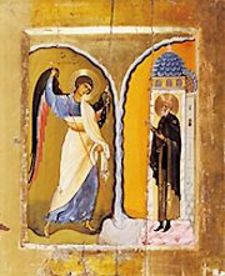
The Commemoration of the Miracle Wrought by Archangel Michael in Colossae (Chonae)

The feast today in honour of the Archangel Michael commemorates the great miracle he wrought when he delivered from destruction a church and holy spring named for him. The pagans, moved by malice, sought to destroy the aforesaid church and holy spring by turning the course of two rivers against them. But the Archangel appeared and, by means of the Cross and a great earthquake that shook the entire area, diverted the waters into an underground course. Henceforth, the name of that place changed from Colossae to Chonae, which means "funnels" in Greek.


September 08

The Nativity of Our Most Holy Lady the Theotokos and Ever-Virgin Mary

According to the ancient tradition of the Church, the Theotokos was born of barren and aged parents, Joachim and Anna, about the year 16 or 17 before the birth of Christ. Joachim was descended from the royal line of David, of the tribe of Judah. Anna was of the priestly tribe of Levi, a daughter of the priest Matthan and Mary, his wife.


September 09

The Holy & Righteous Ancestors of God, Joachim and Anna

Today, the day following the Nativity of the most holy Theotokos, we celebrate the synaxis of Saints Joachim and Anna, honouring them as her parents.


September 11

Euphrosynos the Cook

Our Holy Father Euphrosynos (Euphrósynos)1 the Cook was born into a peasant family, and had no schooling, but he was truly devout and faithful.

As an adult, he became a cook, and was able to save money out of his expenses by depriving himself, but only for the sake of almsgiving. His position as a cook permitted him to eat the best food first, but he never took advantage of this privilege. He ate his greens and olives gratefully, while the most appetizing meats and most tantalizing fish were cooking before him.

Later Euphrosynos went to a monastery, where his obedience was to work in the kitchen as a cook. In contrast to the meals that he used to prepare in secular hotels, he made very plain food in the monastery. To those who complained and mocked him, Euphrosynos meekly replied: "Good cooking is not useful for attaining the Kingdom of Heaven. The more the body craves pleasure, the more the soul will lose that which it truly needs. It is not my intention to punish you."

Some of the monks scorned him because of his coarse rustic background, but he endured their contempt in silence and was not disturbed by it. Saint Euphrosynos strove to please the Lord by his virtuous life, which he concealed from others, but the Lord Himself revealed to the monastic brethren just what spiritual heights their cook had attained.

In the same monastery there was a devout priest who prayed that he might know what good things are prepared for those who love God. One night, as he was sleeping, he found himself in a beautiful garden, where, to his astonishment, he beheld the most wondrous things. Then he saw Father Euphrosynos, the monastery cook standing in the garden and partaking of the good things of that place. As he approached the cook, he asked to whom the garden belonged, and how he came to be there.

Saint Euphrosynos replied, "This garden is reserved for God's elect, and by His great goodness, I also dwell here."

Then the priest asked him what he did in the garden. The Saint told him, "I have authority over all the things you see here. I rejoice and am filled with gladness and the spiritual enjoyment of them."

The priest questioned him again, "Can you give me something of these good things?"

"Certainly," he replied, "by God's grace, take whatever you wish."

Pointing to some apples, he inquired if he might have some of them. Taking a few of the apples, Saint Euphrosynos placed them in the priest's outer garment saying, "Receive that which you requested, and may you delight in them."

At that moment the semantron was heard, summoning the Fathers to the Midnight Service. When the priest awakened, he thought that his vision was just a dream. But when he reached for his outer garment, he found the apples which the cook had given him, and he could still smell their wonderful fragrance.

He got out of bed and then hurried to church. There he saw Euphrosynos and asked him where he had been that night. The Saint said, "Forgive me, Father, I have not been anywhere tonight. I have just come to church or the Service."

The priest urged him to tell the truth, so that God's glory might be made manifest. The humble Euphrosynos told him, "I was in the place where the good things are, which those who love God shall inherit, and which for many years you wished to behold. There you saw me enjoying the blessings of that garden; for God had deigned to reveal to you the blessings of the Just. He has performed this miracle through me, the lowly one."

"Father Euphrosynos, what did you give me from that garden?"

He replied, "The delightful and most fragrant apples which you just put on your bed. Forgive me, Father, for I am a worm and not a man."

When the service of Matins was over, the priest told the brethren about his vision and showed them the apples. They noticed the ineffable fragrance with spiritual joy, marveling at what the priest had told them. Rushing into the kitchen, they found that Saint Euphrosynos had already left the monastery, fleeing from the glory of men, and he could not be found.

The brethren shared the apples among themselves and, as a blessing, gave pieces to those who visited the monastery, especially for those in need of healing, for those who ate the apples were cured of their ailments. Many received benefit from the gift of Saint Euphrosynos. An account of this vision was written, not only on paper, but also in their hearts.

Finally, Saint Euphrosynos reposed in a remote Hēsykhastḗrion. The Church, knowing that a king or a philosopher is not more worthy to enter the Kingdom of Heaven than a cook, has numbered Euphrosynos the Cook among her Saints, for he knew God's will and lived according to it..

A fragment of the Saint's relics is located in the Monastery of Loukous in the Holy Metropolis of Mantineia and Kynouria in Greece.

1 The name Euphrosynos means gladness or delight.


September 13

Cornelius the Centurion & Martyr

Saint Cornelius was a Roman by race, a pagan by religion, a centurion in rank, an inhabitant of Caesarea of Palestine, a man pious and God-fearing who gave many alms to the people and prayed continually unto God. In accordance with an angelic vision granted to him, he sent to Joppa that they might bring the Apostle Peter. Saint Peter catechized him in the Faith of Christ and baptized all his household (Acts, ch.10). This became the beginning and the first fruits of the calling of the nations. It is said that, after this, he became a bishop, as some say, of Caesarea; but others say of Scepsis, which is not far from Troas; and that he died as a martyr.


Hymns of the Day

Tone 5    Troparion    (Resurrection)
Let us, the faithful, praise and worship the Word,
co-eternal with the Father and the Spirit,
born for our salvation from the Virgin;
for He willed to be lifted up on the Cross in the flesh,
to endure death,
and to raise the dead//
by His glorious Resurrection.

Tone 4    Troparion (St. Alexis)
O righteous Father Alexis, our heavenly intercessor and teacher, 
divine adornment of the Church of Christ! 
Entreat the Master of All to strengthen the Orthodox Faith in America, 
to grant peace to the world and to our souls great mercy.

Tone 4    Troparion    (Archangel Michael)
O Michael, commander of the heavenly hosts,
we who are unworthy beseech thee:
by thy prayers encompass us beneath the wings of thine immaterial glory,
and faithfully preserve us who fall down and cry out to thee://
“Deliver us from all harm, for thou art the commander of the Powers on high!”

Tone 5     Kontakion    (Resurrection)
Thou didst descend into hell, O my Savior,
shattering its gates as Almighty,
resurrecting the dead as Creator,
and destroying the sting of death.
Thou hast delivered Adam from the curse, O Lover of man,//
and we cry to Thee: “O Lord, save us!”

Tone 5    Kontakion (St. Alexis)
Let us, the faithful praise the Priest Alexis, 
a bright beacon of Orthodoxy in America, a model of patience and humility, 
a worthy shepherd of the Flock of Christ. 
He called back the sheep who had been led astray 
and brought them by his preaching to the Heavenly Kingdom.

Glory to the Father, and to the Son, and to the Holy Spirit

Tone 2    Kontakion    (Archangel Michael)
O Michael, commander of God’s armies
and minister of the divine glory,
prince of the bodiless angels
and guide of mankind;
ask for what is good for us, and for great mercy,//
as the supreme commander of the Bodiless Hosts.

now and ever and unto ages of ages. Amen.

Tone 6    Kontakion (Steadfast Protectress)
Steadfast Protectress of Christians, 
Constant Advocate before the Creator; 
despise not the entreating cries of us sinners, 
but in your goodness come speedily to help us who call on you in faith. 
Hasten to hear our petition and to intercede for us, 
O Theotokos, for you always protect those who honor you!

COMMUNION HYMN
Praise the Lord from the heavens, praise Him in the highest! Alleluia (3X)


Gospel and Epistle Readings

Epistle Reading

Prokeimenon. 5th Tone. Psalm 11.7,1.
You, O Lord, shall keep us and preserve us.
Verse: Save me, O Lord, for the godly man has failed.

The reading is from St. Paul's Second Letter to the Corinthians 1:21-24; 2:1-4.

Brethren, it is God who establishes us with you in Christ, and has commissioned us; he has put his seal upon us and given us his Spirit in our hearts as a guarantee.

But I call God to witness against me - it was to spare you that I refrained from coming to Corinth. Not that we lord it over your faith; we work with you for your joy, for you stand firm in your faith. For I made up my mind not to make you another painful visit. For if I cause you pain, who is there to make me glad but the one whom I have pained? And I wrote as I did, so that when I came I might not suffer pain from those who should have made me rejoice, for I felt sure of all of you, that my joy would be the joy of you all. For I wrote you out of much affliction and anguish of heart and with many tears, not to cause you pain but to let you know the abundant love that I have for you.


Gospel Reading

14th Sunday of Matthew
The Reading is from Matthew 22:2-14

The Lord said this parable, "The kingdom of heaven may be compared to a king who gave a marriage feast for his son, and sent his servants to call those who were invited to the marriage feast; but they would not come. Again he sent other servants, saying, 'Tell those who are invited, Behold, I have made ready my dinner, my oxen and my fat calves are killed, and everything is ready; come to the marriage feast.' But they made light of it and went off, one to his farm, another to his business, while the rest seized his servants, treated them shamefully, and killed them. The king was angry, and he sent his troops and destroyed those murderers and burned their city. Then he said to his servants, 'The wedding is ready, but those invited were not worthy. Go therefore to the thoroughfares, and invite to the marriage feast as many as you find.' And those servants went out into the streets and gathered all whom they found, both bad and good; so the wedding hall was filled with guests.

But when the king came in to look at the guests, he saw there a man who had no wedding garment; and he said to him, 'Friend, how did you get in here without a wedding garment?' And he was speechless. Then the king said to the attendants, 'Bind him hand and foot, and cast him into the outer darkness; there men will weep and gnash their teeth.' For many are called, but few are chosen."


Wisdom of the Fathers

Prayer should not depend upon our mood or good will. If we are in a bad state, it’s because we are filled with sin. Thus, we need to repent. Every day, examine your conscience and repent. Force yourself to pray regularly every day. If you don’t want to do that, then you need to repent of that. You must understand how necessary this is. Know that the devil lurks and waits to destroy your soul, and that you are always in danger. Prayer alone will give your soul the strength to resist. In order to acquire spiritual muscles, you have to go to the spiritual gym.
Elder Sergei of Vanves †
Calendar Company, Orthodox . Wisdom of the Divine Philosophers-Volume Four (p. 142). (Function). Kindle Edition.


Beyond the Sermon

Giving and Receiving
By Father Michael Oleksa
AGAIN, Vol. 27, No. 3, Fall 2005


The first story I ever heard from my Yup’ik Eskimo friends centered on the First People and their encounter with Raven, the mythic creature of heaven and earth. Native Alaskans never worshiped ravens or big black birds, but their stories related how, whenever the Creators wanted to appear in some visible form on earth, the preferred shape was that of raven. They understood the appearance of the Holy Spirit in the form of a dive readily, remembering that the Raven was originally white too.

According to the ancient story, raven was walking along the beach one morning and discovered the first people, naked in their primal innocence, and strolled around them, inspecting these new creatures.

“What kind of animals are you?” Raven exclaimed. “ No feathers and not enough fur! Pitiful! Hopeless! You’ll die in the first frost in this Artic Paradise!

But Raven had second thoughts about letting these helpless folks perish. Raven called a convocation of all the animals and noted that without fangs, claws, feathers, or fur these newcomers had no chance of survival. He asked the animals for their advice.

Their response was generous. “They are pretty ridiculous,” the animals agreed, “ but they are kind of cute. Let’s keep them.”

“That’s very kind of you,” said Raven, “but how will that be possible?”

The animals replied, “We’ll give them our skins and hides for clothing, and they can use our flesh for meat.”

“That’s very generous of you,” said Raven, “but would you want in return?”

The animals answered unanimously, “We will require gratitude and respect from the human beings.”

And so it was, at the beginning of human history, that a covenant was conclued between the people and animals. The animals see what humans cannot see. They hear what humans cannot hear. They smell what humans cannot smell. They know things humans do not know, and can do things humans cannot do. Besides this, they cooperate. They are in cahoots. They understand each others languages, so that if the moose with his big ears and nose does not hear or smell the approach of a human hunter, the sparrow will certainly alert him. Humans cannot succeed as hunters in this world unless the animals give themselves, so that the otherwise helpless and hopeless human beings can survive.

Humans, for their part, must express there gratitude and respect by speaking humbly about the animals, using and consuming their hides and meat without abusing or wasting them, decorating their weapons, their utensils, and even their homes with the images of animals whose self-sacrifice sustain them. They musteven return the portions of the animals bodies, the bones that have no further use, to the animal has harvested, as a final gesture of appreciation.

Giving back to the source of our life some portion of what was feely given has been a fundamental principle of life in Alaskan cultures. Failing to offer something back upsets the balance of the universe, distorts, the proper cosmic balance, threatens the very survival of human beings.  Hunter/gatherer cultures can never forget to express their gratitude to the animals who give themselves, sacrifice themselves, to sustain the People.

Only when we live so isolated from the very sources of our lives, only when we develop a distorted and haughty view of the place humanity occupies within nature, only when we no longer can appreciate that life is a gift, and that our survival depends on the continuation of this gift, to which we have no “right” – only then will we question our need to respond in gratitude and love to the “Treasury of blessings and Giver of Life.”

The biblical standard of giving back to God was ten percent, but when we think in terms of the ancient Alaskans, we actually owe God one hundred percent.  It is Christ who fulfills the ancient spiritual intuition of the Native Alaskans, by revealing the ultimate Self-Sacrifice for the salvation of the world, the destruction of Hades and death itself, and the transfiguration of the creation into God’s Kingdom.

The Liturgy challenges us, in fact, to “commend ourselves and each other and all our life to Christ our God.”  If we offer only our tithe, we, in fact, are getting off cheaply.  Christ offers us Himself totally, and God will not really be “satisfied” until we reciprocate, with all. 


Fr. Michael J. Oleksa is a missionary priest in Alaska, and formerly an adjunct professor at the St. Patriarch Tikhon’s Theologicsl Institute, Moscow.  He is the author of several books, including “Alaskan Missionary Spirituality” and “Orthodox Alaska:  A Theology of Mission.”


This article is re-typed from:  “Giving and Receiving”, Fall, 2005, AGAIN, The Ancient Christian Faith Today, Vol. 27, No. 3, P34.