June 28

St. Nicholas Greek Orthodox Church
Publish Date: 2026-06-28
Bulletin Contents

St. Nicholas Greek Orthodox Church
General Information
- Phone:
- (734) 332-8200
- Fax:
- (734) 332-8201
- Email:
- [email protected]
- Street Address:
- 3109 Scio Church Road
- Ann Arbor, MI 48103
Contact Information
Services Schedule
9:00 am Orthros
10:00 am Divine Liturgy
Office closed during all church services.
Past Bulletins
- Publish Date:
- 2026-07-26
- Publish Date:
- 2026-07-19
- Publish Date:
- 2026-07-12
- Publish Date:
- 2026-07-05
- Publish Date:
- 2026-06-21
- Publish Date:
- 2026-06-14
Hymns of the Day
Resurrectional Apolytikion in the Third Mode
Let the heavens be glad. Let the earth rejoice exceedingly. For the Lord has shown strength with his arm. He trampled death by death. He became the first-born of the dead. Out of the belly of Hades, He has rescued us, and to the world He has granted the great mercy.
Εὐφραινέσθω τὰ οὐράνια, ἀγαλλιάσθω τὰ ἐπίγεια, ὅτι ἐποίησε κράτος, ἐν βραχίονι αὐτοῦ, ὁ Κύριος, ἐπάτησε τῷ θανάτῳ τὸν θάνατον, πρωτότοκος τῶν νεκρῶν ἐγένετο, ἐκ κοιλίας ᾅδου ἐρρύσατο ἡμᾶς, καὶ παρέσχε τῷ κόσμῳ τὸ μέγα ἔλεος.
Seasonal Kontakion in the Second Mode
A protection of Christians unshamable, intercessor to our Holy Maker, unwavering, please reject not the prayerful cries of those who are in sin. Instead, come to us, for you are good; your loving help bring unto us, who are crying in faith to you: hasten to intercede and speed now to supplicate, as a protection for all time, Theotokos, for those who honor you.
Προστασία τῶν Χριστιανῶν ἀκαταίσχυντε, μεσιτεία πρὸς τὸν Ποιητὴν ἀμετάθετε. Μὴ παρίδῃς ἁμαρτωλῶν δεήσεων φωνάς, ἀλλὰ πρόφθασον, ὡς ἀγαθή, εἰς τὴν βοήθειαν ἡμῶν, τῶν πιστῶς κραυγαζόντων σοι· Τάχυνον εἰς πρεσβείαν, καὶ σπεῦσον εἰς ἱκεσίαν, ἡ προστατεύουσα ἀεί, Θεοτόκε, τῶν τιμώντων σε.
Gospel and Epistle Readings
Matins Gospel Reading
Fourth Orthros Gospel
The Reading is from Luke 24:1-12
On the first day of the week at early dawn, the women went to the tomb, taking spices, which they had prepared. And they found the stone rolled away from the tomb, but when they went in they did not find the body of the Lord Jesus. While they were perplexed about this, behold, two men stood by them in dazzling apparel; and as they were frightened and bowed their faces to the ground, the men said to them, "Why do you seek the living among the dead? He is not here, but has risen. Remember how He told you, while He was still in Galilee, that the Son of Man must be delivered into the hands of sinful men, and be crucified, and on the third day rise." And they remembered His words and returning from the tomb they told all this to the eleven and to all the rest. Now it was Mary Magdalene and Joanna and Mary the mother of James and the other women with them who told this to the Apostles; but these words seemed to them an idle tale, and they did not believe them. But Peter rose and ran to the tomb; stooping and looking in, he saw the linen cloths by themselves; and he went home wondering at what had happened.
Fourth Orthros Gospel
Κατὰ Λουκᾶν 24:1-12
Τῇ μιᾷ τῶν Σαββάτων, ὄρθρου βαθέος ἦλθον ἐπὶ τὸ μνῆμα, φέρουσαι ἃ ἡτοίμασαν ἀρώματα, καί τινες σὺν αὐταῖς. Εὗρον δὲ τὸν λίθον ἀποκεκυλισμένον ἀπὸ τοῦ μνημείου, καὶ εἰσελθοῦσαι οὐχ εὗρον τὸ σῶμα τοῦ Κυρίου Ἰησοῦ. Καὶ ἐγένετο ἐν τῷ διαπορεῖσθαι αὐτὰς περὶ τούτου, καὶ Ἰδού, δύο ἄνδρες ἐπέστησαν αὐταῖς ἐν ἐσθήσεσιν ἀστραπτούσαις· ἐμφόβων δὲ γενομένων αὐτῶν καὶ κλινουσῶν τὰ πρόσωπον εἰς τὴν γῆν, εἶπον πρὸς αὐτάς· Τί ζητεῖτε τὸν ζῶντα μετὰ τῶν νεκρῶν; οὐκ ἔστιν ᾧδε, ἀλλ' ἠγέρθη. Μνήσθητε ὡς ἐλάλησεν ὑμῖν, ἔτι ὢν ἐν τῇ Γαλιλαίᾳ, λέγων, ὅτι δεῖ τὸν υἱὸν τοῦ ἀνθρώπου παραδοθῆναι εἰς χεῖρας ἀνθρώπων ἁμαρτωλῶν, καὶ σταυρωθῆναι, καὶ τῇ τρίτῃ ἡμέρᾳ ἀναστῆναι. Καὶ ἐμνήσθησαν τῶν ῥημάτων αὐτοῦ, καὶ ὑποστρέψασαι ἀπὸ τοῦ μνημείου, ἀπήγγειλαν ταῦτα πάντα τοῖς ἕνδεκα καὶ πᾶσι τοῖς λοιποῖς. Ἦσαν δὲ ἡ Μαγδαληνὴ Μαρία καὶ Ἰωάννα καὶ Μαρία Ἰακώβου, καὶ αἱ λοιπαὶ σὺν αὐταῖς, αἳ ἔλεγον πρὸς τοὺς ἀποστόλους ταῦτα. Καὶ ἐφάνησαν ἐνώπιον αὐτῶν ὡσεὶ λῆρος τὰ ῥήματα αὐτῶν, καὶ ἠπίστουν αὐταῖς, ὁ δὲ Πέτρος ἀναστὰς ἔδραμεν ἐπὶ τὸ μνημεῖον, καὶ παρακύψας βλέπει τὰ ὀθόνια κείμενα μόνα, καὶ ἀπῆλθε, πρὸς ἑαυτόν θαυμάζων τὸ γεγονός.
Epistle Reading
Prokeimenon. Third Mode. Psalm 46.6,1.
Sing praises to our God, sing praises.
Verse: Clap your hands, all you nations.
The reading is from St. Paul's Letter to the Romans 6:18-23.
Brethren, having been set free from sin, you have become slaves of righteousness. I am speaking in human terms, because of your natural limitations. For just as you once yielded your members to impurity and to greater and greater iniquity, so now yield your members to righteousness for sanctification.
When you were slaves of sin, you were free in regard to righteousness. But then what return did you get from the things of which you are now ashamed? The end of those things is death. But now that you have been set free from sin and have become slaves of God, the return you get is sanctification and its end, eternal life. For the wages of sin is death, but the free gift of God is eternal life in Christ Jesus our Lord.
Προκείμενον. Third Mode. ΨΑΛΜΟΙ 46.6,1.
Ψάλατε τῷ Θεῷ ἡμῶν, ψάλατε.
Στίχ. Πάντα τὰ ἔθνη κροτήσατε χεῖρας.
τὸ Ἀνάγνωσμα Πρὸς ῾Ρωμαίους 6:18-23.
Ἀδελφοί, ἐλευθερωθέντες δὲ ἀπὸ τῆς ἁμαρτίας, ἐδουλώθητε τῇ δικαιοσύνῃ. Ἀνθρώπινον λέγω διὰ τὴν ἀσθένειαν τῆς σαρκὸς ὑμῶν· ὥσπερ γὰρ παρεστήσατε τὰ μέλη ὑμῶν δοῦλα τῇ ἀκαθαρσίᾳ καὶ τῇ ἀνομίᾳ εἰς τὴν ἀνομίαν, οὕτως νῦν παραστήσατε τὰ μέλη ὑμῶν δοῦλα τῇ δικαιοσύνῃ εἰς ἁγιασμόν. Ὅτε γὰρ δοῦλοι ἦτε τῆς ἁμαρτίας, ἐλεύθεροι ἦτε τῇ δικαιοσύνῃ. Τίνα οὖν καρπὸν εἴχετε τότε ἐφʼ οἷς νῦν ἐπαισχύνεσθε; Τὸ γὰρ τέλος ἐκείνων θάνατος. Νυνὶ δὲ ἐλευθερωθέντες ἀπὸ τῆς ἁμαρτίας, δουλωθέντες δὲ τῷ θεῷ, ἔχετε τὸν καρπὸν ὑμῶν εἰς ἁγιασμόν, τὸ δὲ τέλος ζωὴν αἰώνιον. Τὰ γὰρ ὀψώνια τῆς ἁμαρτίας θάνατος, τὸ δὲ χάρισμα τοῦ θεοῦ ζωὴ αἰώνιος ἐν Χριστῷ Ἰησοῦ τῷ κυρίῳ ἡμῶν.
Gospel Reading
4th Sunday of Matthew
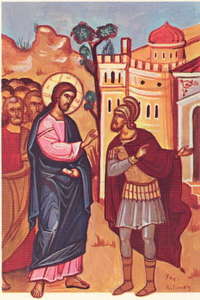
The Reading is from Matthew 8:5-13
At that time, as Jesus entered Capernaum, a centurion came forward to him, beseeching him and saying, "Lord, my servant is lying paralyzed at home, in terrible distress." And he said to him, "I will come and heal him." But the centurion answered him, "Lord, I am not worthy to have you come under my roof; but only say the word, and my servant will be healed. For I am a man under authority, with soldiers under me; and I say to one, 'Go,' and he goes, and to another, 'Come,' and he comes, and to my slave, 'Do this,' and he does it." When Jesus heard him, he marveled, and said to those who followed him, "Truly, I say to you, not even in Israel have I found such faith. I tell you, many will come from east and west and sit at table with Abraham, Isaac, and Jacob in the kingdom of heaven, while the sons of the kingdom will be thrown into the outer darkness; there men will weep and gnash their teeth." And to the centurion Jesus said, "Go; be it done for you as you have believed." And the servant was healed at that very moment.
4th Sunday of Matthew
Κατὰ Ματθαῖον 8:5-13
Τῷ καιρῷ ἐκείνῳ, εἰσελθόντι δὲ αὐτῷ εἰς Καπερναοὺμ προσῆλθεν αὐτῷ ἑκατόνταρχος παρακαλῶν αὐτὸν καὶ λέγων· Κύριε, ὁ παῖς μου βέβληται ἐν τῇ οἰκίᾳ παραλυτικός, δεινῶς βασανιζόμενος. καὶ λέγει αὐτῷ ὁ ᾿Ιησοῦς· ἐγὼ ἐλθὼν θεραπεύσω αὐτόν. καὶ ἀποκριθεὶς ὁ ἑκατόνταρχος ἔφη· Κύριε, οὐκ εἰμὶ ἱκανὸς ἵνα μου ὑπὸ τὴν στέγην εἰσέλθῃς· ἀλλὰ μόνον εἰπὲ λόγῳ, καὶ ἰαθήσεται ὁ παῖς μου. καὶ γὰρ ἐγὼ ἄνθρωπός εἰμι ὑπὸ ἐξουσίαν, ἔχων ὑπ᾿ ἐμαυτὸν στρατιώτας, καὶ λέγω τούτῳ, πορεύθητι, καὶ πορεύεται, καὶ ἄλλῳ, ἔρχου, καὶ ἔρχεται, καὶ τῷ δούλῳ μου, ποίησον τοῦτο, καὶ ποιεῖ. ἀκούσας δὲ ὁ ᾿Ιησοῦς ἐθαύμασε καὶ εἶπε τοῖς ἀκολουθοῦσιν· ἀμὴν λέγω ὑμῖν, οὐδὲ ἐν τῷ ᾿Ισραὴλ τοσαύτην πίστιν εὗρον. λέγω δὲ ὑμῖν ὅτι πολλοὶ ἀπὸ ἀνατολῶν καὶ δυσμῶν ἥξουσι καὶ ἀνακλιθήσονται μετὰ ᾿Αβραὰμ καὶ ᾿Ισαὰκ καὶ ᾿Ιακὼβ ἐν τῇ βασιλείᾳ τῶν οὐρανῶν, οἱ δὲ υἱοὶ τῆς βασιλείας ἐκβληθήσονται εἰς τὸ σκότος τὸ ἐξώτερον· ἐκεῖ ἔσται ὁ κλαυθμὸς καὶ ὁ βρυγμὸς τῶν ὀδόντων. καὶ εἶπεν ὁ ᾿Ιησοῦς τῷ ἑκατοντάρχῳ· ὕπαγε, καὶ ὡς ἐπίστευσας γενηθήτω σοι. καὶ ἰάθη ὁ παῖς αὐτοῦ ἐν τῇ ὥρᾳ ἐκείνῃ.
Saints and Feasts


June 28
Finding of the Relics of Cyrus and John the Unmercenaries
These Saints lived during the years of Diocletian. Saint Cyrus was from Alexandria, and Saint John was from Edessa of Mesopotamia. Because of the persecution of that time, Cyrus fled to the Gulf of Arabia, where there was a small community of monks. John, who was a soldier, heard of Cyrus' fame and came to join him. Henceforth, they passed their life working every virtue, and healing every illness and disease freely by the grace of Christ; hence their title of "Unmercenaries." They heard that a certain woman, named Athanasia, had been apprehended together with her three daughters, Theodora, Theoctiste, and Eudoxia, and taken to the tribunal for their confession of the Faith. Fearing lest the tender young maidens be terrified by the torments and renounce Christ, they went to strengthen them in their contest in martyrdom; therefore they too were seized. After Cyrus and John and those sacred women had been greatly tormented, all were beheaded in the year 292. Their tomb became a renowned shrine in Egypt, and a place of universal pilgrimage. It was found in the area of the modern day resort near Alexandria named Abu Kyr.

June 28
Sergios the Magister

June 28
Pappias the Martyr

June 28
Righteous Fathers Sergius and Herman, Founders of Valaam Monastery
By their life and teachings, our righteous Fathers Sergius and Herman did much to spread and confirm Orthodoxy among the Karelian Finns, who had suffered much oppression at the hands of Swedes of the Latin creed. They founded on Lake Ladoga the renowned Monastery of Valaam, which later became one of the chief centers of the monastic life. Both Saints reposed about 1353.

June 28
Synaxis of the Icon of our Most Holy Lady the Theotokos
The great defender of the Orthodox Faith against the Iconoclasts, our righteous Father John of Damascus (See Dec. 4), was slandered to the Caliph of Damascus by the Iconoclast Emperor Leo the Isaurian (reigned 717-741). Saint John was accused of sedition and his right hand was cut off. Having asked for the severed hand, Saint John passed the night in great pain, praying for the aid of the most holy Theotokos. Awaking from sleep, he found that his hand had been miraculously restored, with only a red scar about the wrist where it had been severed, as a testimony to the wonderous healing. In thanksgiving, he had a silver hand attached to the icon to commemorate this great miracle. On becoming a monk in the lavra of Saint Sabbas the Sanctified in the Holy Land, John brought the icon with him. There it remained until the thirteenth century, when it was given to Saint Sabbas of Serbia (see Jan. 14), who brought it to Serbia, where it remained for a time. Later, it was miraculously transported by an unguided donkey that carried it to the Serbian Monastery of Hilandar on the Holy Mountain, Athos, where it remains to this day.

June 28
Paul the Physician of Corinth

June 29
Peter and Paul, the Holy Apostles
The divinely-blessed Peter was from Bethsaida of Galilee. He was the son of Jonas and the brother of Andrew the First-called. He was a fisherman by trade, unlearned and poor, and was called Simon; later he was renamed Peter by the Lord Jesus Christ Himself, Who looked at him and said, "Thou art Simon the son of Jonas; thou shalt be called Cephas (which is by interpretation, Peter)" (John 1:42). On being raised by the Lord to the dignity of an Apostle and becoming inseparable from Him as His zealous disciple, he followed Him from the beginning of His preaching of salvation up until the very Passion, when, in the court of Caiaphas the high priest, he denied Him thrice because of his fear of the Jews and of the danger at hand. But again, after many bitter tears, he received complete forgiveness of his transgression. After the Resurrection of Christ and the descent of the Holy Spirit, he preached in Judea, Antioch, and certain parts of Asia, and finally came to Rome, where he was crucified upside down by Nero, and thus he ascended to the eternal habitations about the year 66 or 68, leaving two Catholic (General) Epistles to the Church of Christ.
Paul, the chosen vessel of Christ, the glory of the Church, the Apostle of the Nations and teacher of the whole world, was a Jew by race, of the tribe of Benjamin, having Tarsus as his homeland. He was a Roman citizen, fluent in the Greek language, an expert in knowledge of the Law, a Pharisee, born of a Pharisee, and a disciple of Gamaliel, a Pharisee and notable teacher of the Law in Jerusalem. For this cause, from the beginning, Paul was a most fervent zealot for the traditions of the Jews and a great persecutor of the Church of Christ; at that time, his name was Saul (Acts 22:3-4). In his great passion of rage and fury against the disciples of the Lord, he went to Damascus bearing letters of introduction from the high priest. His intention was to bring the disciples of Christ back to Jerusalem in bonds. As he was approaching Damascus, about midday there suddenly shone upon him a light from Heaven. Falling on the earth, he heard a voice saying to him, "Saul, Saul, why persecutest thou Me?" And he asked, "Who art Thou, Lord?" And the Lord said, "I am Jesus Whom thou persecutest; it is hard for thee to kick against the pricks." And that heavenly voice and brilliance made him tremble, and he was blinded for a time. He was led by the hand into the city, and on account of a divine revelation to the Apostle Ananias (see Oct. 1), he was baptized by him, and both his bodily and spiritual eyes were opened to the knowledge of the Sun of Righteousness. And straightway- O wondrous transformation! - beyond all expectation, he spoke with boldness in the synagogues, proclaiming that "Christ is the Son of God" (Acts 9:1-21). As for his zeal in preaching the Gospel after these things had come to pass, as for his unabating labors and afflictions of diverse kinds, the wounds, the prisons, the bonds, the beatings, the stonings, the shipwrecks, the journeys, the perils on land, on sea, in cities, in wildernesses, the continual vigils, the daily fasting, the hunger, the thirst, the nakedness, and all those other things that he endured for the Name of Christ, and which he underwent before nations and kings and the Israelites, and above all, his care for all the churches, his fiery longing for the salvation of all, whereby he became all things to all men, that he might save them all if possible, and because of which, with his heart aflame, he continuously traveled throughout all parts, visiting them all, and like a bird of heaven flying from Asia and Europe, the West and East, neither staying nor abiding in any one place - all these things are related incident by incident in the Book of the Acts, and as he himself tells them in his Epistles. His Epistles, being fourteen in number, are explained in 250 homilies by the divine Chrysostom and make manifest the loftiness of his thoughts, the abundance of the revelations made to him, the wisdom given to him from God, wherewith he brings together in a wondrous manner the Old with the New Testaments, and expounds the mysteries thereof which had been concealed under types; he confirms the doctrines of the Faith, expounds the ethical teaching of the Gospel, and demonstrates with exactness the duties incumbent upon every rank, age, and order of man. In all these things his teaching proved to be a spiritual trumpet, and his speech was seen to be more radiant than the sun, and by these means he clearly sounded forth the word of truth and illumined the ends of the world. Having completed the work of his ministry, he likewise ended his life in martyrdom when he was beheaded in Rome during the reign of Nero, at the same time, some say, when Peter was crucified.