October 25

Kimisis Tis Theotokou Church
Publish Date: 2026-10-25
Bulletin Contents
Hymns of the Day
Gospel and Epistle Readings
Wisdom of the Fathers
Saints and Feasts
Diakonia Newsletter

Kimisis Tis Theotokou Church
General Information
- Phone:
- (631) 283-6169
- Fax:
- (631) 283-6271
- Email:
- [email protected]
- Street Address:
- 111 St. Andrews Road
- Southampton, NY 11968
- Mailing Address:
- 111 St. Andrews Road
- Southampton, NY 11968
Past Bulletins
- Publish Date:
- 2026-11-01
- Publish Date:
- 2026-10-18
- Publish Date:
- 2026-10-11
- Publish Date:
- 2026-10-04
- Publish Date:
- 2026-09-27
- Publish Date:
- 2026-09-20
Hymns of the Day
Resurrectional Apolytikion in the Fourth Mode
Having learned the joyful proclamation of the Resurrection from the Angel, and having cast off the ancestral condemnation, the women disciples of the Lord spake to the Apostles exultantly: Death is despoiled and Christ God is risen, granting great mercy to the world.
Apolytikion for Martyrs Marcian and Martyrius in the Fourth Mode
Thy Martyrs, O Lord, in their courageous contest for Thee received as the prize the crowns of incorruption and life from Thee, our immortal God. For since they possessed Thy strength, they cast down the tyrants and wholly destroyed the demons' strengthless presumption. O Christ God, by their prayers, save our souls, since Thou art merciful.
Seasonal Kontakion in the Second Mode
O Protection of Christians that cannot be put to shame, mediation unto the creator most constant: O despise not the voices of those who have sinned; but be quick, O good one, to come unto our aid, who in faith cry unto thee: Hasten to intercession and speed thou to make supplication, O thou who dost ever protect, O Theotokos, them that honor thee.
Gospel and Epistle Readings
Epistle Reading
Prokeimenon. Fourth Mode. Psalm 103.24,1.
O Lord, how manifold are your works. You have made all things in wisdom.
Verse: Bless the Lord, O my soul.
The reading is from St. Paul's Letter to the Galatians 2:16-20.
Brethren, knowing that a man is not justified by works of the law but through faith in Jesus Christ, even we have believed in Christ Jesus, in order to be justified by faith in Christ, and not by works of the law, because by works of the law shall no one be justified. But if, in our endeavor to be justified in Christ, we ourselves were found to be sinners, is Christ then an agent of sin? Certainly not! But if I build up again those things which I tore down, then I prove myself a transgressor. For I through the law died to the law, that I might live to God. I have been crucified with Christ; it is no longer I who live, but Christ who lives in me; and the life I now live in the flesh I live by faith in the Son of God, who loved me and gave himself for me.
Gospel Reading
6th Sunday of Luke
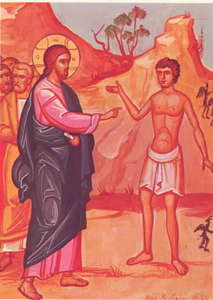
The Reading is from Luke 8:26-39
At that time, as Jesus arrived at the country of the Gadarenes, there met him a man from the city who had demons; for a long time he had worn no clothes and he lived not in a house but among the tombs. When he saw Jesus, he cried out and fell down before him, and said with a loud voice, "What have you to do with me, Jesus, Son of the Most High God? I beseech you, do not torment me." For he had commanded the unclean spirit to come out of the man. (For many a time it had seized him; he was kept under guard, and bound with chains and fetters, but he broke the bonds and was driven by the demon into the desert.) Jesus then asked him, "What is your name?" And he said, "Legion"; for many demons had entered him. And they begged him not to command them to depart into the abyss. Now a large herd of swine was feeding there on the hillside; and they begged him to let them enter these. So he gave them leave. Then the demons came out of the man and entered the swine, and the herd rushed down the steep bank into the lake and were drowned. When the herdsmen saw what happened, they fled, and told it in the city and in the country. Then people went out to see what had happened, and they came to Jesus, and found the man from whom the demons had gone, sitting at the feet of Jesus, clothed and in his right mind; and they were afraid. And those who had seen it told them how he who had been possessed with demons was healed. Then all the people of the surrounding country of the Gadarenes asked him to depart from them; for they were seized with great fear; so he got into the boat and returned. The man from whom the demons had gone begged that he might be with him; but he sent him away, saying, "Return to your home, and declare how much God has done for you." And he went away, proclaiming throughout the whole city how much Jesus had done for him.
Wisdom of the Fathers
For if we, going about on the earth which is familiar and well known to us, being encompassed with a body, when we are journeying in a strange road, know not which way to go unless we have some one to lead us; how should the soul, being rent away from the body, and having gone out from all her accustomed region, know where to walk without one to show her the way?
Homily 28 on Matthew 8, 4th Century
Some say, 'Why do they [demons] possess people?' I answer those who wish to have this explained that the reason of these things is very deep. Somewhere one of His saints addressed God by saying, 'Your judgments are a vast abyss.' As long as we bear this in mind, we will perhaps not miss the mark.
Commentary on Luke, Homily 44. (Ancient Christian Commentary on Scripture; vol 3: Luke, Intervarsity Press)
Saints and Feasts


October 25
The Holy Martyrs Marcian and Martyrius the Notaries
These Martyrs were disciples of Saint Paul the Confessor (see Nov. 6). Martyrius was a subdeacon, Marcian a chanter and reader. They were beheaded by the Arians in the year 346. Miracles were wrought at their tomb, and demons were cast out; Saint John Chrysostom began the building of the church in their honour in Constantinople, and it was completed by patriarch Sisinius.

October 25
Tabitha, who was raised from the dead by Peter the Apostle

October 25
Chrysaphios (or Chrysaphos) the Martyr

October 25
Martyr Chrysanthe

October 26
The Holy Great Martyr Demetrius the Myrrh-streamer
Saint Demetrius was a Thessalonian, a most pious son of pious and noble parents, and a teacher of the Faith of Christ. When Maximian first came to Thessalonica in 290, he raised the Saint to the rank of Duke of Thessaly. But when it was discovered that the Saint was a Christian, he was arrested and kept bound in a bath-house. While the games were under way in the city, Maximian was a spectator there. A certain friend of his, a barbarian who was a notable wrestler, Lyaeus by name, waxing haughty because of the height and strength of his body, boasted in the stadium and challenged the citizens to a contest with him. All that fought with him were defeated. Seeing this, a certain youth named Nestor, aquaintance of Demetrius', came to the Saint in the bath-house and asked his blessing to fight Lyaeus single-handed. Receiving this blessing and sealing himself with the sign of the precious Cross, he presented himself in the stadium, and said, "O God of Demetrius, help me!" and straightway he engaged Lyaeus in combat and smote him with a mortal blow to the heart, leaving the former boaster lifeless upon the earth. Maximian was sorely grieved over this, and when he learned who was the cause of this defeat, he commanded straightway and Demetrius was pierced with lances while he was yet in the bath-house, As for Nestor, Maximian commanded that he be slain with his own sword.

October 26
Eata of Hexham

October 27
Tuesday of the 6th Week

October 27
Nestor the Martyr of Thessaloniki
As mentioned in the account concerning Saint Demetrius (October 26), this Saint contested during the reign of Maximian, in the year 290.

October 26
Commemoration of the Great Earthquake in Constantinople (740)
The great earthquake commemorated here took place in 740, during the reign of Leo the Isaurian, the first of the Iconoclast emperors.

October 27
Kyriakos, Patriarch of Constantinople

October 28
Holy Protection of the Theotokos
The Feast of the Protection commemorates the appearance of the most holy Theotokos in the Church of Blachernae in Constantinople in the tenth century, as recorded in the life of Saint Andrew the Fool for Christ's sake. While the multitudes of the faithful were gathered in church, Epiphanius, the friend of Saint Andrew, through the Saint's prayers, beheld the Virgin Mary above the faithful and spreading out her veil over them, signifying her unceasing protection of all Christians. Because of this we keep a yearly feast of gratitude, imploring our Lady never to cease sheltering us in her mighty prayers.
The Feast is celebrated on October 1. In the 1950s, the Church of Greece began to observe the Feast on October 28.

October 28
Holy Martyrs Terrence and Eunice
Both the country and the time of the martyrdom of these holy Martyrs are unknown. All were beheaded, after having endured many bitter torments.

October 28
Our Righteous Father Steven the Sabbaite
Saint Steven passed his life in ascetical discipline in the Monastery of Saint Sabbas, from whence also he received the name Sabbaite. He was consecrated bishop and reposed about the year 790, bequeathing to the Church a number of melismatic troparia.

October 29
Anastasia the Martyr of Rome
Saint Anastasia, who was young in age and lived in a convent, was seized by the impious. Confessing Christ openly and with boldness and enduring manifold torments, she was beheaded in the year 256, during the reign of Valerian.

October 29
Avramios the Recluse & his niece Maria of Mesopotamia
Our Righteous Father Abramius, born in Edessa in Mesopotamia in 296, took up the monastic life and brought many pagans to Christ. Mary, his niece, upon the death of her parents, joined Abramius at his hermitage and under his guidance advanced swiftly in the love of God. Through the wiles of the evil one, however, she fell into sin, and falling from them into despair, she left her uncle and became a harlot. When he learned where his niece was, Abramius put on the clothes of a man of the world and went to visit her in disguise. Through his exhortations, Mary returned to her first hope in the mercy of God, was rescued from the life of harlotry, and ended her life in great holiness. He himself reposed in the year 366. Saints Abramius and Mary were friends of Saint Ephraim the Syrian, and it was he who wrote their account.

October 30
Zenobios & Zenobia the Martyrs
These Saints were from Aegae in Cilicia, brought up in piety by their parents. Zenobius was a physician, and healed many freely by the power of God; because of his virtue he was consecrated Bishop of Aegae. With his sister he was taken by Lysias the Governor, and after many tortures they were beheaded, about the year 290, during the reign of Diocletian.

October 30
Cleopas and Artemas of the 70 Apostles

October 31
Stachys, Andrew, Amplias, Apelles, Urban, Aristobulus & Narcissus of the 70
Of these holy Apostles, Stachys became the first Bishop of Byzantium, consecrated by the Apostle Andrew. Having shepherded his people for sixteen years, he reposed in the Lord. As for the others, each one shone forth in the episcopal see appointed to him: Apelles, Bishop of Heraclea; Amplias, Bishop of Odyssopolis; Urban, Bishop of Macedonia; Narcissus, Bishop of Athens; and Aristobulus, Bishop of Britain.

October 31
Martyr Epimachus of Alexandria, Egypt
The Martyr Epimachus, who was from Egypt, had lived the ascetical life on Mount Pelusium. He came to Alexandria during the reign of Decius, and was arrested by Apellianus the Governor. He suffered martyrdom in the year 251.
Diakonia Newsletter
Read the latest Diakonia Newsletter for this Sunday
https://bulletinbuilder.org/diakonia-newsletter/2026-10-25?source=bulletin_web
October 25, 2026