August 09

Holy Trinity Greek Orthodox Church
Publish Date: 2026-08-09
Bulletin Contents
Father Paisius McGrath, Presbyter
Gospel and Epistle Readings
Saints and Feasts
Hymns of the Day
Wisdom of the Fathers
Upcoming Events
Announcements
Bulletin

Holy Trinity Greek Orthodox Church
General Information
Contact Information
Services Schedule
Service schedule varies. The current schedule can be found in the bulletin or parish website.
Past Bulletins
- Publish Date:
- 2026-09-27
- Publish Date:
- 2026-09-20
- Publish Date:
- 2026-09-06
- Publish Date:
- 2026-08-30
- Publish Date:
- 2026-08-23
- Publish Date:
- 2026-08-02
Father Paisius McGrath, Presbyter
Glory to Jesus Christ! Greetings to the faithful members and families of Holy Trinity Greek Orthdox Church. May our Transfigured Lord continue to bless and guide us now and always.
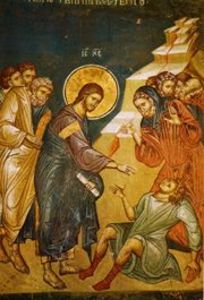
Today as we continue in the celebration of the Transfiguration of Jesus Christ, we are reminded of the power of faith in our lives in allowing God to show His grace. In today's gospel reading from Saint Matthew 17:14-23 we find the familiar story of the father bringing his demon possessed child to Christ for healing after the Disciples were unable to cast it out. The difference, our Lord says, is sufficient amount of faith. When we grow in our faith and truly believe then God is able to work great miracles in our lives and through us to others around us. Let us allow God to deepen our faith and so work His will in our lives and those around us.
Your Pastor,
Father Paisius R. McGrath
Gospel and Epistle Readings
Epistle Reading
Prokeimenon. 1st Tone. Psalm 32.22,1.
Let your mercy, O Lord, be upon us.
Verse: Rejoice in the Lord, O ye righteous.
The reading is from St. Paul's First Letter to the Corinthians 4:9-16.
Brethren, God has exhibited us apostles as last of all, like men sentenced to death; because we have become a spectacle to the world, to angels and to men. We are fools for Christ's sake, but you are wise in Christ. We are weak, but you are strong. You are held in honor, but we in disrepute. To the present hour we hunger and thirst, we are ill-clad and buffeted and homeless, and we labor, working with our own hands. When reviled, we bless; when persecuted, we endure; when slandered, we try to conciliate; we have become, and are now, as the refuse of the world, the off-scouring of all things. I do not write this to make you ashamed, but to admonish you as my beloved children. For though you have countless guides in Christ, you do not have many fathers. For I became your father in Christ Jesus through the gospel. I urge you, then, be imitators of me.
Gospel Reading
10th Sunday of Matthew
The Reading is from Matthew 17:14-23
At that time, a man came up to Jesus and kneeling before him said, "Lord, have mercy on my son, for he is an epileptic and he suffers terribly; for often he falls into the fire, and often into the water. And I brought him to your disciples, and they could not heal him." And Jesus answered, "O faithless and perverse generation, how long am I to be with you? How long am I to bear with you? Bring him here to me." And Jesus rebuked him, and the demon came out of him, and the boy was cured instantly. Then the disciples came to Jesus privately and said, "Why could we not cast it out?" He said to them, "Because of your little faith. For truly I say to you, if you have faith as a grain of mustard seed, you will say to this mountain, 'Move hence to yonder place,' and it will move; and nothing will be impossible to you. But this kind never comes out except by prayer and fasting." As they were gathering in Galilee, Jesus said to them, "The Son of man is to be delivered into the hands of men, and they will kill him, and he will be raised on the third day."
Saints and Feasts


August 09
Matthias, Apostle of the 70
After Judas by transgression fell from his apostleship (Acts 1: 25), and hanging himself out of despair ended his life with a wretched and shameful death (Matt. 27: 5), then, that the number of the Twelve not be lacking, all the disciples gathered in one place after the Ascension of the Savior (the number of men and women being 120), and they chose two men from among them, Joseph, called Barsabas, who was also surnamed Justus, and Matthias, and they set them in the midst. Then they prayed to God and cast lots, "and the lot fell upon Matthias, and he was numbered with the eleven Apostles" (Acts 1: 15-26). And thus, having taken the place of Judas, Matthias fulfilled the work of apostleship and the prophecy concerning Judas, which the Holy Spirit foretold by the mouth of David: "And his bishopric let another take" (Ps. 108(109):8). After this, it is said, Matthias preached the Gospel in Ethiopia, and completed his life there in martyrdom.

August 09
Herman the Wonderworker of Alaska & First Saint of America
Saint Herman (his name is a variant of Germanus) was born near Moscow in 1756. In his youth he became a monk, first at the Saint Sergius Hermitage near Saint Petersburg on the Gulf of Finland; while he dwelt there, the most holy Mother of God appeared to him, healing him of a grave malady. Afterwards he entered Valaam Monastery on Valiant Island in Lake Ladoga; he often withdrew into the wilderness to pray for days at a time. In 1794, answering a call for missionaries to preach the Gospel to the Aleuts, he came to the New World with the first Orthodox mission to Alaska. He settled on Spruce Island, which he called New Valaam, and here he persevered, even in the face of many grievous afflictions mostly at the hands of his own countrymen in the loving service of God and of his neighbour. Besides his many toils for the sake of the Aleuts, he subdued his flesh with great asceticism, wearing chains, sleeping little, fasting and praying much. He brought many people to Christ by the example of his life, his teaching, and his kindness and sanctity, and was granted the grace of working miracles and of prophetic insight. Since he was not a priest, Angels descended at Theophany to bless the waters in the bay; Saint Herman used this holy water to heal the sick. Because of his unwearying missionary labours, which were crowned by God with the salvation of countless souls, he is called the Enlightener of the Aleuts, and has likewise been renowned as a wonderworker since his repose in 1837.

August 13
Maximus the Confessor
The divine Maximus, who was from Constantinople, sprang from an illustrious family. He was a lover of wisdom and an eminent theologian. At first, he was the chief private secretary of the Emperor Heraclius and his grandson Constans. But when the Monothelite heresy became predominant in the royal court, out of hatred for this error the Saint departed for the Monastery at Chrysopolis (Scutari), of which he later became the abbot. When Constans tried to constrain him either to accept the Monothelite teaching, or to stop speaking and writing against it - neither of which the Saint accepted to do - his tongue was uprooted and his right hand was cut off, and he was sent into exile, where he reposed in 662. At the time only he and his few disciples were Orthodox in the East. See also January 21.

August 13
Apodosis of the Transfiguration

August 13
Tikhon of Zadonsk
Saint Tikhon of Zadonsk was born in 1724 into a very poor family of the Novgorod province, and was named Timothy in holy Baptism. In his youth he was sent to seminary in Novgorod where he received a good education and later taught Greek and other subjects. Having received the monastic tonsure with the name Tikhon, in the same year he was ordained deacon and priest, and appointed two years later as rector of the Seminary in Tver. In 1761 he was consecrated Bishop of Kexholm and Ladoga, and in 1763 nominated Bishop of Voronezh, a difficult diocese to administer because of its large size and transient population, which included many schismatics. Feeling the burden of the episcopacy to be beyond his strength, the Saint resigned in 1767, retiring first to the Monastery of Tolshevo, and later to the monastery at Zadonsk, where he remained until his blessed repose. In retirement, he devoted all his time to fervent prayer and the writing of books. His treasury of books earned him the title of "the Russian Chrysostom", whose writings he employed extensively; simple in style, replete with quotes from the Holy Scriptures, they treat mostly of the duties of Christians, with many parables taken from daily life. In them the Christian is taught how to oppose the passions and cultivate the virtues. A large collection of the Saint's letters are included in his works, and these give a wealth of spiritual guidance directed both to the laity and monastics. Saint Tikhon reposed in peace in 1783, at the age of fifty-nine. Over sixty years later, in 1845, when a new church was built in Zadonsk in place of the church where he was buried, it was necessary to remove his body. Although interred in a damp place, his relics were found to be whole and incorrupt; even his vestments were untouched by decay. Many miracles were worked by Saint Tikhon after his death, and some three hundred thousand pilgrims attended his glorification on August 13, 1863. He is one of the most beloved Russian Saints, and is invoked particularly for the protection and upbringing of children.

August 15
The Dormition of our Most Holy Lady the Theotokos and Ever Virgin Mary
Concerning the Dormition of the Theotokos, this is what the Church has received from ancient times from the tradition of the Fathers. When the time drew nigh that our Savior was well-pleased to take His Mother to Himself, He declared unto her through an Angel that three days hence, He would translate her from this temporal life to eternity and bliss. On hearing this, she went up with haste to the Mount of Olives, where she prayed continuously. Giving thanks to God, she returned to her house and prepared whatever was necessary for her burial. While these things were taking place, clouds caught up the Apostles from the ends of the earth, where each one happened to be preaching, and brought them at once to the house of the Mother of God, who informed them of the cause of their sudden gathering. As a mother, she consoled them in their affliction as was meet, and then raised her hands to Heaven and prayed for the peace of the world. She blessed the Apostles, and, reclining upon her bed with seemliness, gave up her all-holy spirit into the hands of her Son and God.
With reverence and many lights, and chanting burial hymns, the Apostles took up that God-receiving body and brought it to the sepulchre, while the Angels from Heaven chanted with them, and sent forth her who is higher than the Cherubim. But one Jew, moved by malice, audaciously stretched forth his hand upon the bed and immediately received from divine judgment the wages of his audacity. Those daring hands were severed by an invisible blow. But when he repented and asked forgiveness, his hands were restored. When they had reached the place called Gethsemane, they buried there with honor the all-immaculate body of the Theotokos, which was the source of Life. But on the third day after the burial, when they were eating together, and raised up the artos (bread) in Jesus' Name, as was their custom, the Theotokos appeared in the air, saying "Rejoice" to them. From this they learned concerning the bodily translation of the Theotokos into the Heavens.
These things has the Church received from the traditions of the Fathers, who have composed many hymns out of reverence, to the glory of the Mother of our God (see Oct. 3 and 4).

August 16
Gerasimus of Cephalonia
Saint Gerasimus was from the Peloponnesus, the son of Demetrius and Kale, of the family of Notaras. He was reared in piety by them and studied the Sacred writings. He left his country and went throughout various lands, and finally came to Cephalonia, where he restored a certain old church and built a convent around it, where it stands to this day at the place called Omala. He finished the course of his life there in asceticism in the year 1570. His sacred relics, which remain incorrupt, are kept there for the sanctification of the faithful.

August 16
Joseph the Hesychast
Hymns of the Day
Resurrectional Apolytikion in the 1st Tone
The stone having been sealed by the Pharisees and chief priests, * and Your all-immaculate body being guarded by soldiers, * You rose on the third day, O Lord and Savior, granting life unto the world. * Then the powers of the heavens cried out to You, O Giver of Life, and shouted, * “Glory to Your resurrection, O Christ! * Glory to Your eternal rule! * Glory to Your plan for saving us, only benevolent God!”
Apolytikion for Afterfeast of the Transfiguration in the Grave Tone
You were transfigured upon the mountain, O Christ our God, showing to Your disciples Your glory as much as they could bear. Do also in us, sinners though we may be, shine Your everlasting light, by the intercessions of the Theotokos, O Giver of light. Glory to You.
Seasonal Kontakion in the Grave Tone
You were transfigured upon the mount, O Christ our God, and Your disciples, in so far as they could bear, beheld Your glory. Thus, when they see You crucified, they may understand Your voluntary passion, and proclaim to the world that You are truly the effulgence of the Father.
Wisdom of the Fathers
Here Christ is not speaking of that faith which believes in Him undoubtingly and knows Him to be true God, but of the faith (needed) to work miracles. If ye have faith, He said, so exceedingly warm and burning as a grain of mustard seed (for these are its qualities), and if it is believed without a doubt that ye will perform signs, then ye will receive such power, that if ye desire to move the very mountains, ye will move them.
The Gospel Commentary, edited by Hieromonk German Ciuba, 2002, 4th Century
For a man to have such faith appears simple, but it is, on the contrary, something very lofty, not easily attained by many. Such faith is born of boldness before God; but such boldness comes (only) from pleasing God. Beloved, great labour is needed to acquire, through pleasing God, such boldness before Him that one firmly believes that he will grant all that one asks; as it is written, Ask, and it shall be given to you.
The Gospel Commentary: edited by Hieromonk German Ciuba, 2002., 4th Century
Upcoming Events
-
Upcoming Services and Events
'Error: no events returned during requested period.'
Announcements
BIRTHDAYS
Today we as a parish community extend our best wishes and congratulations to Natalya Pearcy as she celebrates her birthday on August 11, to Vlad Ionescu as he celebrates his birthday on August 13, and to Rodney Bridges as he celebrates his birthday on August 14. May the Lord our God bless His servants Natalya, Vlad and Rodney and may He grant to them many more blessed and happy years!
ANNOUNCEMENTS
Today as we continue in the Dormition Fast we invite everyone to participate fully in the season of spiritual growth in faith and practice. Let us all take advantage of this time through prayer, fasting, confession, and doing good deeds for ourselves and others as we prepare ourselves in body and soul to celebrate the Dormition of the Holy Theotokos.
We invite everyone to help with the donations for the flowers that will decorate the grave of the Holy Theotokos for the celebration of her Dormition. Please use the white offering envelopes and mark it for Dormition Flowers. Thank you for your generosity!
This week we invite everyone to join us for the beautiful Paraklesis to the Holy Theotokos. Our Holy Orthodox Church offers these supplication services in honor of the Holy Theotokos and in honor of our living friends and family whom we pray for. Come and join us in prayer!
This week on Friday, August 14 at 6:00 p.m. we will celebrate Great Vespers with Artoklasia and Dormition Lamentations. This beautiful service honors the Holy Theotokos as we commemorate her Dormition or Falling Asleep. The Dormition Lamentations is modeled on the Good Friday evening burial service for Christ and is our time honored way of showing the importance of the Holy Theotokos in our lives as Orthodox Christians.
On Saturday, August 15 we continue with the celebration of the Feast of Dormition with Orthros at 9:15 a.m., Divine Liturgy at 10:00 a.m. and the Blessing of Flowers at 11:30 a.m. Come and join us!
The printed copies of our parish August schedule are available in the narthex and side entrance. Please pick up your copy and join us as we worship and pray together as a parish community.
The parish council would like to inform parishioners that we have an online option for donating our tythes and offerings for our parish and for the growth of the Kingdom of God. You may donate offerings through the tithe.ly app and specify where the funds can go. You may click on the link to go directly to the Holy Trinity tithe.ly page.
HOLY TRINITY SCHEDULE THIS WEEK
Monday, August 10, Paraklesis to Holy Theotokos 4:30 p.m.
Parish Council Meeting 6:00 p.m.
Wednesday, August 12, Paraklesis to Holy Theotokos 6:00 p.m. Potluck Meal * Bring a Dish to Share*
Thursday, August 13, Apodosis (Leavetaking) of the Transfiguration, Orthros 9:15 a.m. Divine Liturgy 10:00 a.m.
Parish Bible Study: Book of Revelation 6:00 p.m.
Friday, August 14, Great Vespers with Artoklasia and Dormition Lamentations 6:00 p.m.
Saturday, August 15, Dormition (Falling Asleep) of Holy Theotokos, Orthros 9:15 a.m. Divine Liturgy 10:00 a.m. Blessing of Flowers 11:30 a.m.
Great Vespers 5:00 p.m.
NO Byzantine Chant Class
Sunday, August 16, 11th Sunday of Saint Matthew/Translation of Image Not Made By Hands/Holy Apostle Matthias/Saint Joseph the Heyschast of Mount Athos, Orthros 9:15 am
Parish Sunday School 9:30 a.m. Divine Liturgy 10:00 a.m. Blessing of Flowers 11:45 a.m. Coffee Hour 12:00 p.m. * Bring a Dish to Share *
The Ministry of Holy Trinity is enabled, thanks be to God, by the faithful support of the following stewards of our Parish:
Abrahem Samander
Adam & Shauna Angel
Adelbert & Jill Wilber
Akaterina Vamvakas
Alexandros Sferes
Alijah King
Anagyros Chris Mavromihalis
Angelos & Elizabeth Vamvakas
Austin Cottrell
Ben & Cassandra Warden
Brad & Amanda Sartor
Caleb & Melissa Bridges
Cara Brashears
Carl & Nancy Malek
Chrissanthi Beach
Colleen Collins
Crystal & Cassidy Anderson
Eleni Vganges
Eva Magiros
George & Jane Mavromihalis
George & Sheila Yurchak
George J. Vaporis
George L. Contas
Gus Ravanos
Guy S. Bowering, Jr.
Irene H. Lohrbach
Irene Koskan
Jeffery & Beverly Maung
Jody Comeaux
John & Cornelia Koniditsiotis
Katie Monroe
Kristen Marie Deline
Louis & Linda Peters
Mihnea C. & Viorica M Ionescu
Mousa & Nadine Maalouf
Nada D Harris
Nataliya Petrovska Kirkby
Nicoletta Conners
Panagiotis "Peter" & Maria Loukatos
Rodney and Karen Bridges
Seth Willison
Spiro Vganges
Tim Gilmore
Trent & Rachel Milam
William Patrick Weaver
Bulletin
Holy Trinity Pledge Form 2026
Holy Trinity Greek Orthodox Church Pledge form for 2026