August 02

Holy Trinity Greek Orthodox Church
Publish Date: 2026-08-02
Bulletin Contents
Father Paisius McGrath, Presbyter
Gospel and Epistle Readings
Saints and Feasts
Hymns of the Day
Wisdom of the Fathers
Upcoming Events
Announcements
Bulletin

Holy Trinity Greek Orthodox Church
General Information
Contact Information
Services Schedule
Service schedule varies. The current schedule can be found in the bulletin or parish website.
Past Bulletins
- Publish Date:
- 2026-09-27
- Publish Date:
- 2026-09-20
- Publish Date:
- 2026-09-06
- Publish Date:
- 2026-08-30
- Publish Date:
- 2026-08-23
- Publish Date:
- 2026-08-09
Father Paisius McGrath, Presbyter
Glory to Jesus Christ! Greetings to the faithful members and families of Holy Trinity Greek Orthodox Church. May our Lord and Savior Jesus Christ continue to bless and guide us now and always.
Your Pastor,
Father Paisius R. McGrath
Gospel and Epistle Readings
Epistle Reading
Prokeimenon. Plagal 4th Tone. Psalm 75.11,1.
Make your vows to the Lord our God and perform them.
Verse: God is known in Judah; his name is great in Israel.
The reading is from St. Paul's First Letter to the Corinthians 3:9-17.
Brethren, we are God's fellow workers; you are God's field, God's building. According to the grace of God given to me, like a skilled master builder I laid a foundation, and another man is building upon it. Let each man take care how he builds upon it. For no other foundation can any one lay than that which is laid, which is Jesus Christ. Now if any one builds on the foundation with gold, silver, precious stones, wood, hay, straw - each man's work will become manifest; for the Day will disclose it, because it will be revealed with fire, and the fire will test what sort of work each one has done. If the work which any man has built on the foundation survives, he will receive a reward. If any man's work is burned up, he will suffer loss, though he himself will be saved, but only as through fire. Do you not know that you are God's temple and that God's Spirit dwells in you? If any one destroys God's temple, God will destroy him. For God's temple is holy, and that temple you are.
Gospel Reading
9th Sunday of Matthew
The Reading is from Matthew 14:22-34
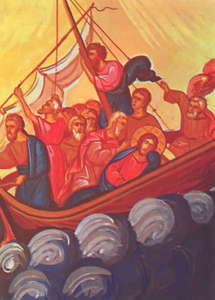
At that time, Jesus made the disciples get into the boat and go before him to the other side, while he dismissed the crowds. And after he had dismissed the crowds, he went up into the hills by himself to pray. When evening came, he was there alone, but the boat by this time was many furlongs distant from the land, beaten by the waves; for the wind was against them. And in the fourth watch of the night he came to them, walking on the sea. But when the disciples saw him walking on the sea, they were terrified, saying, "It is a ghost!" And they cried out for fear. But immediately he spoke to them, saying "Take heart, it is I; have no fear."
And Peter answered him, "Lord, if it is you, bid me come to you on the water." He said, "Come." So Peter got out of the boat and walked on the water and came to Jesus; but when he saw the wind, he was afraid, and beginning to sink he cried out, "Lord, save me." Jesus immediately reached out his hand and caught him, saying to him, "O man of little faith, why did you doubt?" And when they entered the boat, the wind ceased. And those in the boat worshiped him, saying, "Truly you are the Son of God." And when they had crossed over, they came to land at Gennesaret.
Saints and Feasts


August 02
Translation of the Relics of Stephen the Protomartyr
After the First Martyr had been stoned to death (see Dec. 27), Gamaliel, his teacher, encouraged certain of the Christians to go by night and take up the Saint's body and bury it in his field, which was at a distance of some twenty miles from Jerusalem and was called by his name, "Kaphar-gamala," that is, "the field of Gamala," where Gamaliel himself was later buried. About the year 427, a certain pious man called Lucian, who was the parish priest of a church near to that field, received from God a revelation in a dream concerning the place where the First Martyr was buried. He immediately made this known to John, the Patriarch of Jerusalem. Thus, coming to the place indicated, and digging there, they found a box with the word "Stephen" in Aramaic letters. On opening it, they took these most sacred relics and transferred them to Jerusalem with great honor and in the company of a very great multitude of the faithful.

August 03
Salome the Holy Myrrhbearer

August 04
Seven Holy Youths of Ephesus
The Seven Youths hid themselves in a certain cave near Ephesus in the year 250, to escape the persecution of Decius. By divine grace, a sleep came upon them and they slept for 184 years, until the reign of Saint Theodosius the Younger, when the doctrine of the resurrection was being assailed by heretics. They then awoke, that is, were resurrected, confirming in the sight of all the bodily resurrection; and again after a short time, by divine command, they reposed in the Lord in the year 434.

August 06
Transfiguration of our Lord and Savior Jesus Christ
Our Lord had spoken to His disciples many times not only concerning His Passion, Cross, and Death, but also concerning the coming persecutions and afflictions that they themselves would endure. Since all these evils were near at hand, but the enjoyment of good things which they hoped to receive in their stead was yet to come, our Savior desired to give them full assurance, evidently and openly, concerning that glory which is prepared for those who endure to the end. Therefore, fulfilling that which He had promised shortly before, that "there be some standing here which shall not taste of death, till they see the Son of man coming in His Kingdom" (Matt. 16:28), He took His three foremost disciples and ascended Mount Tabor, where He was transfigured before them. His face shone like the sun, and His clothes became white as the light. Suddenly, together with this dread and marvelous effulgence of light, there appeared those pinnacles of the Prophets, Moses and Elias, who spoke with the Lord Jesus concerning His saving Passion which was about to take place. Standing before Him as reverent servants, they showed that He is the Lord of both the living and the dead, for Moses came forth from Hades, having died many centuries before, and Elias, as it were from heaven, whither he had been taken up while yet alive. After a little while a radiant cloud overshadowed them and out of the cloud they heard that same voice which had been heard at the Jordan at the Baptism of Christ, testifying to the Divinity of Jesus and saying: "This is My beloved Son, in Whom I am well-pleased; hear ye Him" (Matt. 17: 5).
Such are the marvels, truly worthy of God, celebrated in this present feast, which is an image and prefiguring of the future state of the righteous, whose splendor the Lord spoke of, saying: "Then shall the righteous shine forth as the sun" (Matt. 13:43). It is because of this that the Kontakion of this Feast is said daily (when there is not a great feast) in the Service of the Typica in perpetual commemoration of the glory that will be the lot of the Saints. According to tradition, the Lord's Transfiguration came to pass forty days before His Crucifixion; this is why the Transfiguration is celebrated forty days before the Exaltation of the Cross.

August 10
Chitus of Athens, Bishop of Rome
This Sixtus is known as "Sixtus II" (pope from 257 to 258) and was martyred prior to St. Laurence, who is commemorated on August 10, during the persecution of Christians by the Emperor Valerian.

August 07
Theodosius the New

August 09
Matthias, Apostle of the 70
After Judas by transgression fell from his apostleship (Acts 1: 25), and hanging himself out of despair ended his life with a wretched and shameful death (Matt. 27: 5), then, that the number of the Twelve not be lacking, all the disciples gathered in one place after the Ascension of the Savior (the number of men and women being 120), and they chose two men from among them, Joseph, called Barsabas, who was also surnamed Justus, and Matthias, and they set them in the midst. Then they prayed to God and cast lots, "and the lot fell upon Matthias, and he was numbered with the eleven Apostles" (Acts 1: 15-26). And thus, having taken the place of Judas, Matthias fulfilled the work of apostleship and the prophecy concerning Judas, which the Holy Spirit foretold by the mouth of David: "And his bishopric let another take" (Ps. 108(109):8). After this, it is said, Matthias preached the Gospel in Ethiopia, and completed his life there in martyrdom.

August 09
Herman the Wonderworker of Alaska & First Saint of America
Saint Herman (his name is a variant of Germanus) was born near Moscow in 1756. In his youth he became a monk, first at the Saint Sergius Hermitage near Saint Petersburg on the Gulf of Finland; while he dwelt there, the most holy Mother of God appeared to him, healing him of a grave malady. Afterwards he entered Valaam Monastery on Valiant Island in Lake Ladoga; he often withdrew into the wilderness to pray for days at a time. In 1794, answering a call for missionaries to preach the Gospel to the Aleuts, he came to the New World with the first Orthodox mission to Alaska. He settled on Spruce Island, which he called New Valaam, and here he persevered, even in the face of many grievous afflictions mostly at the hands of his own countrymen in the loving service of God and of his neighbour. Besides his many toils for the sake of the Aleuts, he subdued his flesh with great asceticism, wearing chains, sleeping little, fasting and praying much. He brought many people to Christ by the example of his life, his teaching, and his kindness and sanctity, and was granted the grace of working miracles and of prophetic insight. Since he was not a priest, Angels descended at Theophany to bless the waters in the bay; Saint Herman used this holy water to heal the sick. Because of his unwearying missionary labours, which were crowned by God with the salvation of countless souls, he is called the Enlightener of the Aleuts, and has likewise been renowned as a wonderworker since his repose in 1837.
Hymns of the Day
Resurrectional Apolytikion in the Plagal 4th Tone
You descended from on high, O compassionate One, and consented to a three-day burial, to free us from the passions. O Lord, our life and resurrection, glory to You!
Apolytikion for Translation of the relics of Stephen in the 4th Tone
The crown of the Kingdom hath adorned the brow of thy head because of the contests that thou hast endured for Christ God, thou first of the martyred Saints; for when thou hadst censured the Jews' madness, thou sawest Christ thy Saviour standing at the right hand of the Father. O Stephen, ever pray Him for us, that He would save our souls.
Seasonal Kontakion in the Grave Tone
You were transfigured upon the mount, O Christ our God, and Your disciples, in so far as they could bear, beheld Your glory. Thus, when they see You crucified, they may understand Your voluntary passion, and proclaim to the world that You are truly the effulgence of the Father.
Wisdom of the Fathers
The principle and source of the virtues is a good disposition of the will, that is to say, an aspiration for goodness and beauty. God is the source and ground of all supernal goodness. Thus the principle of goodness and beauty is faith or, rather, it is Christ, the rock of faith, who is principle and foundation of all virtues. On this rock we stand and on this foundation we build every good thing (cf. I Cor. 3:11).
On Commandments and Doctrines no. 83, Philokalia Vol. 3 edited by Palmer, Sherrard and Ware; Faber and Faber pg. 228, 14th century
Christ did not command the winds to cease at that time, but Himself stretched forth His hand and took hold of Peter, because here faith was required of him. When we do not do our part, divine (grace) slows and stands still.. . . it was not the wind that did Peter harm; his lack of faith sank him. Where faith is fruitfu, firm and strong, none of the evils that may befall us can do us any harm.
The Gospel Commentary edited by Hieromonk German Ciuba, 2002, 4th Century
Upcoming Events
-
Upcoming Services and Events
'Error: no events returned during requested period.'
Announcements
BIRTHDAYS
Today we as a parish community extend our best wishes and congratulations to Cristian Ionescu as he celebrates his birthday on August 6. May the Lord our God bless His servant, Cristian, and may He grant to him many more blessed and happy years!
NEW CATECHUMENS
This morning we welcome Jacob Lee and Marley Anderson-Lee as our newest Catechumens. May God bless them and their daughter Salem as they grow in their faith and take this new journey towards the Orthodox Church!
ANNOUNCEMENTS
On August 1 in the Orthodox Church we began the Dormition Fast. This time from August 1-15 helps us to prepare ourselves physically and spiritually to celebrate the Dormition (Falling Asleep) of the Holy Theotokos on August 15. This is an opportunity to spiritually enrich our lives through prayer, fasting, confession, doing good works, and spiritual reading in a special way. May God bless us all with a fruitful time of the Fast!
During the Dormition Fast the Orthodox Church honors the Holy Theotokos through the special Paraklesis services that culminate with the Dormition Lamentation service on August 14. Come and join us as together we honor the Holy Theotokos with these special prayer services.
This week we celebrate the great Feast of the Transfiguration of Jesus Christ with Great Vespers on August 5 and Orthros and Divine Liturgy followed by Blessing of Fruit on August 6. Come and join us for this great Feast of our Lord and Savior Jesus Christ.
As we have entered into the Dormition Fast we encourage everyone to consider a donation for the flowers to honor the Holy Theotokos at her Dormition. Please use the white offering envelopes and mark them for Dormition Flowers. Thank you.
The printed copies of our parish August schedule are now available to the narthex and church side entrance. Pick up your copy and join us as we worship together as a parish community.
The parish council would like to inform parishioners that we have an online option for donating our tythes and offerings for our parish and for the growth of the Kingdom of God. You may donate offerings through the tithe.ly app and specify where the funds can go. You may click on the link to go directly to the Holy Trinity tithe.ly page.
HOLY TRINITY SCHEDULE THIS WEEK
Wednesday, August 5, Great Vespers with Artoklasia 6:00 p.m.
Potluck Meal * Bring a Dish to Share*
Thursday, August 6, Transfiguration of our Lord Jesus Christ, Orthros 9:15 a.m. Divine Liturgy 10:00 a.m. Blessing of Fruit 11:30 a.m.
Parish Bible Study: Book of Revelation 6:00 p.m.
Friday, August 7, Paraklesis to Holy Theotokos
6:00 p.m.
Saturday, August 8, Great Vespers 5:00 p.m.
NO Byzantine Chant Class
Sunday, August 9, 10th Sunday of Saint Matthew/Holy Apostle Matthias/Saint Herman of Alaska, Orthros 9:15 a.m. Parish Sunday School 9:30 a.m. Divine Liturgy 10:00 a.m.
Coffee Hour 11:45 a.m. *Bring a Dish to Share*
The Ministry of Holy Trinity is enabled, thanks be to God, by the faithful support of the following stewards of our Parish:
Abrahem Samander
Adam & Shauna Angel
Adelbert & Jill Wilber
Akaterina Vamvakas
Alexandros Sferes
Alijah King
Anagyros Chris Mavromihalis
Angelos & Elizabeth Vamvakas
Austin Cottrell
Ben & Cassandra Warden
Brad & Amanda Sartor
Caleb & Melissa Bridges
Cara Brashears
Carl & Nancy Malek
Chrissanthi Beach
Colleen Collins
Crystal & Cassidy Anderson
Eleni Vganges
Eva Magiros
George & Jane Mavromihalis
George & Sheila Yurchak
George J. Vaporis
George L. Contas
Gus Ravanos
Guy S. Bowering, Jr.
Irene H. Lohrbach
Irene Koskan
Jeffery & Beverly Maung
Jody Comeaux
John & Cornelia Koniditsiotis
Katie Monroe
Kristen Marie Deline
Louis & Linda Peters
Mihnea C. & Viorica M Ionescu
Mousa & Nadine Maalouf
Nada D Harris
Nataliya Petrovska Kirkby
Nicoletta Conners
Panagiotis "Peter" & Maria Loukatos
Rodney and Karen Bridges
Seth Willison
Spiro Vganges
Tim Gilmore
Trent & Rachel Milam
William Patrick Weaver
Bulletin
Holy Trinity Pledge Form 2026
Holy Trinity Greek Orthodox Church Pledge form for 2026