
Dormition of the Theotokos - Koimisis tis Theotokou Greek Orthodox Church
Publish Date: 2026-11-15
Bulletin Contents

Organization Icon
Dormition of the Theotokos - Koimisis tis Theotokou Greek Orthodox Church

General Information

  • Phone:
  • (802) 862-2155
  • Fax:
  • (802) 881-0717
  • Street Address:

  • 600 South Willard Street

  • Burlington, VT 05401


Contact Information


Services Schedule

Saturdays: 5:00 PM - Great Vespers
Sundays: 
10:00 AM - DIVINE LITURGY, preceded by Orthros at 9:00 AM

Sacred Weekdays: 9:00 AM - DIVINE LITURGY, preceeded by Orthros at 8:00 AM


Past Bulletins


This Week

8th Sunday of Luke, 14 & 15 November
Saturday, November 14 11:30 AM - 1:00 PM: Philoptochos Bake Sale Pick-up; 5:00 PM: Great Vespers
Sunday, November 15 9:00 AM: Orthros (Matins), followed by 10:00 AM: DIVINE LITURGY, Sunday School
Friday, November 20 6:00 PM: Great Vespers with Artoclasia (Entrance of the Theotokos into the Temple)
Saturday, November 21 9:00 AM: Orthros; 10:00 AM Divine Liturgy

As a reminder, Saturday, November 21 is the Feast of the Entrance of the Theotokos into the Temple (Ἡ ἐν τῳ Ναῳ Είσοδος τῆς Υπεραγίας Θεοτόκου). This is one of the twelve great feasts of the Church and commemorates the Panagia entering into the Temple from the age of three to prepare herself to be the living Ark of the Covenant by our Lord's Incarnation. This is a feast that all Orthodox Christians should endeavor to be in Church for services.

Fasting this Week:

Wed, Fri: Strict Fasting;All Other Days: Fish, wine, and oil


Upcoming Calendar

  • Parish Calendar

    November 15 to November 22, 2026

    Sunday, November 15

    9:00AM Orthros

    10:00AM Divine Liturgy

    Tuesday, November 17

    1:00PM Office Hours

    6:00PM Vespers

    Wednesday, November 18

    8:00AM Daily Orthros

    9:00AM Office Hours

    1:00PM Office Hours

    6:00PM Daily Vespers

    Thursday, November 19

    8:00AM Daily Orthros

    9:00AM Office Hours

    Friday, November 20

    8:00AM Daily Orthros

    9:00AM Office Hours

    1:00PM Office Hours

    6:00PM Great Vespers - Entrance of The Theotokos into the Temple

    Saturday, November 21

    9:00AM Orthros - Entrance of The Theotokos into the Temple

    10:00AM Divine Liturgy - Entrance of The Theotokos into the Temple

    5:00PM Great Vespers

    Sunday, November 22

    9:00AM Orthros

    10:00AM Divine Liturgy


Hymns of the Day

Resurrectional Apolytikion in the Grave Mode

By Your cross, O Lord, You shattered death; to the thief You opened paradise. You transformed the Myrrhbearers' lamentation, and commanded Your Apostles to proclaim that You arose, Christ our God, granting to the world Your great mercy.
Κατέλυσας τῷ Σταυρῷ σου τὸν θάνατον, ἠνέῳξας τῷ Λῃστῇ τὸν Παράδεισον, τῶν Μυροφόρων τὸν θρῆνον μετέβαλες, καὶ τοῖς σοῖς Ἀποστόλοις κηρύττειν ἐπέταξας, ὅτι ἀνέστης Χριστὲ ὁ Θεός, παρέχων τῷ κόσμῳ τὸ μέγα ἔλεος.

Apolytikion for Martyrs Gouria, Shamuna, and Habib in the Plagal First Mode

Since Thou hast given us the miracles of Thy holy Martyrs as an invincible battlement, by their entreaties, scatter the counsels of the heathen, O Christ our God, and strengthen the faith of Orthodox Christians, since Thou alone art good and the Friend of man.
Τά θαύματα τών Αγίων σου Mαρτύρων, τείχος ακαταμάχητον ημίν δωρησάμενος, Χριστέ ό Θεός, ταίς αυτών ικεσίαις, βουλάς εθνών διασκέδασον, τής βασιλείας τά σκήπτρα κραταίωσον, ως μόνος αγαθός καί φιλάνθρωπος.

Apolytikion of Church of the Dormition in the First Mode

In giving birth you did retain your virginity. In your repose, you did not forsake the world, O Theotokos. You have passed into life, you that are the Mother of Life. And by your intercessions, you redeem our souls from death. 

Ἐν τῇ Γεννήσει τὴν παρθενίαν ἐφύλαξας, ἐν τῇ Κοιμήσει τὸν κόσμον οὐ κατέλιπες Θεοτόκε. Μετέστης πρὸς τὴν ζωήν, μήτηρ ὑπάρχουσα τῆς ζωῆς, καὶ ταῖς πρεσβείαις ταῖς σαῖς λυτρουμένη, ἐκ θανάτου τὰς ψυχὰς ἡμῶν.

Seasonal Kontakion in the Fourth Mode

Today, the most pure temple of the Savior, the precious bridal chamber and Virgin, the sacred treasure of God, enters the house of the Lord, bringing the grace of the Divine Spirit. The Angels of God praise her. She is the heavenly tabernacle.
Ο καθαρώτατος ναός τού Σωτήρος, η πολυτίμητος παστάς καί Παρθένος, τό Ιερόν θησαύρισμα τής δόξης τού Θεού, σήμερον εισάγεται, εν τώ οίκω Κυρίου, τήν χάριν συνεισάγουσα, τήν εν Πνευματι θείω, ήν ανυμνούσιν Άγγελοι Θεού, Αύτη υπάρχει σκηνή επουράνιος.


Gospel and Epistle Readings

Epistle Reading

Prokeimenon. Grave Mode. Psalm 28.11,1.
The Lord will give strength to his people.
Verse: Bring to the Lord, O sons of God, bring to the Lord honor and glory.

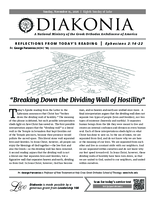
The reading is from St. Paul's Letter to the Ephesians 2:14-22.

Brethren, Christ is our peace, who has made us both one, and has broken down the dividing wall of hostility, by abolishing in his flesh the law of commandments and ordinances, that he might create in himself one new man in place of the two, so making peace, and might reconcile us both to God in one body through the cross, thereby bringing the hostility to an end. And he came and preached peace to you who were far off and peace to those who were near; for through him we both have access in one Spirit to the Father. So then you are no longer strangers and sojourners, but you are fellow citizens with the saints and members of the household of God, built upon the foundation of the apostles and prophets, Christ Jesus himself being the cornerstone, in whom the whole structure is joined together and grows into a holy temple in the Lord; in whom you also are built into it for a dwelling place of God in the Spirit.

Προκείμενον. Grave Mode. ΨΑΛΜΟΙ 28.11,1.
Κύριος ἰσχὺν τῷ λαῷ αὐτοῦ δώσει.
Στίχ. Ἐνέγκατε τῷ Κυρίῳ υἱοὶ Θεοῦ, ἐνέγκατε τῷ Κυρίῳ δόξαν καὶ τιμήν.

τὸ Ἀνάγνωσμα Πρὸς Ἐφεσίους 2:14-22.

Ἀδελφοί, Χριστός ἐστιν ἡ εἰρήνη ἡμῶν, ὁ ποιήσας τὰ ἀμφότερα ἕν, καὶ τὸ μεσότοιχον τοῦ φραγμοῦ λύσας, τήν ἔχθραν ἐν τῇ σαρκί αὐτοῦ, τὸν νόμον τῶν ἐντολῶν ἐν δόγμασιν, καταργήσας· ἵνα τοὺς δύο κτίσῃ ἐν ἑαὐτῷ εἰς ἕνα καινὸν ἄνθρωπον, ποιῶν εἰρήνην, καὶ ἀποκαταλλάξῃ τοὺς ἀμφοτέρους ἐν ἑνὶ σώματι τῷ θεῷ διὰ τοῦ σταυροῦ, ἀποκτείνας τὴν ἔχθραν ἐν αὐτῷ· καὶ ἐλθὼν εὐηγγελίσατο εἰρήνην ὑμῖν τοῖς μακρὰν καὶ τοῖς ἐγγύς· ὅτι διʼ αὐτοῦ ἔχομεν τὴν προσαγωγὴν οἱ ἀμφότεροι ἐν ἑνὶ πνεύματι πρὸς τὸν πατέρα. Ἄρα οὖν οὐκέτι ἐστὲ ξένοι καὶ πάροικοι, ἀλλὰ συμπολῖται τῶν ἁγίων καὶ οἰκεῖοι τοῦ θεοῦ, ἐποικοδομηθέντες ἐπὶ τῷ θεμελίῳ τῶν ἀποστόλων καὶ προφητῶν, ὄντος ἀκρογωνιαίου αὐτοῦ Ἰησοῦ Χριστοῦ, ἐν ᾧ πᾶσα οἰκοδομὴ συναρμολογουμένη αὔξει εἰς ναὸν ἅγιον ἐν κυρίῳ, ἐν ᾧ καὶ ὑμεῖς συνοικοδομεῖσθε εἰς κατοικητήριον τοῦ θεοῦ ἐν πνεύματι.


Gospel Reading

8th Sunday of Luke
The Reading is from Luke 10:25-37

At that time, a lawyer stood up to put Jesus to the test, saying, "Teacher, what shall I do to inherit eternal life?" He said to him, "What is written in the law? How do you read?" And he answered, "You shall love the Lord your God with all your heart, and with all your soul, and with all your strength, and with all your mind; and your neighbor as yourself." And he said to him, "You have answered right; do this, and you will live."

But he, desiring to justify himself, said to Jesus, "And who is my neighbor?" Jesus replied, "A man was going down from Jerusalem to Jericho, and he fell among robbers, who stripped him and beat him, and departed, leaving him half dead. Now by chance a priest was going down that road; and when he saw him he passed by on the other side. So likewise a Levite, when he came to the place and saw him, passed by on the other side. But a Samaritan, as he journeyed, came to where he was; and when he saw him, he had compassion, and went to him and bound up his wounds, pouring on oil and wine; then he set him on his own beast and brought him to an inn, and took care of him. And the next day he took out two denarii and gave them to the innkeeper, saying, 'Take care of him; and whatever more you spend, I will repay you when I come back.' Which of these three, do you think, proved neighbor to the man who fell among the robbers?" He said, "The one who showed mercy on him." And Jesus said to him, "Go and do likewise."

8th Sunday of Luke
Κατὰ Λουκᾶν 10:25-37

Τῷ καιρῷ ἐκείνῳ, νομικός τις ἀνέστη ἐκπειράζων αὐτὸν καὶ λέγων· διδάσκαλε, τί ποιήσας ζωὴν αἰώνιον κληρονομήσω; ὁ δὲ εἶπε πρὸς αὐτόν· ἐν τῷ νόμῳ τί γέγραπται; πῶς ἀναγινώσκεις; ὁ δὲ ἀποκριθεὶς εἶπεν· ἀγαπήσεις Κύριον τὸν Θεόν σου ἐξ ὅλης τῆς καρδίας σου καὶ ἐξ ὅλης τῆς ψυχῆς σου καὶ ἐξ ὅλης τῆς ἰσχύος σου καὶ ἐξ ὅλης τῆς διανοίας σου, καὶ τὸν πλησίον σου ὡς σεαυτόν· εἶπε δὲ αὐτῷ· ὀρθῶς ἀπεκρίθης· τοῦτο ποίει καὶ ζήσῃ. ὁ δὲ θέλων δικαιοῦν ἑαυτὸν εἶπε πρὸς τὸν ᾿Ιησοῦν· καὶ τίς ἐστί μου πλησίον; ὑπολαβὼν δὲ ὁ ᾿Ιησοῦς εἶπεν· ἄνθρωπός τις κατέβαινεν ἀπὸ ῾Ιερουσαλὴμ εἰς ῾Ιεριχώ, καὶ λῃσταῖς περιέπεσεν· οἳ καὶ ἐκδύσαντες αὐτὸν καὶ πληγὰς ἐπιθέντες ἀπῆλθον ἀφέντες ἡμιθανῆ τυγχάνοντα. κατὰ συγκυρίαν δὲ ἱερεύς τις κατέβαινεν ἐν τῇ ὁδῷ ἐκείνῃ, καὶ ἰδὼν αὐτὸν ἀντιπαρῆλθεν. ὁμοίως δὲ καὶ Λευΐτης γενόμενος κατὰ τὸν τόπον, ἐλθὼν καὶ ἰδὼν ἀντιπαρῆλθε. Σαμαρείτης δέ τις ὁδεύων ἦλθε κατ᾿ αὐτόν, καὶ ἰδὼν αὐτὸν ἐσπλαγχνίσθη, καὶ προσελθὼν κατέδησε τὰ τραύματα αὐτοῦ ἐπιχέων ἔλαιον καὶ οἶνον, ἐπιβιβάσας δὲ αὐτὸν ἐπὶ τὸ ἴδιον κτῆνος ἤγαγεν αὐτὸν εἰς πανδοχεῖον καὶ ἐπεμελήθη αὐτοῦ· καὶ ἐπὶ τὴν αὔριον ἐξελθών, ἐκβαλὼν δύο δηνάρια ἔδωκε τῷ πανδοχεῖ καὶ εἶπεν αὐτῷ· ἐπιμελήθητι αὐτοῦ, καὶ ὅ τι ἂν προσδαπανήσῃς, ἐγὼ ἐν τῷ ἐπανέρχεσθαί με ἀποδώσω σοι. τίς οὖν τούτων τῶν τριῶν πλησίον δοκεῖ σοι γεγονέναι τοῦ ἐμπεσόντος εἰς τοὺς λῃστάς; ὁ δὲ εἶπεν· ὁ ποιήσας τὸ ἔλεος μετ᾿ αὐτοῦ. εἶπεν οὖν αὐτῷ ὁ ᾿Ιησοῦς· πορεύου καὶ σὺ ποίει ὁμοίως.


Saints and Feasts

November 15

8th Sunday of Luke


November 15

Nativity Fast Begins

The Nativity Fast is one of four main fast periods throughout the ecclesiastical year. Beginning on November 15 and concluding on December 24, the Nativity Fast gives individuals the opportunity to prepare for the Feast of the Nativity of Our Lord and Savior in the Flesh on December 25. By abstaining from certain food and drink, particularly from meat, fish, dairy products, olive oil, and wine, as well as focusing more deeply on prayer and almsgiving, we can find that the primary aim of fasting is to make us conscious of our dependence upon God.


November 15

Guria, Shamuna, and Habib, Martyrs and Confessors of Edessa

Of these most illustrious Martyrs of the city of Edessa in Syria, Guria and Shamuna contested during the reign of Diocletian, in 288; after many tortures, they were cast into prison, then beheaded. Saint Habib, a deacon, contested in the days of Licinius, in the year 316, and was burned alive; he was buried with Saints Guria and Shamuna. The three have one common feast, and it is always together that they are portrayed in icons and invoked by the faithful. On account of a renowned miracle they worked, they are invoked for help in marital difficulties. A certain Goth had come with the Roman army to Edessa and was quartered in the house of a pious widow named Sophia. The Goth asked Sophia for the hand of her daughter, Euphemia; after resisting for a long time, Sophia at last agreed. When it was time for the army to return home, Sophia made the Goth vow by the power in the holy Martyrs Shamuna, Guria, and Habib, to keep Euphemia as the apple of his eye. As he was nearing his home, however, the treacherous man revealed to Euphemia that he already had a wife. Euphemia was compelled to serve the Goths wife, who dealt with her mercilessly. After extreme sufferings, which included being sealed alive in a tomb and left there to die, Euphemia was miraculously conveyed to Edessa, to the very shrine of the holy Martyrs whose surety they had taken, and was reunited with her mother through their holy prayers.


November 15

Thomas II the New, Archbishop of Constantinople


November 16

Matthew the Apostle & Evangelist

This Apostle, who was also called Levi, was the son of Alphaeus and had Galilee as his homeland. A publican before being called by Christ, he became one of the Twelve Apostles, and an Evangelist. While still in Palestine, he wrote his Gospel first in Hebrew, being also the first of all to write the Gospel. When he is depicted in icons, there is portrayed next to him the likeness of a man, one of the symbolic living creatures mentioned by Ezekiel (1.10), which, as Saint Irenaeus writes, is a symbol of our Saviour's Incarnation.


November 17

Gregory the Wonderworker & Bishop of Neo-Caesarea

Saint Gregory was born in Neocaesarea of Pontus to parents who were not Christians. He studied in Athens, in Alexandria, in Beirut, and finally for five years in Caesarea of Palestine under Origen, by whom he was also instructed in the Faith of Christ. Then, in the year 240, he became bishop of his own city, wherein he found only seventeen Christians. By the time the Saint reposed about the year 265, there were only seventeen unbelievers left there. Virtually the whole duration of his episcopacy was a time of continual, marvellous wonders worked by him. Because of this, he received the surname "Wonderworker"; even the enemies of the truth called him a second Moses (see Saint Basil the Great's On the Holy Spirit, ch. 29).


November 18

Plato the Great Martyr of Ancyra

Saint Plato contested in martyrdom in 266, when Agrippinus was proconsul. He was from the city of Ancyra in the province of Galatia.


November 19

Obadiah the Prophet

The Divine Scriptures do not tell us with any certainty when the Prophet Obadiah lived nor what was his homeland. Thus, some say that he is that Obadiah who was Ahab's steward, who, because of Jezebel's wrath, hid one hundred prophets in a cave and fed them with bread and water (III Kings 18:4), and that he later became a disciple of Elias the Prophet about 903 B.C. But others surmise from the words of the same prophetical book that he is somewhat later than Joel (celebrated on Oct. 19). He is also called Obdiu, or Abdiu, or Obadiah; his name means "servant of God." His book of prophecy, which consists of only one chapter, is ranked fourth among the minor Prophets.


November 20

Gregory the Righteous of Decapolis

Saint Gregory who was from Irenopolis of the Decapolis of Asia Minor, was the son of Sergius and Mary. He became a monk as a young man, and after struggling for many years in virtue and prayer under obedience to a wise spiritual father, he was informed by revelation that it was the will of God for him to live, like the Patriarch Abraham, with no certain dwelling, moving from place to place. His journeyings took him to Ephesus, Constantinople, Corinth, Rome, Sicily, Thessalonica, and again to Constantinople, where, after many labours in defence of Orthodoxy against Iconoclasm, he reposed in peace in the first half of the ninth century. He had two disciples, one of whom was Saint Joseph the Hymnographer (see Apr. 3), who wrote the Menaion service for Saint Gregory, his father in Christ.


November 21

The Entrance of the Theotokos into the Temple

According to the tradition of the Church, the Theotokos was brought to the Temple at three years of age, where she was consecrated to God and spent her days until she was fourteen or fifteen years old; and then, as a mature maiden, by the common counsel of the priests (since her parents had reposed some three years before), she was betrothed to Joseph.


Wisdom of the Fathers

Prayer, fasting, vigil and all other Christian practices, however good they may be in themselves, do not constitute the aim of our Christian life, although they serve as the indispensable means of reaching this end. The true aim of our Christian life consists in the acquisition of the Holy Spirit of God.
St. Seraphim of Sarov
The Acquisition of the Holy Spirit: Chapter 3, The Little Russian Philokalia Vol. 1; Saint Herman of Alaska Brotherhood pg. 79, 19th century

When heavy with over-eating, the body makes the intellect spiritless and sluggish; likewise, when weakened by excessive abstinence, the body makes the contemplative faculty of the soul dejected and disinclined to concentrate. We should therefore regulate our food according to the condition of the body, so that it is appropriately disciplined when in good health and adequately nourished when weak. The body of one pursuing the spiritual way must not be enfeebled; he must have enough strength for his labours, so that the soul may be suitably purified through bodily exertion as well.
St. Diadochos of Photiki
On Spiritual Knowledge no. 45, Philokalia Vol. 1 edited by Palmer, Sherrard and Ware; Faber and Faber pgs. 266-267

We know that fasting, psalmody and prayer cannot save us in their own right, but carrying them out before God can. For when the Lord's eyes are upon us they sanctify us, as the sun warms everything upon which it shines.
St. Gregory Palamas
Homilies Vol. 1, Homily Nine para. 11; Saint Tikhon's Seminary Press pg. 98, 14th century

To what end do fasting and penitence lead? They lead to the cleansing of the soul from sins, to peace of heart, to union with God; they fill us with devotion and sonship, and give us boldness before God.
St. John of Kronstadt
My Life in Christ, Part 1; Holy Trinity Monastery pg. 3, 19th century

The value of fasting consists not in abstinence only from food, but in a relinquishment of sinful practices, since he who limits his fasting only to an abstinence from meat is he who especially disparages it. The change in our way of life during these blessed days will help us to gain holiness. Therefore we should let our soul rejoice during the fast.
St. John Chrysostom
Fourth Century


Archdiocese News

Immigrants built HCHC to train homegrown priests

11/11/2026

It is hard to imagine Orthodoxy in America without Hellenic College Holy Cross Greek Orthodox School of Theology—the only accredited Orthodox undergraduate, graduate school, and seminary in the United States. The two institutions have grown up like siblings over the past century with HCHC molding generations of clergy, pastoral assistants, youth workers, Sunday School teachers, parish leaders, and scholars serving the Greek Orthodox Archdiocese of America and beyond.  

Aerial view of HCHC today. (HCHC)

In the early decades of the 20th century, the United States welcomed more than 15 million immigrants largely from Southern and Eastern Europe—Armenians, Greeks, Romanians, Russians, Serbians and Ukrainians and more. An early success of the Greek and Russian immigrant communities was the establishment of seminaries that would provide indigenous clergy for emerging parishes, notably Holy Cross Greek Orthodox School of Theology in 1937 and Saint Vladimir’s Orthodox Theological Seminary in 1938. 

The first home for Holy Cross was, from 1937 to 1948, in Pomfret, Connecticut. Unfortunately, Pomfret proved to be too remote of a location, so the school’s trustees purchased the Weld Estate, a scenic piece of land on a hill overlooking Boston which set in motion the school’s relocation to Brookline, Massachusetts in 1948. 

It would be another 30 years before Hellenic College came into being.  

Between 1948 and 1968, the Weld Estate was transformed with the mansion becoming the School’s administrative building while construction on other facilities were undertaken, including the Archbishop Cavadas dorm annex (1953), Cotsidas-Tonna Library (1960), Skouros Classroom Building (1960), Pappas Gymnasium (1960), Holy Cross Chapel (1963) and the three-story Polemanakos Dormitory, all done while educating a generation of dedicated clergy. 

As the Chair of the Seminary’s Board of Trustees, the recently enthroned Archbishop Iakovos spearheaded the idea to establish Hellenic College as early as 1959. The proposition received Board support and a resolution was presented to the 1960 Clergy-Laity Congress held in Buffalo, NY. By the mid-1960s, several prominent Greek Orthodox laymen joined in advocating for the establishment of an undergraduate college along with transforming Holy Cross into an accredited school of theology.  

Archbishop Iakovos understood that an institution of higher learning was a necessary component in gaining respectability within the American religious landscape and promoting the Church’s spiritual and intellectual inheritance.  

In 1968, a year described by many as one of the most turbulent years in American history, Hellenic College opened its doors and was led by scholarchis Fr. Leonidas C. Contos. The College adopted a four-year undergraduate curriculum, following the American curricular model that provided general and specialized education programs that culminated in the conferral of a Baccalaureate degree. 

After 30 years of leadership under several hierarchs and presbyters as president, the Board of Trustees appointed Dr. Thomas C. Lelon as the first lay president of the school in 1976. During his tenure, Holy Cross earned full accreditation in the United States and Canada along with Hellenic College receiving accreditation from the New England Association of Schools and Colleges.  

During the 1970s and 80s, the campus experienced another period of expansion which included the construction of multiple facilities saw a spate of capital projects including the Maliotis Cultural Center with its 450-seat auditorium, exhibition halls, classrooms and offices; the Halki Seminarian Residence; Dendrinos Village for married student housing as well as new soccer fields and tennis courts. 

The Archbishop Iakovos Library and Learning Resource Center at HCHC. (HCHC)

As the 20th century came to a close, Bishop Demetrios of Vresthena was enthroned as Archbishop and Primate of the Greek Orthodox Archdiocese of America in 1999. As such, he became Chairman of the HCHC Board of Trustees. Archbishop Demetrios was well-suited to lead the school, having studied and instructed at Harvard University and taught at HCHC for 10 years as a professor of Biblical Studies and Christian Origins. He was an effective advocate for the school at the Ecumenical Patriarchate, the Archdiocese, and beyond.  

In the summer of 2000, Fr. Nicholas C. Triantafilou was installed as president of HCHC after 23 fruitful years as Proistamenos of the Annunciation Cathedral in Houston, Texas. Fr. Triantafilou brought an understanding of the needs and expectations of priests and parishioners and did so with pastoral care and faith-centered leadership that uplifted the school community. Fr. Triantafilou’s 15-year term as president was marked by strategic planning, revised governance, capital improvements, and successful fundraising. 

The Scholi Today 

As we progress through the 2026-27 academic year, HCHC continues to be a growing, vibrant community and remains the only residential Orthodox Christian college in the U.S. While college enrollment is generally down across the country, religious institutions such as HCHC are bucking this trend. Our school welcomed 80 new students (46 at Hellenic College, 34 at Holy Cross) to campus this year. For the fourth consecutive year, HCHC is seeing its student population grow by more than 20 percent.  

May God continue to bless Hellenic College Holy Cross, all who pursue spiritual formation there, and all who make their education possible. And may God bless our Archdiocese, its parishes, and the faithful as well as the United States as it celebrates 250 years of freedom. 

This article is published as part of the America at 250: Orthodoxy in a New Homeland media initiative co-organized by the Orthodox Observer and the Department of Inter-Orthodox, Ecumenical, and Interfaith Relations of the Greek Orthodox Archdiocese of America to honor the contributions and experience of Orthodox Christianity in America and celebrate 250th anniversary of America’s founding.

The post Immigrants built HCHC to train homegrown priests appeared first on Orthodox Observer.


It is hard to imagine Orthodoxy in America without Hellenic College Holy Cross Greek Orthodox School of Theology—the only accredited Orthodox undergraduate, graduate school, and seminary in the United States. The two institutions have grown […]

The post Immigrants built HCHC to train homegrown priests appeared first on Orthodox Observer.


Archbishop Elpidophoros praises Greece’s U.N. initiative to protect children in conflict

11/10/2026

NEW YORK — His Eminence Archbishop Elpidophoros of America praised Greece’s Permanent Mission to the United Nations for securing a Security Council resolution strengthening protections for children affected by armed conflict, saying the achievement held particular significance for him as a hierarch of the Greek Orthodox Church.

Visiting Ambassador Aglaia Balta, Greece’s permanent representative, at the mission’s offices, His Eminence congratulated her and the delegation on their great work during Greece’s Security Council tenure. Archbishop Elpidophoros praised Ambassador Balta on the successful passage of Resolution 2832. Drafted by Greece and adopted unanimously on Oct. 19, it addresses abuses against children in armed conflict that are enabled or intensified by digital technologies, including recruitment and exploitation.

Archbishop Elpidophoros discusses with Permanent Representative of Greece Aglaia Balta issues impacting children during times of armed conflict. Photo by Orthodox Observer/Dimitrios Panagos

The resolution calls for stronger safeguards and accountability, while encouraging the safe use of technology to support education and child protection. Balta said Greece intended to continue its initiatives on children and maritime security beyond its Council term, with a workshop on children planned for early 2027.

The discussion turned to Russia’s continuing invasion of Ukraine and the prospects for ending the war. Archbishop Elpidophoros also expressed concern over intensifying Russian attacks on the Ecumenical Patriarchate, describing efforts by Russian state and affiliated actors to undermine the institution.

On Cyprus, Archbishop Elpidophoros stressed the importance of keeping the issue on the U.N. agenda until a just and viable settlement is achieved. Also discussed was the United Nations’ potential role in establishing an international framework for artificial intelligence. The Archbishop said a U.N. body could help bring countries and other key participants worldwide into the development of shared rules and safeguards. Balta emphasized the need for U.N. leadership with the political foresight to address such emerging challenges.

> Read: Balta’s resolution for the safeguarding of children affected by armed conflict

The post Archbishop Elpidophoros praises Greece’s U.N. initiative to protect children in conflict appeared first on Orthodox Observer.

NEW YORK — His Eminence Archbishop Elpidophoros of America praised Greece’s Permanent Mission to the United Nations for securing a Security Council resolution strengthening protections for children affected by armed conflict, saying the achievement held […]

The post Archbishop Elpidophoros praises Greece’s U.N. initiative to protect children in conflict appeared first on Orthodox Observer.


Diakonia Newsletter


BACK TO TOP