Parish Council members on duty: George Potamitis, Markos Zygouris, Vasilios Piskopanis & George Tgibides.
Fellowship Hour hosted by Philoptochos.
Following Fellowship Hour, please use the elevator exit rather than the main entrance of the church. Thank you for your cooperation. (If you would like to host or sponsor a Fellowship Hour, please call the church office to schedule.)
Election Nominations Filing Deadline has been changed to today, November 15 at 12 noon.
Annual Holy Trinity Parish Council Elections will be held on Sunday, December 13, 2026 between 9am – 1pm in the Church Hall. Parish Council & Board of Auditors: Seven (7) members are to be elected for a 2-year term and One (1) Auditor for a 2-year term.
CANDIDATES FOR ELECTION TO PARISH COUNCIL: A candidate for the Parish Council must be a parishioner in good standing of the Parish for at least one (1) year immediately preceding the date of the election and must live his or her life in accordance with the Faith and canons of the Church. The Priest determines whether the Parishioners are in canonical and financial good standing. All candidates shall attend a seminar prior to the election at which the Priest shall discuss the Uniform Parish Regulations and explain them to the candidates, particularly the oathof office. At the conclusion of the seminar all candidates will acknowledge by signing a statement that they understand the Uniform Parish Regulations and, if elected, will abide by them and the oath of office. If a candidate for the Parish Council refuses to attend the seminar and sign the declaration, his or her name shall be deleted from the list of candidates. All Parish Council members would undergo background checks. Ideally, this background check will be handled before candidates are elected as part of their qualifications to stand for election (this will avoid the situation of having to remove a board member because of a failed background check.) But as this program gets underway, it will be best implemented by doing a background check for every parish council member now, and then in the future, notifying every nominee for a parish council election that a background check is a pre-requisite of running for office, so that every candidate who runs has passed the background check.
Weekly Calendar
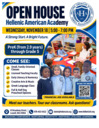
November 18, Wednesday, 5-7pm: HAA Open House (refer to flyer for more datails)
November 19, Thursday at 6:30pm: Orthodoxy 101 at Holy Trinity
November 21, Saturday: Divine Liturgy- Entrance of the Theotokos into the Temple
God bless you and the beginning of a new and promising week.
"Whatever you do, work at it with all your heart, as working for the Lord, not for human masters." — Colossians 3:23
https://www.goarch.org/news
Announcements
Holy Trinity News
Annual Holy Trinity Parish Council Elections will be held on Sunday, December 13, 2026 between 9am – 1pm in the Church Hall. Parish Council & Board of Auditors: Seven (7) members are to be elected for a 2-year term and One (1) Auditor for a 2-year term.
Christmas Offering:As we enter the Nativity Fast, which will lead us to the joyous Feast of the Nativity of our Lord and Savior Jesus Christ, we invite you to prayerfully consider making a Christmas Offering. Your generosity is an expression of faith and gratitude, helping to sustain our Parish and ensuring that our Church continues to serve our community throughout the coming year.Every gift, regardless of size, makes a difference and is sincerely appreciated. Thank you for your continued generosity and support.Wishing you and your families a blessed and joyous Christmas!For your convenience, envelopes were mailed with the November-December Communicator or you may make your offering clicking this link: Christmas Offering
December 10, Thursday, 10:30am: Divine Liturgy at D'Youville Manor
December 12, Saturday: St. Spyridon the Wondermaker
December 15, Tuesday:St. Eleutherios the Holy Martyr
Sunday School News:
Trivia Night – November:Put your knowledge to the test and enjoy a fun evening together. Stay tuned for the date and more information!
Christmas Breakfast and Tree Decoration –December 19:Fun filled morning!! Final Rehearsal for the for Christmas Pageant, Pancakes and Decorating the Sunday School Christmas Tree!!!
Christmas Pageant – December 20:Our Christmas Pageant will take place on December 20.Participants should plan to attend rehearsals on: November 15, November 22, December 6, December 13.More information about the pageant and participation will be shared soon.
Coffee Hour Hosting: Help us continue this special time of fellowship by hosting Coffee Hour! We are looking for signups approximately once a month, including: December 20
Philoptochos News:follow us on Facebook at Holy-Trinity-Ladies-Philoptochos-Lowell
A heartfelt THANK YOU to everyone who supported our Fall Festival! As always, your generosity, time, and dedication helped make this year’s event a success. We are truly grateful to our volunteers, sponsors, donors, parishioners, and friends for your continued support of Holy Trinity.May God bless you all!
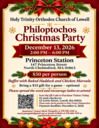
Philoptochos Christmas Party- Sunday, December 13 2:00pm-6:00pm at Princeton Station.For information, you may contact Maria Panagakis (978-996-4307) or Joanne Grillakis (978-660-7619) or click here: Philoptochos Christmas Party
Support the Philoptochos Holiday Bake Sale:Order traditional Greek pastries prepared by our Philoptochos volunteers, sharing the flavors that have long brought our parish families together.
You may mail your order (check payable to Holy Trinity Philoptochos) to: Bessie Kourkoulakos 232 Sanders Ave. Lowell, MA 01851or by clikcing this link. Philoptochos Christmas Bake Sale. Order Deadline: December 12, 2026.
Order Pickup: December 19, 2026 (9am-11:30am) at the Hellenic Cultural Center 41 Broadway St. Lowell
Monthly Meetings Calendar
WED 12/02 at 5:30pm
WED 02/03 at 5:30pm
WED 03/03 at 5:30pm
WED 04/07 at 6:00pm
WED 05/05 at 6:00pm
WED 06/02 at 6:00pm
Annual Hunger & Homeless Food Drive (ends on Nov 22) A collection bin is located in the Narthex.
Hellenic American Academy and HAA PTA News (hellenicaa.org)
Wednesday, November 18: HAA Open House (refer to flyer for more datails)
Tuesday, December 22: Christmas Program at the Hellenic Cultural Center
Thursday, December 31: HAA PTA "One Big Family 2027 New Year's Eve Bash" For more information refer to flyer.
Church Office Hours:(978) 458-8092 / [email protected]) Tu–Wed-Th 10am-2pm: If you need to visit the office at a different date or time, please call during office hours or send an email to [email protected], to schedule an appointment. Kindly use the Lewis Street side entrance and ring the bell or, call the office to enter through the elevator entrance. Note: Office Hours the week of November 23 will be: Mon-Tu-Fri: 10am-2pm
Pastoral Visits:Please call the Church Office at 978 458-8092 to arrange a hospital, nursing home or shut-in visit by Fr. Nick. Health care facilities are unable to contact us because of HIPAA regulations.Greek Orthodox Archdiocese News & On-Line Ministries www.goarch.org:
According to the tradition of the Church, the Theotokos was brought to the Temple at three years of age, where she was consecrated to God and spent her days until she was fourteen or fifteen years old; and then, as a mature maiden, by the common counsel of the priests (since her parents had reposed some three years before), she was betrothed to Joseph.
Gospel and Epistle Readings
Epistle Reading
24th Sunday after Pentecost
The Reading is from St. Paul's Letter to the Ephesians 2:14-22
Brethren, Christ is our peace, who has made us both one, and has broken down the dividing wall of hostility, by abolishing in his flesh the law of commandments and ordinances, that he might create in himself one new man in place of the two, so making peace, and might reconcile us both to God in one body through the cross, thereby bringing the hostility to an end. And he came and preached peace to you who were far off and peace to those who were near; for through him we both have access in one Spirit to the Father. So then you are no longer strangers and sojourners, but you are fellow citizens with the saints and members of the household of God, built upon the foundation of the apostles and prophets, Christ Jesus himself being the cornerstone, in whom the whole structure is joined together and grows into a holy temple in the Lord; in whom you also are built into it for a dwelling place of God in the Spirit.
8th Sunday of Luke
The Reading is from Luke 10:25-37
At that time, a lawyer stood up to put Jesus to the test, saying, "Teacher, what shall I do to inherit eternal life?" He said to him, "What is written in the law? How do you read?" And he answered, "You shall love the Lord your God with all your heart, and with all your soul, and with all your strength, and with all your mind; and your neighbor as yourself." And he said to him, "You have answered right; do this, and you will live."
But he, desiring to justify himself, said to Jesus, "And who is my neighbor?" Jesus replied, "A man was going down from Jerusalem to Jericho, and he fell among robbers, who stripped him and beat him, and departed, leaving him half dead. Now by chance a priest was going down that road; and when he saw him he passed by on the other side. So likewise a Levite, when he came to the place and saw him, passed by on the other side. But a Samaritan, as he journeyed, came to where he was; and when he saw him, he had compassion, and went to him and bound up his wounds, pouring on oil and wine; then he set him on his own beast and brought him to an inn, and took care of him. And the next day he took out two denarii and gave them to the innkeeper, saying, 'Take care of him; and whatever more you spend, I will repay you when I come back.' Which of these three, do you think, proved neighbor to the man who fell among the robbers?" He said, "The one who showed mercy on him." And Jesus said to him, "Go and do likewise."
It is hard to imagine Orthodoxy in America without Hellenic College Holy Cross Greek Orthodox School of Theology—the only accredited Orthodox undergraduate, graduate school, and seminary in the United States. The two institutions have grown up like siblings over the past century with HCHC molding generations of clergy, pastoral assistants, youth workers, Sunday School teachers, parish leaders, and scholars serving the Greek Orthodox Archdiocese of America and beyond.
Aerial view of HCHC today. (HCHC)
In the early decades of the 20th century, the United States welcomed more than 15 million immigrants largely from Southern and Eastern Europe—Armenians, Greeks, Romanians, Russians, Serbians and Ukrainians and more. An early success of the Greek and Russian immigrant communities was the establishment of seminaries that would provide indigenous clergy for emerging parishes, notably Holy Cross Greek Orthodox School of Theology in 1937 and Saint Vladimir’s Orthodox Theological Seminary in 1938.
The first home for Holy Cross was, from 1937 to 1948, in Pomfret, Connecticut. Unfortunately, Pomfret proved to be too remote of a location, so the school’s trustees purchased the Weld Estate, a scenic piece of land on a hill overlooking Boston which set in motion the school’s relocation to Brookline, Massachusetts in 1948.
It would be another 30 years before Hellenic College came into being.
Between 1948 and 1968, the Weld Estate was transformed with the mansion becoming the School’s administrative building while construction on other facilities were undertaken, including the Archbishop Cavadas dorm annex (1953), Cotsidas-Tonna Library (1960), Skouros Classroom Building (1960), Pappas Gymnasium (1960), Holy Cross Chapel (1963) and the three-story Polemanakos Dormitory, all done while educating a generation of dedicated clergy.
As the Chair of the Seminary’s Board of Trustees, the recently enthroned Archbishop Iakovos spearheaded the idea to establish Hellenic College as early as 1959. The proposition received Board support and a resolution was presented to the 1960 Clergy-Laity Congress held in Buffalo, NY. By the mid-1960s, several prominent Greek Orthodox laymen joined in advocating for the establishment of an undergraduate college along with transforming Holy Cross into an accredited school of theology.
Archbishop Iakovos understood that an institution of higher learning was a necessary component in gaining respectability within the American religious landscape and promoting the Church’s spiritual and intellectual inheritance.
In 1968, a year described by many as one of the most turbulent years in American history, Hellenic College opened its doors and was led by scholarchis Fr. Leonidas C. Contos. The College adopted a four-year undergraduate curriculum, following the American curricular model that provided general and specialized education programs that culminated in the conferral of a Baccalaureate degree.
After 30 years of leadership under several hierarchs and presbyters as president, the Board of Trustees appointed Dr. Thomas C. Lelon as the first lay president of the school in 1976. During his tenure, Holy Cross earned full accreditation in the United States and Canada along with Hellenic College receiving accreditation from the New England Association of Schools and Colleges.
During the 1970s and 80s, the campus experienced another period of expansion which included the construction of multiple facilities saw a spate of capital projects including the Maliotis Cultural Center with its 450-seat auditorium, exhibition halls, classrooms and offices; the Halki Seminarian Residence; Dendrinos Village for married student housing as well as new soccer fields and tennis courts.
The Archbishop Iakovos Library and Learning Resource Center at HCHC. (HCHC)
As the 20th century came to a close, Bishop Demetrios of Vresthena was enthroned as Archbishop and Primate of the Greek Orthodox Archdiocese of America in 1999. As such, he became Chairman of the HCHC Board of Trustees. Archbishop Demetrios was well-suited to lead the school, having studied and instructed at Harvard University and taught at HCHC for 10 years as a professor of Biblical Studies and Christian Origins. He was an effective advocate for the school at the Ecumenical Patriarchate, the Archdiocese, and beyond.
In the summer of 2000, Fr. Nicholas C. Triantafilou was installed as president of HCHC after 23 fruitful years as Proistamenos of the Annunciation Cathedral in Houston, Texas. Fr. Triantafilou brought an understanding of the needs and expectations of priests and parishioners and did so with pastoral care and faith-centered leadership that uplifted the school community. Fr. Triantafilou’s 15-year term as president was marked by strategic planning, revised governance, capital improvements, and successful fundraising.
The Scholi Today
As we progress through the 2026-27 academic year, HCHC continues to be a growing, vibrant community and remains the only residential Orthodox Christian college in the U.S. While college enrollment is generally down across the country, religious institutions such as HCHC are bucking this trend. Our school welcomed 80 new students (46 at Hellenic College, 34 at Holy Cross) to campus this year. For the fourth consecutive year, HCHC is seeing its student population grow by more than 20 percent.
May God continue to bless Hellenic College Holy Cross, all who pursue spiritual formation there, and all who make their education possible. And may God bless our Archdiocese, its parishes, and the faithful as well as the United States as it celebrates 250 years of freedom.
This article is published as part of the America at 250: Orthodoxy in a New Homeland media initiative co-organized by the Orthodox Observer and the Department of Inter-Orthodox, Ecumenical, and Interfaith Relations of the Greek Orthodox Archdiocese of America to honor the contributions and experience of Orthodox Christianity in America and celebrate 250th anniversary of America’s founding.
It is hard to imagine Orthodoxy in America without Hellenic College Holy Cross Greek Orthodox School of Theology—the only accredited Orthodox undergraduate, graduate school, and seminary in the United States. The two institutions have grown […]
Opinion | Faith or propaganda? Reflections on the political and ecclesiastical authority
11/10/2026
The Russian invasion of Ukraine has exposed a profound crisis in Orthodox Christian theology: the relationship between the Church, the state, and the moral responsibilities of Christian leadership in times of war. Although Orthodox history includes different models of cooperation between ecclesiastical and political authorities, the Church’s relationship with the state cannot be reduced to unconditional support for political power. The war in Ukraine raises a particularly urgent question: what happens when religious language and ecclesiastical authority are used to legitimize a state’s military ambitions?
The position adopted by the Moscow Patriarchate under Patriarch Kirill makes this question especially significant. Its response to the war must be considered alongside its rejection of Ukrainian ecclesiastical independence and its broader understanding of Russian civilization, historical identity, and the Church’s relationship with the state.
Ukrainian Autocephaly and the Crisis of Ecclesiastical Unity
In January 2019, the Ecumenical Patriarchate of Constantinople granted a Tomos of autocephaly to the Orthodox Church of Ukraine (OCU), establishing its status as an independent, self-governing local Orthodox Church.¹ The decision followed a long-standing dispute over ecclesiastical jurisdiction in Ukraine. The Moscow Patriarchate rejected Constantinople’s actions, maintaining that Ukraine belonged to its canonical territory. In October 2018, before the Tomos was issued, the Russian Orthodox Church announced its decision to break Eucharistic communion with the Ecumenical Patriarchate.²
His All-Holiness Ecumenical Patriarch Bartholomew at the Ecumenical Patriarchate in May, 2022. Photo by Orthodox Observer/Brittainy Newman.
The canonical dispute is complex, and the competing ecclesiological arguments should not be confused with a direct explanation of the subsequent invasion. Nevertheless, the rejection of Ukrainian autocephaly has become part of a wider struggle over Ukraine’s historical and cultural identity. From the perspective of the Ecumenical Patriarchate, the Ukrainian question concerns not only jurisdiction but also the right of a local Church to exercise ecclesiastical self-government. In the Moscow Patriarchate’s interpretation, by contrast, the assertion of Ukrainian ecclesiastical independence challenges its understanding of the historical unity of the Orthodox world associated with Russia.
This conflict becomes especially consequential when ecclesiastical jurisdiction is linked to geopolitical claims. The Church’s spiritual and canonical boundaries risk becoming instruments for asserting the political unity of territories whose populations have their own national identities and aspirations.
Religious Language and the Legitimation of War
The relationship between the Moscow Patriarchate and the Russian state has become increasingly visible in the religious language used to interpret the war. In public discourse, Patriarch Kirill has situated the conflict within a broader narrative concerning Russia’s historical mission, moral identity, and spiritual confrontation with the contemporary West. Such language does more than express political preferences: it can place political conflict within a framework of religious meaning, making opposition to state policy appear to be opposition to a sacred historical community.
In a March 2023 address on the response of Churches and religious communities to war and conflict, Ecumenical Patriarch Bartholomew explicitly criticized the instrumentalization of religion for geopolitical purposes. He identified the ideology of Russkiy Mir (“Russian World”) as a principal instrument for the “spiritual” legitimation of the invasion of Ukraine.³ His criticism identifies a fundamental theological problem: the transformation of a particular national and geopolitical project into an allegedly sacred mission.
Academic research supports a careful version of this argument. Vebjørn L. Horsfjord’s study of Patriarch Kirill’s sermons and speeches during the first year of the full-scale war finds that explicit expressions of support for the war were relatively rare, while the historical narratives employed in his discourse helped construct a worldview in which the conflict could be understood as necessary or legitimate.⁴ A separate study by Marcin Składanowski, Andrzej Szabaciuk, and Agnieszka Łukasik-Turecka examines the role of Patriarch Kirill’s discourse in Russian propaganda and disinformation, arguing that the Moscow Patriarchate became an important part of the broader system through which the Russian state presented and justified its aggression.⁵
These findings suggest that ecclesiastical legitimation does not depend exclusively on direct endorsements of military action. It may also operate through historical narratives, moral binaries, selective interpretations of identity, and claims that a nation is engaged in a civilizational or spiritual struggle.
The Ecclesial Feedback Loop of War Propaganda
To understand the relationship between ecclesiastical discourse and political power in this case, I propose the concept of an “ecclesial feedback loop of war propaganda.” This concept describes a mutually reinforcing relationship among three processes.
First, the rejection of Ukrainian autocephaly weakens the ecclesiastical recognition of a distinct Ukrainian religious identity within the framework defended by Moscow.Second, the ideology of Russkiy Mir and related appeals to Holy Rus situate Russian statehood within a larger historical and spiritual community, potentially blurring the distinction between Russian national interests and the universal mission of Orthodoxy.Third, religious interpretations of the war can provide moral and spiritual legitimacy to the state’s actions, presenting the conflict as part of a struggle over civilizational values rather than simply an act of military aggression.
The relationship is a feedback loop because each element can reinforce the others. The denial of Ukrainian ecclesiastical independence supports a narrative of historical unity; that narrative can be mobilized to frame Russian political claims as guardianship of a shared spiritual inheritance; and religious legitimation of the war, in turn, can reinforce the rejection of Ukrainian independence as a threat to that inheritance.
This analytical framework does not mean that the canonical dispute alone caused the invasion, nor does it imply that all Russian Orthodox clergy or faithful endorse the war. It identifies instead a mechanism through which ecclesiastical claims and political narratives can mutually reinforce one another. The Church’s institutional authority becomes especially vulnerable when its language of unity is used to diminish the agency of another people or to justify violence against them.
Recovering the Prophetic Freedom of the Church
The crisis in Ukraine invites a broader reconsideration of the Orthodox understanding of symphonia, the ideal of cooperation between Church and state. Historically, the concept has been interpreted in different ways, and it should not be reduced to a simple formula of ecclesiastical submission to political authority. The Church may cooperate with civil authorities for the common good, but such cooperation cannot eliminate its responsibility to speak critically when state power violates human dignity, justice, and peace.
Orthodox ecclesiology, with its emphasis on communion and the Church’s universal character, offers resources for resisting the identification of the Church with any single national or geopolitical project. The Church’s mission transcends state borders. Its unity cannot legitimately be invoked to erase the ecclesiastical agency of other peoples, and its spiritual authority cannot be made conditional upon loyalty to a government.
The war in Ukraine therefore presents Orthodoxy with a test of theological integrity. The challenge is not simply to resolve a jurisdictional dispute or to restore institutional relations. It is to recover the distinction between the Gospel and political ideology, between Christian solidarity and national domination, and between pastoral leadership and the sacralization of state ambitions. Where religious authority becomes a vehicle for war propaganda, the Church risks compromising the very universal mission it is called to serve.
Rev. Dr. Vassilios Bebis is the Parish Priest of Sts. Constantine and Helen Greek Orthodox Church in Cambridge, Massachusetts, and an Affiliate of Harvard University’s Davis Center for Russian and Eurasian Studies.
2 Holy Synod of the Russian Orthodox Church, “Statement by the Holy Synod of the Russian Orthodox Church concerning the encroachment of the Patriarchate of Constantinople on the canonical territory of the Russian Church,” October 15, 2018, https://old.mospat.ru/en/2018/10/15/news165263/
4 Vebjørn L. Horsfjord, “Patriarch and Patriot: History in Patriarch Kirill’s Sermons in the First Year of the Full-Scale War in Ukraine,” Religion, State & Society 52, no. 4 (2024): 367–82, https://doi.org/10.1080/09637494.2024.2353417
5 Marcin Składanowski, Andrzej Szabaciuk, and Agnieszka Łukasik-Turecka, “Church of War: Propaganda and Disinformation in Patriarch Kirill’s Discourse on Russia’s Aggression,” Cogent Arts & Humanities 12, no. 1 (2025), article 2515329, https://doi.org/10.1080/23311983.2025.2515329
6 John Meyendorff, Byzantine Theology: Historical Trends and Doctrinal Themes, 2nd ed. (New York: Fordham University Press, 1983)*7 John D. Zizioulas, Being as Communion: Studies in Personhood and the Church (Crestwood, NY: St. Vladimir’s Seminary Press, 1985).
The Russian invasion of Ukraine has exposed a profound crisis in Orthodox Christian theology: the relationship between the Church, the state, and the moral responsibilities of Christian leadership in times of war. Although Orthodox history […]
The Church should neither withdraw nor accommodate, Orthodox speakers say
11/09/2026
More than 250 participants gathered Nov. 6-7 for a two-day educational conference on the social ethos of the Orthodox Church. The event, titled “For the Life of the World,” took place at the St. Gregory Palamas Educational and Cultural Foundation of the Holy Metropolis of Thessaloniki.
Attendees included 40 priests, 110 parish catechists, 75 schoolteachers and 25 theology students. The conference centered on the Ecumenical Patriarchate’s document For the Life of the World: Toward a Social Ethos of the Orthodox Church. Organizers sought to explore how its theological principles and pastoral vision can inform the Church’s educational, cultural and catechetical ministries, and how they can respond to the challenges facing humanity today.
Opening and Participants
His Eminence Metropolitan Philotheos of Thessaloniki offered welcoming remarks. Greetings followed from representatives of theological and ecclesiastical circles in the Church of Greece. They included the Fr. Athanasios Gikas, dean of the Faculty of Theology at Aristotle University of Thessaloniki; Professor Elias Evangelou, chair of the Department of Theology; and Professor Emeritus Theodoros Giagkos of the Department of Social Theology and Christian Culture.
Fr. John Chryssavgis, Archdeacon of the Ecumenical Throne, professor at Holy Cross Greek Orthodox School of Theology, and Executive Director of the Huffington Ecumenical Institute, also brought greetings. His Eminence Metropolitan Apostolos of Miletus, Abbot of the Patriarchal and Stavropegic Monastery of St. Anastasia, attended throughout.
Fr. John Chryssavgis speaks at an educational conference entitled “For the Life of the World,” hosted at the St. Gregory Palamas Educational and Cultural Foundation of the Holy Metropolis of Thessaloniki. (Metropolis of Thessaloniki)
Associate Professor Stavros Yangazoglou of the National and Kapodistrian University of Athens moderated the opening session. That evening, a musical tribute honored the late Professor Chrysostomos Stamoulis. The “Voices” Mixed Choir of St. Barbara’s Church in Thessaloniki, conducted by Konstantinos Diminakis, performed.
Presentations and Workshops
The conference program had two parts. Theologians from the universities of Thessaloniki and Athens presented on the eight central themes of For the Life of the World: the social character of Orthodox Christian ethics; the Church in the public sphere; the course of human life; poverty, wealth, and civil justice; war, peace, and violence; ecumenical and interreligious relations; Orthodoxy and human rights; and science, art, and the natural environment.
Nine interactive workshops followed, led by theologians, educators, and advisors. They turned the document’s themes into practical teaching approaches on social justice, Christian witness in public life, the search for meaning, reconciliation and nonviolence, ecumenical and interreligious dialogue, human rights, technology, and environmental responsibility. Workshop titles included “The Art of Reconciliation in a World of Conflict and Violence” and “Our Gift, Our Responsibility: From the Climate Crisis to an Ethos of Shared Responsibility.”
Clergy attend an educational conference entitled “For the Life of the World,” hosted at the St. Gregory Palamas Educational and Cultural Foundation of the Holy Metropolis of Thessaloniki. (Metropolis of Thessaloniki)
Drawing on biblical and patristic sources, iconography, literature, and art, the workshops provided resources for parish catechesis and secondary education. Organizers placed particular emphasis on methods that connect the Church’s tradition with the experience of children, adolescents, and the wider community.
Charity and Justice
Speakers said the Church’s social responsibility is rooted in the creation of every person in the image and likeness of God, the communion of love revealed in the Holy Trinity, and the Eucharistic and ascetical life of the Church. Participants said that while charity remains indispensable, Orthodox social teaching also calls for addressing the structures and causes of injustice, poverty, exclusion, and exploitation. They drew a distinction between charity and justice, and said the Church must speak prophetically, even when its message challenges those holding political or economic power.
Presenters cited Christ’s identification with the hungry, the suffering, the incarcerated, and the marginalized in Matthew 25. They also said the Divine Liturgy does not end at the church doors–the Eucharistic celebration continues in the daily struggle for justice and compassion.
Human Rights, Dialogue, and Creation
On human rights, presenters said the Orthodox Church supports the protection of fundamental and inalienable rights, as affirmed by the Holy and Great Council of Crete in 2016 and by His All-Holiness Ecumenical Patriarch Bartholomew in a 2017 address in Germany.
The conference also considered pastoral questions such as family life, child protection, sexuality, abortion, suicide, and end-of-life care. Participants called for a pastoral approach marked by theological integrity, compassion, discernment, realism, and sensitivity.
For the Life of the World was presented as an invitation to cooperation between Christians and people of other faiths on peacebuilding, social justice, environmental protection, and human dignity.
Care for creation was described as an essential expression of Christian faith tied to Eucharistic spirituality and the Incarnation. Participants said catechesis should cultivate gratitude, restraint, shared responsibility, and active care for the environment.
Looking ahead
Speakers said the Church should neither withdraw from society nor simply accommodate prevailing attitudes. Participants called for wider study of the document in theological schools, seminaries, parishes, youth ministries and religious education programs.
The conference closed with a plenary discussion on applying its insights in parish and educational settings. In closing remarks, Metropolitan Philotheos thanked the organizers, presenters, facilitators and participants. He expressed hope that For the Life of the World, the fruit of a synodal process within the Ecumenical Patriarchate, would receive a creative response across the Church, including in catechesis, pastoral ministry, theological education and public witness.
More than 250 participants gathered Nov. 6-7 for a two-day educational conference on the social ethos of the Orthodox Church. The event, titled “For the Life of the World,” took place at the St. Gregory […]
Philoptochos hosts Metropolitan of Sweden ahead of New Jersey enthronement
11/06/2026
The National Philoptochos Society welcomed His Eminence Metropolitan Cleopas of Sweden and All Scandinavia to its Center of Philanthropy on Thursday, where he thanked the organization for “the love, generosity, and steadfast support” it has shown his Metropolis.
His Eminence Archbishop Elpidophoros of America, who chairs the National Philoptochos Board; His Eminence Metropolitan Athenagoras of New Jersey, Philoptochos’s Spiritual Advisor; and Fr. Elias Villis, Chancellor of the Archdiocesan District, also attended. Metropolitan Cleopas thanked Archbishop Elpidophoros “for the brotherly friendship” shown to him “throughout the years we have known one another and served together.”
Clergy and National Philoptochos leaders pray before a luncheon at the National Philoptochos headquarters in New York, Thursday, Nov. 5, 2026. (Orthodox Observer/Dimitrios Panagos)
National Philoptochos President Debbie George welcomed the three hierarchs, calling their presence “a blessing to our organization and a meaningful encouragement to the women across our country who carry out the ministry of Philoptochos every single day.” To Metropolitan Cleopas, she said, “It’s a joy to welcome you home to our headquarters once again.” She called Saturday’s enthronement of Metropolitan Athenagoras “a blessed and historic moment for our Church.”
Metropolitan Cleopas thanked Mrs. George and First Vice President Anita Kartalopoulos, whom he has known since his years as dean of the Annunciation Cathedral in Boston. “Anita has always welcomed others with a warm smile, one that reflects her love for the Church and her devotion to Philoptochos,” he said.
Metropolitan Cleopas is in the United States to represent the Ecumenical Patriarchate at Saturday’s enthronement of Metropolitan Athenagoras at the Metropolitan Cathedral of St. John the Theologian in Tenafly, N.J. The Holy and Sacred Synod of the Ecumenical Patriarchate elected Metropolitan Athenagoras on Oct. 1. He had served as Bishop of Nazianzos since 2021 and has for several years been Spiritual Advisor to the National Philoptochos Society.
Metropolitan Cleopas was elected to lead the Metropolis of Sweden and All Scandinavia in 2014, after serving as dean of the Boston cathedral.
“Through your loving service, you bear witness to the Gospel and to the compassion of Christ,” he told the Philoptochos board and members.
The National Philoptochos Society welcomed His Eminence Metropolitan Cleopas of Sweden and All Scandinavia to its Center of Philanthropy on Thursday, where he thanked the organization for “the love, generosity, and steadfast support” it has […]