St. Spyridon Parish News, Events, Activities and Announcements
This Sunday's Memorials
Rose Sissons - 3 years
Sesen Medhanie - 37 years
Dashai Terry - 37 years
As a reminder: The pews on the front right side of the church, as you enter the church, are reserved for the family/families who are having a Memorial Service for their loved ones. Thus, please allow one pew per Memorial family on any given Sunday. Thank you for your understanding.
Daylight Saving Time Ends This Sunday - Fall Backwards
Daylight Saving Time ends this Sunday, November 1st. It's time to "Fall Back" and set your clocks back one hour this Saturday night.
Church Office Email Addresses
For Bulletins, Memorials, and Icon Decoration, email Jadranka:[email protected].
For Sacraments, Calendar, and Newsletter, email Soula:[email protected].
For Stewardship, Donations Processing, and Facilities, email Christine: [email protected].
Philoptochos Decorated Icons
Commemorate a Feast Day by offering a decorated icon to be venerated in the Narthex. The suggested donation is $85 to the Greek Orthodox Ladies Philoptochos Society. Call the church office at 619-297-4165 to reserve.
Icons available:
11/13: St. John Chrysostom
12/4: St. Barbara the Great Martyr
12/6: St. Nicholas the Wonderworker
12/12: St. Spyridon the Wonderworker
12/25: Holy Nativity of The Lord
Fellowship and Coffee Hour
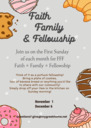
We invite you to consider offering a future Sunday Fellowship Hour with your family or friends by providing simple refreshments such as donuts or bagels, fruit, and juice. This is a meaningful way to honor a loved one or celebrate a special occasion. To sign up, please contact the Fellowship Coordinator, Olympia (Debbie) Kyriakidis at 619-507-6521 or[email protected].
Available Sundays:
November 29th
January 17th
January 24th
January 31st
With appreciation,
Anthousa Chapter of Philoptochos
See the attached flyer in the Inserts & Flyers section below.
Hellenic Fairways Golf Tournament and Dinner is Back
Today, at Willowbrook Golf Course. 100% of the net proceeds from this year’s golf tournament will go to St. Spyridon Greek Dance & Choral School. https://www.wesharegiving.org/App/Form/ead2bb82-37c2-43ad-bef0-273a6ce94c01.
St. Spyridon Food Drive
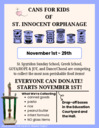
Join Sunday School, Greek School, GOYA, HOPE & JOY, and Dance & Choral in collecting non-perishable food items for St. Innocent Orphanage, starting Sunday, November 1st. The ministries will be competing to collect the most food! Collection bins will be in the Hall and Education Courtyard.
See the attached flyer in the Inserts & Flyers section below.
Philoptochos Invites You to Join Team Anthousa This Sunday
As a member of Team Anthousa, we each play a part in helping Susan G. Komen® in their one mission to end breast cancer forever. Please join Team Anthousa as we honor our community members who are battling, have survived, and those we have lost in this fight by making your one donation today. Join here by registering and selecting Team Anthousa:
See the attached flyer in the Inserts & Flyers section below.
FDF Hotel Reservations Open This Sunday
Hotel Reservations open thisSunday, November 1st at 4:00 pm and usually sell out quickly. The Folk Dance Festival is an annual event attended by thousands that showcases youth and young adult talent from all over the Metropolis. This year, FDF is in Anaheim, February 11-14, 2027. If you would like to attend FDF as a spectator or if you have a Dance and Choral participant, register here: https://www.yourfdf.org/hotel-reservations/.
Bookstore
New book - “Suffer With You” Orthodox Christian Prison Ministry (OCPM) brings to us humbling examples of the power of forgiveness. Pick up your copy today for $10.
Greek Heritage Night
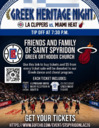
Final day to buy tickets is this Sunday, November 1st. The game is thisWednesday, November 4th. Tip-off at 7:30 pm, Intuit Dome, Los Angeles: Get your Greek on and support our program when the LA Clippers face the Miami Heat. Every ticket purchased through this link gets you access to the pregame reception in court B and a special Greek Heritage Night T-shirt. $5 from ticket sales purchased through this link will be donated directly to the St. Spyridon Greek Dance and Choral Schoolhttps://www.gofevo.com/event/StSpyridonLAC26.
See the attached flyer in the Inserts & Flyers section below.
Greek Dance and Choral School
Schedule of practices for dance groups for Sunday, November 1st:
Ta Spyridonakia: 12:15 to 12:45 pm, Youth Room
Youth Choir: 12:30 to 1:10 pm, Choir Loft
High School Girls Group: 1:10 to 1:25 pm, Choir Loft
Lunch break for Helios/Pelagos/Choir participants: 12:10 to 12:20 pm, Youth Room
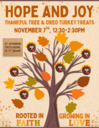
Saturday, November 7th, 12:30-2:30 pm. Our next activity is Thankful Tree and Turkey Treats! Kids in TK-5th grade can come and make a giant Thankful Tree and Oreo Turkey Treats in the Youth Room. We will also have plenty of time for games in the Youth Room! Lunch will be served. RSVP to [email protected].
See the attached flyer in the Inserts & Flyers section below.
Young at Heart Seniors
Join us for our next meeting on Tuesday, November 10th, 11:00 am, Church Hall. Following lunch, we will welcome two special guest speakers. Fr. Andrew will share the story of his calling and journey to the priesthood. Presvytera Diane will reflect on supporting his calling and their life together during his seminary years. All St. Spyridon parishioners are welcome to join us for this special afternoon of fellowship!
Women of the Word
Will be meeting in the Parish Hall for our Saturday, November 14th meeting for a special activity. If you have registered for our study, please check your e-mail and be sure we are in your contacts so that our updates do not go to your spam folder. [email protected]. Also remember that our schedule and resources are available on our landing page: https://wowsandiego.carrd.co/. Any questions? Just email Kay Harkins[email protected]
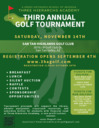
Three Hierarchs Academy - Third Annual Golf Tournament
During this season of giving, give the gift of education! Three Hierarchs Academy - an Orthodox School Third Annual Golf Tournament fundraiser is scheduled for November 14th. Even if you don’t golf, please consider a donation to this Greek Orthodox School located near St. Anthony’s Monastery in Arizona. For sponsorship opportunities and more information please call or text Alexandra Aram at 760-521-0472 or email [email protected].
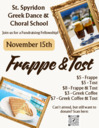
Frappe and Tost Fundraiser is Back
Join us on Sunday, November 15th during fellowship (and General Assembly meeting) in the hall after Divine Liturgy. We will have frappe, Greek coffee, and tost (grilled cheese) available for sale. All proceeds will benefit the St. Spyridon Greek Dance and Choral School.
See the attached flyer in the Inserts & Flyers section below.
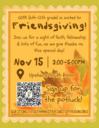
GOYA Friendsgiving
Sunday, November 15th, 3:00 pm, in the Youth Room. Kids and teens in grades 6-12, come enjoy a potluck supper with friends! We will eat delicious food and play fun games organized by the GOYA Board. Sign up for the potluck on the Youth Ministries website.
See the attached flyer in the Inserts & Flyers section below.
Little Angels Playgroup
Next playgroup is November 18th from 9:45-11:00 am. This is for babies, toddlers, and parents! We play, sing songs, and do fun activities in our St. Spyridon Playroom (Lower Education Building). If you have any questions, please contact Julie Dennis, Youth Ministries Director, at [email protected].
Fall See's Candy Fundraiser is Back
See’s Candy makes a great Thanksgiving and Christmas treat and gift! All proceeds go to support the Dance and Choral School! Candy is shipped directly to your (or your recipient’s) home. Fundraiser ends December 4th. https://www.yumraising.com/store/winter-2026-st-spyridon-dance-and-choral-166d/Kat_Mec6915 Email Kathy Meck with questions: [email protected].
See the attached flyer in the Inserts & Flyers section below.
Upcoming Memorials in November
11/8: Eleftheria (Ritsa) Horeftis - 1 year
11/8: Patrikia Yoanidis - 40 days
11/8: Gregory Gallanis - 10 years
11/8: Hariklia Atsalos - 40 days
11/15: Steve Kosmos - 40 days
11/15: Panayiotis Limperis - 16 years
11/22: Nick Panos - 15 years
11/22: Popi Panos - 22 years
11/22: Konstantinos Loukatos - 22 years
11/22: Elly Loukatos - 15 years
11/22: John Stamatelatos - 19 years
11/22: Deacon Michael Kallas - 6 months
11/22: Marika Livas - 25 years
11/22: Stavros Livas - 54 years
11/22: Argirios Livas - 12 years
11/22: Nikos Livas - 2 years
11/22: Athena Livas - 2 years
11/22: Joseph Livas - 2 years
Men’s Ministry
Meets on the 4th Thursday of each month in the Church Hall at 6:30 pm. We invite every man - young and old - to join us as we grow stronger in faith, love, and responsibility. During our meetings, we share specific Scripture and teachings from the Church Fathers, connecting the topics we discuss to how we should live in the world today. Our goal is to strengthen ourselves as: men, fathers, husbands, brothers, and, above all, how to better serve our Lord and our church community.
Each month, we average around 30 participants, with ages ranging from 18 to 90 - and we always welcome new faces. We look forward to seeing you at our next meeting! Questions? Contact: John Georges - jhgeorges58@gmail.com, text: 951-536-1217.
Church Parking
We respectfully ask that you please adhere to these guidelines when using the church parking lot:
Please do not park in handicap spaces unless your vehicle displays a valid handicap placard or license plate.
Please ensure that no vehicles are blocked in from any side. Blocking someone in is not only a big inconvenience to them, but damage to your vehicle is very possible.
Please park only in marked spaces. If there is no line marking a parking spot, please do not park there.
To ensure Emergency Vehicle access, please do not park in the red-painted driveway onto Indiana Street.
Please ensure that no Entrances or Exits are blocked by your car.
Please be mindful not to mistakenly take up two spotswith your car.
Thank you for your cooperation and for helping to keep our parking area safe and accessible for all parishioners.
The Nursery and Cry Room
A nursery and cry room is available in the Narthex behind the candle box, offering a quiet space (with toys, books, changing table) for parents with young children. The room is equipped with both video and audio, allowing you to follow the Divine Liturgy. For assistance, please speak with a member of the Narthex Team.
Agape Meals
Our Philoptochos Agape Meal program provides meals to our St. Spyridon community members who may need help with a meal(s) during a time of need. If you are interested in preparing a home-cooked meal for our parishioners, please reach out to Marian Dougenis at[email protected] or mobile 619-520-3660. Thank you!
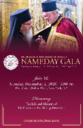
2026 Archbishop Elpidophoros Nameday Gala
Monday, November 2, 2026 | 6:00 pm. Pier Sixty, Chelsea Piers, New York, NY.
The Department of Youth and Young Adult Ministries (Y2AM) invites the faithful to support the Archdiocesan Youth Summer Camp Scholarship Fund through the upcoming 2026 Archbishop Elpidophoros Nameday Gala.
An annual celebration of the feast day of Saint Elpidophoros, patron of His Eminence Archbishop Elpidophoros, the gala raises critical funds for the Archdiocesan Youth Summer Camp Scholarship Fund, which provides financial assistance to children from across the Archdiocese, enabling them to attend Greek Orthodox summer camps regardless of their financial circumstances. The generous contributions from our parishes will be instrumental in making this vision a reality, and we humbly invite each and every one of you to participate in this blessed endeavor. Register here: https://www.goarch.org/nameday.
See the attached flyer in the Inserts & Flyers section below.
Orthodox Parish Leadership Monthly Webinar Series
Monday, November 16, 2026 • 5:00 p.m. Pacific / 8:00 p.m. Eastern. To Prepare: Healthy Catechism for Newcomers This webinar is hosted by the Metropolis of Boston Thriving Congregations Initiative (TCI) and responds to a growing reality across Orthodox parishes in the United States: increasing numbers of inquirers and converts, many of whom arrive after self-directed online learning. The session will explore how parishes can offer catechism that is not only a transfer of information but an opening of Orthodox spiritual practice. With limited clergy and a shortage of trained catechists, the webinar will highlight sustainable models that involve lay leaders, peer support, and integration into the liturgical and communal life of the parish. Emphasis will be placed on moving newcomers from knowledge to participation, helping them develop relationships, spiritual practices, and a lived experience of Orthodoxy. Drawing from TCI parish examples, this session will equip communities to form newcomers in a way that is scalable, relational, and deeply rooted in the life of the Church. Register here: https://sanfran.goarch.org/events/orthodox-parish-leadership-2026-webinar-series-to-prepare-healthy-catechism-for-newcomers?date=2026-11-16
Strengthen Your Relationship withEight Dates
Join the Metropolis of San Francisco Family Wellness Ministry forEight Dates, a relationship series based on the book by Drs. John and Julie Gottman.
When:Thursdays at 6:30 PM (Pacific) via Zoom
Dates:September 10 – December 10.
Topics:Trust, Conflict, Intimacy, Family, Spirituality, and more!
Eleventh Orthros Gospel
The Reading is from John 21:14-25
At that time, Jesus revealed himself to the disciples after he was raised from the dead. And he said to Simon Peter, "Simon, son of John, do you love me more than these?" He said to him, "Yes, Lord; you know that I love you." He said to him, "Feed my lambs." A second time he said to him, "Simon, son of John, do you love me?" He said to him, "Yes, Lord; you know that I love you." He said to him, "Tend my sheep." He said to him the third time, "Simon, son of John, do you love me?" Peter was grieved because he said to him the third time, "Do you love me?" And he said to him, "Lord, you know everything; you know that I love you." Jesus said to him, "Feed my sheep. Truly, truly, I say to you, when you were young, you girded yourself and walked where you would; but when you are old, you will stretch out your hands, and another will gird you and carry you where you do not wish to go." (This he said to show by what death he was to glorify God.) And after this he said to him, "Follow me." Peter turned and saw following them the disciple whom Jesus loved, who had lain close to his breast at the supper and had said, "Lord, who is it that is going to betray you?" When Peter saw him, he said to Jesus, "Lord, what about this man?" Jesus said to him, "If it is my will that he remain until I come, what is that to you? Follow me!" The saying spread abroad among the brethren that this disciple was not to die; yet Jesus did not say to him that he was not to die, but, "If it is my will that he remain until I come, what is that to you?" This is the disciple who is bearing witness to these things, and who has written these things; and we know that his testimony is true. But there are also many other things which Jesus did; were every one of them to be written, I suppose that the world itself could not contain the books that would be written. Amen.
Epistle Reading
Prokeimenon. Fourth Mode. Psalm 15.3,8. Among the saints who are in his land, the Lord has been wondrous.
Verse: I see the Lord before me continually.
The reading is from St. Paul's First Letter to the Corinthians 12:27-31; 13:1-8.
Brethren, you are the body of Christ and individually members of it. And God has appointed in the church first apostles, second prophets, third teachers, then workers of miracles, then healers, helpers, administrators, speakers in various kinds of tongues. Are all apostles? Are all prophets? Are all teachers? Do all work miracles? Do all possess gifts of healing? Do all speak with tongues? Do all interpret? But earnestly desire the higher gifts. And I will show you a still more excellent way. If I speak in the tongues of men and of angels, but have not love, I am a noisy gong or a clanging cymbal. And if I have prophetic powers, and understand all mysteries and all knowledge, and if I have all faith, so as to remove mountains, but have not love, I am nothing. If I give away all I have, and if I deliver my body to be burned, but have not love, I gain nothing. Love is patient and kind; love is not jealous or boastful; it is not arrogant or rude. Love does not insist on its own way; it is not irritable or resentful; it does not rejoice at wrong, but rejoices in the right. Love bears all things, believes all things, hopes all things, endures all things. Love never ends.
Gospel Reading
5th Sunday of Luke
The Reading is from Luke 16:19-31
The Lord said, "There was a rich man, who was clothed in purple and fine linen and who feasted sumptuously every day. And at his gate lay a poor man named Lazaros, full of sores, who desired to be fed with what fell from the rich man's table; moreover the dogs came and licked his sores. The poor man died and was carried by the angels to Abraham's bosom. The rich man also died and was buried; and in Hades, being in torment, he lifted up his eyes, and saw Abraham far off and Lazaros in his bosom. And he called out, 'Father Abraham, have mercy upon me, and send Lazaros to dip the end of his finger in water and cool my tongue; for I am in anguish in this flame.' But Abraham said, 'Son, remember that you in your lifetime received your good things, and Lazaros in like manner evil things; but now he is comforted here, and you are in anguish. And besides all this, between us and you a great chasm has been fixed, in order that those who would pass from here to you may not be able, and none may cross from there to us.' And he said, 'Then I beg you, father, to send him to my father's house, for I have five brothers, so that he may warn them, lest they also come into this place of torment.' But Abraham said, 'They have Moses, and the prophets; let them hear them.' And he said, 'No, father Abraham; but if some one goes to them from the dead, they will repent.' He said to them, 'If they do not hear Moses and the prophets, neither will they be convinced if some one should rise from the dead.'"
Diakonia Newsletter
Read the latest Diakonia Newsletter for this Sunday
School of Byzantine Music honors first diploma graduates with “Grace and Praise” oncert
10/30/2026
On Wednesday, October 28, the School of Byzantine Music, a national ministry of the Greek Orthodox Archdiocese of America, celebrated its first diploma program graduates with a concert entitled “Grace and Praise” in the chapel of Holy Cross Greek Orthodox School of Theology in Brookline, MA. The evening honored the next generation of Byzantine cantors and their commitment to the sacred musical tradition of the Church.
The concert followed the School’s Psaltikon pilgrimage to Thessaloniki and Mount Athos in July 2026, an educational and spiritual initiative organized in collaboration with the Holy Metropolis of Thessaloniki. The pilgrimage and this diploma honor event were generously funded by Leadership 100. In Greece, participants took part in workshops in the Psaltic Art, liturgical services, and conservatory sessions, including examinations, immersing themselves in the living tradition of Byzantine chant.
Before the concert, Protopresbyter Romanos Karanos, Ph.D., Adjunct Assistant Professor of Byzantine Liturgical Music and Director of the Byzantine Music Program at Holy Cross, welcomed participants and guests to campus and shared his personal experiences from the July pilgrimage. He spoke of the growing interest among students in Byzantine music and the increasing number of budding cantors in America, thanks to initiatives such as these. He concluded by congratulating the graduates on their achievement.
The Director of the School of Byzantine Music, Archon Georgios Theodoridis, also congratulated the graduates. He credited the success of the Psaltikon pilgrimage to His Eminence Archbishop Elpidophoros and to the continuing support of Leadership 100.
Special appreciation was extended to His Eminence Metropolitan Philotheos of Thessaloniki and the Holy Metropolis of Thessaloniki for their support and hospitality. All gratefully acknowledged the Educational and Cultural Institute of the Metropolis of Thessaloniki and its director, the Very Reverend Archimandrite Cheruveim Tsinoglou.
The concert was both a celebration of academic achievement and a testament to the enduring importance of Byzantine chant as the living musical tradition of Orthodox worship. A highlight of the evening was the participation of both the Doxologia Choir, led by Fr. Cheruveim, and the School of Byzantine Music Choir, who performed hymns from the service of Great Vespers. Each graduate also had the opportunity to share their individual musical gifts through solo performances, demonstrating the fruits of years of study, dedication, and service to the Psaltic Art.
After the concert, Fr. Cheruveim offered closing remarks. He thanked His Eminence Metropolitan Philotheos of Thessaloniki and His Eminence Archbishop Elpidophoros for their blessings and fatherly love, and he thanked School of Byzantine Music Director Georgios Theodoridis for a great collaboration.
As a national ministry of the Archdiocese, the School of Byzantine Music equips music ministry leaders and workers for building up the body of Christ. Through its educational programs, partnerships, and international collaborations, the School continues to fulfill that mission by equipping and educating Byzantine cantors for the Church in America and preparing them to serve their parishes with knowledge, humility, and ecclesiastical devotion.
On Wednesday, October 28, the School of Byzantine Music, a national ministry of the Greek Orthodox Archdiocese of America, celebrated its first diploma program graduates with a concert entitled “Grace and Praise” in the chapel […]
BROOKLINE, MA–Under the spiritual direction of His Eminence Archbishop Elpidophoros of America, the Board of Trustees of Hellenic College Holy Cross Greek Orthodox School of Theology met October 27-28 on the school’s campus. Two days of focused, productive discussions and honest dialogue about advancing the school’s mission were facilitated by Board Vice Chairman and Protopresbyter of the Ecumenical Throne Fr. Mark Leondis (Hellenic, BA ‘92, Holy Cross, MDiv ‘95).
“Hellenic College Holy Cross is not just another institution of higher learning, but a sacred institution of our sacred archdiocese,” said Archbishop Elpidophoros of America, Board of Trustees Chairman. “Our strength is a collective responsibility. We must be united in one purpose to ensure that the school endures and flourishes for years to come. We must approach our work with faith, trust and a shared love for the school and our Church.”
Under the spiritual direction of His Eminence Archbishop Elpidophoros of America, the Board of Trustees of Hellenic College Holy Cross Greek Orthodox School of Theology met October 27-28 on the school’s campus. Photo by HCHC
Announcements and Highlights
The Trustees concluded their forthright discussions with clarity of purpose and a continued commitment to advancing the mission of HCHC. In 2027, Holy Cross is celebrating its 90th anniversary and Hellenic College approaches the 60th year since its founding. Positioning itself for another hundred years of equipping students with the spiritual, intellectual, and professional tools needed to serve the Church in an ever- changing society at large.
Among the highlights of the meeting:
The Executive Committee of the Board of Trustees has been elected to serve a two-year term; the following officers were nominated and approved to serve as officers alongside the Chairman and Archbishop: Fr. Mark Leondis, Vice Chair; Paul Kalamaras, Treasurer; and Fr. Nicholas Anctil, Secretary.
The Presidential Search Committee reported that its work continues on the 9- to 12-month timeline set forth earlier this year. Prior to the meetings, Search Committee members held question-and-answer sessions open to all students, faculty and staff in its pursuit of the person who will lead the institution and help shape future clergy and lay leaders.
Koinonoia, a collaboration between the HCHC and Greek Orthodox parishes to establish and support a full-time, one semester parish internship for MDiv seminarians, announced its organizational structure with support from the Lilly Endowment Pathways for Tomorrow grant. Alexander Popovici is the Director; Stavroula Gurguliatos, Assistant Director; and Dr. Philip Mamalakis, the Faculty Coordinator.
In 2027, plans are underway to celebrate the 90th Anniversary of our beloved School. A committee was formed to work with His Eminence Metropolitan Nathanael of Chicago, who was appointed by the Holy Eparchial Synod, to help plan and coordinate the events.
Robust discussion took place on various Committee reports, including: Academic Affairs, Enrollment and Student Life, Endowment, Institutional Advancement, Board Governance and Finance.
HCHC Interim President Rev. Protopresbyter Michael Lambakis (Holy Cross, MDiv ‘06) concluded, “By strengthening how we work together and by making the most of our resources, we can meet the challenges before us while continuing to advance the unique mission of HCHC. We are in an exciting period of growth and opportunity. To build on this momentum and sustain the excitement surrounding our institution, we must operate in ways that are efficient, pragmatic and strategic. With clear priorities.”
About Hellenic College Holy Cross
Hellenic College Holy Cross is the intellectual, educational, and spiritual center of the Greek Orthodox Church in America. As an institution of higher learning, it is dedicated to the formation of Orthodox Christian leaders—clergy and laity—equipped to serve the Church and society with faith, integrity, and excellence.
BROOKLINE, MA–Under the spiritual direction of His Eminence Archbishop Elpidophoros of America, the Board of Trustees of Hellenic College Holy Cross Greek Orthodox School of Theology met October 27-28 on the school’s campus. Two days […]
Opinion | They planted the faith; we must welcome the harvest
10/28/2026
Every convert to Orthodoxy has a story. Some discover the Church through marriage; others through the Fathers, a university course, or more recently, on social media or an internet browser. Their journeys differ, but each requires the courage to step beyond the familiar into something deeper.
As America celebrates its 250th anniversary, we should remember another story of courage: before people could discover Orthodoxy in America, Orthodox immigrants first had to bring it here.
In my family, these are not merely stories from a history book. Borrowing funds, my uncle left Cyprus at fourteen. He quickly learned how to cut hair on his voyage ($.25/cut) to pay back that loan. My father left the same village with a $20 bill in his pocket and the hope of building a better life. Our forefathers and foremothers arrived with little money, limited English, and few guarantees. There are countless stories of our immigrant ancestors coming to America. Among everything they carried, the greatest treasure was the one they refused to leave behind: the Orthodox Christian faith.
Assimilation would have been easier. There was tremendous pressure to change their names, learn the language, adjust to new foods and customs, and adapt to an unfamiliar religious landscape. They could have walked into Catholic or Episcopalian Churches to find worship. Yet instead of surrendering everything that made them different, they lived into their faith and celebrated their culture with joy no matter the circumstance.
They gathered in homes, storefronts, and rented halls. From hard-earned wages, they gave what they could barely afford. They built churches to baptize their children, to celebrate the Divine Liturgy and Pascha. They taught the next generation to make the sign of the Cross. They sacrificed because the Church was not an accessory to their new life in America; it was essential to it.
We must also remember the clergy who crossed the ocean to encounter the unknown and to serve scattered communities. Wherever an altar could be raised, they celebrated the Liturgy, crowned marriages, buried the dead, taught the Faith, and became spiritual fathers. Together clergy and laity planted Orthodoxy in America. They may have dreamed of the parishes, cathedrals, seminaries, monasteries, and ministries their devotion would one day build. But did they imagine that someone with no ancestral connection to an Orthodox homeland would walk through those same doors and ask, “How can I become Orthodox?”
This is one of the beautiful paradoxes of Orthodoxy in America: our ancestors preserved the Church because they did not want their children to lose it. By doing so, they made it possible for countless others to find it.
Today, an inquirer may first encounter the Faith online, but Orthodoxy cannot be lived through a screen. The seeker must physically enter a parish to appreciate its worship, community, prayer, fasting, and Eucharistic life. Conversion is not merely accepting new ideas; it is allowing Christ to redirect one’s life. Our calling is not simply to provide information, but to accompany people patiently in transformation.
This is where the stories of our ancestors and today’s converts meet. Both resist the easiest path. Our ancestors declared, “We can become fully American without ceasing to be Orthodox.” Today’s converts reveal the other side of that truth: one need not be any particular ethnicity to become fully Orthodox.
America, ultimately, welcomed Orthodox Christians. Now Orthodoxy welcomes Americans. As descendants of those who established the faith in this land, it is our responsibility to receive anyone seeking Christ. The question of this great responsibility is not merely whether we will preserve what we inherited, but whether we possess enough of our ancestors’ courage to share it.
When we proclaim, “This is the faith of the Apostles. This is the faith of the Fathers. This is the faith of the Orthodox,” we rightly remember the saints who defended and preserved the faith. In America, we may also remember our own fathers and mothers, grandfathers and grandmothers, who crossed an ocean of uncertainty without abandoning their greatest treasure. They carried it here. They planted it here. They sacrificed for it here.
The faith planted by our ancestors is now entrusted to us. We are called to preserve it by offering it courageously to all who come after us. Some may bear Greek surnames; others will have no ancestral connection to an Orthodox homeland. Each will bring a story of how they found the Church, and each will find a place within it. Perhaps the greatest fruit of our ancestors’ courage is to witness people of varying backgrounds and ethnicities gather in the churches they established to share in the love of Christ they never could abandon.
This article is published as part of the America at 250: Orthodoxy in a New Homeland media initiative co-organized by the Orthodox Observer and the Department of Inter-Orthodox, Ecumenical, and Interfaith Relations of the Greek Orthodox Archdiocese of America to honor the contributions and experience of Orthodox Christianity in America and celebrate 250th anniversary of America’s founding.
Every convert to Orthodoxy has a story. Some discover the Church through marriage; others through the Fathers, a university course, or more recently, on social media or an internet browser. Their journeys differ, but each […]
I am reluctant to admit that I begin each morning by snoozing my alarm a few too many times and mindlessly scrolling on TikTok. And once awake, school, work, socializing, and a workout always seem to fall into place effortlessly. So why doesn’t prayer?
While I make my σταυρό before every meal, and mumble Πάτερ ἡμῶν everynight before going to sleep, I didn’t establish a set prayer time each day until a month ago. The forty-five minutes I might dedicate to a pilates class had become more feasible, and I convinced myself that it is more worthwhile. I lived under the pretext that being busy was an excuse from establishing a set time with God. The Orthodox Church teaches the importance of a traditional worship: venerating icons, the seven sacraments and routine prayer. These rituals come naturally to me, yet I mostly practice them during services. I have never doubted my relationship with God, yet I have always struggled to pray. And while it may sound obvious, learning ‘how to pray’ is important and it is a conversation that is often shelved.
Recently, I’ve been observing the way in which my grandmother worships God in her daily life outside of Church. Her morning routine swaps scrolling for reading scripture, her afternoon walks do not require blaring music or a phone call to catch up with a friend, and her evenings end with silent prayer and reflection each night. Meals are introduced with a proper prayer and thanks to God, not a half-hearted and hastily done cross. She incorporates God into her routine, arguably gossiping to Him just as I would with friends. And while she is 83 and has more downtime, these habits are ones that anyone could emulate.
For much of my life I was truly uncomfortable in personal prayer; shifting in the silence, asking God for wants like some sort of genie, and eventually resorting to repeating familiar prayers because I was impatient. Our time spent together felt forced, ingenuine and painfully redundant. My screen time was an abjection and this summer, I admitted to myself that the restlessness in silence with God needed to change. Observing my grandmother required me to face my fears and accept the reality that nourishing an intimate relationship with God will require self reflection and this dreaded, uncomfortable silence. Yet acceptance was the easiest part; it has been putting it into practice for me that has proven to be most difficult, while dually the most fruitful.
Under the advice of my older brother, I reached out to my priest to speak about these feelings. During our conversation, he urged me to test out the ‘closet method’ wherein you set a timer and sit somewhere kept away from distraction -hence the closet- and dedicate a period of time to God. While this may seem a bit dramatic, it has changed the way I pray and I’ve grown increasingly comfortable in the silence that was formerly so daunting to me. Much like meditation, it reminded me that I need to relax my breath, set my mind and my intentions onto my goal: building my relationship with God. This approach to prayer has allowed me to focus my entire attention on God, weakened distraction and has translated into other moments of my day. The reward of knowing God intimately requires struggle and in just the few weeks I’ve put this advice into practice, I have begun to look forward to our conversations. I look for Him in my solitude and no longer feel the need to drown Him out with music, idle scrolling or former unfulfilling distractions. I shifted my perspective of God from not just my creator, but to my friend. And just like any strong friendship, it requires effort, listening and patience with both parties. Further, allocating time for God in the same way you would a workout, a healthy meal, or a good catch up with a friend is nourishing; it is a free and effective wellness supplement!
Mary Markis is a part-time writer for the Orthodox Observer. A Greek American and lifelong Orthodox Christian, she is currently pursuing a Bachelor of Art in Art History and Social Anthropology at the University of St. Andrews in Scotland.
I am reluctant to admit that I begin each morning by snoozing my alarm a few too many times and mindlessly scrolling on TikTok. And once awake, school, work, socializing, and a workout always seem […]
On Good Deed Day, Loukoumi Foundation pledges $50,000 to St. Michael’s Home
10/27/2026
The Loukoumi Make A Difference Foundation in New York closed its 19th annual International Make A Difference with Loukoumi Day on Saturday, Oct. 24, with a visit to the construction site of the new St. Michael’s Home (SMH) in Uniondale, where the foundation pledged to raise $50,000 to create a Loukoumi Lounge.
The foundation arrived on its Loukoumi Good Deed Bus and made a pledge at the site, where construction is underway. The group toured the building, including the space where the lounge will be built, and made a $3,000 deposit toward the pledge.
The lounge is intended as a gathering place where residents can socialize and spend time with visiting volunteers and family, according to the foundation. The new facility, which is moving from its current campus in Yonkers, is expected to be complete at the end of next year.
Rendering of the Loukoumi Lounge at the new St. Michael’s Home. Rendering courtesy of Loukoumi.
International Make A Difference with Loukoumi Day is held on the last Saturday of October, when children and young adults take part in service projects and acts of kindness. Over the years, the initiative has reached more than 150,000 participants in 35 countries. This year, Loukoumi Good Deed Buses also departed from Athens, Greece; Cologne, Germany; Deerfield, Illinoid; and Gander, Newfoundland.
“This is a meaningful pledge from the Loukoumi Foundation for two reasons. One, from SMH perspective, this pledge is the first pledge to the project from a youth organization. It reflects SMH’s belief that compassion has no age limit,” St. Michael’s Home Office of Development spokesperson Paul Politis said. “It shows that young people care about the well-being of older adults, that they are cherished, appreciated, and not forgotten, and they are willing to take action to make a positive difference in their lives.”
The foundation was established by Nick Katsoris, its president, founder and executive director, and author of the Loukoumi children’s books.A foundation study published by Fordham University surveyed more than 1,000 children and young adults in 20 countries; more than 90 percent said doing good made them happier.
Katsoris himself volunteered at St. Michael’s Home with the foundation when he was a senior in high school. As a Loukoumi volunteer, Katsoris would help the residents of the Yonkers facility to their medical appointments. “It’s really very rewarding,” Katsoris said. “What we’re doing is creating this space where people can go and spend time because some of these people are very lonely.”
Earlier in the day, participants boarded the Loukoumi Good Deed Bus at Holy Trinity Greek Orthodox Church in New Rochelle, N.Y., and traveled to Fordham University, where panelists spoke about the meaning of charity.
Here, New York State Assemblywoman Amy Paulin called in: “I spent many years volunteering and in public service,” Paulin said. “Sometimes those deeds affect many, many people and sometimes just one. But no matter, it is all important.” Paulin also spoke about her efforts to secure state funding for the Loukoumi Service Learning Curriculum in the Eastchester school district. The curriculum requires that students in schools that adopt the learning plan to participate in acts of volunteerism.
New York State Senator Shelley Mayer also joined the panel, and spoke at length about the “acts of goodness” Loukoumi stands for. “I love hearing from students all over the world,” Shelley said. “What a credit to Loukoumi for this worldwide initiative.”
From there, the Good Deed Bus left for POTS (Part of the Solution), a Bronx organization that serves individuals and families in need. Participants donated diapers, infant formula, wipes and nonperishable food.
After listening to the panelists at Fordham University, volunteers went to POTS in the Bronx to donate goods. Photo courtesy of Loukoumi.
Students from Loukoumi Good Deed Councils at Greek Orthodox parishes and schools are raising money for the project. Participants include Holy Trinity Greek Orthodox Church in New Rochelle, N.Y.; St. Demetrios School in Astoria, N.Y.; Archangel Michael Greek Orthodox Church in Port Washington, N.Y.; Holy Trinity Greek Orthodox Church in Bridgeport, Conn.; and the William Spyropoulos School at St. Nicholas Greek Orthodox Church in Flushing, N.Y.
The Loukoumi Make A Difference Foundation in New York closed its 19th annual International Make A Difference with Loukoumi Day on Saturday, Oct. 24, with a visit to the construction site of the new St. […]
Orthodox institute joins 11 theological schools teaching climate science
10/27/2026
The Huffington Ecumenical Institute (HEI) at Hellenic College Holy Cross has been selected as a grantee in the third cohort of the Climate Science in Theological Education (CSTE) initiative, a project of the Dialogue on Science, Ethics, and Religion (DoSER) program at the American Association for the Advancement of Science (AAAS).
Through the grant, HEI will work with DoSER to engage current climate science in its curriculum and programming. HEI is one of 11 theological institutions in this cohort, which includes schools in the United States, Nigeria, Tanzania, and Ukraine.
“This grant will enable us to prepare a graduate course for our school focused on practical steps for greening our parishes,” said Fr. John Chryssavgis, HEI’s Executive Director. “It follows the groundbreaking course offered by HEI two years ago and works with the new program of the Greek Orthodox Archdiocese of America for developing a Green Church Initiative across the country.”
The Huffington Ecumenical Institute (HEI) at Hellenic College Holy Cross has been selected as a grantee in the third cohort of the Climate Science in Theological Education (CSTE) initiative, a project of the Dialogue on […]
Archbishop urges support for Greece’s foreign policy
10/26/2026
The Stathakion Center in Astoria, headquarters of the Federation of Hellenic Societies of Greater New York, proved far too small to accommodate both the crowd and the enthusiasm of the Greek community members who gathered to celebrate the national anniversary of October 28. This year’s event had a special significance: it was the first in many years to be held by a reunited Federation, which had recently overcome its divisions and elected the distinguished Greek American Christos Vournias as a unifying president.
The Federation’s unity was immediately welcomed by both the Church and the Greek state, with His Eminence Archbishop Elpidophoros of America and the Minister of Foreign Affairs of the Hellenic Republic, George Gerapetritis, honoring yesterday’s event with their presence. To help bring about a resolution, the Archbishop had previously made unity within the Federation a condition for his participation in its events, while Mr. Gerapetritis is the first Greek Foreign Minister to visit the Stathakion Center in more than two decades.
His Eminence Archbishop Elpidophoros of America greets Greek Foreign Minister George Gerapetritis at the Stathakion Center in Astoria, N.Y., during the Federation of Hellenic Societies of Greater New York’s celebration of the October 28 national anniversary. (Orthodox Observer/Dimitrios Panagos)
Also attending on behalf of the Hellenic Republic were Greece’s Ambassador in Washington, Antonis Alexandridis; Greece’s Permanent Representative to the United Nations, Aglaia Balta; the Consul General of Greece in New York, Iphigenia Kanara; and the Director of Greece’s Public Diplomacy Office in New York, Spyros Diamantis.
The event combined an account of Greece’s participation in World War II with a musical program of songs from the era, audiovisual material featuring historical documents, films, and dramatized accounts of the epic struggle of 1940.
The event was planned by Evangelos Athanasopoulos and Grigoris Marinakis, together with Peter Stavrianidis, President of the Federation of Hellenic American Societies of New Jersey. Nikitas Tampakis directed the musical program and performed an exceptional selection of songs alongside Angeliki Psoni, accompanied by Kostas Psarros on bouzouki and Glavkos Kontemeniotis on keyboards.
The speakers’ accounts of the heroism and sacrifices of the Greek people during the war, the role of the women of Pindus in supplying the soldiers, and the contribution of Greek military chaplains, together with the performers’ renditions of songs associated with the epic struggle of 1940, had already created an emotionally charged atmosphere in the hall by the time Archbishop Elpidophoros of America and Foreign Minister George Gerapetritis took the floor. The musical performances culminated in Angeliki Psoni’s moving rendition of the iconic “Children, Children of Greece.”
Addressing those present, Archbishop Elpidophoros spoke of the significance of having senior officials of the Hellenic Republic at the event and, speaking directly to Mr. Vournias, emphasized the importance of unity within the Federation. In his address, His Eminence highlighted the spirit of Hellenism’s struggles for freedom throughout history, which continues to inspire people today:
“There are moments in the history of a people when time seems to stand still,” the Archbishop said, turning to a literary reference to illustrate how the Greek army had surpassed its apparent limits by defeating an adversary that was, in theory, overwhelmingly superior in every respect:
“Nikos Kazantzakis, in his work “Report to Greco”, describes a symbolic encounter with the great Cretan painter Doménikos Theotokópoulos, whom he calls his spiritual grandfather. He asks him for advice, and the painter replies: ‘Reach as far as you can, my child.’ But Kazantzakis is not satisfied. He asks for advice that is even harder, more demanding. And then he hears the answer: ‘Reach farther than you can!’ An entire approach to life is distilled into this phrase. Human beings are called not merely to exhaust their potential, but to dare to transcend what they consider impossible.”
Members of the Greek American community fill the Stathakion Center in Astoria, N.Y., for the Federation of Hellenic Societies of Greater New York’s celebration of the October 28 national anniversary. (Orthodox Observer/Dimitrios Panagos)
The Archbishop also reflected on a second moment in which time seemed to stand still. The funeral of the national poet Kostis Palamas during the Occupation, in February 1943, became a symbolic act of resistance by the Greek people against the occupier. The verses of Angelos Sikelianos, recited by the Archbishop, captured the spirit of that day for eternity:
“Sound, you trumpets… Thunderous bells,
Shake the whole country from end to end…
Roar, drums of war…
You formidable flags, unfurl in the air!”
“Poetry that day was not merely a literary creation,” the Archbishop said. “It became an act of freedom.” With a third literary reference, this time to Yannis Ritsos, Archbishop Elpidophoros sought to connect Hellenism with Orthodoxy, and the struggles for national freedom with the pursuit of existential freedom as understood in Orthodoxy: “These trees will not settle for less sky.”
“This image is deeply moving. A tree cannot live without the sky. Nor can a human being truly live without freedom. Yet it is not enough simply to remove the chains imposed on us by others. There are chains we create ourselves. There are prisons without walls. It is precisely here, my dear friends, that historical experience meets the deeper message of the Gospel. The freedom Christ offers us is not the freedom to dominate others. It is the freedom of sacrificial love. And this dimension of freedom allows us to understand more deeply the sacrifice of the people of 1940.”
Before yielding the floor to Mr. Gerapetritis, Archbishop Elpidophoros also referred to those who lose their sense of proportion when writing on social media about the serious and sensitive issues of Greek foreign policy—”matters not to be trifled with”—hurling accusations, spreading rumors, or expressing views that defy all reason and are uninformed:
“Our duty, my dear friends,” the Archbishop said, “is to support with all our strength the foreign policy charted by our national leadership. Government officials, and especially our experienced diplomats at the Ministry of Foreign Affairs, having all the facts at their disposal, make decisions and determine the most appropriate strategy for our homeland. It is not wise for us to judge our national strategy, because we do not know what they are in a position to know. Quite simply, we cannot, and at times should not, know every aspect of these matters. We must have confidence in our homeland and preserve our national unity, especially on national issues.” Inviting George Gerapetritis to the podium, he concluded: “Mr. Minister, we look to you and your colleagues with confidence and assure you that all of us—the Church, the Greek diaspora, and all diaspora organizations—are always at the service of the nation. Long live Greece!”
“If you want to know the soul of Greece, travel!” George Gerapetritis opened his speech with these words, seeking to emphasize the special relationship between the worldwide Greek diaspora and the motherland, and the duty of Greece’s national leadership to keep alive the bridges that unite Greeks everywhere while also connecting their present with their past and future. The Foreign Minister also shared a personal account of his family’s history. As he explained, his family had set out from a small village on a small island in the Dodecanese, come to the United States, and, after working hard, managed to return home.
“In your faces, I see my own ancestors”, he said. He went on to speak of the particular honor he felt in being at the Federation and congratulated Mr. Vournias, likewise emphasizing the importance of unity: “Greece’s most precious jewel is the unity of its people!”
Mr. Gerapetritis then congratulated those who had contributed to the event, making special mention of the singers. Speaking about the spirit of October 28, he observed: “Greece has always defied the odds; Greece was the country that said the great Nos. We will never shy away from saying a resounding “NO” if necessary to defend our homeland.”
The Greek Foreign Minister spoke about Greece’s position in the world today, its voice being heard in international forums, its presidency of the Security Council, and its upcoming presidency of the European Council. Referring to the agreement with the Republic of Egypt concerning the Holy Monastery of Saint Catherine at Sinai, he emphasized the relationship between Hellenism and Orthodoxy through the centuries. He struggled to hold back tears as he spoke of the value of Greek identity, while also affirming the country’s determination to resist any hostile designs against it.
“There is no easy road” for those who harbor such designs against Greece, Mr. Gerapetritis warned to enthusiastic applause, before offering his wish: “Happy Anniversary, Greece!”
The Stathakion Center in Astoria, headquarters of the Federation of Hellenic Societies of Greater New York, proved far too small to accommodate both the crowd and the enthusiasm of the Greek community members who gathered […]
The things that have come into being have received from the Creator their proper place, their beginning and, in some cases, their end. But there is no boundary to virtue. The psalmist says, 'I have seen the end the end of all perfection, but Your commandment is very broad and is without limit' (Ps. 118:96). Now if it is true...that love never fails (I Cor. 13:8),... then love has no boundary, and both in the present age and in the future age we will never cease to progress in it, as we add light to light.
St. John Climacus
Ladder of Divine Ascent, Step 26: On Discernment; Paulist Press pgs. 250-251, 6th century
By these words it is surely shown that in his [the rich man] daily feasting he had frequently sinned by his tongue, seeing that, while burning all over, he demanded to be cooled especially in his tongue. Again, that levity of conduct follows closely upon gluttony sacred authority testifies ... For the most part also edacity leads us even to lechery, because, when the belly is distended by repletion, the stings of lust are excited.
St. Gregory the Dialogist
The Book of Pastoral Rule, Chapter XIX, 6th century
The man who has once chosen pleasure in this life, and has not cured his inconsiderateness by repentance, places the land of the good beyond his own reach; for he has dug against himself the yawning impassable abyss of a necessity that nothing can break through.
St. Gregory of Nyssa
How then is it possible for the rich man to be saved. By possessing his goods in common with them that are in need, being such as Job was, and exterminating out of his soul the desire of more, and in no points going beyond real need ....
St. John Chrysostom
Homily 74 on Matthew 23; Homily 78 on Matthew 6, 20, 25, 4th Century
Hymns of the Day
Resurrectional Apolytikion in the Plagal First Mode
Let us, the faithful, give praise and worship to the Word, coeternal with the Father and the Spirit and born of the Virgin for our salvation. Of his own will he mounted the cross in the flesh, suffered death, and raised the dead by his glorious resurrecti
Apolytikion for Unmercenaries Cosmas and Damian in the Third Mode
Sainted Unmercenaries and Wonder Workers, regard our infirmities; freely you have received, freely share with us.
Apolytikion for the Church in the First Mode
The Hymn of Saint Spyridon
At the first of the Synods, you appeared as a champion, * and Wonderworker, our God-bearing Father Spyridon. * Wherefore, you addressed the dead one in the grave, * and a serpent you changed to gold. * And while chanting * in service your sacred prayers, * you joined the angels concelebrating, most holy one.* Glory to Christ who glorified you, * glory to Him who crowned you, * glory to the One who works through You, * healings for everyone.
A protection of Christians unshamable, intercessor to our Holy Maker, unwavering, please reject not the prayerful cries of those who are in sin. Instead, come to us, for you are good; your loving help bring unto us, who are crying in faith to you: hasten to intercede and speed now to supplicate, as a protection for all time, Theotokos, for those who honor you.
Saints and Feasts
November 01
Cosmas and Damianos the Holy Unmercenaries and their mother Theodota
These Saints were from Asia (that is, Asia Minor). After the death of their father, their Christ-loving mother Theodota reared them in piety and in all manner of virtue, and had them instructed in every science, especially that of medicine. This became their vocation, and they went about healing every illness and malady, bestowing healing freely on both men and beasts alike; because of this, they are called "Unmercenaries." And thus, having completed the course of their life, they reposed in peace.
November 02
Acindynos, Pegasios, Aphthonios, Elpidophoros, and Anempodistos of Persia
These Martyrs contested in Persia about the year 330, in the reign of Sapor (Shapur) II, King of Persia (325-379). Acindynus, Pegasius, and Anempodistus, Persian Christians, confessed Christ before the King, and were put to many torments. Aphthonius and Elpidophoros, drawn to the Faith of Christ through the Martyrs, were beheaded with another 7,000. Saints Acindynus, Pegasius, and Anempodistus were at last burned to death. Two churches were dedicated in their honour in Constantinople. As is often the case in church hymns, there is a play on the meanings of the Saints' names here. Acindynus means "unimperilled"; Pegasius is derived from pegazo--"to gush forth"; Aphthonius is derived from aphthonos-"abundant"; Elpidophoros means "hope-bearing"; Anempodistus means "unhindered." These are all Greek translations of their Persian names.
November 03
Acepsimas the Bishop, Joseph the Presbyter, & Aeithalas the Deacon, Martyrs of Persia
Saint Acepsimas, a bishop, Saint Joseph, a presbyter, and Saint Aeithalas, a deacon, suffered exceedingly cruel torments and martyrdom during the reign of Sapor II, King of Persia (325-379). See also April 17.
November 04
Ioannikos the Great
Saint Joannicius was born in Bithynia about the year 740. His father was named Myritrikes and his mother Anastaso. When he had reached maturity, he excelled in soldiery and was counted worthy of royal honours for his bravery. He had been brought up an iconoclast, but while yet a soldier, he was converted to Orthodoxy by a certain holy elder. He later forsook all things and departed for Mount Olympus, where he spent the remainder of his life in asceticism. Becoming great in virtue, he reposed in the Lord in the year 834, having lived some ninety-four years. To this Saint is ascribed the brief prayer, "My hope is the Father ...."
November 05
Galaktion & his wife Episteme, the Martyrs of Emesa
Saint Galaktion was from Emesa, the son of Cleitophon and Leucippe, pagans who had been instructed in piety by a certain Christian named Onuphrius and received holy Baptism. Saint Episteme, born of unbelieving parents, was baptized before she was wedded to Galaktion. After their marriage they remained in virginity and lived in separate monastic houses. Betrayed as Christians, they suffered martyrdom during the reign of Decius, about the year 250.
November 06
Paul the Confessor, Patriarch of Constantinople
Saint Paul was from Thessalonica. He became the secretary of Alexander, Patriarch of Constantinople (see Aug. 30), a deacon, and then the successor of Saint Alexander in about 337. Because of his virtue, his eloquence in teaching, and his zeal for Orthodoxy, the Arians hated and feared him. When the Arian Emperor Constantius, who was in Antioch, learned of Paul's election, he exiled Paul and proclaimed the Arian Eusebius Patriarch. Saint Paul went to Rome, where he found Saint Athanasius the Great also in exile. Provided with letters by Pope Julius, Paul returned to Constantinople, and after the death of Eusebius in 342, ascended again his rightful throne; the Arians meanwhile elected Macedonius, because he rejected the Son's con-substantiality with the Father (and the divinity of the Holy Spirit besides). When Constantius, yet at Antioch, learned of Paul's return, he sent troops to Constantinople to drive Paul out. The Saint returned to Rome, where Saint Athanasius also was again in exile. Constans, Emperor of the West, Constantius' brother, but Orthodox, wrote to Constantius that if Athanasius and Paul were not allowed to return to their sees, he would come with troops to restore them him-self. So Paul again returned to his throne. After the death of Constans, however, Constantius had Paul deposed. Because of the love of the people for Saint Paul, Philip the Prefect, who was sent for him, was compelled to arrest him secretly to avoid a sedition. Paul was banished to Cucusus, on the borders of Cilicia and Armenia; a town through which his most illustrious successor, Saint John Chrysostom would also pass on his way to Comana in his last exile. In Cucusus, about the year 350, as Saint Paul was celebrating the Divine Liturgy in the little house where he was a prisoner, the Arians strangled him with his own omophorion, so much did they fear him even in exile. His holy relics were brought back to Constantinople with honour by the Emperor Theodosius the Great.
November 07
Bishop Raphael Hawaweeny of Brooklyn
Saint Raphael Hawaweeny was born on November 8, 1860 A.D., in Damascus, Syria, to pious Christian parents. He studied Arabic grammar and mathematics at the Antiochian Patriarchate parochial school where he was tonsured a reader in 1874. His strong academics served him well throughout his life, providing for him numerous opportunities to succeed and grow. He accepted a position in 1877 as an assistant teacher of Arabic and Turkish, which became full time in 1879. In 1879 he was tonsured a monk while working with Patriarch Hierotheos at the patriarchate, traveling with him on pastoral visits and serving as his personal assistant.
Longing to continue his theological studies, Raphael petitioned the Patriarch for permission to study at Halki Theological School, which was the only option for students of the Antiochian Patriarchate as the Balamand Seminary in Lebanon had been closed since 1840. After much persistence, Raphael received the blessing of the Patriarch and enrolled in Halki Seminary where he was ordained a deacon in 1885. After completing his degree at Halki, the young Deacon Raphael studied at the Kiev Theological Academy, working as a liaison between the Moscow and Antiochian patriarchates. Deacon Raphael was ordained to the holy priesthood in 1889 while in Kiev, continuing to serve that community for many years.
The opening of the Suez Canal in 1869 led to the subsequent collapse of the silk industry in the Middle East, causing many Syrians and others to immigrate to the United States. These new citizens desired to have their religion present in their new homeland and sent letters to their mother churches for pastoral help. A few priests were sent, but none lasted, and so the people asked for Father Raphael Hawaweeny to come to America and serve. Both the Antiochian and Moscow Patriarchs agreed to this idea, and Father Raphael left for America where the people greeted him with great love. Father Raphael then spent many years serving the Syrians in Brooklyn, New York, but he desired to scan the continent for Syrians and other Orthodox Christians who were without spiritual leadership. He traveled by train and carriage across the nation, finding Orthodox Christians, recording their location, and performing liturgies, baptisms, and weddings. Upon his return to Brooklyn, Father Raphael worked to find clergy to send to these dispersed communities, giving them a full time pastor to minister to their needs.
In 1904, by the hands of Bishops Tikhon and Innocent of the Moscow Patriarchate, he was the first bishop consecrated in the New World. The now Bishop Raphael continued his ministry to the Christians throughout America. Bishop Raphael worked tirelessly in Brooklyn to mediate disputes between the Orthodox Christians from Syria and Maronite Catholic Christians who often fought violently with one another. Despite numerous outbursts and setbacks, Bishop Raphael continued his ministry serving the Orthodox throughout his vast diocese. One such incident was when an influential leader of the Maronite group was killed and many people accused Bishop Raphael of ordering his murder. This led to many people attempting to harm the bishop, but he endured it all willingly. He was arrested under attempted murder charges, but was eventually cleared and let go after much time and money was spent in his defense.
Throughout his time in North America, Bishop Raphael founded 36 parishes to bring the Church to the faithful who were without a priest to guide them. Bishop Raphael truly lived out the Gospel in all aspects of his life, striving tirelessly for the people in his care, even to the point of sacrificing his own physical health in order to maintain the spiritual health of his people. Bishop Raphael died on February 27, 1915, at his home in Brooklyn. His funeral was attended by hundreds of people, including clergy from all ethnic backgrounds, illustrating his love for all of the people of God regardless of where they came from. The sacred relics of Saint Raphael, “the good shepherd of the lost sheep in North America,” were first interred in a crypt beneath the holy table at his Saint Nicholas Cathedral in Brooklyn on March 7, 1915, before being moved to the Syrian section of Mount Olivet Cemetery in Brooklyn on April 2, 1922. They were finally translated to the Holy Resurrection Cemetery at the Antiochian Village near Ligonier, Pennsylvania, on August 15, 1988. His sanctity was officially proclaimed by the Holy Synod of the Orthodox Church in America on March 29, 2000, and his glorification was celebrated on May 29 of that year at the Monastery of Saint Tikhon in Pennsylvania.