
St. Nicholas Greek Orthodox Church
Publish Date: 2026-03-08
Bulletin Contents

Organization Icon
St. Nicholas Greek Orthodox Church

General Information

  • Phone:
  • (254) 754-6519
  • Street Address:

  • 617 North 17th Street

  • Waco, TX 76707


Contact Information


Past Bulletins


Gospel and Epistle Readings

Epistle Reading

Prokeimenon. 6th Mode. Psalm 27.9,1.
O Lord, save your people and bless your inheritance.
Verse: To you, O Lord, I have cried, O my God.

The reading is from St. Paul's Letter to the Hebrews 1:10-14; 2:1-3.

IN THE BEGINNING, Thou, Lord, didst found the earth in the beginning, and the heavens are the work of thy hands; they will perish, but thou remainest; they will all grow old like a garment, like a mantle thou wilt roll them up, and they will be changed. But thou art the same, and thy years will never end." But to what angel has he ever said, "Sit at my right hand, till I make thy enemies a stool for thy feet?" Are they not all ministering spirits sent forth to serve, for the sake of those who are to obtain salvation?

Therefore we must pay closer attention to what we have heard, lest we drift away from it. For if the message declared by angels was valid and every transgression or disobedience received a just retribution, how shall we escape if we neglect such a great salvation? It was declared at first by the Lord, and it was attested to us by those who heard him.


Gospel Reading

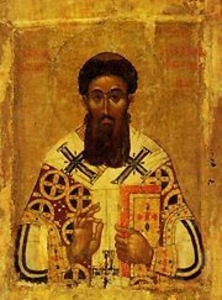
Sunday of St. Gregory Palamas
The Reading is from Mark 2:1-12

At that time, Jesus entered Capernaum and it was reported that he was at home. And many were gathered together, so that there was no longer room for them, not even about the door; and he was preaching the word to them. And they came, bringing to him a paralytic carried by four men. And when they could not get near him because of the crowd, they removed the roof above him; and when they had made an opening, they let down the pallet on which the paralytic lay. And when Jesus saw their faith, he said to the paralytic, "My son, your sins are forgiven." Now some of the scribes were sitting there, questioning in their hearts, "Why does this man speak thus? It is a blasphemy! Who can forgive sins but God alone?" And immediately Jesus, perceiving in his spirit that they thus questioned within themselves, said to them, "Why do you question thus in your hearts? Which is easier, to say to the paralytic, 'Your sins are forgiven,' or to say, 'Rise, take up your pallet and walk? But that you may know that the Son of man has authority on earth to forgive sins"-he said to the paralytic-"I say to you, rise, take up your pallet and go home." And he rose, and immediately took up the pallet and went out before them all; so that they were all amazed and glorified God, saying, "We never saw anything like this!"


Hymns of the Day

Resurrectional Apolytikion in the 6th Mode

The angelic powers appeared at your tomb, the soldiers guarding it became as dead men, and Mary stood at your grave seeking, seeking your most pure body. But you made hell a captive; you were untouched by its might. You came to the virgin and granted life. O Lord, who rose from the dead, glory to you.

Apolytikion for Sun. of St. Gregory Palamas in the 8th Mode

Light of Orthodoxy, pillar and teacher of the Church, adornment of monastics, invincible champion of theologians, O Gregory, you wonderworker, boast of Thessalonica, herald of grace: ever pray that our souls be saved.

Seasonal Kontakion in the 8th Mode

Victorious Lady, mighty champion, defending us, we, your servants, now inscribe to you this hymn of thanks, for you rescued us from suff'ring and tribulation. Theotokos, with your power that can never fail, keep us safe from ev'ry danger our whole life long, that we may cry to you: Rejoice, O Bride unwedded.


Saints and Feasts

March 08

Sunday of St. Gregory Palamas

This divine Father, who was from Asia Minor, was from childhood reared in the royal court of Constantinople, where he was instructed in both religious and secular wisdom. Later, while still a youth, he left the imperial court and struggled in asceticism on Mount Athos, and in the Skete at Beroea. He spent some time in Thessalonica being treated for an illness that came from his harsh manner of life. He was present in Constantinople at the Council that was convened in 1341 against Barlaam of Calabria, and at the Council of 1347 against Acindynus, who was of like mind with Barlaam; Barlaam and Acindynus claimed that the grace of God is created. At both these Councils, the Saint contended courageously for the true dogmas of the Church of Christ, teaching in particular that divine grace is not created, but is the uncreated energies of God which are poured forth throughout creation: otherwise it would be impossible, if grace were created, for man to have genuine communion with the uncreated God. In 1347 he was appointed Metropolitan of Thessalonica. He tended his flock in an apostolic manner for some twelve years, and wrote many books and treatises on the most exalted doctrines of our Faith; and having lived for a total of sixty-three years, he reposed in the Lord in 1359.

His holy relics are kept in the Cathedral of Thessalonica. A full service was composed for his feast day by the Patriarch Philotheus in 1368, when it was established that his feast be celebrated on this day. Since works without right faith avail nothing, we set Orthodoxy of faith as the foundation of all that we accomplish during the Fast, by celebrating the Triumph of Orthodoxy the Sunday before, and the great defender of the teachings of the holy Fathers today.


March 08

Theophylact the Confessor, Bishop of Nicomedia

Theophylact was from the East; his native city is unknown. In Constantinople he became a close friend of Tarsius, who afterwards became Patriarch of Constantinople (see Feb. 25).Theophylact was made Bishop of Nicomedia. After the death of Saint Tarsius, his successor Nicephorus (see June 2) called together a number of Bishops to help him in fighting the iconoclasm of Emperor Leo the Armenian, who reigned from 813-820. Among them was Euthymius, Bishop of Sardis (celebrated Dec. 26), who had attended the holy Seventh Ecumenical Council in 787 - he was exiled three times for the sake of the holy icons, and for defying the Emperor Theophilus' command to renounce the veneration of the icons, was scourged from head to foot until his whole body was one great wound, from which he died eight days later, about the year 830; Joseph of Thessalonica (see July 14); Michael of Synnada (see May 23); Emilian, Bishop of Cyzicus (see Aug. 8); and Saint Theophylact, who boldly rebuked Leo to his face, telling him that because he despised the long-suffering of God, utter destruction was about to overtake him, and there would be none to deliver him. For this, Theophylact was exiled to the fortress of Strobilus in Karia of Asia Minor, where, after 30 years of imprisonment and hardship, he gave up his holy soul about the year 845. Leo the Armenian, according to the Saint's prophecy, was slain in church on the eve of our Lord's Nativity, in 820.


March 08

Hermas the Apostle of the 70


Wisdom of the Fathers

Take up your bed. Carry the very mat that once carried you. Change places, so that what was the proof of your sickness may now give testimony to your soundness. Your bed of pain becomes the sign of healing, its very weight the measure of the strength that has been restored to you.
St. Peter Chrysologus
Homily 50.6. Taken from: Ancient Christian Commentary on Scripture. Vol. 2: Mark. Downers Grove: Intervarsity Press, 2005, p. 27.

Now Matthew indeed saith, that "they brought him," but the others, that they also broke up the roof, and let him down. And they put the sick man before Christ, saying nothing, but committing the whole to Him.
St. John Chrysostom
Homily 29 on Matthew 9, 1. B#54, pp. 195, 196, 4th Century


Diakonia Newsletter

BACK TO TOP