August 02

St. Nicholas Church
Publish Date: 2026-08-02
Bulletin Contents
Saints and Feasts
Gospel and Epistle Readings
Wisdom of the Fathers
Hymns of the Day
Diakonia Newsletter

St. Nicholas Church
General Information
- Phone:
- (915) 833-0882
- Email:
- [email protected]
- Street Address:
- 124 South Festival Drive
- El Paso, TX 79912
- Mailing Address:
- 124 South Festival Drive
- El Paso, TX 79912
Contact Information
Services Schedule
EVERY SUNDAY
9am ORTHROS
10am DIVINE LITURGY
Past Bulletins
- Publish Date:
- 2026-09-27
- Publish Date:
- 2026-09-20
- Publish Date:
- 2026-09-13
- Publish Date:
- 2026-09-06
- Publish Date:
- 2026-08-16
- Publish Date:
- 2026-07-26
Saints and Feasts


August 02
Translation of the Relics of Stephen the Protomartyr
After the First Martyr had been stoned to death (see Dec. 27), Gamaliel, his teacher, encouraged certain of the Christians to go by night and take up the Saint's body and bury it in his field, which was at a distance of some twenty miles from Jerusalem and was called by his name, "Kaphar-gamala," that is, "the field of Gamala," where Gamaliel himself was later buried. About the year 427, a certain pious man called Lucian, who was the parish priest of a church near to that field, received from God a revelation in a dream concerning the place where the First Martyr was buried. He immediately made this known to John, the Patriarch of Jerusalem. Thus, coming to the place indicated, and digging there, they found a box with the word "Stephen" in Aramaic letters. On opening it, they took these most sacred relics and transferred them to Jerusalem with great honor and in the company of a very great multitude of the faithful.

August 02
Holy Glorious New Martyr Theodore of Dardanelles

August 02
Phocas the Martyr
Saint Phocas was a gardener in a small village on the south coast of the Black Sea. He lived a simple life, carrying out acts of piety and love for all around him, even serving the pagans of the village, some of who left their ways and followed Christ. The local governor heard of this and sent soldiers to kill him. The saint stumbled upon these very soldiers and, without disclosing his name, ministered to them by receiving them into his home, feeding them, and giving them rest. That night he dug a grave for himself in his garden and prepared for all his possessions to be given away after his death.
The next morning, Phocas disclosed to the soldiers that it was he whom they were seeking to kill. The soldiers were distraught, not wanting to kill the saint who had shown them so much kindness. Phocas insisted that they must carry out their mission as he willingly laid his head beneath the sword. They proceeded to execute him and then bury him in the grave he dug in his garden. The site later became a source of miracles, and eventually a Church was erected upon it. Saint Phocas is frequently invoked for those who travel by sea. His life was recorded by Saint Asterius of Amasia (see October 10th).

August 02
Plegmund, Archbishop of Canterbury

August 06
Transfiguration of our Lord and Savior Jesus Christ
Our Lord had spoken to His disciples many times not only concerning His Passion, Cross, and Death, but also concerning the coming persecutions and afflictions that they themselves would endure. Since all these evils were near at hand, but the enjoyment of good things which they hoped to receive in their stead was yet to come, our Savior desired to give them full assurance, evidently and openly, concerning that glory which is prepared for those who endure to the end. Therefore, fulfilling that which He had promised shortly before, that "there be some standing here which shall not taste of death, till they see the Son of man coming in His Kingdom" (Matt. 16:28), He took His three foremost disciples and ascended Mount Tabor, where He was transfigured before them. His face shone like the sun, and His clothes became white as the light. Suddenly, together with this dread and marvelous effulgence of light, there appeared those pinnacles of the Prophets, Moses and Elias, who spoke with the Lord Jesus concerning His saving Passion which was about to take place. Standing before Him as reverent servants, they showed that He is the Lord of both the living and the dead, for Moses came forth from Hades, having died many centuries before, and Elias, as it were from heaven, whither he had been taken up while yet alive. After a little while a radiant cloud overshadowed them and out of the cloud they heard that same voice which had been heard at the Jordan at the Baptism of Christ, testifying to the Divinity of Jesus and saying: "This is My beloved Son, in Whom I am well-pleased; hear ye Him" (Matt. 17: 5).
Such are the marvels, truly worthy of God, celebrated in this present feast, which is an image and prefiguring of the future state of the righteous, whose splendor the Lord spoke of, saying: "Then shall the righteous shine forth as the sun" (Matt. 13:43). It is because of this that the Kontakion of this Feast is said daily (when there is not a great feast) in the Service of the Typica in perpetual commemoration of the glory that will be the lot of the Saints. According to tradition, the Lord's Transfiguration came to pass forty days before His Crucifixion; this is why the Transfiguration is celebrated forty days before the Exaltation of the Cross.
Gospel and Epistle Readings
Matins Gospel Reading
Ninth Orthros Gospel
The Reading is from John 20:19-31
On the evening of that day, the first day of the week, the doors being shut where the disciples were for fear of the Jews, Jesus came and stood among them and said to them, "Peace be with you." When He had said this, He showed them His hands and His side. Then the disciples were glad when they saw the Lord. Jesus said to them again, "Peace be with you. As the Father has sent Me, even so I send you." And when He had said this, He breathed on them and said to them, "Receive the Holy Spirit. If you forgive the sins of any, they are forgiven; if you retain the sins of any, they are retained." Now Thomas, one of the twelve, called the Twin, was not with them when Jesus came. So the other disciples told him, "We have seen the Lord." But he said to them, "Unless I see in His hands the print of the nails, and place my finger in the mark of the nails, and place my hand in His side, I will not believe." Eight days later, His disciples were again in the house, and Thomas was with them. The doors were shut, but Jesus came and stood among them and said, "Peace be with you." Then He said to Thomas, "Put your finger here, and see My hands; and put out your hand, and place it in My side; do not be faithless, but believing." Thomas answered Him, "My Lord and My God!" Jesus said to him, "Have you believed because you have seen Me? Blessed are those who have not seen and yet believe." Now Jesus did many other signs in the presence of the disciples, which are not written in this book; but these are written that you may believe that Jesus is the Christ, the Son of God, and that believing, you may have life in His name.
Ninth Orthros Gospel
Κατὰ Ἰωάννην 20:19-31
Οὔσης ὀψίας τῇ ἡμέρᾳ ἐκείνῃ τῇ μιᾷ τῶν σαββάτων, καὶ τῶν θυρῶν κεκλεισμένων ὅπου ἦσαν οἱ μαθηταὶ συνηγμένοι διὰ τὸν φόβον τῶν Ἰουδαίων, ἦλθεν ὁ Ἰησοῦς καὶ ἔστη εἰς τὸ μέσον, καὶ λέγει αὐτοῖς· Εἰρήνη ὑμῖν. Καὶ τοῦτο εἰπὼν ἔδειξεν αὐτοῖς τὰς χεῖρας καὶ τὴν πλευρὰν αὐτοῦ· ἐχάρησαν οὖν οἱ μαθηταὶ ἰδόντες τὸν Κύριον. Εἶπεν οὖν αὐτοῖς ὁ Ἰησοῦς πάλιν· Εἰρήνη ὑμῖν, καθὼς ἀπέσταλκέ με ὁ πατήρ, κᾀγὼ πέμπω ὑμᾶς. Καὶ τοῦτο εἰπὼν ἐνεφύσησε καὶ λέγει αὐτοῖς· Λάβετε Πνεῦμα Ἅγιον. Ἄν τινων ἀφῆτε τὰς ἁμαρτίας, ἀφιένται αὐτοῖς, ἄν τινων κρατῆτε, κεκράτηνται. Θωμᾶς δέ, εἷς ἐκ τῶν δώδεκα, ὁ λεγόμενος Δίδυμος, οὐκ ἦν μετʼ αὐτῶν ὅτε ἦλθεν Ἰησοῦς· ἔλεγον οὖν αὐτῷ οἱ ἄλλοι μαθηταί· Ἑωράκαμεν τὸν Κύριον. Ὁ δὲ εἶπεν αὐτοῖς· Ἐὰν μὴ ἴδω ἐν ταῖς χερσὶν αὐτοῦ τὸν τύπον τῶν ἥλων, καὶ βάλω τὸν δάκτυλόν μου εἰς τὸν τύπον τῶν ἥλων, καὶ βάλω τὴν χεῖρά μου εἰς τὴν πλευρὰν αὐτοῦ, οὐ μὴ πιστεύσω. Καὶ μεθʼ ἡμέρας ὀκτὼ πάλιν ἦσαν ἔσω οἱ μαθηταὶ αὐτοῦ, καὶ Θωμᾶς μετʼ αὐτῶν. Ἔρχεται ὁ Ἰησοῦς τῶν θυρῶν κεκλεισμένων, καὶ ἔστη εἰς τὸ μέσον καὶ εἶπεν· Εἰρήνη ὑμῖν. Εἶτα λέγει τῷ Θωμᾶ· φέρε τὸν δάκτυλόν σου ᾧδε, καὶ ἴδε τὰς χεῖράς μου. καὶ φέρε τὴν χεῖρά σου καὶ βάλε εἰς τὴν πλευράν μου, καὶ μὴ γίνου ἄπιστος ἀλλὰ πιστός. Καὶ ἀπεκρίθη ὁ Θωμᾶς, καὶ εἶπεν αὐτῷ· Ὁ Κύριός μου καὶ ὁ Θεός μου. Λέγει αὐτῷ ὁ Ἰησοῦς· Ὅτι ἑώρακάς με πεπίστευκας, μακάριοι οἱ μὴ ἰδόντες, καὶ πιστεύσαντες. Πολλὰ μὲν οὖν καὶ ἄλλα σημεῖα ἐποίησεν ὁ Ἰησοῦς ἐνώπιον τῶν μαθητῶν αὐτοῦ, ἃ οὐκ ἔστιν γεγραμμένα ἐν τῷ βιβλίῳ τούτῳ· ταῦτα δὲ γέγραπται ἵνα πιστεύσητε ὅτι ὁ Ἰησοῦς ἐστιν ὁ Χριστὸς ὁ υἱὸς τοῦ Θεοῦ, καὶ ἵνα πιστεύοντες, ζωὴν ἔχητε ἐν τῷ ὀνόματι αὐτοῦ.
Epistle Reading
Prokeimenon. Plagal Fourth Mode. Psalm 75.11,1.
Make your vows to the Lord our God and perform them.
Verse: God is known in Judah; his name is great in Israel.
The reading is from St. Paul's First Letter to the Corinthians 3:9-17.
Brethren, we are God's fellow workers; you are God's field, God's building. According to the grace of God given to me, like a skilled master builder I laid a foundation, and another man is building upon it. Let each man take care how he builds upon it. For no other foundation can any one lay than that which is laid, which is Jesus Christ. Now if any one builds on the foundation with gold, silver, precious stones, wood, hay, straw - each man's work will become manifest; for the Day will disclose it, because it will be revealed with fire, and the fire will test what sort of work each one has done. If the work which any man has built on the foundation survives, he will receive a reward. If any man's work is burned up, he will suffer loss, though he himself will be saved, but only as through fire. Do you not know that you are God's temple and that God's Spirit dwells in you? If any one destroys God's temple, God will destroy him. For God's temple is holy, and that temple you are.
Προκείμενον. Plagal Fourth Mode. ΨΑΛΜΟΙ 75.11,1.
Εὔξασθε καὶ ἀπόδοτε Κυρίῳ τῷ Θεῷ ἡμῶν.
Στίχ. Γνωστὸς ἐν τῇ Ἰουδαίᾳ ὁ Θεός, ἐν τῷ Ἰσραὴλ μέγα τὸ ὄνομα αὐτοῦ.
τὸ Ἀνάγνωσμα Πρὸς Κορινθίους α' 3:9-17.
Ἀδελφοί, Θεοῦ γάρ ἐσμεν συνεργοί· θεοῦ γεώργιον, θεοῦ οἰκοδομή ἐστε. Κατὰ τὴν χάριν τοῦ θεοῦ τὴν δοθεῖσάν μοι, ὡς σοφὸς ἀρχιτέκτων θεμέλιον τέθεικα, ἄλλος δὲ ἐποικοδομεῖ. Ἕκαστος δὲ βλεπέτω πῶς ἐποικοδομεῖ. Θεμέλιον γὰρ ἄλλον οὐδεὶς δύναται θεῖναι παρὰ τὸν κείμενον, ὅς ἐστιν Ἰησοῦς Χριστός. Εἰ δέ τις ἐποικοδομεῖ ἐπὶ τὸν θεμέλιον τοῦτον χρυσόν, ἄργυρον, λίθους τιμίους, ξύλα, χόρτον, καλάμην, ἑκάστου τὸ ἔργον φανερὸν γενήσεται· ἡ γὰρ ἡμέρα δηλώσει, ὅτι ἐν πυρὶ ἀποκαλύπτεται· καὶ ἑκάστου τὸ ἔργον ὁποῖόν ἐστιν τὸ πῦρ δοκιμάσει. Εἴ τινος τὸ ἔργον μένει ὃ ἐποικοδόμησεν, μισθὸν λήψεται. Εἴ τινος τὸ ἔργον κατακαήσεται, ζημιωθήσεται· αὐτὸς δὲ σωθήσεται, οὕτως δὲ ὡς διὰ πυρός. Οὐκ οἴδατε ὅτι ναὸς θεοῦ ἐστε, καὶ τὸ πνεῦμα τοῦ θεοῦ οἰκεῖ ἐν ὑμῖν; Εἴ τις τὸν ναὸν τοῦ θεοῦ φθείρει, φθερεῖ τοῦτον ὁ θεός· ὁ γὰρ ναὸς τοῦ θεοῦ ἅγιός ἐστιν, οἵτινές ἐστε ὑμεῖς.
Gospel Reading
9th Sunday of Matthew
The Reading is from Matthew 14:22-34
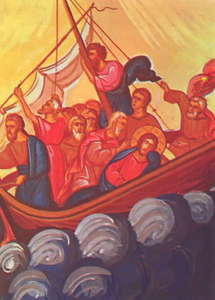
At that time, Jesus made the disciples get into the boat and go before him to the other side, while he dismissed the crowds. And after he had dismissed the crowds, he went up into the hills by himself to pray. When evening came, he was there alone, but the boat by this time was many furlongs distant from the land, beaten by the waves; for the wind was against them. And in the fourth watch of the night he came to them, walking on the sea. But when the disciples saw him walking on the sea, they were terrified, saying, "It is a ghost!" And they cried out for fear. But immediately he spoke to them, saying "Take heart, it is I; have no fear."
And Peter answered him, "Lord, if it is you, bid me come to you on the water." He said, "Come." So Peter got out of the boat and walked on the water and came to Jesus; but when he saw the wind, he was afraid, and beginning to sink he cried out, "Lord, save me." Jesus immediately reached out his hand and caught him, saying to him, "O man of little faith, why did you doubt?" And when they entered the boat, the wind ceased. And those in the boat worshiped him, saying, "Truly you are the Son of God." And when they had crossed over, they came to land at Gennesaret.
9th Sunday of Matthew
Κατὰ Ματθαῖον 14:22-34
Τῷ καιρῷ ἐκείνῳ, ἠνάγκασεν ὁ Ἰησοῦς τοὺς μαθητὰς ἐμβῆναι εἰς τὸ πλοῖον καὶ προάγειν αὐτὸν εἰς τὸ πέραν, ἕως οὗ ἀπολύσῃ τοὺς ὄχλους. Καὶ ἀπολύσας τοὺς ὄχλους ἀνέβη εἰς τὸ ὄρος κατ᾽ ἰδίαν προσεύξασθαι. ὀψίας δὲ γενομένης μόνος ἦν ἐκεῖ. Τὸ δὲ πλοῖον ἤδη σταδίους πολλοὺς ἀπὸ τῆς γῆς ἀπεῖχεν, βασανιζόμενον ὑπὸ τῶν κυμάτων, ἦν γὰρ ἐναντίος ὁ ἄνεμος. Τετάρτῃ δὲ φυλακῇ τῆς νυκτὸς ἦλθεν πρὸς αὐτοὺς περιπατῶν ἐπὶ τὴν θάλασσαν. Οἱ δὲ μαθηταὶ ἰδόντες αὐτὸν ἐπὶ τῆς θαλάσσης περιπατοῦντα ἐταράχθησαν λέγοντες ὅτι Φάντασμά ἐστιν, καὶ ἀπὸ τοῦ φόβου ἔκραξαν. Εὐθὺς δὲ ἐλάλησεν [ὁ ᾽Ιησοῦς] αὐτοῖς λέγων, Θαρσεῖτε, ἐγώ εἰμι· μὴ φοβεῖσθε. Ἀποκριθεὶς δὲ αὐτῷ ὁ Πέτρος εἶπεν, Κύριε, εἰ σὺ εἶ, κέλευσόν με ἐλθεῖν πρὸς σὲ ἐπὶ τὰ ὕδατα· ὁ δὲ εἶπεν, ᾽Ελθέ. καὶ καταβὰς ἀπὸ τοῦ πλοίου ὁ Πέτρος περιεπάτησεν ἐπὶ τὰ ὕδατα καὶ ἦλθεν πρὸς τὸν ᾽Ιησοῦν. Βλέπων δὲ τὸν ἄνεμον ἐφοβήθη, καὶ ἀρξάμενος καταποντίζεσθαι ἔκραξεν λέγων, Κύριε, σῶσόν με. Εὐθέως δὲ ὁ ᾽Ιησοῦς ἐκτείνας τὴν χεῖρα ἐπελάβετο αὐτοῦ καὶ λέγει αὐτῷ, ᾽Ολιγόπιστε, εἰς τί ἐδίστασας; καὶ ἀναβάντων αὐτῶν εἰς τὸ πλοῖον ἐκόπασεν ὁ ἄνεμος. Οἱ δὲ ἐν τῷ πλοίῳ προσεκύνησαν αὐτῷ λέγοντες, ᾽Αληθῶς Θεοῦ υἱὸς εἶ. Καὶ διαπεράσαντες ἦλθον ἐπὶ τὴν γῆν εἰς Γεννησαρέτ.
Wisdom of the Fathers
The principle and source of the virtues is a good disposition of the will, that is to say, an aspiration for goodness and beauty. God is the source and ground of all supernal goodness. Thus the principle of goodness and beauty is faith or, rather, it is Christ, the rock of faith, who is principle and foundation of all virtues. On this rock we stand and on this foundation we build every good thing (cf. I Cor. 3:11).
On Commandments and Doctrines no. 83, Philokalia Vol. 3 edited by Palmer, Sherrard and Ware; Faber and Faber pg. 228, 14th century
Christ did not command the winds to cease at that time, but Himself stretched forth His hand and took hold of Peter, because here faith was required of him. When we do not do our part, divine (grace) slows and stands still.. . . it was not the wind that did Peter harm; his lack of faith sank him. Where faith is fruitfu, firm and strong, none of the evils that may befall us can do us any harm.
The Gospel Commentary edited by Hieromonk German Ciuba, 2002, 4th Century
Hymns of the Day
Resurrectional Apolytikion in the Plagal Fourth Mode
From on high didst Thou descend, O Compassionate One; to burial of three days hast Thou submitted that Thou mightest free us from our passions. O our Life and Resurrection, Lord, glory be to Thee.
Ἐξ ὕψους κατῆλθες ὁ εὔσπλαγχνος, ταφὴν καταδέξω τριήμερον, ἵνα ἡμᾶς ἐλευθερώσῃς τῶν παθῶν. Ἡ ζωὴ καὶ ἡ Ἀνάστασις ἡμῶν, Κύριε δόξα σοι.
Apolytikion for Translation of the relics of Stephen in the Fourth Mode
The crown of the Kingdom hath adorned the brow of thy head because of the contests that thou hast endured for Christ God, thou first of the martyred Saints; for when thou hadst censured the Jews' madness, thou sawest Christ thy Saviour standing at the right hand of the Father. O Stephen, ever pray Him for us, that He would save our souls.
Βασίλειον διάδημα, εστέφθη σή κορυφή, εξ άθλων ών υπέμεινας, υπέρ Χριστού τού Θεού, Μαρτύρων πρωτόαθλε, σύ γάρ τήν Ιουδαίων, απελέγξας μανίαν, είδές σου τόν Σωτήρα, τού Πατρός δεξιόθεν, Αυτόν ούν εκδυσώπει αεί, υπέρ τών ψυχών ημών.
Seasonal Kontakion in the Grave Mode
You were transfigured upon the mount, O Christ our God, and Your disciples, in so far as they could bear, beheld Your glory. Thus, when they see You crucified, they may understand Your voluntary passion, and proclaim to the world that You are truly the effulgence of the Father.
Επί τού όρους μετεμορφώθης, καί ως εχώρουν οι Μαθηταί σου τήν δόξαν σου, Χριστέ ο Θεός εθεάσαντο, ίνα όταν σε ίδωσι σταυρούμενον, τό μέν πάθος νοήσωσιν εκούσιον, τώ δέ κόσμω κηρύξωσιν, ότι σύ υπάρχεις αληθώς, τού Πατρός τό απαύγασμα.
Diakonia Newsletter
Read the latest Diakonia Newsletter for this Sunday
https://bulletinbuilder.org/diakonia-newsletter/2026-08-02?source=bulletin_web
August 2, 2026