St. George Church
Publish Date: 2026-11-01
Bulletin Contents

Organization Icon
St. George Church

General Information

  • Phone:
  • (734) 283-8820
  • Fax:
  • (734) 283-8866
  • Street Address:

  • 16300 Dix Toledo Highway

  • Southgate, MI 48195
  • Mailing Address:

  • 16300 Dix Toledo Highway

  • Southgate, MI 48195


Contact Information


Services Schedule

Sundays:

9 am - Orthros

10:15 am - Divine Liturgy


Weekday Services:

Please check the Services schedule in the bulletin or call the Church office.


Past Bulletins


Parish Calendar

  • Church Calendar

    November 1 to November 8, 2026

    Sunday, November 1

    Daylight Saving Time ends

    8:50AM Orthros

    10:00AM Divine Liturgy

    12:00PM Philoptochos Meeting

    12:15PM Senior & Junior Greek Dance Practice

    Monday, November 2

    6:00PM Vespers for the dedication of the Temple of the Holy Great Martyr George in Lydda

    Tuesday, November 3

    9:00AM Orthros and Divine Liturgy for the Dedication of the Temple of the Holy Great Martyr George in Lydda

    6:00PM Bible Study & Catechism

    Thursday, November 5

    4:30PM Junior Greek School

    6:30PM Adult Greek School

    Saturday, November 7

    4:00PM YAL Chili's Dinner

    Sunday, November 8

    8:50AM Orthros

    10:00AM Divine Liturgy - Synaxis of the Archangels

    12:15PM Senior & Junior Greek Dance Practice


Church Announcements

Memorial Service

Maria Tsikaris - 1 year

May the Lord our God grant rest to her soul where the righteous repose, in a place where there is no pain, no sorrow, and no suffering, but rather everlasting life. May her memory be eternal. A light luncheon is offered by the family.


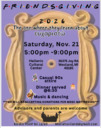
GOYA Friendsgiving

Sts. Constantine and Helen GOYA is excited to invite you and your GOYAns to their 3rd annual Friendsgiving event! This year's Friendsgiving is on Saturday, November 21, from 5-9pm.  Dinner and desserts will be provided, and we will be accepting donations to help raise money for new mattresses for MDSC. 
 
Click here to register. 

Philoptochos Tray

Today is Philoptochos Sunday. Philoptochos will pass a tray to honor our Mother Church, the Ecumenical Patriarchate, to support her sacred ministries. It celebrates the mission of Philoptochos, "friends of the poor", serving those in need through compassion and faith. See the bulletin attachment for more information.


Upcoming Services

Church Feast Day Services

  • Vespers for the dedication of the Temple of the Holy Great Martyr George in Lydda with Artoklasia Blessing - Monday, November 2 @ 6 pm
  • Orthros and Divine Liturgy for the dedication of the Temple of the Holy Great Martyr George in Lydda - Tuesday, November 3 @ 9 am Orthros/ 10 am Divine Liturgy 
  • Orthros and Divine Liturgy for Nektarius the Wonderworker, Metropolitan of Pentapolis - Monday, November 9 @ 9 am Orthros/ 10 am Divine Liturgy

About the November 3 Feastday of Saint George

The city of Lydda (Lod) is the birthplace of the Great Martyr George the Victorious. His mother's house was there, where he spent his childhood. The Holy Great Martyr George was a Roman soldier, he suffered under Emperor Diocletian in Nicomedia at the beginning of the IV century. His relics were transferred by Christians to their homeland, Lydda, and there he was buried.

The tomb where the relics of the Great Martyr were laid is now located in an Orthodox church dedicated to the Great Martyr George. In the temple itself there is a piece of the relics of Saint George, as well as the chain with which the Great Martyr was bound.

The first church was built here in the VI century. The temple was destroyed several times and was restored in its present form only in 1872, thanks to donations from Russia. The consecration of the restored temple took place on November 3, 1872, the anniversary of the day when it was first consecrated. The Russian Church remembers and celebrates this event until the present day. This Feast is included in the Menaion, in honor of the churches built and dedicated to Saint George in Russia.

It was also in Lydda that the Apostle Peter healed Aeneas, who had been lying paralyzed for eight years (Acts 9:32-35).


Children's Christmas Play - Update

Practices for the children's Christmas play will begin today, Nov. 1, from 12:30-1:15 pm. Our annual Christmas play will occur on Sunday, Dec. 20. 


Bible Study & Adult Catechism Meeting

We will hold our next Bible Study/Adult Catechism this Tuesday, November 3 @ 6 pm, in the Church Library. Refreshments will be provided. 


Donations for new Divine Liturgy Books

The church is seeking donations for new Divine Liturgy books since many of our current books are showing signs of wear and tear. The new Divine Liturgy books are $20 each. So far we have 94 books donated out of the 390 needed to evenly cover all the pews in the church. Any number of books donated is greatly appreciated and each book donated will have a donation label. If you would like to make a donation, please contact Fr. John. Thank you to all who have generously donated! 


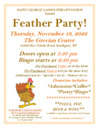
Feather Party Sponsors Needed

If you would like to be a sponsor for the Feather Party (Thursday, November 19), you can sponsor online under "Support Our Ministries." You may also see a Philoptochos Member to sponsor. Sponsorship $25


Feather Party!

On Thursday, November 19, the Philoptochos will hold their Feather Party in the Parthenon hall. Doors open at 5:30 pm; games start at 6:30 pm. Pre-purchase your tickets by calling the church office or online HERE.  


Update on Memorial Area

If you would like to donate a memorial paver in memory of a loved one, Memorial Paver Order Forms are available in the school hallway, along with a granite sample and symbols.


Unwanted Orthodox Icons

If you have any extra icons and need a new home for them, please don't hesitate to bring them to the church office or to Father John. From there, Father John will give them out to people who have recently converted to the Orthodox Church or to those who are interested in the Orthodox Faith. 


2026 Stewardship Adjustment

The Parish Council has adjusted Stewardship donations for 2026 as follows:

Families $350
Seniors $200
Students in College/Working $100

As always, if you have a hardship with meeting your Stewardship, please talk with Fr. John.


Metropolis of Detroit Friends Program

Please consider being a part of the Friends Program supporting our Metropolis. Please pick up a flyer in the pamphlet rack in the school hallway or attached to this bulletin and consider supporting. 


Stay Connected w/YAL

Use the QR code to install and connect to the St. George YAL group for future meetings and events!


Hymns of the Day

Resurrectional Apolytikion in the Plagal First Mode

As the Father and Spirit are unoriginate, * so the Word, who was born from the Virgin for us. * Let us praise Him, O believers, and let us worship Him. * For our salvation He was pleased * to be crucified in the flesh, * and to undergo death, * and to resurrect the dead, by His glorious resurrection.

Apolytikion for Unmercenaries Cosmas and Damian in the Third Mode

O Holy Unmercenaries and wonderworkers, visit our infirmities; freely ye received, freely give to us.

Apolytikion for the Church in the Fourth Mode

Liberator of captives, defender of the poor, physician of the sick and champion of kings, O trophy-bearer Great Martyr George, intercede with Christ God that our souls be saved.

Seasonal Kontakion in the Second Mode

O Protection of Christians that cannot be put to shame, mediation unto the creator most constant: O despise not the voices of those who have sinned; but be quick, O good one, to come unto our aid, who in faith cry unto thee: Hasten to intercession and speed thou to make supplication, O thou who dost ever protect, O Theotokos, them that honor thee.


Saints and Feasts

November 01

Cosmas and Damian the Holy Unmercenaries of Asia, and their mother Theodota

These Saints were from Asia (that is, Asia Minor). After the death of their father, their Christ-loving mother Theodota reared them in piety and in all manner of virtue, and had them instructed in every science, especially that of medicine. This became their vocation, and they went about healing every illness and malady, bestowing healing freely on both men and beasts alike; because of this, they are called "Unmercenaries." And thus, having completed the course of their life, they reposed in peace.


November 02

Acindynos, Pegasios, Aphthonios, Elpidophoros, and Anempodistos of Persia

These Martyrs contested in Persia about the year 330, in the reign of Sapor (Shapur) II, King of Persia (325-379). Acindynus, Pegasius, and Anempodistus, Persian Christians, confessed Christ before the King, and were put to many torments. Aphthonius and Elpidophoros, drawn to the Faith of Christ through the Martyrs, were beheaded with another 7,000. Saints Acindynus, Pegasius, and Anempodistus were at last burned to death. Two churches were dedicated in their honour in Constantinople. As is often the case in church hymns, there is a play on the meanings of the Saints' names here. Acindynus means "unimperilled"; Pegasius is derived from pegazo--"to gush forth"; Aphthonius is derived from aphthonos-"abundant"; Elpidophoros means "hope-bearing"; Anempodistus means "unhindered." These are all Greek translations of their Persian names.


November 03

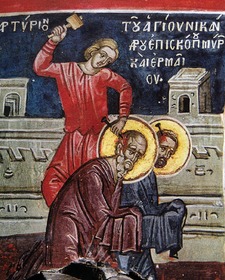
Acepsimas the Bishop, Joseph the Presbyter, & Aeithalas the Deacon, Martyrs of Persia

Saint Acepsimas, a bishop, Saint Joseph, a presbyter, and Saint Aeithalas, a deacon, suffered exceedingly cruel torments and martyrdom during the reign of Sapor II, King of Persia (325-379). See also April 17.


November 03

Dedication of the Temple of the Holy Great Martyr George in Lydda

The consecration of the Church of Saint George in Lydda of Palestine took place during the reign of Saint Constantine the Great. See also April 23.


November 04

Ioannikos the Great

Saint Joannicius was born in Bithynia about the year 740. His father was named Myritrikes and his mother Anastaso. When he had reached maturity, he excelled in soldiery and was counted worthy of royal honours for his bravery. He had been brought up an iconoclast, but while yet a soldier, he was converted to Orthodoxy by a certain holy elder. He later forsook all things and departed for Mount Olympus, where he spent the remainder of his life in asceticism. Becoming great in virtue, he reposed in the Lord in the year 834, having lived some ninety-four years. To this Saint is ascribed the brief prayer, "My hope is the Father ...."


November 04

Nikandros, Bishop of Myra

The holy Martyrs Nikandros and Hermias were ordained by the holy Apostle Titus. When they had drawn many to the Faith of Christ, they were accused to Libanius, the Count of the city of Myra, where, after suffering many torments, they were enclosed in a tomb alive, and thus surrendered their spirits into the hands of God.


November 05

Galaktion & his wife Episteme, the Martyrs of Emesa

Saint Galaktion was from Emesa, the son of Cleitophon and Leucippe, pagans who had been instructed in piety by a certain Christian named Onuphrius and received holy Baptism. Saint Episteme, born of unbelieving parents, was baptized before she was wedded to Galaktion. After their marriage they remained in virginity and lived in separate monastic houses. Betrayed as Christians, they suffered martyrdom during the reign of Decius, about the year 250.


November 06

Paul the Confessor, Patriarch of Constantinople

Saint Paul was from Thessalonica. He became the secretary of Alexander, Patriarch of Constantinople (see Aug. 30), a deacon, and then the successor of Saint Alexander in about 337. Because of his virtue, his eloquence in teaching, and his zeal for Orthodoxy, the Arians hated and feared him. When the Arian Emperor Constantius, who was in Antioch, learned of Paul's election, he exiled Paul and proclaimed the Arian Eusebius Patriarch. Saint Paul went to Rome, where he found Saint Athanasius the Great also in exile. Provided with letters by Pope Julius, Paul returned to Constantinople, and after the death of Eusebius in 342, ascended again his rightful throne; the Arians meanwhile elected Macedonius, because he rejected the Son's con-substantiality with the Father (and the divinity of the Holy Spirit besides). When Constantius, yet at Antioch, learned of Paul's return, he sent troops to Constantinople to drive Paul out. The Saint returned to Rome, where Saint Athanasius also was again in exile. Constans, Emperor of the West, Constantius' brother, but Orthodox, wrote to Constantius that if Athanasius and Paul were not allowed to return to their sees, he would come with troops to restore them him-self. So Paul again returned to his throne. After the death of Constans, however, Constantius had Paul deposed. Because of the love of the people for Saint Paul, Philip the Prefect, who was sent for him, was compelled to arrest him secretly to avoid a sedition. Paul was banished to Cucusus, on the borders of Cilicia and Armenia; a town through which his most illustrious successor, Saint John Chrysostom would also pass on his way to Comana in his last exile. In Cucusus, about the year 350, as Saint Paul was celebrating the Divine Liturgy in the little house where he was a prisoner, the Arians strangled him with his own omophorion, so much did they fear him even in exile. His holy relics were brought back to Constantinople with honour by the Emperor Theodosius the Great.


November 07

Bishop Raphael Hawaweeny of Brooklyn

Saint Raphael Hawaweeny was born on November 8, 1860 A.D., in Damascus, Syria, to pious Christian parents. He studied Arabic grammar and mathematics at the Antiochian Patriarchate parochial school where he was tonsured a reader in 1874. His strong academics served him well throughout his life, providing for him numerous opportunities to succeed and grow. He accepted a position in 1877 as an assistant teacher of Arabic and Turkish, which became full time in 1879. In 1879 he was tonsured a monk while working with Patriarch Hierotheos at the patriarchate, traveling with him on pastoral visits and serving as his personal assistant.

Longing to continue his theological studies, Raphael petitioned the Patriarch for permission to study at Halki Theological School, which was the only option for students of the Antiochian Patriarchate as the Balamand Seminary in Lebanon had been closed since 1840. After much persistence, Raphael received the blessing of the Patriarch and enrolled in Halki Seminary where he was ordained a deacon in 1885. After completing his degree at Halki, the young Deacon Raphael studied at the Kiev Theological Academy, working as a liaison between the Moscow and Antiochian patriarchates. Deacon Raphael was ordained to the holy priesthood in 1889 while in Kiev, continuing to serve that community for many years.

The opening of the Suez Canal in 1869 led to the subsequent collapse of the silk industry in the Middle East, causing many Syrians and others to immigrate to the United States. These new citizens desired to have their religion present in their new homeland and sent letters to their mother churches for pastoral help. A few priests were sent, but none lasted, and so the people asked for Father Raphael Hawaweeny to come to America and serve. Both the Antiochian and Moscow Patriarchs agreed to this idea, and Father Raphael left for America where the people greeted him with great love. Father Raphael then spent many years serving the Syrians in Brooklyn, New York, but he desired to scan the continent for Syrians and other Orthodox Christians who were without spiritual leadership. He traveled by train and carriage across the nation, finding Orthodox Christians, recording their location, and performing liturgies, baptisms, and weddings. Upon his return to Brooklyn, Father Raphael worked to find clergy to send to these dispersed communities, giving them a full time pastor to minister to their needs.

In 1904, by the hands of Bishops Tikhon and Innocent of the Moscow Patriarchate, he was the first bishop consecrated in the New World. The now Bishop Raphael continued his ministry to the Christians throughout America. Bishop Raphael worked tirelessly in Brooklyn to mediate disputes between the Orthodox Christians from Syria and Maronite Catholic Christians who often fought violently with one another. Despite numerous outbursts and setbacks, Bishop Raphael continued his ministry serving the Orthodox throughout his vast diocese. One such incident was when an influential leader of the Maronite group was killed and many people accused Bishop Raphael of ordering his murder. This led to many people attempting to harm the bishop, but he endured it all willingly. He was arrested under attempted murder charges, but was eventually cleared and let go after much time and money was spent in his defense.

Throughout his time in North America, Bishop Raphael founded 36 parishes to bring the Church to the faithful who were without a priest to guide them. Bishop Raphael truly lived out the Gospel in all aspects of his life, striving tirelessly for the people in his care, even to the point of sacrificing his own physical health in order to maintain the spiritual health of his people. Bishop Raphael died on February 27, 1915, at his home in Brooklyn. His funeral was attended by hundreds of people, including clergy from all ethnic backgrounds, illustrating his love for all of the people of God regardless of where they came from. The sacred relics of Saint Raphael, “the good shepherd of the lost sheep in North America,” were first interred in a crypt beneath the holy table at his Saint Nicholas Cathedral in Brooklyn on March 7, 1915, before being moved to the Syrian section of Mount Olivet Cemetery in Brooklyn on April 2, 1922. They were finally translated to the Holy Resurrection Cemetery at the Antiochian Village near Ligonier, Pennsylvania, on August 15, 1988. His sanctity was officially proclaimed by the Holy Synod of the Orthodox Church in America on March 29, 2000, and his glorification was celebrated on May 29 of that year at the Monastery of Saint Tikhon in Pennsylvania.


November 07

33 Martyrs of Melitene

These holy Martyrs confessed during the reign of Diocletian and Maximian in the year 290. Of them, Saint Hieron was from Tyana in Cappadocia, a husbandman, of great bodily strength and high nobility of soul. As he was at work digging in his field, certain soldiers came to impress him into military service. He, however, not wishing to keep company with the impious, refused, and with his wooden tool alone drove away the armed soldiers, who fled in fear because of his strength. Later, however, he went of his own free will, and confessed Christ before the governor. His right hand was cut off, and he was imprisoned with thirty-two others, whom he strengthened in the Faith of Christ. Together they were all beheaded outside the city of Melitene in Armenia.


November 07

Lazarus the Wonderworker

Our righteous Father Lazarus was born in 967 in Magnesia of Asia Minor, and passed through various regions of the East, visiting monasteries. He was tonsured a monk, and then ordained priest, at the Monastery of Mar Sabbas in Palestine. In 1005 he returned to his homeland, and beginning in the year 1012, he built the monasteries that are on Mount Galesion. He raised up a pillar, on which he lived as a stylite for many years, enduring unspeakable hardships for the love of Christ, and reposed in the Lord in deep old age in the year 1053, during the reign of Constantine Monomachus (1042-1055).


Gospel and Epistle Readings

Matins Gospel Reading

Eleventh Orthros Gospel
The Reading is from John 21:14-25

At that time, Jesus revealed himself to the disciples after he was raised from the dead. And he said to Simon Peter, "Simon, son of John, do you love me more than these?" He said to him, "Yes, Lord; you know that I love you." He said to him, "Feed my lambs." A second time he said to him, "Simon, son of John, do you love me?" He said to him, "Yes, Lord; you know that I love you." He said to him, "Tend my sheep." He said to him the third time, "Simon, son of John, do you love me?" Peter was grieved because he said to him the third time, "Do you love me?" And he said to him, "Lord, you know everything; you know that I love you." Jesus said to him, "Feed my sheep. Truly, truly, I say to you, when you were young, you girded yourself and walked where you would; but when you are old, you will stretch out your hands, and another will gird you and carry you where you do not wish to go." (This he said to show by what death he was to glorify God.) And after this he said to him, "Follow me." Peter turned and saw following them the disciple whom Jesus loved, who had lain close to his breast at the supper and had said, "Lord, who is it that is going to betray you?" When Peter saw him, he said to Jesus, "Lord, what about this man?" Jesus said to him, "If it is my will that he remain until I come, what is that to you? Follow me!" The saying spread abroad among the brethren that this disciple was not to die; yet Jesus did not say to him that he was not to die, but, "If it is my will that he remain until I come, what is that to you?" This is the disciple who is bearing witness to these things, and who has written these things; and we know that his testimony is true. But there are also many other things which Jesus did; were every one of them to be written, I suppose that the world itself could not contain the books that would be written. Amen.


Epistle Reading

Prokeimenon. Fourth Mode. Psalm 15.3,8.
Among the saints who are in his land, the Lord has been wondrous.
Verse: I see the Lord before me continually.

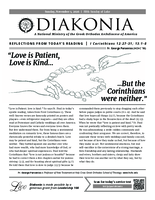
The reading is from St. Paul's First Letter to the Corinthians 12:27-31; 13:1-8.

Brethren, you are the body of Christ and individually members of it. And God has appointed in the church first apostles, second prophets, third teachers, then workers of miracles, then healers, helpers, administrators, speakers in various kinds of tongues. Are all apostles? Are all prophets? Are all teachers? Do all work miracles? Do all possess gifts of healing? Do all speak with tongues? Do all interpret? But earnestly desire the higher gifts. And I will show you a still more excellent way. If I speak in the tongues of men and of angels, but have not love, I am a noisy gong or a clanging cymbal. And if I have prophetic powers, and understand all mysteries and all knowledge, and if I have all faith, so as to remove mountains, but have not love, I am nothing. If I give away all I have, and if I deliver my body to be burned, but have not love, I gain nothing. Love is patient and kind; love is not jealous or boastful; it is not arrogant or rude. Love does not insist on its own way; it is not irritable or resentful; it does not rejoice at wrong, but rejoices in the right. Love bears all things, believes all things, hopes all things, endures all things. Love never ends.


Gospel Reading

5th Sunday of Luke
The Reading is from Luke 16:19-31

The Lord said, "There was a rich man, who was clothed in purple and fine linen and who feasted sumptuously every day. And at his gate lay a poor man named Lazaros, full of sores, who desired to be fed with what fell from the rich man's table; moreover the dogs came and licked his sores. The poor man died and was carried by the angels to Abraham's bosom. The rich man also died and was buried; and in Hades, being in torment, he lifted up his eyes, and saw Abraham far off and Lazaros in his bosom. And he called out, 'Father Abraham, have mercy upon me, and send Lazaros to dip the end of his finger in water and cool my tongue; for I am in anguish in this flame.' But Abraham said, 'Son, remember that you in your lifetime received your good things, and Lazaros in like manner evil things; but now he is comforted here, and you are in anguish. And besides all this, between us and you a great chasm has been fixed, in order that those who would pass from here to you may not be able, and none may cross from there to us.' And he said, 'Then I beg you, father, to send him to my father's house, for I have five brothers, so that he may warn them, lest they also come into this place of torment.' But Abraham said, 'They have Moses, and the prophets; let them hear them.' And he said, 'No, father Abraham; but if some one goes to them from the dead, they will repent.' He said to them, 'If they do not hear Moses and the prophets, neither will they be convinced if some one should rise from the dead.'"


Wisdom of the Fathers

The things that have come into being have received from the Creator their proper place, their beginning and, in some cases, their end. But there is no boundary to virtue. The psalmist says, 'I have seen the end the end of all perfection, but Your commandment is very broad and is without limit' (Ps. 118:96). Now if it is true...that love never fails (I Cor. 13:8),... then love has no boundary, and both in the present age and in the future age we will never cease to progress in it, as we add light to light.
St. John Climacus
Ladder of Divine Ascent, Step 26: On Discernment; Paulist Press pgs. 250-251, 6th century

...every tree is known by its own fruit. So also is love known by its own fruit and the love of which Christianity speaks is known by its own fruit - revealing that it has in itself the truth of the eternal. All other love, whether humanly speaking it withers early and is altered or lovingly preserves itself for a round of time - such love is still transient; it merely blossoms. This is precisely its weakness and tragedy, whether it blossoms for an hour or for seventy years - it merely blossoms; but Christian love is eternal.
Soren Kierkegaard
Works of Love, Chapter 1; Harper Torchbooks pg. 25, 19th century


Prayer List


The names of the living will be commemorated at the Proskomide of every Orthros Service, which takes place prior to the Divine Liturgy.

Christina, Sofia, Don, Karen, George, Nadia, Donna, Kathy, Stephanie, Anastasia, Elizabeth, Stelios, Yolanda, Eugene, Liana, Sarah,
Fanis, Nikos, Aristea, Eftihia

Please contact the church office to add your name to the Prayer List. Thank you.


Upcoming Memorials

November 1
Maria Tsikaris - 1 year


Flyers of Interest


Diakonia Newsletter

BACK TO TOP