November 09

St. George Church
Publish Date: 2025-11-09
Bulletin Contents
Today
Parish Council Corner
This Week
Parish News
Hymns of the Day
Gospel and Epistle Readings
Archdiocese News
Saints and Feasts
Wisdom of the Fathers

St. George Church
General Information
- Phone:
- (309) 786-8163
- Email:
- [email protected]
- Street Address:
- 2930 31st Avenue
- Rock Island, IL 61201
Contact Information
Services Schedule
Office Hours:
By Appointment
Sunday Services:
Orthros at 8:00 a.m.
Divine Liturgy at 9:30 a.m.
Weekday Services:
Orthros at 8:30 a.m. followed by the Divine Liturgy
Past Bulletins
- Publish Date:
- 2024-06-23
- Publish Date:
- 2024-06-16
- Publish Date:
- 2024-06-09
- Publish Date:
- 2024-06-02
- Publish Date:
- 2024-05-26
- Publish Date:
- 2024-05-19
Today
7th Sunday of Luke
8:30 a.m. Orthros/9:30 a.m. Divine Liturgy
Orthros and Divine Liturgy will be streamed live on Facebook and YouTube at
Saint George:
https://www.facebook.com/StGeorgeQC/?ref=bookmarks YouTube link: https://bit.ly/3aTbZrI
To follow along with the services at home, use the AGES DCS app or visit
Readings:
Eleventh Mattins Gospel: John 21:14 – 25
Epistle: Eph. 5:8 – 19
Gospel: Lk. 8:41 – 56
Epistle Reader: Kim Eastland
Prosphoron Maker: Adrienne Johnson
Sunday Council Duty: Tom Bakeris, Nick Coin, Mariellen Crosson, and Pete Hadjis
THE NICENE CREED & LORD'S PRAYER: Cards are found on the backs of the pews. Everyone is encouraged to recite them aloud.
COFFEE FELLOWSHIP HOUR: Hosted by Elizabeth and James Teros
Memorials:
Gordon Smith - 4 years
Helen Smith - 6 years
Stephanie Yokas - 22 years
Grace Damos - 26 years
Bill Yokas - 28 years
Chris Smith - 31 years
Special Tray to be passed for the Metropolis Holy Cross Scholarship Fund
No Sunday School Classes.
Veneration of the Holy Slipper of Saint Gerasimos
Parish Council Corner
Parish Council Schedule for November
Sunday, November 9, 2025: Tom Bakeris, Nick Coin, Mariellen Crosson, and Pete Hadjis
Sunday, November 16, 2025: Kathy Begyn, Joe Burmeister, Dennis Spurgetis, and Mary Rankin
Sunday, November 23, 2025: Kim Eastland, Mary Kay Eckert, Gus Pappas, and Ted Pitsoulakis
Sunday, November 30, 2025: Tom Bakeris, Nick Coin, Mariellen Crosson, and Pete Hadjis
This Week
THIS WEEK…
Wednesday, November 12, 2025
8:00 a.m. Men's Fellowship Group @ Coffee House (1315 Jersey Ridge Road, Davenport, IA)
11:00 a.m. “In-Person” Orthodox Study Forum
Thursday November 13, 2025
7:00 p.m Viewing of “Sacred Alaska” @ Assumption Church
No Book Study
Friday, November 14, 2025
9:00 a.m. Women's Fellowship Group @ Coffee House (1315 Jersey Ridge Road, Davenport, IA)
Parish News
WELCOME
To all our parishioners, friends, and guests, a sincere welcome to God's house, where we may share in prayer and join together for fellowship at our coffee hour.
PASTORAL NOTE
The Christmas Fast, which begins on November 15, is unlike Great and Holy Lent in that fish, wine, and oil are permitted (except on Wednesday and Friday) until December 12. After December 12, wine and oil are permitted (except on Wednesday and Friday), but fish is no longer permitted—the fast ends following the Divine Liturgy on Christmas Day.
PARISH COUNCIL ELECTIONS
Parish Council elections will be held on Sunday, December 14, 2025. It is an honor and a privilege to serve on the Parish Council, but it also entails a commitment to the well-being of our Parish. If you feel the call to support and represent our Parish in this special way, please come forward. All new candidates are required to attend one of the seminars being held. The first is on Tuesday, November 17, 2025, at 6:30 p.m., and the second is on Monday, November 24, 2025, at 6:30 p.m. (Both classes are offered either in person or on Zoom)
EPISTLE READERS FOR NOVEMBER
Sunday, November 9, 2025: 7th Sunday of Luke: Kim Eastland
Sunday, November 16, 2025: Saint Matthew the Evangelist: Aletheia Hadjis
Sunday, November 23, 2025: 9th Sunday of Luke: Harry Coin
Sunday, November 30, 2025: Saint Andrew: Mary Rankin
COFFEE HOUR HOSTS FOR NOVEMBER
November 9, 2025: Elizabeth and James Teros
November 16, 2025: Vickie Patramanis
November 23, 2025: Mary Rankin
November 30, 2025: Connie Zeroth
PROSPHORA MAKERS FOR NOVEMBER
Sunday, November 9, 2025: Adrienne Johnson
Sunday, November 16, 2025: Open
Sunday, November 23, 2025: Open
Sunday, November 30, 2025: Open
EVENING MEAL VOLUNTEERS
November 20, 2025 (Thursday): Ted Pitsoulakis and Jimmy Pliakos
December 18, 2025 (Thursday): Deacon Paul and Deaconess Romilie Speed
Anyone interested in taking part in this worthwhile ministry should contact Mary Winters at 563-726-2880
EVENING MEAL NEWS
The St. Joseph Evening Meal program is working on filling its calendar for next year (2026). This program provides a dinner to those less fortunate than we are. St. George is assigned one meal a month. So far this year (9 months YTD) in 2025, thanks to the generosity of those in our beloved St. George who served, we provided a dinner to 581 men, women & children. If you'd like to participate in this worthwhile ministry, contact Mary Winters (cell #563-726-2880).
Hymns of the Day
Resurrectional Apolytikion in the Plagal First Mode
Let us worship the Word, O ye faithful, praising Him that with the Father and the Spirit is co-beginningless God, Who was born of a pure Virgin that we all be saved; for He was pleased to mount the Cross in the flesh that He assumed, accepting thus to endure death. And by His glorious rising, He also willed to resurrect the dead.
Reading is under copyright and is used with permission, all rights reserved by: Holy Transfiguration Monastery
Apolytikion for Nectarius the Wonderworker in the First Mode
The offspring of Selyvria and the guardian of Aegina, the true friend of virtue who didst appear in the last years, O Nectarius, we faithful honour thee as a godly servant of Christ, for thou pourest forth healings of every kind for those who piously cry out: Glory to Christ Who hath glorified thee. Glory to Him Who hath made thee wondrous. Glory to Him Who worketh healings for all through thee.
Reading is under copyright and is used with permission, all rights reserved by: Holy Transfiguration Monastery
Seasonal Kontakion in the Fourth Mode
Today, the most pure temple of the Savior, the precious bridal chamber and Virgin, the sacred treasure of God, enters the house of the Lord, bringing the grace of the Divine Spirit. The Angels of God praise her. She is the heavenly tabernacle.
Reading is under copyright and is used with permission, all rights reserved by: Narthex Press
Gospel and Epistle Readings
Matins Gospel Reading
Eleventh Orthros Gospel
The Reading is from John 21:14-25
At that time, Jesus revealed himself to the disciples after he was raised from the dead. And he said to Simon Peter, "Simon, son of John, do you love me more than these?" He said to him, "Yes, Lord; you know that I love you." He said to him, "Feed my lambs." A second time he said to him, "Simon, son of John, do you love me?" He said to him, "Yes, Lord; you know that I love you." He said to him, "Tend my sheep." He said to him the third time, "Simon, son of John, do you love me?" Peter was grieved because he said to him the third time, "Do you love me?" And he said to him, "Lord, you know everything; you know that I love you." Jesus said to him, "Feed my sheep. Truly, truly, I say to you, when you were young, you girded yourself and walked where you would; but when you are old, you will stretch out your hands, and another will gird you and carry you where you do not wish to go." (This he said to show by what death he was to glorify God.) And after this he said to him, "Follow me." Peter turned and saw following them the disciple whom Jesus loved, who had lain close to his breast at the supper and had said, "Lord, who is it that is going to betray you?" When Peter saw him, he said to Jesus, "Lord, what about this man?" Jesus said to him, "If it is my will that he remain until I come, what is that to you? Follow me!" The saying spread abroad among the brethren that this disciple was not to die; yet Jesus did not say to him that he was not to die, but, "If it is my will that he remain until I come, what is that to you?" This is the disciple who is bearing witness to these things, and who has written these things; and we know that his testimony is true. But there are also many other things which Jesus did; were every one of them to be written, I suppose that the world itself could not contain the books that would be written. Amen.
Epistle Reading
Prokeimenon. Plagal First Mode. Psalm 11.7,1.
You, O Lord, shall keep us and preserve us.
Verse: Save me, O Lord, for the godly man has failed.
The reading is from St. Paul's Letter to the Galatians 6:11-18.
Brethren, see with what large letters I am writing to you with my own hand. It is those who want to make a good showing in the flesh that would compel you to be circumcised, and only in order that they may not be persecuted for the cross of Christ. For even those who receive circumcision do not themselves keep the law, but they desire to have you circumcised that they may glory in your flesh. But far be it from me to glory except in the cross of our Lord Jesus Christ, by which the world has been crucified to me, and I to the world. For neither circumcision counts for anything, nor uncircumcision, but a new creation. Peace and mercy be upon all who walk by this rule, upon the Israel of God. Henceforth let no man trouble me; for I bear on my body the marks of Jesus. The grace of our Lord Jesus Christ be with your spirit, brethren. Amen.
Gospel Reading
7th Sunday of Luke
The Reading is from Luke 8:41-56
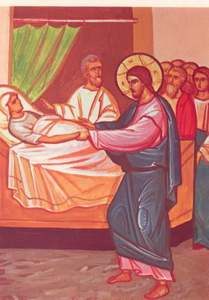
At that time, there came to Jesus a man named Jairus, who was a ruler of the synagogue; and falling at Jesus' feet he besought him to come to his house, for he had an only daughter, about twelve years of age, and she was dying. As he went, the people pressed round him. And a woman who had had a flow of blood for twelve years and had spent all her living upon physicians and could not be healed by anyone, came up behind him, and touched the fringe of his garment; and immediately her flow of blood ceased. And Jesus said, "Who was it that touched me?" When all denied it, Peter and those who were with him said, "Master, the multitudes surround you and press upon you!" But Jesus said, "Some one touched me; for I perceive that power has gone forth from me." And when the woman saw that she was not hidden, she came trembling, and falling down before him declared in the presence of all the people why she had touched him, and how she had been immediately healed. And he said to her, "Daughter, your faith has made you well; go in peace." While he was still speaking, a man from the ruler's house came and said, "Your daughter is dead; do not trouble the Teacher any more." But Jesus on hearing this answered him, "Do not fear; only believe, and she shall be well." And when he came to the house, he permitted no one to enter with him, except Peter and John and James, and the father and mother of the child. And all were weeping and bewailing her; but he said, "Do not weep; for she is not dead but sleeping." And they laughed at him, knowing that she was dead. But taking her by the hand he called, saying, "Child, arise." And her spirit returned, and she got up at once; and he directed that something should be given her to eat. And her parents were amazed; but he charged them to tell no one what had happened.
Saints and Feasts


November 09
Onesiphorus and Porphyrius of Ephesus
During the persecution of Diocletian and Maximian, about the year 290, Saints Onesiphorus and Porphyrius were betrayed as Christians to the persecutors. After many torments through which they stood fast in confessing their faith, they were bound by the feet to wild horses and dragged to death.

November 09
Matrona, Abbess of Constantinople
Saint Matrona was from Perga in Pamphylia, and lived in the fifth century; she was wedded to a husband and bore him a daughter. After her husband's death, she entrusted her daughter to a certain woman she knew, and then passed her life in asceticism in Constantinople, living almost one hundred years.

November 09
Nektarios the Wonderworker, Bishop of Pentapolis
Saint Nektarius was born in Selyvria of Thrace on October 1, 1846. After putting himself through school in Constantinople with much hard labour, he became a monk on Chios in 1876, receiving the monastic name of Lazarus; because of his virtue, a year later he was ordained deacon, receiving the new name of Nektarius. Under the patronage of Patriarch Sophronius of Alexandria, Nektarius went to Athens to study in 1882; completing his theological studies in 1885, he went to Alexandria, where Patriarch Sophronius ordained him priest on March 23, 1886 in the Cathedral of Saint Sabbas, and in August of the same year, in the Church of Saint Nicholas in Cairo, made him Archimandrite. Archimandrite Nektarius showed much zeal both for preaching the word of God, and for the beauty of God's house. He greatly beautified the Church of Saint Nicholas in Cairo, and years later, when Nektarius was in Athens, Saint Nicholas appeared to him in a dream, embracing him and telling him he was going to exalt him very high.
On January 15, 1889, in the same Church of Saint Nicholas, Nektarius was consecrated Metropolitan of the Pentapolis in eastern Libya, which was under the jurisdiction of Alexandria. Although Nektarius' swift ascent through the degrees of ecclesiastical office did not affect his modesty and childlike innocence, it aroused the envy of lesser men, who convinced the elderly Sophronius that Nektarius had it in his heart to become Patriarch. Since the people loved Nektarius, the Patriarch was troubled by the slanders. On May 3, 1890, Sophronius relieved Metropolitan Nektarius of his duties; in July of the same year, he commanded Nektarius to leave Egypt.
Without seeking to avenge or even to defend himself, the innocent Metropolitan left for Athens, where he found that accusations of immorality had arrived before him. Because his good name had been soiled, he was unable to find a position worthy of a bishop, and in February of 1891 accepted the position of provincial preacher in Euboia; then, in 1894, he was appointed dean of the Rizarios Ecclesiastical School in Athens. Through his eloquent sermons his unwearying labours to educate fitting men for the priesthood, his generous alms deeds despite his own poverty, and the holiness, meekness, and fatherly love that were manifest in him, he became a shining light and a spiritual guide to many. At the request of certain pious women, in 1904 he began the building of his convent of the Holy Trinity on the island of Aegina while yet dean of the Rizarios School; finding later that his presence there was needed, he took up his residence on Aegina in 1908, where he spent the last years of his life, devoting himself to the direction of his convent and to very intense prayer; he was sometimes seen lifted above the ground while rapt in prayer. He became the protector of all Aegina, through his prayers delivering the island from drought, healing the sick, and casting out demons. Here also he endured wicked slanders with singular patience, forgiving his false accusers and not seeking to avenge himself. Although he had already worked wonders in life, an innumerable multitude of miracles have been wrought after his repose in 1920 through his holy relics, which for many years remained incorrupt. There is hardly a malady that has not been cured through his prayers; but Saint Nektarius is especially renowned for his healings of cancer for sufferers in all parts of the world.

November 10
Erastos, Olympas, Herodion, Sosipatros, Quartus, Tertios, Apostles of the 70
Of these Saints, Olympas and Rodion became disciples of Peter, the chief Apostle, and came to Rome, where they were beheaded by Nero. The others reposed in peace, having become bishops: Sosipater of Iconium, Quartus of Beirut, and Erastus of Paneas, or Paneias (which was also called Caesarea of Philippi); Saint Erastus had been chamberlain of the city of Corinth (Rom.16:23).

November 10
Orestes the Martyr of Cappadocia
Saint Orestes was from Tyana of Cappadocia. During the persecution of Diocletian, this Martyr's ankles were pierced with long nails; being bound to a wild horse and violently dragged by it, he gave up his spirit in the year 289.

November 11
Menas of Egypt
Saint Menas, who had Egypt as his fatherland, contested in Cotyaeion of Phrygia in 296 during the reign of Diocletian and Maximian. A soldier distinguished for his valour in war, he renounced his rank and withdrew to devote himself to ascetical struggles and prayer in the mountains. Filled with zeal and more than human courage, he presented himself in the midst of a pagan festival in Cotyaeion and declared himself to be a Christian. After terrible torments which he endured with astonishing courage, he was beheaded. His martyrium in Egypt became a place of universal pilgrimage; evidence of ancient journeys to his shrine have been found as far away as Ireland. The glory and refuge of the Christians of Egypt, he has been revealed to be a worker of great miracles and a swift defender for all who call on him with faith; besides all else, he is also invoked for help in finding lost objects.

November 11
Victor of Damascus
Saints Victor and Stephanie contested in Damascus in 160, during the reign of Antoninus Pius. The pagans arrested Saint Victor as a Christian and cut off his fingers, put out his eyes, and beheaded him. As Saint Stephanie, the wife of a certain soldier, and a Christian, saw Victor's nobility in his sufferings, she loudly cried out to call him blessed and to say that she saw two crowns prepared, one for him, and one for herself. She also was taken, and was tied to two palm trees which had been bowed down; when they were released, she was torn asunder.

November 11
Martyr Vincent
Saint Vincent is the most illustrious of the Martyrs of Spain. Because of his virtue, he was ordained deacon by Valerius, Bishop of Saragossa, who, because of his advanced age and an impediment in his speech, commissioned Vincent to be preacher of the Gospel. In 303, the impious Emperors Diocletian and Maximian sent Dacian to Spain as governor, with an edict to persecute the clergy. Saint Vincent was brought with Bishop Valerius to Valencia; the bishop was sent into exile, but the holy deacon was tortured on a rack, and after suffering other cruel torments, gave up his soul into the hands of God on January 22 in the year 304.

November 11
Theodore the Studite
Saint Theodore the Studite was born in Constantinople in 759; his pious parents were named Photinus and Theoctiste. He assumed the monastic habit in his youth, at the monastery called Sakkoudion, and became abbot there in 794. About the year 784 he was ordained deacon, and later presbyter by the most holy Patriarch Tarasius. On joining the brotherhood of the Monastery of Studium (which was named after its founder Studius, a Roman consul), the Saint received the surname "Studite." He proved to be a fervent zealot for the traditions of the Fathers and contested even unto death for the sake of his reverence for the holy icons. He endured three exiles because of his pious zeal. During the third one, to which he was condemned by the Iconoclast autocrat, Leo the Armenian, he endured courageously - being beaten and bound and led from one dark dungeon to another - for seven whole years. Finally he was recalled from exile by Michael the Stutterer. Receiving thus a small respite from his labours of long endurance, he reposed in the Lord on November 11, 826, a Sunday, while his disciples, who stood round about him, chanted the 118th Psalm. Some say that after receiving the immaculate Mysteries, he himself began chanting this psalm. And on reaching the verse, ' I will never forget Thy statutes, for in them hast Thou quickened me" (Ps. 118:93), he gave up his spirit, having lived for sixty-seven years. In addition to his other sacred writings, he composed, with the collaboration of his brother Joseph, almost the whole of the compunctionate book of the Triodion (see also July 14).

November 12
John the Merciful, Patriarch of Alexandria
Saint John was born in 555 on the island of Cyprus in the city of Amathus; his father, Epiphanius, was a ruler of Cyprus. The Saint was consecrated Archbishop of Alexandria in 608. A man of exemplary uprightness, in his zeal for Orthodoxy he strove mightily to fight the many heresies among the Christians in Egypt; but above all, he was famous for his singular generosity, humility, and sympathy towards all, especially the poor. His mercy was so great that the report of it reached the Persian invaders of Jerusalem, who desired to see him because of it. Saint John reposed in 619, at the age of sixty-four.

November 12
Nilus the Ascetic of Sinai
Saint Nilus, who had Constantinople as his homeland, was a disciple of Saint John Chrysostom. He had formerly been an eparch of the city, then became an ascetic on Mount Sinai. He wrote epistles and various ascetical works, and reposed about 451.

November 12
Martin, Bishop of Tours
Saint Martin, the great luminary of Gaul, was the son of pagan parents. When he was still quite young he became a catechumen; at the age of twenty-two he received Holy Baptism. Then he undertook the labours of a monk, and was afterwards consecrated Bishop of Tours, renowned as an ascetic and wonderworker, a faithful shepherd of Christ's flock. He converted many both from paganism and heresy, cast out demons and raised the dead, and while undertaking all the apostolic burdens of a bishop, he never ceased to be a simple monk and man of prayer. His monastery became a center of monasticism not only for Gaul, but for all of Western Europe. A widely celebrated incident of his life took place when he was still a catechumen, fulfilling his military service. Seeing an ill-clad beggar asking alms at the gate of the city of Amiens and being overlooked by passersby, Saint Martin, having nothing else to give, rent his military cloak in two with his sword and gave half to the beggar, so that he might cover himself in the cold. That night, the Lord Jesus Christ appeared to him, clothed with the half of the cloak he had given to the beggar. Saint Martin's cloak - capella in Latin - was kept in a sanctuary which came to be called capella, from which the word "chapel" is derived; and they under whose care it was kept were called cappellani, from which "chaplain" is derived. Saint Martin reposed in peace in the year 397.

November 13
John Chrysostom, Archbishop of Constantinople
This greatest and most beloved of all Christian orators was born in Antioch the Great in the year 344 or 347; his pious parents were called Secundus and Anthusa. After his mother was widowed at the age of twenty, she devoted herself to bringing up John and his elder sister in the nurture and admonition of the Lord. John received his literary training under Anthragathius the philosopher, and Libanius the sophist, who was the greatest Greek scholar and rhetorician of his day. Libanius was a pagan, and when asked before his death whom he wished to have for his successor, he said, "John, had not the Christians stolen him from us." With such a training, and with such gifts as he had by nature, John had before him a brilliant career as a rhetorician. But through the good example of his godly mother Anthusa and of the holy Bishop Meletius of Antioch (see Feb. 12), by whom he was ordained reader about the year 370, he chose instead to dedicate himself to God. From the years 374 to 381 he lived the monastic life in the hermitages that were near Antioch. His extreme asceticism undermined his health, compelling him to return to Antioch, where Saint Meletius ordained him deacon about the year 381. Saint Meletius was called to Constantinople later that year to preside over the Second Ecumenical Council, during which he fell asleep in the Lord. In 386 Bishop Flavian ordained John presbyter of the Church of Antioch. Upon his elevation to the priesthood his career as a public preacher began, and his exceptional oratorical gifts were made manifest through his many sermons and commentaries. They are distinguished by their eloquence and the remarkable ease with which rich imagery and scriptural allusions are multiplied; by their depth of insight into the meaning of Scripture and the workings of God's providence; and, not least of all, by their earnestness and moral force, which issue from the heart of a blameless and guileless man who lived first what he preached to others. Because of his fame, he was chosen to succeed Saint Nectarius as Patriarch of Constantinople. He was taken away by stealth, to avoid the opposition of the people, and consecrated Patriarch of Constantinople on February 28, 398, by Theophilus, Patriarch of Alexandria, who was to prove his mortal enemy.
At that time the Emperor of the East was Arcadius, who had had Saint Arsenius the Great as his tutor (see May 8); Arcadius was a man of weak character, and much under the influence of his wife Eudoxia. The zealous and upright Chrysostom's unsparing censures of the lax morals in the imperial city stung the vain Eudoxia; through Theophilus' plottings and her collaboration, Saint John was banished to Pontus in 403. The people were in an uproar, and the following night an earthquake shook the city; this so frightened the Empress Eudoxia that she begged Arcadius to call Chrysostom back. While his return was triumphant, his reconciliation with the Empress did not last long. When she had a silver statue of herself erected in the forum before the Church of the Holy Wisdom (Saint Sophia) in September of 403, and had it dedicated with much unseemly revelry, Saint John thundered against her, and she could not forgive him. In June of 404 he was exiled to Cucusus, on the borders of Cilicia and Armenia. From here he exchanged letters with Pope Innocent of Rome, who sent bishops and priests to Constantinople requesting that a council be held. Saint John's enemies, dreading his return, prevailed upon the Emperor to see an insult in this, and had John taken to a more remote place of banishment called Pityus near the Caucasus. The journey was filled with bitter sufferings for the aged bishop, both because of the harshness of the elements and the cruelty of one of his 310 guards. He did not reach Pityus, but gave up his soul to the Lord near Comana in Pontus, at the chapel of the Martyr Basiliscus (see May 22), who had appeared to him shortly before, foretelling the day of his death, which came to pass on September 14, 407. His last words were "Glory be to God for all things." His holy relics were brought from Comana to Constantinople thirty-one years later by the Emperor Theodosius the Younger and Saint Pulcheria his sister, the children of Arcadius and Eudoxia, with fervent supplications that the sin of their parents against him be forgiven; this return of his holy relics is celebrated on January 27.
Saint John was surnamed Chrysostom ("Golden-mouth") because of his eloquence. He made exhaustive commentaries on the divine Scriptures and was the author of more works than any other Church Father, leaving us complete commentaries on the Book of Genesis, the Gospels of Saints Matthew and John, the Acts, and all the Epistles of Saint Paul. His extant works are 1,447 sermons and 240 epistles. Twenty-two teachers of the Church have written homilies of praise in his honour. Besides his feasts today and on January 27, he is celebrated as one of the Three Hierarchs on January 30, together with Saint Basil the Great and Saint Gregory the Theologian.
It should be noted that, because September 14 is the Exaltation of the Cross, the Saint's memory has been transferred to this day.

November 14
Philip the Apostle
This Apostle, one of the Twelve, was from Bethsaida of Galilee, and was a compatriot of Andrew and Peter. He was instructed in the teachings of the Law, and devoted himself to the study of the prophetic books. Therefore, when the Lord Jesus called him to the dignity of apostleship, he immediately sought out and found Nathanael and said to him, "We have found Him of Whom Moses in the Law and the Prophets did write, Jesus of Nazareth, the son of Joseph" (John 1.45). Having preached Jesus the God-man throughout many parts of Asia Minor, and having suffered many things for His Name's sake, he was finally crucified upside down in Hierapolis of Phrygia.

November 14
Gregory Palamas, Archbishop of Thessaloniki
This divine Father, who was from Asia Minor, was from childhood reared in the royal court of Constantinople, where he was instructed in both religious and secular wisdom. Later, while still a youth, he left the imperial court and struggled in asceticism on Mount Athos, and in the Skete at Beroea. He spent some time in Thessalonica being treated for an illness that came from his harsh manner of life. He was present in Constantinople at the Council that was convened in 1341 against Barlaam of Calabria, and at the Council of 1347 against Acindynus, who was of like mind with Barlaam; Barlaam and Acindynus claimed that the grace of God is created. At both these Councils, the Saint contended courageously for the true dogmas of the Church of Christ, teaching in particular that divine grace is not created, but is the uncreated energies of God which are poured forth throughout creation: otherwise it would be impossible, if grace were created, for man to have genuine communion with the uncreated God. In 1347 he was appointed Metropolitan of Thessalonica. He tended his flock in an apostolic manner for some twelve years, and wrote many books and treatises on the most exalted doctrines of our Faith; and having lived for a total of sixty-three years, he reposed in the Lord in 1359.His holy relics are kept in the Cathedral of Thessalonica.

November 14
Holy Great New Martyr Constantine of Hydra
Constantine was born on the island of Hydra in the 18th century. Born to a pious Orthodox Christian family, he left the island to the city of Rhodes in order to find work. There he worked for the Turkish governor and converted to Islam. He soon repented and returned to his Christian faith and lived on Mt Athos for a period of time as a monastic. He returned to Rhodes to confront the governor and confess his Christian faith. He died the death of a martyr by being hanged on November 14, 1800.

November 15
Nativity Fast Begins
The Nativity Fast is one of four main fast periods throughout the ecclesiastical year. Beginning on November 15 and concluding on December 24, the Nativity Fast gives individuals the opportunity to prepare for the Feast of the Nativity of Our Lord and Savior in the Flesh on December 25. By abstaining from certain food and drink, particularly from meat, fish, dairy products, olive oil, and wine, as well as focusing more deeply on prayer and almsgiving, we can find that the primary aim of fasting is to make us conscious of our dependence upon God.

November 15
Gurias, Samonas, and Avivos, Martyrs and Confessors of Edessa
Of these most illustrious Martyrs of the city of Edessa in Syria, Guria and Shamuna contested during the reign of Diocletian, in 288; after many tortures, they were cast into prison, then beheaded. Saint Habib, a deacon, contested in the days of Licinius, in the year 316, and was burned alive; he was buried with Saints Guria and Shamuna. The three have one common feast, and it is always together that they are portrayed in icons and invoked by the faithful. On account of a renowned miracle they worked, they are invoked for help in marital difficulties. A certain Goth had come with the Roman army to Edessa and was quartered in the house of a pious widow named Sophia. The Goth asked Sophia for the hand of her daughter, Euphemia; after resisting for a long time, Sophia at last agreed. When it was time for the army to return home, Sophia made the Goth vow by the power in the holy Martyrs Shamuna, Guria, and Habib, to keep Euphemia as the apple of his eye. As he was nearing his home, however, the treacherous man revealed to Euphemia that he already had a wife. Euphemia was compelled to serve the Goths wife, who dealt with her mercilessly. After extreme sufferings, which included being sealed alive in a tomb and left there to die, Euphemia was miraculously conveyed to Edessa, to the very shrine of the holy Martyrs whose surety they had taken, and was reunited with her mother through their holy prayers.
Wisdom of the Fathers
For in a contest there is much labor needed--and after the contest victory falls to some, to others disgrace. Is the palm ever given or the crown granted before the course is finished? ... Therefore no one can receive a reward, unless he has striven lawfully; nor is the victory a glorious one, unless the contest also has been toilsome.
Chapter 15, Three Books on the Duties of the Clergy, 4th century
He puts an end to the woman's fear ... He sets her right, in respect of her thinking to be hid ... He exhibits her faith to all, so as to provoke the rest also to emulation ...
Homily 31 on Matthew 9, 4th Century