Our recommended catechism book
Can be purchased in our church bookshop or ordered on-line
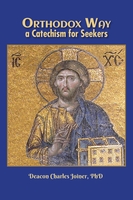
TITLE: Orthodox Way: a Catechism for Seekers
AUTHOR: Deacon Charles Joiner, PhD
Complementary on-line materials (slides, videos, articles) for the above catechism course:
BASIC STEPS FOR CATECHUMENS
I have my catechisim book (Orthodox Way a Catechism for Seekers by Deacon Charles Joiner, PhD) and am going through it at my own pace. I am making note of any questions I have as I go. I am attending the Divine Liturgy regularly. Should I be doing something else? Yes.
ESTABLISH A PRAYER CORNER AND START TO PRAY
As an Orthodox Christian and even while yet a catechumen, you will want to establish a prayer corner in your home or room. Start with at least one icon, often of Christ and His mother, our Panagia, and an Orthodox prayer book. You can add a wall cross and a candle, too, or an oil lamp. Often a prayer corner grows and other icons get added as time passes. It is also a good place to keep your Bible and an Orthodox Psalter (Book of Psalms). Examples of icon corners can be found by doing a search of images on-line.
Set up your prayer corner facing east whenever possible. Use the area for prayer only, don't stage other personal items there. If you use a shelf or top of a bookcase or dresser, perhaps put down a cloth and arrange your icons there. Keep it a sacred space where you meet with God. Use an Orthodox prayer book--our bookshop area has a variety of books from different publishers and you can choose which one you like. Some people use just one prayer book, some like to collect more than one. A hardcover prayer book is a very good investment. Follow the prayers in the prayer book in the order they are written for morning and evening. You can also purchase a knotted prayer rope and use the Jesus Prayer, "Lord Jesus Christ, have mercy on me." This prayer helps cleanse the heart and draw grace to oneself.
An Orthodox Christian life is rooted in prayer, repentance and love. Setting a daily discipline of prayer will undergird you for the rest of your life. You can start while you are yet a catechumen and we suggest that you do--to begin getting rooted in Orthodox Christian practice.
Learn Psalm 50/51 "Have mercy on me, O God," and the Nicene Creed. If you read them regularly, you will naturally commit them to memory over time. Psalm 50/51 is King David's prayer of repentance. The Nicene Creed states what we believe as Orthodox Christians. The Nicene Creed we use at St. George is standard throughout the Greek Orthodox Archdiocese. It is printed on pew cards. You can photocopy it for use at home. If anyone ever asks you what you believe, you can recite the Nicene Creed. If you have questions or concerns about any tenet of the Nicene Creed, please talk with our priest. You will be asked to state the Nicene Creed at your Baptism / Chrismation before being received into the Church. It is very important that you are in full agreement with it.
THE IMPORTANCE OF BEING PRESENT FOR THE DIVINE LITURGY
The Divine Liturgy is the pinnacle of Christian worship where we receive Christ Himself, His Body and Blood, mystically, in the Eucharistic cup. We know this Communion is essential for a Christian life. The Lord spoke to this in John 6:53-58. Although catechumens are not able to Commune until they are formally received into the Church as Orthodox Christians, they are able to be present in the Divine Liturgy, to learn the prayers that are prayed, the responses that are sung and to partake of the grace that is imparted through this liturgical worship. Your regular presence, your longing for God, your patience in preparing yourself and waiting for the time of reception into the Church is an evidence of sincere desire and commitment. In short, you need to be present regularly for an unspecified period of time in order to move forward with your desire to become Orthodox.
STARTING OUR JOURNEY IN THE CHURCH - GUIDELINES FOR "SUNDAY BEST"
God meets us in the church, receives our worship, and Communes with us as His own. That which we participate in is sacred; the way we dress reflects that event. If how to appropriately dress for church were condensed to two words, it would read, "Sunday best."
However, since we live in a casual world and attending church might even be new to some, it might not always be understood what "Sunday best" means. To be clear, here are some guidelines:
Men
Office attire: long pants.
Shorts are not appropriate for church.
Jeans in very good shape are OK.
Office attire: a shirt or a polo shirt is fine.
Avoid t-shirts or sleeveless shirts.
Avoid clothing with graphics or slogans on the front or back.
Avoid athletic wear unless at church camp.
Shoes worn with socks--shoes that complement office attire pants or jeans.
Sandals can be worn, but with socks.
Hats of any kind, for men, are not worn in church.
It's OK to bring casual wear to change into after services.
Women
The cardinal rule is to dress modestly. The Mother of God is the role model for women; she exudes modesty, and we know her example is well-pleasing to God. In church, sleeveless dresses or tops are best worn with a light sweater, jacket, or bolero for modesty's sake. Avoid tight-fitting or other revealing-type clothing, which can be distracting by drawing unnecessary attention to one's beauty during worship. Avoid shorts or mini-skirts. Avoid attire with graphics or slogans on front or back. Skirts and dresses are preferred church attire. Long skirts might offer greater comfort and modesty for those accustomed to wearing slacks. Wearing slacks in church in the USA is generally accepted, but when visiting monasteries or churches in traditionally Orthodox countries, slacks are not considered acceptable dress for women. Wearing a headcovering would also be expected, especially in Slavic churches. Monasteries in the USA almost always require women to wear headcoverings in the church and on the grounds. Closed shoes are preferred, but sandals are accepted. Stockings worn with sandals are usually the guideline when visiting monasteries.
PLEASE, NO FOOD OR BEVERAGES IN CHURCH
The Divine Liturgy is the service where we are prepared to receive the Lord in Holy Communion, also known as the Mystical Supper. The proper preparation is to always refrain from food or drink from midnight, the night prior. Thus, there should be no food or drinks brought into the Church.
Sometimes choir members receive a special blessing from the priest to sip water or have throat lozenges during a Divine Liturgy, depending on the person's needs. But the blessing is not given by an individual for themselves to do so, only by the priest. Otherwise, those prepared for Holy Communion should keep the normal fast from food and drink before receiving.
START TO FAST ON PRESCRIBED DAYS AND SEASONS OF THE YEAR
Orthodox Christians fast every Wednesday and Friday of the week except during special weeks of the year that are held as non-fasting, i.e., the Twelve Days of Christmas, the first week of the Triodion, Bright Week (the week of Holy Pascha), the week following Holy Pentecost. More detail below:
|
|
| Fasting Seasons and Days |
Paschal Cycle:
1. Meatfast, the week before the beginning of Great Lent
2. Great Lent and Holy Week
Yearly Cycle:
1. Nativity (St. Philip's) Fast Nov. 15 through Dec. 24
2. Apostles' (Peter and Paul) Fast from the Monday after All Saints Sunday through June 28
3. Dormition (Theotokos) Fast Aug. 1 through Aug. 14
Fast Days:
1. The Wednesdays and Fridays of the Year, except for Fast-free Weeks
2. The Eve of Theophany Jan. 5
3. The Beheading of St. John the Baptist Aug. 29
4. The Elevation of the Cross Sept. 14
Fast-free Weeks:
1. Afterfeast of the Nativity of Christ to Theophany Eve Dec. 25 through Jan. 4
2. The week following the Sunday of the Publican and Pharisee
3. Bright Week the week after Pascha
4. Trinity Week the week after Pentecost, concluding with All Saints Sunday
|
Excerpt taken from "These Truths We Hold - The Holy Orthodox Church: Her Life and Teachings". Compiled and Edited by A Monk of St. Tikhon's Monastery. Copyright 1986 by the St. Tikhon's Seminary Press, South Canaan, Pennsylvania 18459.
|
How to fast?
A plant based diet, or a vegan diet, is suitable for the Orthodox fasting days and seasons. Abstain from meat (from any animal, including fish) and dairy products (eggs are classified under the dairy category) and products made with them.
Dairy refers to products derived from mammalian milk. Dairy encompasses milk products--most often sourced from cows, sheep and goats. Butter is outside the list of acceptable fasting foods. Ghee is not for fasting periods, either. It may have most milk solids removed, but it still contains dairy-derived components. So, no mammalian milk, butter, ghee or by-products sourced from mammals.
Eggs (for our consideration) are most often laid by birds. Eating fowl or fowl derived products is not on the list of acceptable fasting foods.
Fish have a backbone with fins and gills and are not on the list of acceptable fasting foods, except for some Feast days that fall during fasting seasons, such as the Palm Sunday, the Annunciation or the Holy Transfiguration. Other days when fish are permitted during fasting periods are noted on church calendars. Look on the candle stand for a free church wall calendar. It will help you anticipate the fasting seasons by looking ahead and planning.
Seafood is fine for fasting. It includes sea life that is classified as shellfish, crustaceans, and other edible marine life, i.e., mussels, clams, lobster, crab, shrimp, scallops, octopus and squid. Edible sea plants are also acceptable for fasting periods.
Which foods are OK for fasting?
Acceptable foods include: fruits; vegetables; grains (including bread, rice, pasta or cereal); legumes (beans, peas, lentils, tofu); nuts and seeds, plant based milks. Add seafood / shellfish if desired. Honey and other sweeteners are fine. Vegetable oils are fine and margarine made from them. Olive oil is usually just used on weekends during fasting seasons, but the other oils are fine anytime (consult your church calendar for specifics). Grain beverages (including beer) are OK during fasting seasons. There is quite a bit to choose from.
Is this food OK for fasting?
If a food comes from an animal with a backbone, it is not for fasting.
Why do we fast?
On Wednesdays, we remember Christ's betrayal and arrest. On Friday, we remember Christ's Crucifixion and laying down His life for our Salvation.
Eat moderately, endeavor to pray and reflect on the meaning of why we are fasting on particular days and seasons.
Fasting effects a good outcome for us when done with obedience and prayer. Fasting humbles the body and make us more reliant on God. We are also able to be better attuned to God's leading in our lives. Remember the great result Daniel and the Holy Children had in the land of Babylon while in captivity. They were told not to fast as they were accustomed to do, but to eat luxuriously from the king's table. Instead they respectfully decilined, deciding to please God and not man and kept their fasting rule. God elevated their status in the eyes of the king and people. Read the Old Testament Book of Daniel, chapter 1.
Greek Orthodox Dispensation on Thanksgiving Fasting
Overview of the Nativity Fast
The Nativity Fast for Greek Orthodox Christians begins on November 15 and lasts until December 24. During this period, the faithful are encouraged to abstain from meat, dairy, fish, wine, and oil, with some exceptions on certain days.
Thanksgiving and Fasting
Thanksgiving in the United States often coincides with the Nativity Fast. However, the Greek Orthodox Church recognizes the cultural significance of Thanksgiving and provides guidance on how to navigate fasting during this holiday.
Dispensation Details
-
Cultural Significance: Thanksgiving is viewed as a time for family unity and gratitude, aligning with the Church's teachings on thanksgiving and worship.
-
Patriarchal Guidance: The Patriarchate of Constantinople has granted a dispensation for Orthodox Christians in America to break the fast on Thanksgiving Day. This allows for participation in traditional meals without strict adherence to fasting rules.
-
Focus on Family and Worship: The Church encourages attending the Divine Liturgy on Thanksgiving morning, emphasizing the importance of giving thanks to God for His blessings.
Recommendations for Observance
-
Participate in the Meal: It is acceptable to partake in the Thanksgiving meal, including turkey and other traditional foods, while maintaining a spirit of gratitude.
-
Return to Fasting: After Thanksgiving, it is advised to resume the fasting guidelines as prescribed by the Church.
This approach allows Orthodox Christians to honor both their faith and cultural traditions during Thanksgiving. Sourced from Pravmir.com and Wikipedia
For guidance on fasting for Great and Holy Lent, scroll down to the section "GREAT LENT"
HOW TO CHOOSE A PATRON SAINT
You might notice that often an Orthodox person is called by a Saint's name rather than by their street name. It is not required that you take a Saint's name, but many people do. In taking a Saint's name, we emulate that Saint's life as a role model and ask his or her intercessions before God's throne. Think of Saints as holy friends, which they are. They are role models, they have already fought the good fight of Faith and are now enrolled in the Church Triumphant, on high with Almighty God. They are available to pray for us, that we, too, will triumph in Faith and join them eventually in God's eternal Kingdom.
A good place to start is to read some Lives of Saints. Check our bookshop area for resources or ask Fr. for a recommendation. You might consider your full name--sometimes people have Christian names as a middle name. You can look into the life of that Saint. You can also look for Saints celebrated on your date of birth. If you have a particular type of job or hobby there may be a related Saint. For example, there is an Orthodox Saint for beekeepers--St. Modomnoc! You might read church history or writings of church fathers and be drawn to a particular theologian or ascetic or the life and teachings of a contemporary Saint. You might ask your sponsor for a suggestion. Pray about your decision and then choose a Saint that you relate to. There are many Saints and all have our best interest at heart!
HOW TO CHOOSE A SPONSOR
A sponsor is an Orthodox Christian who is active in the Church. The best way to choose a sponsor is to start getting to know people during fellowship hour. A sponsor is usually someone who is or who could become, over time, a good friend. The sponsor would best be a man or woman of prayer, who shows genuine interest in and concern for you spiritually. Males sponsor other men and women sponsor other women.
READING THE BIBLE
The Bible is the Word of God and through it we learn what God wants us to know. It takes us from the Creation through to Revelation of the Eternal Kingdom to come.
The Bible can be a bit daunting to read for the very first time. In order to help those new to Bible reading, we suggest reading through an excellent children's Bible to start. That will give you an easier overall understanding of the Bible as a whole. You will learn about events, people, blessings, miracles, warnings and judgments--all that God wants us to know.
If you'd like to start by reading a children's Bible, ask Presbytera, she will order one for you.
Otherwise, get started by purchasing an Orthodox Study Bible which includes full color icons with helpful articles and footnotes.
Which Scriptures should I read? The Greek Archdiocese offers a daily Scripture reading guide on their on-line Chapel homepage: https://www.goarch.org/chapel/. There are also Bible reading apps available from the Greek Archdiocese: https://www.goarch.org/-/daily-reading-app.
ORTHODOX BIBLE STUDY Here is a recommended resource for Bible Study for Orthodox Christians. Learn from Dr. Jeannie Constantinou, a well respected and engaging Orthodox Christian expositor. Visit her site and go deep into the Scriptures: https://orthodoxbiblestudy.info/ Read her bio here: https://orthodoxbiblestudy.info/about-your-professor/. Many of us have read books written by Dr. Constintinou already and been greatly edified. She has a second web site, as well: https://www.drjeannie.com/.
ORTHODOX CHRISTIAN APP AVAILABLE Athon is the Orthodox Christian app for seekers, catechumens, and practicing Orthodox believers, guiding you step by step through Scripture, saints, prayers, and audio teachings to grow in the life of the Church. https://athonapp.com/
BECOME ACQUAINTED
In any Orthodox community, there are people who adhere together through thick and thin out of love for Christ and the Holy Faith. These are people you see weekly and who you will want to know better and be known by them, too. So, make an effort to be better acquainted. Not everyone is a social butterfly but it is possible to sit with new people every so often, introduce yourself, follow the conversation and add to it. And never worry about asking questions. You'll find people here who are genuinely interested in you. We have a mix of ages, ethnicities and backgrounds, even a couple published authors among us, so don't hesitate to get to know people because they are fascinating. You can learn a lot (and contribute a lot) in the process. If you're looking to learn more about Orthodox faith and life, ask others if they have a favorite book or author they might recommend to you. That question can open up interesting topics all on its own. Enjoy the process of getting acquainted with our St. George community. When it comes time for you to be received as a member, the community should recognize who you are and rejoice with you--your Christian brothers and sisters of St. George!
SUPPORT YOUR CHURCH AND SPIRITUAL COMMUNITY
Each parishioner / family is expected to help care for the on-going needs of the church as though it is an extension of their home. St. George is our spiritual home, after all. It's our place of worship and fellowship. There are on-going costs for utilities (especially during the cold months), cleaning, supplies used on a weekly basis, building and property upkeep, i.e., lawn care, snow removal and the "unexpected." Along with that there are assessments that churches are expected to pay to their Metropolis and Archdiocese to help with their on-going operations, too. Here at St. George no one gets paid a salary, we are all volunteers. Thus we rely on one another to keep things in good shape and to be good stewards of what God makes available. We ask parishioners to pledge an amount that will be paid over a year's time and that figure is used for budgeting. If you can give more than the pledged amount in a year, wonderful! But at least submit a pledge that you believe will be attainable for you. Keep in mind the blessings God routinely sends you and offer a pledge of thanksgiving in faith of His provision, love and mercy. Our stewardship chair is Donna Walter and she is often on duty in the office on Sunday mornings.
Along with financial support, bringing food for the fellowship meal somewhat regularly is a great way to step into contributing to this vibrant community. Also, assuming tasks every so often is very much needed and appreciated. Vacuuming the church after fellowship hour, straightening the books in the pews, wiping the surfaces of the portable icons so the church is ready for the coming week--washing dishes, wiping tables and sweeping in the fellowship hall after meals is most welcome labor! You will automatically get to know some people better in the process. Thank you for strengthening our community!
SPIRITUAL SEASONS OF THE CHURCH YEAR
GREAT LENT (every Spring, dates are variable)
THE LENTEN PRAYER OF ST. EPHRAIM THE SYRIAN (AD 306-373) It is offered morning and night--except Fridays and Saturdays--during Great Lent:
Lord and Master of my life, cast away from me the spirit of laziness, idle curiosity, love of power and vain talk. (prostration)
But rather grant me, Your servant, the spirit of moderation, humility, patience, and love. (prostration)
Yes, Lord and King, grant me to see my own faults and not to judge my brother or sister. For You are blessed now and ever and unto the ages of ages. (prostration)
O God cleanse me a sinner (12x with bows).
Yes, Lord and King, grant me to see my own faults and not to judge my brother or sister. For You are blessed now and ever and unto the ages of ages. Amen. (prostration)
THE PENETENTIAL USE OF PROSTRATIONS IN ORTHODOX TRADITION https://orthodoxfaithandtradition.blogspot.com/2025/03/the-penitential-practice-of.html?m=1
PROSTRATIONS AND BOWS A priest prays at home with his children using prostrations: https://www.youtube.com/watch?v=brQDe6yhEvE Do as you are able. God knows each person. Here's a demonstration that could make the practice attainable for more people, especially for those a bit older: https://www.youtube.com/watch?v=r4FaqRa1KFE
FASTING FOR GREAT AND HOLY LENT
Approach eating with moderation, following a vegan menu (no meat or dairy products). Eat according to the fasting guidelines, trying not to indulge. Choose healthy foods. Many Orthodox eat just one or two meals a day, but if you need three, it's OK. Not everyone has the same level of physical health so please refrain from evaluating what others are doing. Hoe your own row, keep up with your prayers. God will help all who ask Him. Seek repentance, let love be your aim this season. Be generous in spirit. The eating program will fall into place, don't overly stress. Any modifications to the fasting rule, if necessary, should be made with the blessing of one's priest. Many people in the world already eat as though they are fasting like the Orthodox and feel healthier for it. We are different in that we fast, pray and seek repentance while doing so. Here is an edifying video on the topic: https://www.youtube.com/watch?v=OOYBSCJMFHg
SATAN'S FAVORITE WEAPON A worthy homily focused on the topic of fasting: https://www.youtube.com/watch?v=3Z_GMEuPdYQ
ST THEODORE AND THE MIRACLE OF THE KOLIVA
A wondrous account: https://www.youtube.com/watch?v=5O6YtF2BF1g
The Holy Martyr Theodore lived during the reigns of Emperors Maximian (286-305) and Maximinus (308-313), and resided in the metropolis of Amasea, which is an eminent city of Cappadocia off the coast of the Black Sea, and was from the village of Houmialos. At the time therefore when the Saint was numbered among the soldiers called the Tiron (Tiro means armed soldier, or rather was a newly enlisted recruit), when he was under the regimental command of Vriga, then he confessed that Christ was the true God, and that the idols of the Greeks were lifeless statues, the work of men's hands. Wherefore he was brought before his commander, and he gave Theodore some time and a deadline to think things over. Then the Saint did a great virtuous action, for he took an idol of Rhea, the mother of the gods, which played the Greeks for fools, and he threw it into the fire and burned it.
Thus he was arrested and confessed that it was he who burned the idol. First he was hung up and scraped, then he was put in a flaming furnace, in which he was perfected, and received the crown of martyrdom. His Synaxis is held in his martyric Temple which is in Phorakion, on the Saturday of the first week of the Fast. This is when the miracle with the kollyva took place through him, by which he liberated the Orthodox Christian people from the polluted foods of the pagans.
When Julian the Apostate, who ruled over the Empire after Constantios, the son of Constantine the Great, had departed from Christ to idolatry, a mighty persecution was stirred up against Christians, both openly and secretly. Refraining from inflicting savage or inhuman punishments on them, the ungodly Emperor tempted the Christians in the following way: feeling shame, and at the same time suspecting that more might be added to their numbers if he persecuted them openly, the crafty and impious man plotted somehow to pollute them secretly.
Observing that our Christian race purifies itself and devotes itself to God more during the First Week of the Fast, he summoned the Eparch of the city and ordered him to remove the food that was usually for sale and to set out other comestibles in the marketplace, namely bread and beverages, having first mixed these with the blood from his sacrificial offerings, polluting them in the process, so that, when the Christians purchased them during the Fast, they might be defiled rather than cleansed. The Eparch carried out his order immediately and set out all over the marketplace the food and drink that had been polluted with blood from the sacrifices.
But the all-seeing eye of God, Who catches the wise of this world in their cleverness and ever provides for us, His servants, destroyed the loathsome devices directed against us by the Apostate. He dispatched His Great Trophy-bearer, Theodore the Recruit, to Evdoxios, the Archbishop of the city, who had obtained this office improperly.
Standing before Evdoxios, not in a dream, but while he was awake, St. Theodore spoke words such as these: “Arise with all speed and gather together the flock of Christ, and order them under no circumstances to buy any of the items set out in the marketplace; for they have been polluted by the most impious Emperor with blood from his sacrificial offerings.” Puzzled by this, the Archbishop asked: “And how can those who do not have abundant provisions in their homes easily avoid buying food from the marketplace?” “Provide them with Kollyva,” the Saint replied, “to relieve them in their time of need.” Puzzled again, and not knowing what Kollyva was, Evdoxios asked the Saint for an explanation. The great Theodore replied: “It is boiled wheat; for this is what we are accustomed to calling it in Euchaïta.” When the Archbishop inquired who precisely this provider for the Christian people might be, the Saint answered: “I am Theodore, the Martyr of Christ, Who has just now sent me to aid you.”
The Archbishop arose at once and announced what he had seen to the multitude. By acting thus, he preserved Christ’s flock unharmed by the machination of their enemy, the Apostate. When Julian saw that his trickery had been exposed, that he had accomplished nothing, and that he had been sufficiently put to shame, he ordered the usual comestibles to be put back in the marketplace.
At the end of the week, the Christian people gave thanks to their benefactor, the Holy Great Martyr Theodore, and joyously celebrated his memorial on this Saturday with kollyva. Ever since then, and up until now, we faithful revive this miracle, lest the martyr’s great deed become forgotten with the passage of time, and celebrate the memory of the Holy Great Martyr Theodore with kollyva.
CROSS VENERATION SUNDAY (third Sunday of Great Lent)
The Holy Cross is set forth for veneration on this day and fresh basil and flowers are blessed and distributed to the parish family. Keep your flowers in your icon corner and a sprig of basil, too. But for those who receive EXTRA basil and there often are some who do, you can plan a pasta dinner using blessed basil in a vegan pesto. Love and Lemons has a great recipe: https://www.loveandlemons.com/vegan-pesto/. But first let's look at the connection between the basil plant and the Holy Cross:
Did you know that Saint Helen found the True Cross beneath a mound of basil?
Saint Helen discovered the True Cross of Christ underneath a sweet-smelling herb we now call “basil.” Basil is derived from the Greek word (βασιλεύς) “basileus,” a title used for emperors, monarchs, and kings. Basil is considered “The King of Herbs” as Christ is “The King of Kings.”
After Emperor Saint Constantine the Great legalized Christianity, his mother, Saint Helen, made a pilgrimage to the Holy Land. She was commissioned to restore holy sites from Christ’s life and to find the True Cross. She founded many churches with help from the Patriarch of Jerusalem, Saint Macarius.
A Jewish man named Jude knew the Cross was buried beneath the temple of Venus. Saint Helen then ordered the temple to be destroyed and the site excavated. They discovered Golgotha and the Lord’s Sepulchre. On May 3, 326 A.D., within the temple rubble and beneath the mound of basil, Saint Helen found three crosses, four nails, and a wooden plaque with the Hebrew, Greek, and Latin inscription: “Jesus of Nazareth, the King of the Jews.” The Church celebrates the Finding of the Precious Cross on March 6.
To identify the True Cross of Christ, Saint Macarius prayed to God and told a dying woman to kiss each of the three crosses. Upon kissing the third cross, she was immediately healed. Coincidentally, a funeral procession was passing by, and the dead man’s body was placed on each of the crosses. When placed on the True Cross, he came back to life. Thus, the bitterness of death was overcome by the sweetness of the Life-Giving Cross.
Enjoy your blessed vegan pesto!
SUNDAY OF ST. JOHN CLIMACUS (fourth Sunday of Great Lent)
Who was St. John Climacus? https://youtube.com/watch?v=0_FFQ7lGUzY (The previous video is not from an Orthodox source, but it is still quite good for learning about St. John). What is St. John's Ladder? How does it apply to us? https://youtube.com/watch?v=PBTkKBmpFck
SUNDAY OF ST. MARY OF EGYPT (Fifth Sunday of Great Lent) Today we honor this holy ascetic whose life is outstanding in its revelation of humility, repentance and a transformed life. Learn more about St. Mary here: https://www.trisagionfilms.com/videos#/saints/. From this link, please choose the film "Human Transformation through Repentance: St. Mary of Egypt." It is well worth watching.
HOLY WEEK - Experience the events with Christ and His Church--an explanation of each day and its services: https://www.goarch.org/holyweek
HOLY PASCHA is the biggest and brightest Feast of the Church year. We are in the season of Pascha until the Feast of the Holy Ascension, so we will still sing the Paschal hymn and give and receive the greeting: Xristos Anesti! Christ is Risen! Response: Alithos Anesti! Truly He is Risen!
LINKS RELATED TO THE RESURRECTION OF CHRIST
IS THE SHROUD OF TURIN REALLY CHRIST'S BURIAL CLOTH? The evidence is very strong for this to be accurate. There are ways to investigate further. The best video we've come across which can be purchased on Amazon.com: 
AN INTRIGUING PRESENTATION ABOUT THE SHROUD OF TURIN https://www.youtube.com/watch?v=S1JCB1J2N84
ARTICLE WITH PHOTOS FROM HOLY SEPULCHRE CHURCH, JERUSALEM https://www.theepochtimes.com/bright/church-of-the-holy-sepulchre-the-holiest-christian-site-5942598?utm_source=Bright&src_src=Bright&utm_campaign=bright-2025-11-21&src_cmp=bright-2025-11-21&utm_medium=email&est=LgYLngvUCyXJNhcBahJNwTgK80bhZmgwWqP26MiXOvJefGx8FiHK5wyJDyCs
CONSIDER READING THE BOOK HOLY FIRE (learn about this recurring miracle which, for centuries, takes place every year in the Church of the Holy Sepulcher in Jerusalem on Holy Saturday). Blurb follows: HOLY FIRE: The miraculous appearance of the Light of the Resurrection at the tomb of Jesus / Eighty-Five Historical Accounts (4th–16th c.)
The coming of the Holy Fire at the Tomb of Jesus every Holy Saturday is the only miraculous event in human history which has taken place each year on the same day for more than one and a half millennia. Covering a period of thirteen centuries, from the 4th to the 16th century, this book assembles historical accounts of the celebrated event. Eighty-five authors—seventeen French, nine Englishmen, eight Greeks, seven Italians, seven Arabs, six Germans, five Armenians, five Ethiopians, four Russians, four Persians, three Icelanders, two Egyptians, two Chaldeans, one Cypriot, one Syrian, one Moldovan, one Belgian, one Austrian and one Swiss—describe the greatest miracle of the Christian world: the Holy Fire (i.e., the Light of the Resurrection of Christ) which appears every Holy Saturday at the Tomb of Jesus, a few hours before the celebration of his resurrection. Furthermore, the scientific measurements that were taken in the tomb of Jesus on Holy Saturday in 2008 by the Russian physicist Prof. Andrey Volkov, confirm the descent of the Holy Fire and reveal three phenomena, which he himself characterizes as “incredible and entirely inexplicable.” Similarly, the thermal measurements of the sacred flame, made by the Italian Professor Giulio Fanti on Holy Saturday 2019, document the supernatural origin of the Holy Fire and verify a fact that has been recorded historically for eleven centuries: that the sacred flame, in the first minutes after its ignition, burns almost imperceptibly—much less than a normal flame—without burning those who touch it. This book also includes a historical and archaeological study concerning the original appearance of Jesus’ tomb and the rock of Golgotha, along with a series of reconstructive drawings of the two locations, as they appeared to be in AD 33.
THE DORMITION FAST (August 1-14)
During the first 14 days of August, Orthodox Christians fast in preparation for the falling asleep of the Holy Theotokos. The words "falling asleep," or "dormition" or "repose" all refer to her passing from this life to the next. On the 15th, we celebrate the remembrance of her Dormition.
Now, here is a question that often comes to mind. Why is there a fast for the Dormition of the Theotokos? The answer can be found here:
https://orthochristian.com/38699.html
If you lived in Greece you could go to church during the weeknight evenings during the Fast and sing the paraklesis to the Mother of God. This is what is traditionally done. Since we are a commuter church, we would encourage everyone to listen and learn the small paraklesis by listening to it on-line. The service is presented by Eikona as "Paraklesis Mother of Light." Sheet music is also available at this site:
https://eikona.com/shop.
The Mother of Light Paraklesis (also known as the small paraklesis) is the one most Orthodox are familiar with and a perfect place to start learning the music for this service. You can listen to Mother of Light on Spotify, Apple Music and other listening sites. The Eikona shop also has Mother of Light available on a CD. You can listen to a sample of the third ode here:
https://www.youtube.com/watch?v=5AfgNa4CqDw
To be specific: From August 1-14, fast (follow a plant based diet) like we do during most fasting seasons. Eat a vegan menu incorporating vegetables, fruits, legumes, nuts, grains. You can use plant based milks and "cheese" made from nuts, there are many vegan options at local groceries. You can have seafood, if desired, i.e., lobster, clams, oysters, mussels, scallops, shrimp, crab is fine. On August 6, the Feast of the Holy Transfiguration, fish can be eaten. During the fast, abstain from using olive oil or wine, except on Saturdays or Sundays. If you need ideas for cooking, visit the Whole Food Plant Based Cooking Show on YouTube:
https://plantbasedcookingshow.com/ You will be amazed at what you can make and how delicious the options can be! All the recipes on that site are also gluten free.
God bless us all as we seek to draw closer to our Panagia, the most holy Theotokos as her Dormition draws near. Most Holy Theotokos, save us!