September 06

Kimisis Tis Theotokou Church
Publish Date: 2026-09-06
Bulletin Contents
Hymns of the Day
Gospel and Epistle Readings
Wisdom of the Fathers
Saints and Feasts
Diakonia Newsletter

Kimisis Tis Theotokou Church
General Information
- Phone:
- (631) 283-6169
- Fax:
- (631) 283-6271
- Email:
- [email protected]
- Street Address:
- 111 St. Andrews Road
- Southampton, NY 11968
- Mailing Address:
- 111 St. Andrews Road
- Southampton, NY 11968
Past Bulletins
- Publish Date:
- 2026-09-13
- Publish Date:
- 2026-08-30
- Publish Date:
- 2026-08-23
- Publish Date:
- 2026-08-16
- Publish Date:
- 2026-08-09
- Publish Date:
- 2026-08-02
Hymns of the Day
Resurrectional Apolytikion in the Plagal First Mode
Let us worship the Word, O ye faithful, praising Him that with the Father and the Spirit is co-beginningless God, Who was born of a pure Virgin that we all be saved; for He was pleased to mount the Cross in the flesh that He assumed, accepting thus to endure death. And by His glorious rising, He also willed to resurrect the dead.
Apolytikion for Miracle of Michael in Colossae in the Fourth Mode
Supreme Commanders of the Hosts of Heavens, we, the unworthy, importune and beseech thee that by thy supplications thou encircle us in the shelter of the wings of thine immaterial glory, guarding us who now fall down and cry to thee with fervour: Deliver us from dangers of all kinds, as the great marshal of the heavenly hosts on high.
Seasonal Kontakion in the Fourth Mode
In your holy birth, Immaculate One, Joachim and Anna were rid of the shame of childlessness; Adam and Eve of the corruption of death. And so your people, free of the guilt of their sins, celebrate crying: "The barren one gives birth to the Theotokos, who nourishes our life."
Gospel and Epistle Readings
Epistle Reading
Prokeimenon. Plagal First Mode. Psalm 11.7,1.
You, O Lord, shall keep us and preserve us.
Verse: Save me, O Lord, for the godly man has failed.
The reading is from St. Paul's Second Letter to the Corinthians 1:21-24; 2:1-4.
Brethren, it is God who establishes us with you in Christ, and has commissioned us; he has put his seal upon us and given us his Spirit in our hearts as a guarantee.
But I call God to witness against me - it was to spare you that I refrained from coming to Corinth. Not that we lord it over your faith; we work with you for your joy, for you stand firm in your faith. For I made up my mind not to make you another painful visit. For if I cause you pain, who is there to make me glad but the one whom I have pained? And I wrote as I did, so that when I came I might not suffer pain from those who should have made me rejoice, for I felt sure of all of you, that my joy would be the joy of you all. For I wrote you out of much affliction and anguish of heart and with many tears, not to cause you pain but to let you know the abundant love that I have for you.
Gospel Reading
14th Sunday of Matthew
The Reading is from Matthew 22:2-14
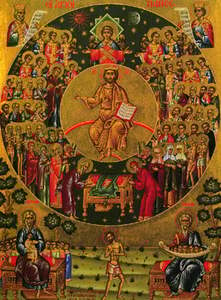
The Lord said this parable, "The kingdom of heaven may be compared to a king who gave a marriage feast for his son, and sent his servants to call those who were invited to the marriage feast; but they would not come. Again he sent other servants, saying, 'Tell those who are invited, Behold, I have made ready my dinner, my oxen and my fat calves are killed, and everything is ready; come to the marriage feast.' But they made light of it and went off, one to his farm, another to his business, while the rest seized his servants, treated them shamefully, and killed them. The king was angry, and he sent his troops and destroyed those murderers and burned their city. Then he said to his servants, 'The wedding is ready, but those invited were not worthy. Go therefore to the thoroughfares, and invite to the marriage feast as many as you find.' And those servants went out into the streets and gathered all whom they found, both bad and good; so the wedding hall was filled with guests.
But when the king came in to look at the guests, he saw there a man who had no wedding garment; and he said to him, 'Friend, how did you get in here without a wedding garment?' And he was speechless. Then the king said to the attendants, 'Bind him hand and foot, and cast him into the outer darkness; there men will weep and gnash their teeth.' For many are called, but few are chosen."
Saints and Feasts


September 06
The Commemoration of the Miracle Wrought by Archangel Michael in Colossae (Chonae)
The feast today in honour of the Archangel Michael commemorates the great miracle he wrought when he delivered from destruction a church and holy spring named for him. The pagans, moved by malice, sought to destroy the aforesaid church and holy spring by turning the course of two rivers against them. But the Archangel appeared and, by means of the Cross and a great earthquake that shook the entire area, diverted the waters into an underground course. Henceforth, the name of that place changed from Colossae to Chonae, which means "funnels" in Greek.

September 06
Holy Martyr Calodote

September 07
15th Monday after Pentecost

September 07
The Forefeast of the Nativity of the Theotokos

September 07
Sozon the Martyr
This holy Martyr was a shepherd in Lycaonia. Born a pagan, named Tarasius, he received holy Baptism and was renamed Sozon. Filled with zeal for the truth, he taught his countrymen to desist from the worship of idols. Once he entered the temple of Artemis in Pompeiopolis of Cilicia, cut off the golden hand of the idol, and breaking it in pieces, distributed it among the poor. When he saw that many were being unjustly punished for the theft, of his own accord he gave himself up to Maximian the Governor. He was beaten with rods until his bones were broken. According to some, he suffered martyrdom in 288; according to others, in 304.

September 07
Kassiani the Hymnographer

September 07
John and Sergios, Bishops of Lerna
September 07
Daniel Katounakiotis of Smyrna

September 07
Euodos and Onesiphoros, Apostles of the 70

September 08
The Nativity of Our Most Holy Lady the Theotokos and Ever-Virgin Mary
According to the ancient tradition of the Church, the Theotokos was born of barren and aged parents, Joachim and Anna, about the year 16 or 17 before the birth of Christ. Joachim was descended from the royal line of David, of the tribe of Judah. Anna was of the priestly tribe of Levi, a daughter of the priest Matthan and Mary, his wife.

September 09
The Holy & Righteous Ancestors of God, Joachim and Anna
Today, the day following the Nativity of the most holy Theotokos, we celebrate the synaxis of Saints Joachim and Anna, honouring them as her parents.

September 09
Severianos the Martyr of Sebaste
Saint Severian, a senator from Sebastia, was both an illustrious man of wealth and a fearless Christian. Because he encouraged the holy Forty Martyrs of Sebastia to stand fast in their confession, he was given over to terrible torments, and received his own crown during the reign of Licinius and Lysius the Duke, about the year 315.

September 10
Menodora, Metrodora, & Nymphodora the Martyrs
These Martyrs, sisters according to the flesh, were from Bithynia. They lived in virginity on a mountain near the Pythian hot springs of Bithynia, devoting themselves to asceticism and prayer. Betrayed to the local governor, Fronto, they were subjected to frightful tortures, and so gave up their holy souls into the hands of God. They contested for the Faith during the reign of Maximian, in the year 304.

September 11
Theodora the Martyr of Alexandria
This saint lived in the fifth century. Out of remorse for the adultery that she committed with another man, she fled from her husband's house, renamed herself Theodore, clothed herself as a man, and pretending to be a eunuch, entered a monastery of men. Her identity as a woman was discovered only after her death.

September 11
Euphrosynos the Cook

September 11
Demetrios & Evanthea the Martyrs & their son Demetrianos

September 12
Autonomos the Martyr
This saint was a bishop in Italy. Fleeing from the persecution of Diocletian in 298, he came to Bithynia, where he went from place to place converting many from the idols to the true God. Because of this, one day as he was celebrating the Divine Liturgy in the Church of the Archangels, they who worshipped wood and stones fell upon him and beat him to death with staves and stones.
Diakonia Newsletter
Read the latest Diakonia Newsletter for this Sunday
https://bulletinbuilder.org/diakonia-newsletter/2026-09-06?source=bulletin_web
September 6, 2026