September 13

Kimisis Tis Theotokou Church
Publish Date: 2026-09-13
Bulletin Contents
Hymns of the Day
Gospel and Epistle Readings
Wisdom of the Fathers
Saints and Feasts
Diakonia Newsletter


Kimisis Tis Theotokou Church
General Information
- Phone:
- (631) 283-6169
- Fax:
- (631) 283-6271
- Email:
- [email protected]
- Street Address:
- 111 St. Andrews Road
- Southampton, NY 11968
- Mailing Address:
- 111 St. Andrews Road
- Southampton, NY 11968
Past Bulletins
- Publish Date:
- 2026-09-06
- Publish Date:
- 2026-08-30
- Publish Date:
- 2026-08-23
- Publish Date:
- 2026-08-16
- Publish Date:
- 2026-08-09
- Publish Date:
- 2026-08-02
Hymns of the Day
Resurrectional Apolytikion in the Plagal Second Mode
Angelic powers were above Thy tomb, and they that guarded Thee became as dead. And Mary stood by the grave seeking Thine immaculate Body. Thou hast despoiled Hades and wast not tried thereby. Thou didst meet the Virgin and didst grant us life. O Thou Who didst arise from the dead, Lord, glory be to Thee.
Apolytikion for Forefeast of the Exaltation in the Second Mode
We offer Thee in mediation the life-giving Cross which, of Thy goodness, Thou hast given unto us, the unworthy, O Lord. Save Thy hierarchs and Thy flock, and grant Thou peace through the Theotokos, O only friend of man.
Apolytikion for Temple of the Resurrection in the Fourth Mode
Thou hast shown the earthly beauty of the holy tabernacle of Thy glory to be like unto the splendour of the heavenly firmament, O Lord. Strengthen it for ever and ever, and accept our prayers which we unceasingly offer therein unto Thee, through the Theotokos, O Thou Who art the Life and Resurrection of all.
Seasonal Kontakion in the Fourth Mode
The Church is shown to be a many-lighted heaven that doth shine a guiding light upon all them that do believe; wherein while standing we cry aloud: Do Thou Thyself now establish this house, O Lord.
Gospel and Epistle Readings
Epistle Reading
Prokeimenon. Plagal Second Mode. Psalm 27.9,1.
O Lord, save your people and bless your inheritance.
Verse: To you, O Lord, I have cried, O my God.
The reading is from St. Paul's Letter to the Galatians 6:11-18.
Brethren, see with what large letters I am writing to you with my own hand. It is those who want to make a good showing in the flesh that would compel you to be circumcised, and only in order that they may not be persecuted for the cross of Christ. For even those who receive circumcision do not themselves keep the law, but they desire to have you circumcised that they may glory in your flesh. But far be it from me to glory except in the cross of our Lord Jesus Christ, by which the world has been crucified to me, and I to the world. For neither circumcision counts for anything, nor uncircumcision, but a new creation. Peace and mercy be upon all who walk by this rule, upon the Israel of God. Henceforth let no man trouble me; for I bear on my body the marks of Jesus. The grace of our Lord Jesus Christ be with your spirit, brethren. Amen.
Gospel Reading
Sunday before Holy Cross
The Reading is from John 3:13-17
The Lord said, "No one has ascended into heaven but he who descended from heaven, the Son of man who is in heaven. And as Moses lifted up the serpent in the wilderness, so must the Son of man be lifted up, that whoever believes in him may have eternal life.
"For God so loved the world that he gave his only Son, that whoever believes in him should not perish but have eternal life. For God sent the Son into the world, not to condemn the world, but that the world might be saved through him."
Wisdom of the Fathers
Our Redeemer and Maker, Who was Son of God before the ages, became Son of Man at the end of ages. Thus the One Who, through the power of His divinity, had created us to enjoy the happiness of everlasting life, might Himself restore us, through the weakness of our humanity, to recover the life we had lost.
Homilies on the Gospels, 2.18. 7th Century. Taken from: Ancient Christian Commentary on Scripture. Vol: John 1-10. Intervarsity Press, 2006, p. 126.
For since Nicodemus had said, "We know that Thou art a teacher come from God," on this very point He sets him right, all but saying, "Think Me not a teacher in such manner as were the many of the prophets who were of earth, for I have come from heaven (but) now. None of the prophets hath ascended up thither, but I dwell there."
Homily 27 on John 3, 4th Century
Saints and Feasts


September 13
The Consecration of the Church of the Holy Resurrection (Holy Sepulchre)
The church that is honoured far above all others is that of the Holy Resurrection, which Saint Constantine the Great constructed at the place of Golgotha, where our Saviour was crucified and buried. For a long time this place had been purposely buried beneath the earth by the Jews and heathen; furthermore, during the reign of Hadrian (117-138), a temple dedicated to Aphrodite was built over the site so that this sacred place might be even further desecrated and fall into utter oblivion. It was here that the Cross was hidden. However, at the command of the pious Emperor Constantine, excavations were made and the tokens of the saving Passion were found. It was here, then, that the very great and magnificent temple named in honour of Christ God's Resurrection-the Anastasis-was built under the supervision of the blessed Helen, while Dracilian was Eparch of Palestine and Macarius was Archbishop of Jerusalem. It was the latter, also, who exalted the venerable Cross and performed the consecration of this temple in the year 336.

September 13
Forefeast of the Elevation of the Holy Cross

September 13
Cornelius the Centurion & Martyr
Saint Cornelius was a Roman by race, a pagan by religion, a centurion in rank, an inhabitant of Caesarea of Palestine, a man pious and God-fearing who gave many alms to the people and prayed continually unto God. In accordance with an angelic vision granted to him, he sent to Joppa that they might bring the Apostle Peter. Saint Peter catechized him in the Faith of Christ and baptized all his household (Acts, ch.10). This became the beginning and the first fruits of the calling of the nations. It is said that, after this, he became a bishop, as some say, of Caesarea; but others say of Scepsis, which is not far from Troas; and that he died as a martyr.

September 13
Aristides the Philosopher

September 13
Hierotheos the Righteous of Iveron Monastery, Mount Athos

September 14
The Elevation of the Venerable and Life-Giving Cross
Saint Helen, the mother of Saint Constantine the Great, when she was already advanced in years, undertook, in her great piety, the hardships of a journey to Jerusalem in search of the cross, about the year 325. A temple to Aphrodite had been raised up by the Emperor Hadrian upon Golgotha, to defile and cover with oblivion the place where the saving Passion had been suffered. The venerable Helen had the statue of Aphrodite destroyed, and the earth removed, revealing the Tomb of our Lord, and three crosses. Of these, it was believed that one must be that of our Lord, the other two of the thieves crucified with Him; but Saint Helen was at a loss which one might be the Wood of our salvation. At the inspiration of Saint Macarius, Archbishop of Jerusalem, a lady of Jerusalem, who was already at the point of death from a certain disease, was brought to touch the crosses, and as soon as she came near to the Cross of our Lord, she was made perfectly whole. Consequently, the precious Cross was lifted on high by Archbishop Macarius of Jerusalem; as he stood on the ambo, and when the people beheld it, they cried out, "Lord have mercy." It should be noted that after its discovery, a portion of the venerable Cross was taken to Constantinople as a blessing. The rest was left in Jerusalem in the magnificent church built by Saint Helen, until the year 614. At that time, the Persians plundered Palestine and took the Cross to their own country (see Jan. 22, Saint Anastasius the Persian). Late, in the year 628, Emperor Heraclius set out on a military campaign, retrieved the Cross, and after bringing it to Constantinople, himself escorted it back to Jerusalem, where he restored it to its place.
Rest from labour. A Fast is observed today, whatever day of the week it may be.

September 14
The Elevation of the Venerable and Life-Giving Cross
Saint Helen, the mother of Saint Constantine the Great, when she was already advanced in years, undertook, in her great piety, the hardships of a journey to Jerusalem in search of the cross, about the year 325. A temple to Aphrodite had been raised up by the Emperor Hadrian upon Golgotha, to defile and cover with oblivion the place where the saving Passion had been suffered. The venerable Helen had the statue of Aphrodite destroyed, and the earth removed, revealing the Tomb of our Lord, and three crosses. Of these, it was believed that one must be that of our Lord, the other two of the thieves crucified with Him; but Saint Helen was at a loss which one might be the Wood of our salvation. At the inspiration of Saint Macarius, Archbishop of Jerusalem, a lady of Jerusalem, who was already at the point of death from a certain disease, was brought to touch the crosses, and as soon as she came near to the Cross of our Lord, she was made perfectly whole. Consequently, the precious Cross was lifted on high by Archbishop Macarius of Jerusalem; as he stood on the ambo, and when the people beheld it, they cried out, "Lord have mercy." It should be noted that after its discovery, a portion of the venerable Cross was taken to Constantinople as a blessing. The rest was left in Jerusalem in the magnificent church built by Saint Helen, until the year 614. At that time, the Persians plundered Palestine and took the Cross to their own country (see Jan. 22, Saint Anastasius the Persian). Late, in the year 628, Emperor Heraclius set out on a military campaign, retrieved the Cross, and after bringing it to Constantinople, himself escorted it back to Jerusalem, where he restored it to its place.
Rest from labour. A Fast is observed today, whatever day of the week it may be.

September 14
Commemoration of the 6th Ecumenical Council

September 15
Nikitas the Great Martyr
This Saint was of high birth among the Goths beyond the Danube River. He was taken by Athanaric, pagan ruler of the Goths, and after being tortured, was burned to death for his confession of Christ. According to some, this took place during the reign of Saint Constantine the Great; according to others, under the Emperor Gratian.

September 15
Bessarion of Larissa

September 16
Euphemia the Great Martyr
Saint Euphemia was from Chalcedon and lived in virginity. According to some, she suffered martyrdom during the reign of Diocletian, in 303; according to others, in 307. Her sacred relics are preserved in the Patriarchate in Constantinople.

September 16
Ninian the Enlightener of Scotland
Saint Ninian was born in Cumberland in Britain around the year 360, about a half century after the Emperor Constantius Chlorus died in the British city of York, and his son Constantine, who was with him when he died, was proclaimed Emperor. Ninian was born of Christian parents of noble lineage, at a time when paganism was still strong in his native land. As a young man he went to Rome, where he spent many years in study and ascetical struggles. At Rome, Saint Ninian was consecrated some time after the death of Pope Damasus in 384, and was sent back to his native island about the end of the fourth century. On his return journey, it is likely that he passed through Tours and met Saint Martin; what is certain is that many churches and cells associated with Saint Ninian, including his own cathedral in Whithorn, were named in honour of Saint Martin. When Saint Ninian returned to Cumberland, he established monasteries that fostered both the life of prayer and missionary labours. By his preaching, his godly life, and his miracles, he ministered to his own countrymen, the Britons, and also converted many of the pagan Picts, who inhabited the northern regions (in today's Scotland). He reposed in peace at his see of Whithorn in Galloway in 432.

September 17
Sophia & her three daughters: Faith, Hope, and Love
These Saints were from Italy and contested for the Faith about the year 126, during the reign of the Emperor Hadrian. Faith was twelve years old, Hope, ten, and Love, nine; each was tormented and then beheaded, from the eldest to the youngest. Their mother Sophia mourned at their grave for three days, where she also fell asleep in peace; because of her courageous endurance in the face of her daughters' sufferings, she is also counted a martyr. The name Sophia means "wisdom" in Greek; as for her daughters' names, Faith, Hope, and Love (Charity), they are Pistis, Elpis, and Agape in Greek, and Vera, Nadezhda, and Lyubov in Russian.

September 18
Eumenius the Wonderworker, Bishop of Gortynia
This Saint took up the monastic life from his youth, and later became Bishop of Gortynia in Crete. He travelled to Rome, and to Thebes in Upper Egypt, where through his prayers he ended a drought; there also, after working many miracles, he reposed in deep old age. His holy relics were returned to Gortynia and buried at the place called Raxos.

September 18
Ariadne the Martyr

September 19
Trophimos, Sabbatios, & Dorymedon the Martyrs
In 278, during the reign of Probus, Saints Trophimus and Sabbatius came to Antioch, and seeing the city celebrating the festival of Apollo at Daphne lamented the blindness of the people, and presented themselves as Christians to Atticus the Governor. Saint Trophimus was stripped of his clothing, and was stretched out and beaten until the earth was red with his blood. Then he was hung up, scraped on his sides, and imprisoned in torments. Saint Sabbatius was tortured so savagely that he gave up his spirit in his sufferings. Trophimus was sent to Synnada, wearing iron shoes fitted with sharp iron nails within; he was further tormented without mercy, then cast into prison. Dorymedon, a counsellor, and a pagan, came to the prison and cared for Trophimus. When a certain feast came, Dorymedon was asked why he did not sacrifice to the idols; he proclaimed himself a Christian, for which he was imprisoned, pierced with heated spits, frightfully punished, and finally beheaded with Saint Trophimus.
Diakonia Newsletter
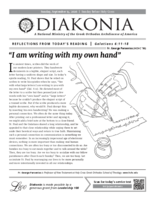
Read the latest Diakonia Newsletter for this Sunday
https://bulletinbuilder.org/diakonia-newsletter/2026-09-13?source=bulletin_web
September 13, 2026