
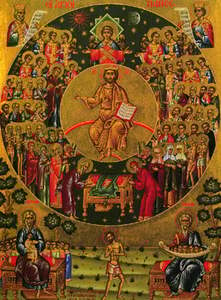
Holy Transfiguration Church
Publish Date: 2026-08-30
Bulletin Contents

Organization Icon
Holy Transfiguration Church

General Information

  • Phone:
  • (907) 344-0190
  • Fax:
  • (907) 344-9909
  • Street Address:

  • 2800 O'Malley Road

  • Anchorage, AK 99507
  • Mailing Address:

  • 2800 O'Malley Road

  • Anchorage, AK 99507


Contact Information


Services Schedule

Saturday 5pm - Great Vespers

Sunday 8:45 am - Orthros

Sunday 10 am - Divine Liturgy


Past Bulletins


Hymns of the Day

Resurrectional Apolytikion in the Fourth Mode

The women disciples of the Lord, having learned from the Angel the joyous news of the Resurrection and having rejected the ancestral decision, then told the apostles elatedly: Death has been stripped of its power; Christ God has risen, granting to the world His great mercy.
Τὸ φαιδρὸν τῆς Ἀναστάσεως κήρυγμα, ἐκ τοῦ Ἀγγέλου μαθοῦσαι αἱ τοῦ Κυρίου Μαθήτριαι, καὶ τὴν προγονικὴν ἀπόφασιν ἀπορρίψασαι, τοῖς Ἀποστόλοις καυχώμεναι ἔλεγον· Ἐσκύλευται ὁ θάνατος, ἠγέρθη Χριστὸς ὁ Θεός, δωρούμενος τῷ κόσμῳ τὸ μέγα ἔλεος.

Apolytikion for Apodosis of the Forerunner in the Second Mode

The memory of the just is celebrated with hymns of praise, but the Lord's testimony is sufficient for thee, O Forerunner; for thou hast proved to be truly even more venerable than the Prophets, since thou was granted to baptize in the running waters Him Whom they proclaimed. Wherefore, having contested for the truth, thou didst rejoice to announce the good tidings even to those in Hades: that God hath appeared in the flesh, taking away the sin of the world and granting us great mercy.
Μνήμη δικαίου μέτ' ἐγκωμίων, σοὶ δὲ ἀρκέσει ἡ μαρτυρία τοῦ Κυρίου Πρόδρομε, ἀνεδείχθης γὰρ ὄντως καὶ Προφητῶν σεβασμιώτερος, ὅτι καὶ ἐν ῥείθροις βαπτίσαι κατηξιώθης τὸν κηρυττόμενον. Ὅθεν τῆς ἀληθείας ὑπεραθλήσας, χαίρων εὐηγγελίσω καὶ τοὶς ἐν ἅδῃ, Θεὸν φανερωθέντα ἐν σαρκί, τὸν αἴροντα τὴν ἁμαρτίαν τοῦ κόσμου, καὶ παρέχοντα ἡμῖν τὸ μέγα ἔλεος.

Seasonal Kontakion in the Fourth Mode

In your holy birth, Immaculate One, Joachim and Anna were rid of the shame of childlessness; Adam and Eve of the corruption of death. And so your people, free of the guilt of their sins, celebrate crying: "The barren one gives birth to the Theotokos, who nourishes our life."
Ιωακείμ καί Άννα όνειδισμού ατεκνίας, καί Αδάμ καί Εύα, εκ τής φθοράς τού θανάτου, ηλευθερώθησαν, Άχραντε, εν τή αγία γεννήσει σου, αυτήν εορτάζει καί ο λαός σου, ενοχής τών πταισμάτων, λυτρωθείς εν τώ κράζειν σοι, Η στείρα τίκτει τήν Θεοτόκον, καί τροφόν τής ζωής ημών.


Saints and Feasts

August 31

Aidan, Bishop of Lindisfarne


September 01

Ecclesiastical New Year

For the maintenance of their armed forces, the Roman emperors decreed that their subjects in every district should be taxed every year. This same decree was reissued every fifteen years, since the Roman soldiers were obliged to serve for fifteen years. At the end of each fifteen-year period, an assessment was made of what economic changes had taken place, and a new tax was decreed, which was to be paid over the span of the fifteen years. This imperial decree, which was issued before the season of winter, was named Indictio, that is, Definiton, or Order. This name was adopted by the emperors in Constantinople also. At other times, the latter also used the term Epinemisis, that is, Distribution (Dianome). It is commonly held that Saint Constantine the Great introduced the Indiction decrees in A.D. 312, after he beheld the sign of the Cross in heaven and vanquished Maxentius and was proclaimed Emperor in the West. Some, however (and this seems more likely), ascribe the institution of the Indiction to Augustus Caesar, three years before the birth of Christ. Those who hold this view offer as proof the papal bull issued in A.D. 781 which is dated thus: Anno IV, Indictionis LIII -that is, the fourth year of the fifty-third Indiction. From this, we can deduce the aforementioned year (3 B.C.) by multiplying the fifty-two complete Indictions by the number of years in each (15), and adding the three years of the fifty-third Indiction. There are three types of Indictions: 1) That which was introduced in the West, and which is called Imperial, or Caesarean, or Constantinian, and which begins on the 24th of September; 2) The so-called Papal Indiction, which begins on the 1st of January; and 3) The Constantinopolitan, which was adopted by the Patriarchs of that city after the fall of the Eastern Empire in 1453. This Indiction is indicated in their own hand on the decrees they issue, without the numeration of the fifteen years. This Indiction begins on the 1st of September and is observed with special ceremony in the Church. Since the completion of each year takes place, as it were, with the harvest and gathering of the crops into storehouses, and we begin anew from henceforth the sowing of seed in the earth for the production of future crops, September is considered the beginning of the New Year. The Church also keeps festival this day, beseeching God for fair weather, seasonable rains, and an abundance of the fruits of the earth. The Holy Scriptures (Lev. 23:24-5 and Num. 29:1-2) also testify that the people of Israel celebrated the feast of the Blowing of the Trumpets on this day, offering hymns of thanksgiving. In addition to all the aforesaid, on this feast we also commemorate our Saviour's entry into the synagogue in Nazareth, where He was given the book of the Prophet Esaias to read, and He opened it and found the place where it is written, "The Spirit of the Lord is upon Me, for which cause He hath anointed Me..." (Luke 4:16-30).

It should be noted that to the present day, the Church has always celebrated the beginning of the New Year on September 1. This was the custom in Constantinople until its fall in 1453 and in Russia until the reign of Peter I. September 1 is still festively celebrated as the New Year at the Patriarchate of Constantinople; among the Jews also the New Year, although reckoned according to a moveable calendar, usually falls in September. The service of the Menaion for January 1 is for our Lord's Circumcision and for the memorial of Saint Basil the Great, without any mention of its being the beginning of a new year.


September 01

Symeon the Stylite

Our righteous Father Symeon was born about the year 390 in a certain village named Sis, in the mountain region of Cilicia and Syria. Having first been a shepherd, he entered the monastic discipline at a young age. After trying various kinds of ascetical practices, both in the monastery and then in the wilderness, he began standing on pillars of progressively greater height, and heroically persevered in this for more than forty years; the greater part of this time he spent standing upright, even when one of his feet became gangrenous, and other parts of his body gave way under the strain. He did not adopt this strange way of life out of vainglory, a charge that some of his contemporaries made against him at the first: because he was already famous for his asceticism and holiness before ascending his first pillar (in Greek, style, whence he is called "Stylite"), many pious people came to him wishing to touch his garments, either for healing or for a blessing; to escape the continual vexation they caused, he made a pillar about ten feet high, and then higher and higher, until the fourth and last was about fifty feet high. The Church historian Theodoret of Cyrrhus, an eyewitness of his exploits who wrote of him while Symeon was yet alive, called him "the great wonder of the world." God gave him the grace to persevere in such an astonishing form of asceticism that multitudes came to see him from Persia, Armenia, South Arabia, Georgia, Thrace, Spain, Italy, Gaul, and the British Isles. Theodoret says that he became so famous in Rome that the Nomadic Arabs by the thousands believed in Christ and were baptized because of him; the King of Persia sent envoys to inquire into his way of life, and the Queen asked to be sent oil that he had blessed. He also was a great defender of sound doctrine, and confirmed the Orthodoxy of the Holy Council of Chalcedon for many who had been beguiled by the teachings of the Monophysites, including the Empress Eudocia, widow of Theodosius the Younger. After a life of unheard-of achievements and struggles, he reposed in peace at the age of sixty-nine, in the year 459.


September 04

Moses the Prophet & Godseer

The Prophet Moses-whose name means "one who draws forth," or "is drawn from," that is, from the water-was the pinnacle of the lovers of wisdom, the supremely wise lawgiver, the most ancient historian of all. He was of the tribe of Levi, the son of Amram and Jochabed (Num. 26:59). He was born in Egypt in the seventeenth century before Christ. While yet a babe of three months, he was placed in a basket made of papyrus and covered with pitch, and cast into the streams of the Nile for fear of Pharaoh's decree to the mid-wives of the Hebrews, that all the male children of the Hebrews be put to death. He was taken up from the river by Pharaoh's daughter, became her adopted son, and was reared and dwelt in the King's palace for forty years. Afterward, when he was some sixty years old, he fled to Madian, where, on Mount Horeb, he saw the vision of the burning bush. Thus he was ordained by God to lead Israel and bring it out of the land of Egypt. He led Israel through the Red Sea as it were dry land and governed the people for forty years. He wrought many signs and wonders, and wrote the first five books of the Old Testament, which are called the Pentateuch. When he reached the land of Moab, he ascended Mount Nabau, on the peak called Phasga, and there, by divine command, he reposed in the sixteenth century before Christ, having lived for some 120 years. The first two Odes of the Old Testament, "Let us sing to the Lord" and "Attend, O heaven, and I will speak," were written by him. Of these hymns, the first was chanted by the shore of the Red Sea as soon as the Israelites had crossed it; the second, in the land of Moab, a few days before his repose. The Holy High Priest Aaron was the elder brother of the Holy Prophet Moses. He was appointed by God to serve as the spokesman of Moses before the people, and also before Pharaoh, in Egypt. Afterwards, in the wilderness, he was called to the ministry of the high priesthood, as narrated in the books of Exodus, Leviticus, and Numbers in the Old Testament. The name Aaron means "enlightened."


Gospel and Epistle Readings

Epistle Reading

Prokeimenon. Fourth Mode. Psalm 103.24,1.
O Lord, how manifold are your works. You have made all things in wisdom.
Verse: Bless the Lord, O my soul.

The reading is from St. Paul's First Letter to the Corinthians 16:13-24.

Brethren, be watchful, stand firm in your faith, be courageous, be strong. Let all that you do be done in love. Now, brethren, you know that the household of Stephanas were the first converts in Achaia, and they have devoted themselves to the service of the saints; I urge you to be subject to such men and to every fellow worker and laborer. I rejoice at the coming of Stephanas and Fortunatus and Achaicos, because they have made up for your absence; for they refreshed my spirit as well as yours. Give recognition to such men. The churches of Asia send greetings. Aquila and Prisca, together with the church in their house, send you hearty greetings in the Lord. All the brethren send greetings. Greet one another with a holy kiss. I, Paul, write this greeting with my own hand. If any one has no love for the Lord, let him be accursed. Our Lord, come! The grace of the Lord Jesus be with you. My love be with you all in Christ Jesus. Amen.

Προκείμενον. Fourth Mode. ΨΑΛΜΟΙ 103.24,1.
Ὡς ἐμεγαλύνθη τὰ ἔργα σου Κύριε, πάντα ἐν σοφίᾳ ἐποίησας.
Στίχ. Εὐλόγει ἡ ψυχή μου τὸν Κύριον.

τὸ Ἀνάγνωσμα Πρὸς Κορινθίους α' 16:13-24.

Ἀδελφοί, γρηγορεῖτε, στήκετε ἐν τῇ πίστει, ἀνδρίζεσθε, κραταιοῦσθε. Πάντα ὑμῶν ἐν ἀγάπῃ γινέσθω. Παρακαλῶ δὲ ὑμᾶς, ἀδελφοί - οἴδατε τὴν οἰκίαν Στεφανᾶ, ὅτι ἐστὶν ἀπαρχὴ τῆς Ἀχαΐας, καὶ εἰς διακονίαν τοῖς ἁγίοις ἔταξαν ἑαυτούς - ἵνα καὶ ὑμεῖς ὑποτάσσησθε τοῖς τοιούτοις, καὶ παντὶ τῷ συνεργοῦντι καὶ κοπιῶντι. Χαίρω δὲ ἐπὶ τῇ παρουσίᾳ Στεφανᾶ καὶ Φουρτουνάτου καὶ Ἀχαϊκοῦ, ὅτι τὸ ὑμῶν ὑστέρημα οὗτοι ἀνεπλήρωσαν. Ἀνέπαυσαν γὰρ τὸ ἐμὸν πνεῦμα καὶ τὸ ὑμῶν· ἐπιγινώσκετε οὖν τοὺς τοιούτους. Ἀσπάζονται ὑμᾶς αἱ ἐκκλησίαι τῆς Ἀσίας· ἀσπάζονται ὑμᾶς ἐν κυρίῳ πολλὰ Ἀκύλας καὶ Πρίσκιλλα, σὺν τῇ κατʼ οἶκον αὐτῶν ἐκκλησίᾳ. Ἀσπάζονται ὑμᾶς οἱ ἀδελφοὶ πάντες. Ἀσπάσασθε ἀλλήλους ἐν φιλήματι ἁγίῳ. Ὁ ἀσπασμὸς τῇ ἐμῇ χειρὶ Παύλου. Εἴ τις οὐ φιλεῖ τὸν κύριον Ἰησοῦν Χριστόν, ἤτω ἀνάθεμα. Μαρὰν ἀθά. Ἡ χάρις τοῦ κυρίου Ἰησοῦ Χριστοῦ μεθʼ ὑμῶν. Ἡ ἀγάπη μου μετὰ πάντων ὑμῶν ἐν Χριστῷ Ἰησοῦ. Ἀμήν.


Gospel Reading

13th Sunday of Matthew
The Reading is from Matthew 21:33-42

The Lord said this parable, "There was a householder who planted a vineyard, and set a hedge around it, and dug a wine press in it, and built a tower, and let it out to tenants, and went into another country. When the season of fruit drew near, he sent his servants to the tenants, to get his fruit; and the tenants took his servants and beat one, killed another, and stoned another. Again he sent other servants, more than the first; and they did the same to them. Afterward he sent his son to them, saying 'They will respect my son.' But when the tenants saw the son, they said to themselves, 'This is the heir; come, let us kill him and have his inheritance.' And they took him and cast him out of the vineyard and killed him. When therefore the owner of the vineyard comes, what will he do to those tenants?" They said to him, "He will put those wretches to a miserable death, and let out the vineyard to other tenants who will give him the fruits in their seasons." Jesus said to them, "Have you never read in the scriptures: 'The very stone which the builders rejected has become the head of the corner; this was the Lord's doing, and it is marvelous in our eyes?'"

13th Sunday of Matthew
Κατὰ Ματθαῖον 21:33-42

Εἶπεν ὁ Κύριος τήν παραβολὴν ταύτην· ῎Αλλην παραβολὴν ἀκούσατε. ἄνθρωπός τις ἦν οἰκοδεσπότης, ὅστις ἐφύτευσεν ἀμπελῶνα καὶ φραγμὸν αὐτῷ περιέθηκε καὶ ὤρυξεν ἐν αὐτῷ ληνὸν καὶ ᾠκοδόμησε πύργον, καὶ ἐξέδοτο αὐτὸν γεωργοῖς καὶ ἀπεδήμησεν. ὅτε δὲ ἤγγισεν ὁ καιρὸς τῶν καρπῶν, ἀπέστειλε τοὺς δούλους αὐτοῦ πρὸς τοὺς γεωργοὺς λαβεῖν τοὺς καρποὺς αὐτοῦ. καὶ λαβόντες οἱ γεωργοὶ τοὺς δούλους αὐτοῦ ὃν μὲν ἔδειραν, ὃν δὲ ἀπέκτειναν, ὃν δὲ ἐλιθοβόλησαν. πάλιν ἀπέστειλεν ἄλλους δούλους πλείονας τῶν πρώτων, καὶ ἐποίησαν αὐτοῖς ὡσαύτως. ὕστερον δὲ ἀπέστειλε πρὸς αὐτοὺς τὸν υἱὸν αὐτοῦ λέγων· ἐντραπήσονται τὸν υἱόν μου. οἱ δὲ γεωργοὶ ἰδόντες τὸν υἱὸν εἶπον ἐν ἑαυτοῖς· οὗτός ἐστιν ὁ κληρονόμος· δεῦτε ἀποκτείνωμεν αὐτὸν καὶ κατάσχωμεν τὴν κληρονομίαν αὐτοῦ. καὶ λαβόντες αὐτὸν ἐξέβαλον ἔξω τοῦ ἀμπελῶνος, καὶ ἀπέκτειναν. ὅταν οὖν ἔλθῃ ὁ κύριος τοῦ ἀμπελῶνος, τί ποιήσει τοῖς γεωργοῖς ἐκείνοις; λέγουσιν αὐτῷ· κακοὺς κακῶς ἀπολέσει αὐτούς, καὶ τὸν ἀμπελῶνα ἐκδώσεται ἄλλοις γεωργοῖς, οἵτινες ἀποδώσουσιν αὐτῷ τοὺς καρποὺς ἐν τοῖς καιροῖς αὐτῶν. λέγει αὐτοῖς ὁ ᾿Ιησοῦς· οὐδέποτε ἀνέγνωτε ἐν ταῖς γραφαῖς, λίθον ὃν ἀπεδοκίμασαν οἱ οἰκοδομοῦντες, οὗτος ἐγενήθη εἰς κεφαλὴν γωνίας· παρὰ Κυρίου ἐγένετο αὕτη, καὶ ἔστι θαυμαστὴ ἐν ὀφθαλμοῖς ἡμῶν;


Wisdom of the Fathers

Our most dire enemy is pride. Its power is immense. Pride saps our every aspiration, vitiates our every endeavour. Most of us fall prey to its insinuations. The proud man wants to dominate, to impose his will on others; and so conflict arises between brothers... [This] is contrary to revelation concerning the Trinity in Whom there is no greater, no lesser; where each Person possesses absolute plenitude of Divine Being.
Archimandrite Sophrony
His Life is Mine, Part 2: Chapter 2; SVS Press pg. 118, 20th century

Prayer can accomplish all things. It is possible for any of us lacking in natural talent to obtain through prayer supranatural gifts. Where we encounter a deficiency of rational knowledge we should do well to remember that prayer, independently of man's intellectual capacity, can bring a higher form of cognition. There is the province of reflex consciousness, of demonstrative argument; and there is the province where prayer is the passageway to direct contemplation of divine truth.
Archimandrite Sophrony
His Life is Mine, Chapter 6; SVS Press pg. 56, 20th century


Parish News & Events

MEMORIAL TODAY

08/30/2026

Today at the end of the Liturgy we will serve a Memorial on behalf of the departed loved ones of the Paris and Bollerud Families.


ALASKA GREEK FESTIVAL

08/30/2026

Thank you again to all of you who worked so hard for our Annual Greek Festival! And thank you for cleaning up so thoroughly! We have some pastries leftover that are being sold for a heavy discount - look for those on the special table downstairs during Coffee Hour.


8 DATES MARRIAGE ENRICHMENT

08/23/2026

Make time for what matters most this fall with “8 Dates,” a relationship enrichment series presented by the Family Wellness Ministry. Starting September 10, couples are invited to share eight intentional conversations that nurture connection, communication, and closeness. Whether you are dating, engaged, newly married, or have been together for decades, this is a wonderful opportunity to grow together and strengthen your bond. Fr Vasili is one of the facilitator's of this program, and believes that it can be very helpful for all couples, even healthy ones! Learn more and register: www.familywellnessministry.org/eight-dates/


BISHOP IOANNIS MAKING PASTORAL VISIT

08/23/2026

The Chancellor of our Metropolis, Bishop Ioannis, will be making a pastoral visit to our parish the weekend before our consecration, and will stay through the following Sunday with Metropolitan Gerasimos. His Grace will preside over the services on Sunday September 13th, and Monday the 14th (for the Holy Cross), and will help Fr Vasili prepare for the arrival of the Archbishop and the consecration of our church later that week.


THE CONSECRATION BANQUET

08/30/2026

By now most of you should have received your invitation to the Consecration of our Church. If you did NOT receive one yet, please see the table in the Narthex, where we have some addressed invitations for our local parishioners, as well as some extra blank envelopes with the invitation enclosed. If you want to attend the banquet on Saturday night, you will need to RSVP, and those directions are enclosed in the invitation. In addition, you may RSVP online https://givebutter.com/htgoc

The banquet is not really child-friendly, though nursing babies would probably be fine. With your ticket you will gain entry to the Museum Parking Garage so that you do not need to park on the street. The cost for an individual ticket is $125, which is just above the actual cost to the parish. We tried to be sensitive to the current financial situation of our parishioners, while still making sure that we could cover our costs, which include the comp tickets that we are providing for a few dignitaries and special guests. However, if you would like to attend but cannot afford to do so, please see Fr Vasili. The other meals during the Consecration Weekend are being provided by the Church and tickets do not need to be purchased.


CELEBRATION OF CULTURES COFFEE HOUR

08/30/2026

On the Sunday after the consecration we are having a "Celebration of Cultures" meal for Coffee Hour to highlight the multi-ethnic character of our congregation. Today during Coffee Hour please see either Ioanna or Margaret to get further instruction and to pick up the trays that you will use to cook if you want your culture to be included.



Diakonia Newsletter

“Be mature in faith…”—Reflections From Today’s Reading – I Corinthians 16:13-24

“Be mature in faith…”—Reflections From Today’s Reading – I Corinthians 16:13-24

Fr. George Parsenios (HCHC ’96)

In today’s epistle reading, St. Paul urges the Corinthians to “stand firm in faith, be courageous, be strong.” One of these admonitions deserves special attention, not only for its importance in Paul’s letter, but for its importance today as well. It is the word translated as “be courageous.” The Greek word is ἀνδρίζεσθε/andrizesthe, which is based on the Greek word for “man,” ἀνήρ/anêr. By using this word, Paul is not just urging the Corinthians to show manly courage, but more important, to show mature courage. In chapter 3, Paul already had exhorted the Corinthians to be more mature in their faith, lamenting that he had to teach them simply, as though giving milk to babies. And he referred to his own maturation in faith when he said that he acted like a child when he was a child, but when he became a man (anêr), he put aside childish ways. By concluding his letter with this same word, he urges the Corinthians to mature from their childish approach to their faith. We, too, must develop a mature faith, which means at least two things. First, we must learn deeply the tenets of our faith. Many of us approach our careers with a mature level of professional seriousness, but when it comes to our faith we remain oddly content to rely on the simple formulations we learned in Sunday School, even though we have access to libraries of books and podcasts could help us learn more. Second, mature faith means more than just knowing doctrines. Our faith is not just what we think, but what we do. As adults, we manage our money, but how much does our faith impact our finances? As adults, we manage our families, but how much does our faith define our families? Let all of us, men and women, strive ever more for a mature faith.

Fr. George Parsenios is Professor of New Testament at Holy Cross Greek Orthodox School of Theology. www.hchc.edu


What does “cathedral” mean? From The Original Greek: kathedra (καθέδρα)

What does “cathedral” mean? From The Original Greek: kathedra (καθέδρα)

Fr. George Parsenios (HCHC ’96)

A cathedral is the chief church of any region, serving as the ecclesiastical center of a bishop in his diocese. Why, though, is a cathedral such an important church and one so closely tied to the bishop? The name “cathedral” derives from the Greek term καθέδρα/kathedra, made up two Greek words. The word κατά/kata means “down,” and the term ἕδρα/hedra means “chair.” At the most basic level, therefore, a kathedra is simply a place to “sit down,” literally a “chair.”  To make the matter even more interesting, our English word “chair” is derived from the Old French shortening of Greek kathedra, which was borrowed first into Latin and evolved further in Latin’s daughter languages in Europe. In Christian usage, however, a kathedra, is not just any seat: it is the throne of the bishop that is situated behind the altar within the apse of every church. The kathedra is reserved exclusively for the presiding hierarch. The primary church in any bishop’s region, therefore, is called his cathedral. 

Fr. George Parsenios is Professor of New Testament at Holy Cross Greek Orthodox School of Theology. www.hchc.edu

BACK TO TOP