August 16
 ☰
☰
Holy Cross Church
Publish Date: 2026-08-16
Bulletin Contents
Gospel and Epistle Readings
Wisdom of the Fathers
Hymns of the Day
Saints and Feasts
Schedule
Flyers
Prayer Requests
Philoptochos
Memorial Donations


Holy Cross Church
General Information
- Phone:
- (248) 477-1677
- Email:
- [email protected]
- Web:
- www.holycrossgo.org
- Street Address:
- 25225 Middlebelt Rd.
- Farmington Hills, MI 48336
Contact Information
Services Schedule
DIVINE LITURGY
Sundays 10am
OFFICE HOURS
Monday-Friday, 10am - 3pm
Past Bulletins
- Publish Date:
- 2026-09-27
- Publish Date:
- 2026-09-20
- Publish Date:
- 2026-09-13
- Publish Date:
- 2026-09-06
- Publish Date:
- 2026-08-30
- Publish Date:
- 2026-08-23
Gospel and Epistle Readings
Matins Gospel Reading
Eleventh Orthros Gospel
The Reading is from John 21:14-25
At that time, Jesus revealed himself to the disciples after he was raised from the dead. And he said to Simon Peter, "Simon, son of John, do you love me more than these?" He said to him, "Yes, Lord; you know that I love you." He said to him, "Feed my lambs." A second time he said to him, "Simon, son of John, do you love me?" He said to him, "Yes, Lord; you know that I love you." He said to him, "Tend my sheep." He said to him the third time, "Simon, son of John, do you love me?" Peter was grieved because he said to him the third time, "Do you love me?" And he said to him, "Lord, you know everything; you know that I love you." Jesus said to him, "Feed my sheep. Truly, truly, I say to you, when you were young, you girded yourself and walked where you would; but when you are old, you will stretch out your hands, and another will gird you and carry you where you do not wish to go." (This he said to show by what death he was to glorify God.) And after this he said to him, "Follow me." Peter turned and saw following them the disciple whom Jesus loved, who had lain close to his breast at the supper and had said, "Lord, who is it that is going to betray you?" When Peter saw him, he said to Jesus, "Lord, what about this man?" Jesus said to him, "If it is my will that he remain until I come, what is that to you? Follow me!" The saying spread abroad among the brethren that this disciple was not to die; yet Jesus did not say to him that he was not to die, but, "If it is my will that he remain until I come, what is that to you?" This is the disciple who is bearing witness to these things, and who has written these things; and we know that his testimony is true. But there are also many other things which Jesus did; were every one of them to be written, I suppose that the world itself could not contain the books that would be written. Amen.
Epistle Reading
Prokeimenon. 2nd Mode. Psalm 117.14,18.
The Lord is my strength and my song.
Verse: The Lord has chastened me sorely.
The reading is from St. Paul's First Letter to the Corinthians 9:2-12.
Brethren, you are the seal of my apostleship in the Lord. This is my defense to those who would examine me. Do we not have the right to our food and drink? Do we not have the right to be accompanied by a wife, as the other apostles and the brothers of the Lord and Cephas? Or is it only Barnabas and I who have no right to refrain from working for a living? Who serves as a soldier at his own expense? Who plants a vineyard without eating any of its fruit? Who tends a flock without getting some of the milk? Do I say this on human authority? Does not the law say the same? For it is written in the law of Moses, "You shall not muzzle an ox when it is treading out the grain." Is it for oxen that God is concerned? Does he not speak entirely for our sake? It was written for our sake, because the plowman should plow in hope and the thresher thresh in hope of a share in the crop. If we have sown spiritual good among you, is it too much if we reap your material benefits? If others share this rightful claim upon you, do not we still more? Nevertheless, we have not made use of this right, but we endure anything rather than put an obstacle in the way of the gospel of Christ.
Gospel Reading
11th Sunday of Matthew
The Reading is from Matthew 18:23-35
The Lord said this parable: "The kingdom of heaven may be compared to a king who wished to settle accounts with his servants. When he began the reckoning, one was brought to him who owed him ten thousand talents; and as he could not pay, his lord ordered him to be sold, with his wife and children and all that he had, and payment to be made. So the servant fell on his knees, imploring him, 'Lord, have patience with me, and I will pay you everything.' And out of pity for him the lord of that servant released him and forgave him the debt. But that same servant, as he went out, came upon one of his fellow servants who owed him a hundred denarii; and seizing him by the throat he said, 'Pay what you owe.' So his fellow servant fell down and besought him, 'Have patience with me, and I will pay you.' He refused and went and put him in prison till he should pay the debt. When his fellow servants saw what had taken place, they were greatly distressed, and they went and reported to their lord all that had taken place. Then his lord summoned him and said to him, 'You wicked servant! I forgave you all that debt because you besought me; and should not you have had mercy on your fellow servant, as I had mercy on you?' And in anger his lord delivered him to the torturers, till he should pay all his debt. So also my heavenly Father will do to every one of you, if you do not forgive your brother from your heart."
Wisdom of the Fathers
Do we forgive our neighbors their trespasses? God also forgives us in His mercy. Do we refuse to forgive? God, too, will refuse to forgive us. As we treat our neighbors, so also does God treat us. The forgiveness, then, of your sins or unforgiveness, and hence also your salvation or destruction, depend on you yourself, man. For without forgiveness of sins there is no salvation.
Unknown, 18th century
Wherefore then did He not do this, nor forgive the debt before the account? Desiring to teach him, from how many obligations He is delivering him, that in this way at least he might become more mild towards his fellow servant .... He gave more than he asked, remission and forgiveness of the entire debt.
Homily 61 on Matthew 18, 4th Century
Hymns of the Day
Resurrectional Apolytikion in the 2nd Mode
When You descended unto Death, O Lord, You who are immortal Life put Hades to death, by the lightning of Your divinity. And when You raised the dead from the netherworld, all the hosts of heaven sang aloud to You, “O Christ God, Giver of life, glory to You!”
Apolytikion for Holy Napkin in the 2nd Mode
Thy pure image do we venerate, O good One, asking forgiveness of our sins, O Christ our God; for by thine own will thou didst ascend the Cross in thy body, to save thy creatures from the bondage of the enemy. Thou hast verily filled all with joy, since thou didst come, O our Saviour, to save the world.
Apolytikion for Afterfeast of the Dormition in the 1st Mode
You gave birth yet preserved your virginity. You fell asleep in death yet did not desert the world, O Theotokos. You were transported to life, as you are Mother of Life and, by virtue of your intercessions, deliver our souls from death.
Seasonal Kontakion in the 2nd Mode
Neither the grave nor death could contain the Theotokos, the unshakable hope, ever vigilant in intercession and protection. As Mother of life, He who dwelt in the ever-virginal womb transposed her to life.
Saints and Feasts


August 16
Translation of the Image of Our Lord and God and Savior, Jesus Christ
When the fame of our Lord Jesus Christ came to Abgar, the ruler of Edessa, who was suffering from leprosy, Abgar sent a messenger named Ananias, through him asking the Savior to heal him of his disease, while bidding Ananias bring back a depiction of Him. When Ananias came to Jerusalem, and was unable to capture the likeness of our Lord, He, the Knower of hearts, asked for water, and having washed His immaculate and divine face, wiped it dry with a certain cloth, which He gave to Ananias to take to Abgar; the form of the Lord's face had been wondrously printed upon the cloth. As soon as Abgar received the cloth, which is called the Holy Napkin (Mandylion), he reverenced it with joy, and was healed of his leprosy; only his forehead remained afflicted. After the Lord's Death, Resurrection, and Ascension, the Apostle Thaddaeus (see Aug. 21) came to Edessa, and when he had baptized Abgar and all his men, Abgar's remaining leprosy also was healed. Abgar had the holy image of our Savior fixed to a board and placed at the city gate, commanding that all who entered the city reverence it as they passed through. Abgar's grandson, however, returned to the worship of the idols, and the Bishop of Edessa learned of his intention to replace the Holy Napkin with an idol. Since the place where it stood above the city gate was a rounded hollow, he set a burning lamp before the Holy Napkin, put a tile facing it, then bricked up the place and smoothed it over, so that the holy icon made without hands was no longer to be seen, and the ungodly ruler gave no further thought to it.
With the passage of time, the hidden icon was forgotten, until the year 615, when Chosroes II, King of Persia, was assaulting the cities of Asia, and besieged Edessa. The Bishop of Edessa, Eulabius, instructed by a divine revelation, opened the sealed chamber above the city gate and found the Holy Napkin complete and incorrupt, the lamp burning, and the tile bearing upon itself an identical copy of the image that was on the Holy Napkin. The Persians had built a huge fire outside the city wall; when the Bishop approached with the Holy Napkin, a violent wind fell upon the fire, turning it back upon the Persians, who fled in defeat. The Holy Napkin remained in Edessa, even after the Arabs conquered it, until the year 944, when it was brought with honor and triumph to Constantinople in the reign of Romanus I, when Theophylact was Ecumenical Patriarch. The Holy Napkin was enshrined in the Church of the most holy Theotokos called the Pharos. This is the translation that is celebrated today.
Schedule
Calendar updates: holycrossgo.org/calendar
Schedule
TODAY
Sunday, August 16
- 10:00 am | Divine Liturgy & Artoklasia
- 11:20 am | Coffee Hour - Lisa Sturm
THIS WEEK
Monday, August 17
- 07:00 pm | Bible Study (Isaiah 7-8)
UPCOMING
Sunday, August 23
- 10:00 am | Divine Liturgy
- 11:20 am | Coffee Hour - Denise Liberty
Announcements & Reminders
FLOWERS
If you are interested in donating to purchase flowers to decorate an icon for a feast day, or to decorate the church for Pascha, please contact the Church Office or look for donation box on the pangari.
PROSPHORA
Interested in sponsoring prosphora? Please contact the Church Office.
ICONS IN THE ALTAR
If you brought icons to be blessed in the altar, please retrieve them after 40 days.
WORSHIP
Please download the Daily Readings App Lite (free download) for the daily Gospel & Epistle readings.
LIVESTREAM SERVICES
STEWARDSHIP PLEDGE
Please continue to support our Chuch via your Stewardship pledge and donations. Please mail your checks directly to the church or donate online by clicking on the "GIVE" button on our website. Visit the Stewardship webpage to fill out your annual pledge card and/or to pay your stewardship.
VIGIL CANDLES
If you would like us to light a vigil candle for you, please call the Church Office or email [email protected] with your name(s) and Fr. Alex will light a vigil candle for you and say a prayer.
SHOP AT ACE HARDWARE? 5% minus tax = (!)
Holy Cross Greek Orthodox Church or #214538. 5% line discount off everyday pricing in the store Ace Rewards as well as 6% Tax Exempt will come off automatically. 2% Ace Rewards
SHOP AT KROGER?
Register your card in a few steps. Each May the registration needs to be renewed,
so if you were part of the program last year and haven't renewed, please do so. Go to:
www.krogercommunityrewards.com
Holy Cross' ID # 83567
Flyers

Philoptochos Summer Collection Drive
Help those in need. Details in the flyer.

Spinach Pie Sales August 2026
Order today.
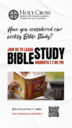
Bible Study
Join us for our weekly Bible Study.

2026 Philoptochos Stewardship Flyer
Join us today.
Prayer Requests
Please continue to pray for the health and healing of:
- Metropolitan Nicholas
- Metropolitan Isaiah
- Psa. Gabriela Pantea
- Adam Angelas
- Andy Athens
- George Benardos
- Polydora Bourdouvalis
- Antonia Comer
- Helene Cuscutis
- Dan Dallas
- Grace Decco
- Marilyn Georgeson
- Elise Gorman
- Brian Heikkuri
- Bill Hiotaky
- Julie Hiotaky
- Irene Katsias
- Maureen Kelly
- Zachary King
- Niki Klimatianos
- Eva Kocoves
- Elaine Kourtakis
- Tom Lagos
- Nayiri Misirliyan
- Faye Prekeges
- Dina Rand
- Paraskevi Theodorou
- Pete Varvaresos
- Nicholas Varveris
- Rafael Vasu
- Dennis Watkins
- Gina Weiler
- Rick Wilson
- Bentley
- Heather
- Perris
- Lexi
- Kanella Katsikas
- Erica Bittinger
- Michael Diamond
- Archie
- Jason
- Sophie Paron
- Gheorghia Cherpes
- Baby Elias
- Allison Ricardi
- Virginia, John & Olivia Koutsouros
- Alexandra Anton
- Christine & Vasili Zoyes
- Baby Josie Bills
- Baby Layla Bills
- George R.
- Soledad Liadis
- Aria Sophia Liadis
- Evelyn Morris
- James
- Tommy
- Phyllis
- Andrea Szczygiel
- Jackie
- Lori
- Michael
- Amanda
- Ayva
- Mary Casoglos
- Joyce
- Karolyn
- Jason
- Tracey
- Sorin
- Pat Thrubis
- Michelle Madau
- Allen George
Please email the office if you want to add your name or loved ones to the prayer list. Thank you!
Philoptochos
INVITATION TO JOIN HOLY CROSS PHILOPTOCHOS
All women 18 years old and over are encouraged to join our Holy Cross Philoptochos. New and returning members are welcome! The 2025 Philoptochos Stewardship Form is attached.
NEXT MEETING
- September 1 @ 6:00 pm
COFFEE HOUR
- 08/16 - Lisa Sturm
- 08/23 - Denise Liberty
- 08/30 - Dianne Tzouras/Eleni Ioanou/Angel Linzell, Mary R.
NOTE ABOUT THE COFFEE HOUR: Philoptochos would like to thank our parishioners who support us throughout the year by sponsoring our Sunday Coffee Hour and bringing delicious treats to share. Your sponsorship and sharing promote fellowship and we are so grateful.
Please consider hosting a Sunday Coffee Hour by signing up on the sheet in the church lobby or contacting Bonnie Sitaras at 248-259-0986.
When scheduling a memorial through the Church Office and you would like to host coffee hour that day, please let Michelle in the office know so we can plan accordingly.
Thank you.
Memorial Donations
In Loving Memory
HELEN MIGHION
Ms. Elaine Ioanou
GEORGIA MORRIS
Mr. & Mrs. Peter Morris