In the year 326, Saint Helen, the faithful mother of Saint Constantine the Great, traveled to Jerusalem to find the places of Christ's suffering, death, and Resurrection. Over the years, many of these sacred sites had been hidden. Emperor Hadrian had built a pagan temple over Golgotha in an attempt to erase the memory of Christ's Passion.
Guided by the faith and tradition of the local Christians, Saint Helen ordered the temple destroyed and the ground excavated. There, workers uncovered the Holy Sepulcher and three crosses. One was the Cross on which Christ had been crucified, while the other two belonged to the thieves crucified beside Him. The challenge was determining which Cross was the Lord's.
Saint Macarius, the Archbishop of Jerusalem, brought forward a woman who was gravely ill. As she touched each cross, nothing happened until she came in contact with the True Cross of Christ. Immediately, she was healed. Through this miracle, God revealed the True Cross of salvation. Joyfully, Patriarch Macarius lifted the Precious Cross high for all the people to see. This moment is the origin of the Feast of the Universal Exaltation of the Precious and Life-Giving Cross, celebrated on September 14.
The feast reminds us that the Cross, once a symbol of shame and death, became through Christ the source of victory, hope, and eternal life. It is the new Tree of Life, revealing God's love for the world and the triumph of light over darkness. As Orthodox Christians, we honor the Cross not only as a sacred relic, but as the sign of our salvation and the path that leads us to Christ.
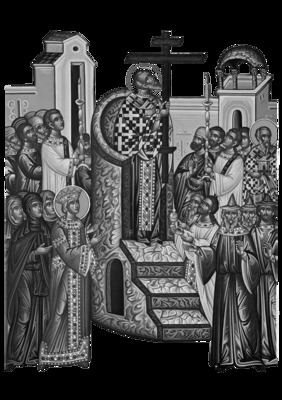
The icon of the Feast of the Precious Cross tells the story of the finding of the Cross and of its Exaltation. Patriarch Macarius is standing in the pulpit elevating the Cross for all to see and venerate. On each side of the Patriarch are deacons holding candles. The elevated Cross is surrounded and venerated by many clergy and lay people, including Saint Helen, the mother of Emperor Constantine. In the background of the icon is a domed structure that represents the Church of the Resurrection in Jerusalem. This church was one of the churches constructed and dedicated by Emperor Constantine on the holy sites of Jerusalem.
FAITH IN ACTION
Today, make the Sign of the Cross slowly and prayerfully, thanking Christ for transforming the Cross from a symbol of suffering into a source of hope, salvation, and new life.