July 12

Holy Trinity Church
Publish Date: 2026-07-12
Bulletin Contents
Hymns of the Day
Saints and Feasts
Gospel and Epistle Readings
Parish News and Events
Parish Events of the Week
Bulletin Inserts
Diakonia Newsletter


Holy Trinity Church
General Information
- Phone:
- (603)225-2961
- Fax:
- (603)225-2961
- Email:
- [email protected]
- Street Address:
- 68 North State Street
- Concord, NH 03301
Contact Information
Services Schedule
Sundays: Divine Liturgy 10:00 am
Weekdays: Divine Liturgy 10:00 am
Past Bulletins
- Publish Date:
- 2026-08-09
- Publish Date:
- 2026-08-02
- Publish Date:
- 2026-07-26
- Publish Date:
- 2026-07-19
- Publish Date:
- 2026-07-05
- Publish Date:
- 2026-06-28
Hymns of the Day
Resurrectional Apolytikion in the Plagal 1st Tone
Τὸν συνάναρχον Λόγον Πατρὶ καὶ Πνεύματι, τὸν ἐκ Παρθένου τεχθέντα εἰς σωτηρίαν ἡμῶν, ἀνυμνήσωμεν πιστοὶ καὶ προσκυνήσωμεν, ὅτι ηὐδόκησε σαρκί, ἀνελθεῖν ἐν τῷ σταυρῷ, καὶ θάνατον ὑπομεῖναι, καὶ ἐγεῖραι τοὺς τεθνεῶτας, ἐν τῇ ἐνδόξῳ Ἀναστάσει αὐτοῦ.
Eternal with the Father and the Spirit is the Word who of a virgin was begotten for our salvation. As the faithful we both praise and worship Him for in the flesh did He consent to ascend unto the cross and death did He endure and He raised unto life the dead through His all-glorious resurrection
Our Holy Father Paisios of Mt. Athos in the 1st Tone
The offspring of Farasa and the adornment of Athos
And the imitator and equal in honor
Of the venerable ones of ages past;
Let us honor Paisios, o faithful.
The vessel full of graces,
Who guards from all sorrows,
The faithful crying out:
Glory to Him who gave you strength,
Glory to Him who crowned you,
Glory to Him who grants to you healings to all.
Seasonal Kontakion in the 2nd Tone
The protection of Christians unshameable, intercessor to our Holy Maker, unwavering, do not turn from the prayerful cries of those who are in sin; instead, come to us, for you are good; your loving help bring unto us, who are crying in faith to you: Hasten to intercession and speed now to supplication as a protection for all time, Theotokos, for those who honor you.
Προστασία τῶν Χριστιανῶν ἀκαταίσχυντε, μεσιτεία πρὸς τὸν Ποιητὴν ἀμετάθετε. Μὴ παρίδῃς ἁμαρτωλῶν δεήσεων φωνάς, ἀλλὰ πρόφθασον, ὡς ἀγαθή, εἰς τὴν βοήθειαν ἡμῶν, τῶν πιστῶς κραυγαζόντων σοι· Τάχυνον εἰς πρεσβείαν, καὶ σπεῦσον εἰς ἱκεσίαν, ἡ προστατεύουσα ἀεί, Θεοτόκε, τῶν τιμώντων σε.
Saints and Feasts


July 12
Proclus & Hilary the Martyrs of Ancyra
These Martyrs contested in Ancyra in 106, during the reign of the Emperor Trajan. Saint Proclus was seized as a Christian and, confessing his faith, was burned on his sides and belly, was hung upon a beam with heavy stones tied to his feet, and finally was taken away to be shot with arrows. As he was being led forth, his nephew Hilary encountered him and greeted him, and was himself seized. After his uncle had been slain with arrows, Hilary, because he would not deny Christ, was tormented, then beheaded.

July 12
Paisios the Athonite
Venerable Father Paisios (Paϊsios) of the Holy Mountain was born to devout parents, Pródromos (Prodromos) and Eulampίa Enzepίde (Enzepίdē), at Pharasa (Phárasa) in Cappadocia on July 25, 1924. Shortly before the family left for Greece because of the exchange of populations,1 he was baptized by Saint Arsenios of Cappadocia (November 10). His godfather wanted to name the child Christos, after his grandfather, but Archimandrite Arsenios, the parish priest, refused saying, "Not so! He shall be called Arsenios. You shall have many other children, but I am a monk; I will have no children. I want him to be a reminder of me."
Archimandrite Arsenios, a man who lived a most holy life, also foretold that he was leaving a monk in his place. He gave the child a special blessing, and so, like Elijah and Elisha,2 grace passed from the Spiritual Father to his child. He also predicted that he himself would not live more than forty days after he arrived in Greece. Forty days after their arrival in Greece, Saint Arsenios went to the Lord and was buried on the island of Kephalonia (Kephaloniá).
In Greece, the family of little Arsenios settled in Konitsa in Epeiros, where he spent his childhood and youth. Nurtured with stories about the wondrous life of Saint Arsenios, the boy, at the age of five, declared that he would become a monk. When he learned to read, he was loved by those who had not been taught. He went into the forest to study and pray in silence. Delighting in the Lives of the Saints, he tried to imitate their ascetical contests with fervent zeal and astonishing exactness. At the same time, he cultivated the virtues of humility and love.
After completing his studies, Arsenios did not wish to continue with his education, preferring to imitate Christ, and so he learned the trade of a carpenter, which he practiced with diligence and skill.
At the age of fifteen, he was deemed worthy of seeing the Lord, because of one philotimo3 thought, by which he repelled a demonic assault and a temptation toward impiety. From that time, the fire of God's love increased in him even more, as well as a longing for the monastic life.
Times of turmoil and upheaval followed for Greece, because of foreign occupation and civil war (1945-1949). However, he was both a citizen and a soldier during his service, displaying unparalleled courage and self-sacrifice. Sometimes he volunteered to take the place of married men with families, who were about to be sent to the Front. He was willing to give every moment, and even his life, to save others. In fact, he was often in the line of fire. Not only did he protect many soldiers by his fervent prayers, but he also guarded himself in a miraculous way.
For most of his military service Arsenios served as a radio operator. He said that they all felt secure only when they communicated with their Division every hour. "When our communication was limited to every two hours," he revealed later, "we felt a bit insecure. Sometimes, when we could be in touch with them just twice a day, we felt uncomfortable, lonely, and lost. The same thing applies to our prayers. The more we pray, the more we feel secure, on a spiritual basis, of course."
After all these things, he wanted to embrace the angelic life of monasticism, which gives wings of divine love.4 Thus, he went to the Holy Mountain seeking a guide to a life of godly silence. However, he did not manage to fulfill his desire right away. At the same time, people found themselves in great economic difficulty when they called on him for help. Thus, he returned to Konitsa and worked as a carpenter. In 1953, at the age of 29, he forsook the world and went to the Holy Mountain.
After visiting various Sketes (Skḗtēs) and Kalyves,5 the Saint finally followed the advice of a venerable Elder and joined the brotherhood of the Holy Monastery of Ἐsphigmenou, known at the time for its strictness. There he lived in the midst of everyone and engaged in severe asceticism, surpassing the others in his labors for the grace of Christ and his brethren. Then, on March 27, 1954, he was tonsured and received the name Averkios. But desiring a stricter life of asceticism, he received the Igoumen's blessing and went to live in the Holy Monastery of Philotheou, which was then idiorhythmic. Under the guidance of a hermit, they lived a very strict ascetical life. When his Elder reposed, he left and went to another hermit. This Elder would greet people he had never met by name, and that is what he did with Father Averkios. However, he did not permit Father to live with him. Instead, he told him to take care of another old and sick hermit, and then come back to him for Confession. In this way, Father Averkios prepared himself for the eremitic life, under the guidance of a wise monk, Elder Simeon.
On March 12, 1956 he was tonsured into the Small Schema and received the name Paisios (which means "child"), thanks to Metropolitan Paisios II of Caesarea, who was also his compatriot.
In August 1958, heeding divine counsel, he did not move to the desert, for which he was being prepared, but into the ruined Monastery of the Mother of God of Stomio, which is located near Konitsa. There he lived for four years, living an angelic life, struggling with temptation, working for the people of the region, saving many from the false teachings of Protestant sects who were active in their midst, and restored the Monastery with a great deal of labor.
In 1962, when the work of restoration and the danger from heterodox groups was ended, he left. The Saint pleaded fervently with God to remove the temptations which besieged him every day, and to show him the path he must follow. So, he accepted the invitation of a certain Hierodeacon to accompany him to the God-trodden Mount Sinai. In this waterless place, in the kelli6 of Saints Galaktion and Episteme (Epistḗmē) (November 5) near Saint Katherine's Monastery, living in solitude and in asceticism. One day, as he searched for matches to light his lamp in order to read, a light shone in his cell showing where the matches were. Father Paisios did not trust this, so he made the Sign of the Cross, and the light disappeared. At last he lived as he had wanted to live for years, alone and near God.
He was beloved by the Bedouins, giving them food and money which he earned by selling to the pilgrims wooden crosses that he made himself. The Arab children in the area often visited Father Paisios. He wished that he had something to give them, but when he brought his handiwork to the Monastery he asked for some cookies and was told that he had to bring more handiwork to obtain cookies. Father Paisios shortened his Prayer Rule and spent more time for his handiwork so that he might have cookies for the children. By this act of love, he discerned that he received even more grace from God.
Returning to Mount Athos in 1964, he did not cease his ascetical contests despite his bodily ailments, but maintained his former fervor in his soul. So, living as a stranger and a sojourner on the earth (Genesis 23:4, LXX), he became a citizen of the Heavens. He attained the heights and became a partaker of divine mysteries, with the blessing of the Mother of God. In addition, he conversed with the Saints who appeared before him, and he had a vision of his Guardian Angel. He also heard angelic hymns, and he shone with heavenly light.
In 1966 he became seriously ill and was admitted to the Center for Thoracic Diseases of Northern Greece (Papanikolaou Hospital). He had a major operation, which resulted in the partial removal of his lungs. Some young women who wished to become nuns donated their blood for his operation. When he recovered he helped them to establish their Convent at Sourote (Sourotḗ), and was able return to the Holy Mountain. He recuperated at the Holy Monastery of Saint John the Evangelist in Sourote in Thessaloniki, and returned to the Holy Mountain after his recovery.
In 1967, he moved to Katounákia, specifically to the Lavriote kelli of Hypatios (Vlachika), where he had a vision of the Uncreated Light. He also saw various Saints, the Mother of God, and even Christ Himself. On one occasion, he was visited by Saint Euphemίa, with whom he discussed certain Church matters.
On August 12, 1968, Saint Paisios came to the Holy Monastery of Stavronikita and lived alone in the kelli of the Holy Cross. There he was tonsured into the Great Schema by the Russian Elder Tikhon, who had the gift of tears. After the latter's repose, Father Paisios would visit the Elder's grave to ask him questions, and Father Tikhon would reply from the grave.
Saint Paisios became ill shortly afterward, and had to leave the Holy Mountain. Then he lived for a time in a monastery in northern Greece. As a consolation, he took with him the relics of Saint Arsenios, who had baptized him. Father Paisios did return to Mount Athos and settled in a cell.
In 1979 he left Holy Cross and, looking for a kelli, went to the Panagouda kelli of Koutloumousίou Monastery, near Karyes. He worked hard to create a kelli with a "Confessor", where he stayed until the end of his life. From the time he settled in Panagouda, a large number of people visited him. In fact, it got so crowded that there were special markers showing the way to his cell, so that the monks would not be disturbed by so many visitors. He also received too many letters. As the Saint said, he became very upset by reading the letters, because he learned only about divorces and mental or physical illnesses. Despite his busy schedule, he continued his intense ascetical life, pausing to rest only two or three hours a day. But he continued to receive and help visitors. He also used to make small printed icons which he gave to them as a blessing.
To the daily fatigue of Saint Paisios, some health problems were added, which tormented him. In the final years of his life, the pains of various diseases such as colitis, which left him permanently dyspeptic, an inguinal hernia, and especially from the cancer with which he had been diagnosed. There was more and more of this, nevertheless, he was calm and did not complain at all. On the contrary, he continued to pray for everyone.
In the early 1980s he moved near Karyes, to a kelli at Koutloumousίou.
After 1993 he began to hemorrhage, for which he was hospitalized, saying that "everything will be done, it is convenient for me." In November of the same year, he left the Holy Mountain for the last time, and went to Sourote, to the Monastery of Saint John the Theologian for its Feast Day; and later for the Feast of Saint Arsenios (November 10). He stayed for a few days, but when he was preparing to leave, he fell ill and was taken to Theageneio, where he was diagnosed with a tumor in the large intestine.
He asked God to grant him bodily and spiritual health. On February 4, 1994, he underwent surgery. The disease was not halted, but it metastasized to the lungs and to the liver. The Saint announced his desire to return to the Holy Mountain on June 13, but a high fever and shortness of breath forced him to remain. At the end of June, his doctors announced that he had only two or three weeks to live at most. On Monday, July 11, 1994 (the Feast of Saint Euphemia), Father Paisios received Holy Communion for the last time, kneeling by his bed. In the last days of his life he decided not to take medicines or painkillers, despite the horrible pains of his sickness. He reposed on Tuesday, July 12, 1994 at 11:00 and was buried in the Holy Hesychasterion of Saint John the Theologian in Sourotei, Thessaloniki, next to Saint Arsenios of Cappadocia, whose Life was written by Saint Paisios.
On January 13, 2015, the Holy Synod of the Ecumenical Patriarchate of Constantinople met and decided to include Saint Paisios of the Holy Mountain in the Hagiologion of the Orthodox Church. May his blessing be upon us.
1 Under the terms of the Treaty of Lausanne, Greeks living in Asia Minor were forced to move to Greece, and Turks living in Greece had to return to Turkey.
2 4 Kings 2:15 (Septuagint).
3 According to Saint Paisios, philotimo is a reverent distribution of goodness, the love shown by humble persons, from which every trace of self (ego) has been rooted out. Their hearts are filled with gratitude toward God and to their fellow man; and out of spiritual sensitivity, they try to repay the slightest good which others do to them.
4 "Life is blessed for those in the wilderness, as they fly upon the wings of divine love" (Sunday Matins: Hymn of Degrees, Tone 5, First Antiphon).
5 Skete: Typically a settlement of hermits near a common church, known as the kyriakon. Kalyva: cells gathered around a church.
6 A monk's cell, or a monastic establishment consisting of a building with a chapel in it, and some land. Usually, a kelli was inhabited by three monks.

July 15
Julitta & Kyrikos the Martyrs
Saint Julitta was from the city of Iconium. Fearing the persecution of Diocletian, she took her son Cyricus, who was three years old, and departed for Seleucia; but finding the same evil there, she went over to Tarsus in Cilicia, where the ruler arrested her. He took her son from her and tried with flatteries to draw the youth to himself. But the little one, in his childish voice, called on the Name of Christ and kicked the ruler in the belly so hard, that the tyrant became enraged and cast him down the steps of the tribunal. In this manner, the child's head was crushed, and he gave up the spirit. As for his blessed mother, she first endured many torments, and finally was beheaded in the year 296.

July 15
Vladimir, Equal-to-the-Apostles of Kiev
Grandson of Saint Olga, Saint Vladimir ascended the throne of Kiev in 980. Though a zealous idolater, he was illumined by the grace of God, accepted the Christian Faith, and completely changed his ways. He was baptized in Cherson in 988, receiving the name Basil; he came forth from the font not only healed of a blindness lately afflicting him, but also from being passionate and warlike, he became meek, peaceable, and exceedingly godly. Whereas his grandmother had refused marriage with the Emperor in Constantinople (see July 11), he married Anna, sister of the Emperors Basil and Constantine, and was accompanied home by priests from Constantinople. Diligently seeking to spread Christianity throughout his realm like a new Constantine, he destroyed the idols (having the chief diety Perun scourged and then cast into the Dnieper River), and summoned all his subjects to Holy Baptism. He reposed in peace in 1015.

July 17
Marina the Great Martyr of Antioch
This Martyr lived during the reign of Claudius II (268-270). She was from Pisidia of Cilicia and was the only daughter of a certain priest of the idols. On being orphaned by her mother, she was handed over to a certain woman who instructed her in the Faith of Christ. When she was fifteen years old, she was apprehended by the ruler of Olmbrius, and when asked her name, homeland, and faith, she answered: "My name is Marina; I am the offspring of the Pisidia; I call upon the Name of my Lord Jesus Christ." Because of this she endured bonds, imprisonment, and many whippings, and was finally beheaded in the year 270. Saint Marina is especially invoked for deliverance from demonic possession.

July 18
Holy New Martyrs Elizabeth the Grand Duchess and the Novice Barbara
Grand Duchess Elizabeth, a grand-daughter of Queen Victoria of England and elder sister of Empress Alexandra of Russia (see July 4), was one of the most illustrious women of her day, known throughout Europe not only for her high birth and graceful beauty, but also for her modesty and goodness of heart. After marrying Grand Duke Sergius Alexandrovich, she converted to Orthodoxy, although this was not required of her by her position. After the assassination of her husband in 1905, Grand Duchess Elizabeth withdrew from public life, founding the convent of Saints Martha and Mary, of which she became the superior. There she dedicated herself to prayer, fasting, tending the sick, and caring for the poor. After the Bolsheviks seized power, she was exiled to the Urals, where she and those with her were martyred in 1918 when they were cast alive into an abandoned mine. The Novice Barbara followed Saint Elizabeth into exile. When she was separated from the Grand Duchess, Barbara asked to be allowed to join her again; to terrify her, the Bolsheviks told her that she would be allowed to do this, but only if she were prepared for unheard-of torments and a violent death. To their amazement, she consented, and was deemed worthy of martyrdom with the Grand Duchess. Their holy relics were recovered and taken through Russia to China, and came to rest in the Convent of Saint Mary Magdalene in Jerusalem. When their reliquaries were opened in 1981, their bodies were found to be partially incorrupt, and sweet with the odour of sanctity. With them are also commemorated their fellow Martyrs: Grand Duke Sergius Mikhailovich; Princes John, Constantine, and Igor, the brethren; Prince Vladimir Paley; and Theodore Remez.
Gospel and Epistle Readings
Epistle Reading
Προκείμενον. Plagal 4th Tone. ΨΑΛΜΟΙ 149.5,6.
Καυχήσονται ὅσιοι ἐν δόξῃ.
Στίχ. Αἱ υψώσεις τοῦ Θεοῦ ἐν τῷ λάρυγγι αὐτῶν.
τὸ Ἀνάγνωσμα Πρὸς Γαλάτας 5:22-26, 6:1-2.
Ἀδελφοί, ὁ καρπὸς τοῦ πνεύματός ἐστιν ἀγάπη, χαρά, εἰρήνη, μακροθυμία, χρηστότης, ἀγαθωσύνη, πίστις, πρᾳότης, ἐγκράτεια· κατὰ τῶν τοιούτων οὐκ ἔστιν νόμος. Οἱ δὲ τοῦ Χριστοῦ, τὴν σάρκα ἐσταύρωσαν σὺν τοῖς παθήμασιν καὶ ταῖς ἐπιθυμίαις. Εἰ ζῶμεν πνεύματι, πνεύματι καὶ στοιχῶμεν. Μὴ γινώμεθα κενόδοξοι, ἀλλήλους προκαλούμενοι, ἀλλήλοις φθονοῦντες. Ἀδελφοί, ἐὰν καὶ προληφθῇ ἄνθρωπος ἔν τινι παραπτώματι, ὑμεῖς οἱ πνευματικοὶ καταρτίζετε τὸν τοιοῦτον ἐν πνεύματι πρᾳότητος, σκοπῶν σεαυτόν μὴ καὶ σὺ πειρασθῇς. Ἀλλήλων τὰ βάρη βαστάζετε, καὶ οὕτως ἀναπληρώσατε τὸν νόμον τοῦ Χριστοῦ.
Prokeimenon. Plagal 4th Tone. Psalm 149.5,6.
The saints shall rejoice in glory.
Verse: The high praises of God shall be in their mouths.
The reading is from St. Paul's Letter to the Galatians 5:22-26; 6:1-2.
Brethren, the fruit of the Spirit is love, joy, peace, patience, kindness, goodness, faithfulness, gentleness, self-control; against such there is no law. And those who belong to Christ Jesus have crucified the flesh with its passions and desires. If we live by the Spirit, let us also walk by the Spirit. Let us have no self-conceit, no provoking of one another, no envy of one another. Brethren, if a man is overtaken in any trespass, you who are spiritual should restore him in a spirit of gentleness. Look to yourself, lest you too be tempted. Bear one another's burdens, and so fulfill the law of Christ.
Gospel Reading
6th Sunday of Matthew
Κατὰ Ματθαῖον 9:1-8
Τῷ καιρῷ ἐκείνῳ, ἐμβὰς εἰς πλοῖον διεπέρασε καὶ ἦλθεν εἰς τὴν ἰδίαν πόλιν. Καὶ ἰδοὺ προσέφερον αὐτῷ παραλυτικὸν ἐπὶ κλίνης βεβλημένον· καὶ ἰδὼν ὁ ᾿Ιησοῦς τὴν πίστιν αὐτῶν εἶπε τῷ παραλυτικῷ· θάρσει, τέκνον· ἀφέωνταί σοι αἱ ἁμαρτίαι σου. καὶ ἰδού τινες τῶν γραμματέων εἶπον ἐν ἑαυτοῖς· οὗτος βλασφημεῖ. καὶ ἰδὼν ὁ ᾿Ιησοῦς τὰς ἐνθυμήσεις αὐτῶν εἶπεν· ἵνα τί ὑμεῖς ἐνθυμεῖσθε πονηρὰ ἐν ταῖς καρδίαις ὑμῶν; τί γάρ ἐστιν εὐκοπώτερον, εἰπεῖν, ἀφέωνταί σου αἱ ἁμαρτίαι, ἢ εἰπεῖν, ἔγειρε καὶ περιπάτει; ἵνα δὲ εἰδῆτε ὅτι ἐξουσίαν ἔχει ὁ υἱὸς τοῦ ἀνθρώπου ἐπὶ τῆς γῆς ἀφιέναι ἁμαρτίας - τότε λέγει τῷ παραλυτικῷ· ἐγερθεὶς ἆρόν σου τὴν κλίνην καὶ ὕπαγε εἰς τὸν οἶκόν σου. καὶ ἐγερθεὶς ἀπῆλθεν εἰς τὸν οἶκον αὐτοῦ. ἰδόντες δὲ οἱ ὄχλοι ἐθαύμασαν καὶ ἐδόξασαν τὸν Θεὸν τὸν δόντα ἐξουσίαν τοιαύτην τοῖς ἀνθρώποις.
6th Sunday of Matthew
The Reading is from Matthew 9:1-8
At that time, getting into a boat Jesus crossed over and came to his own city. And behold, they brought to him a paralytic, lying on his bed; and when Jesus saw their faith he said to the paralytic, "Take heart, my son; your sins are forgiven." And behold, some of the scribes said to themselves, "This man is blaspheming." But Jesus, knowing their thoughts, said, "Why do you think evil in your hearts? For which is easier, to say 'Your sins are forgiven,' or to say 'Rise and walk?' But that you may know that the Son of man has authority on earth to forgive sins" he then said to the paralytic -- "Rise, take up your bed and go home." And he rose and went home. When the crowds saw it, they were afraid, and they glorified God, who had given such authority to men.
Parish News and Events
Fellowship Hour
Today's Fellowship Hour is hosted by Presbytera Anna in honor of the 40 day blessing for Sebastian Theodore and his mother Elena. Thank you so much!
Bedding Donations for Friends of Forgotten Children
The Outreach Ministry will be collecting donations of new bed sets and bed sheets for the Friends of Forgotten Children charity organization. Please note that, although the name of the organization mentions children, they take care of adults as well, and they are actually mainly in need of adult size bedding. Please bring all donations to the miniature bed on the front table in the Church Hall. Thank you for your generosity! The drive will go on until the Feast of the Dormition, August 15.
We are also in need to sunscreeen and bug spray.
Helping Hands Ministry
Do you need some help with cutting the lawn or doing some housework? These things can become difficult as we get older. If you find yourself in this dilemma, please get in touch with our Helping Hands Ministry. Members of our parish have volunteered to do yard work, small repairs, household chores or other such odd jobs, please get in touch with our Helping Hands! Please give Presbytera a call (603-953-3051) and she will put you in touch with someone to help!
Parish Events of the Week
Sunday, July 12--6th Sunday of Matthew / St. Paisios of the Holy Mountain
No Orthros
10:00 am--Divine Liturgy
40 Day Blessing for Sebastian Theodore Ketchen and Elena Newman
Wednesday, July 15
6:30 pm--Parish Counci Zoom Meeting
Thursday, July 16
7:30 pm--Bible Study Epistle to the Hebrews
Zoom Link: https://us02web.zoom.us/j/86006721110?pwd=OMgSamE49lZTS9mvgAriZxwt6yBaha.1
Sunday, July 19--7th Sunday of Matthew / Sunday of the Fathers of the 4th Ecumenical Council
9:00 am--Orthros
10:00 am--Divine Liturgy
Diakonia Newsletter
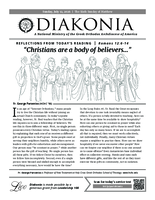
Read the latest Diakonia Newsletter for this Sunday
https://bulletinbuilder.org/diakonia-newsletter/2026-07-12?source=bulletin_web
July 12, 2026