St. Mary Antiochian Orthodox Christian Church
Publish Date: 2026-08-30
Bulletin Contents

Organization Icon
St. Mary Antiochian Orthodox Christian Church

General Information

  • Phone:
  • (316) 264-1576
  • Street Address:

  • 344 S Martinson St.

  • Wichita, KS 67213-4044


Contact Information


Past Bulletins


Hymns of the Day

SUNDAY SERVICE ATTENDANCE in the First Tone

Last Sunday Attendance: 191; 52-Week Average Attendance: 158; 2025 Average Attendance: 148

Resurrectional Apolytikion in the Fourth Tone

Having learned the joyful message of the Resurrection from the angel, the women Disciples of the Lord cast from them their parental condemnation, and proudly broke the news to the Disciples, saying, Death hath been spoiled. Christ God is risen, granting the world Great Mercy.

Apolytikion for Apodosis of the Forerunner in the Second Tone

The memory of the righteous is celebrated with songs of praise, but the Lord’s testimony is sufficient for thee, O Forerunner. Thou wast shown indeed to be the most honorable of the prophets, for in the waters thou didst baptize Him Whom they had proclaimed. After suffering with joy in behalf of the truth, thou didst proclaim even to those in Hades the God Who appeared in the flesh, Who taketh away the sin of the world, and granteth us Great Mercy.

Seasonal Kontakion in the Fourth Tone

By thy holy nativity, O pure one, Joachim and Anna were delivered from the reproach of barrenness; and Adam and Eve were delivered from the corruption of death; thy people do celebrate it, having been saved from the stain of iniquity, crying unto thee: The barren doth give birth to the Theotokos, who nourisheth our life.


Gospel and Epistle Readings

Epistle Reading

Prokeimenon. Fourth Tone. Psalm 103.24,1.
O Lord, how manifold are your works. You have made all things in wisdom.
Verse: Bless the Lord, O my soul.

The reading is from St. Paul's First Letter to the Corinthians 16:13-24.

Brethren, be watchful, stand firm in your faith, be courageous, be strong. Let all that you do be done in love. Now, brethren, you know that the household of Stephanas were the first converts in Achaia, and they have devoted themselves to the service of the saints; I urge you to be subject to such men and to every fellow worker and laborer. I rejoice at the coming of Stephanas and Fortunatus and Achaicos, because they have made up for your absence; for they refreshed my spirit as well as yours. Give recognition to such men. The churches of Asia send greetings. Aquila and Prisca, together with the church in their house, send you hearty greetings in the Lord. All the brethren send greetings. Greet one another with a holy kiss. I, Paul, write this greeting with my own hand. If any one has no love for the Lord, let him be accursed. Our Lord, come! The grace of the Lord Jesus be with you. My love be with you all in Christ Jesus. Amen.


Gospel Reading

13th Sunday of Matthew
The Reading is from Matthew 21:33-42

The Lord said this parable, "There was a householder who planted a vineyard, and set a hedge around it, and dug a wine press in it, and built a tower, and let it out to tenants, and went into another country. When the season of fruit drew near, he sent his servants to the tenants, to get his fruit; and the tenants took his servants and beat one, killed another, and stoned another. Again he sent other servants, more than the first; and they did the same to them. Afterward he sent his son to them, saying 'They will respect my son.' But when the tenants saw the son, they said to themselves, 'This is the heir; come, let us kill him and have his inheritance.' And they took him and cast him out of the vineyard and killed him. When therefore the owner of the vineyard comes, what will he do to those tenants?" They said to him, "He will put those wretches to a miserable death, and let out the vineyard to other tenants who will give him the fruits in their seasons." Jesus said to them, "Have you never read in the scriptures: 'The very stone which the builders rejected has become the head of the corner; this was the Lord's doing, and it is marvelous in our eyes?'"


Holy Bread Offering:

HOLY BREAD

Holy Bread (Prosphora) and Coffee Hour is offered by: The Belles of St Mary

Orthodox servants of God, that they may have mercy, life, peace, health, salvation and visitation: All members of the Belles of St Mary

The Orthodox servants of God departed this life in the hope of resurrection unto life eternal: All departed members of the Belles of St Mary

Your prayers are requested:

Nadia Abdelmaseh, George Augst, Kh. Cindy Baize, Dawneen Banks, Karl Beal, Dn. Stephen Beasley,  Anita Bourgerie, Dennis Bourgerie, Joseph Broz, Jim Buckler, Teresa C., Deana Carothers, Roy Clark, George Cochran, Elisabeth Esquivel, Weine Habtemariam, Jacqueline Howk, Jordan Kaab, Edwin Kerley & family, Kandace Khoury,  Mary Ann Khoury, Michael and Robin Khoury and family, Marlo and Sue Kinsey, Sean and Valerie Lehl & family, Matthew and Erica Lockwood, Linda Love, Donna Namee, Robbie Namee, Barbara Nassif, Lee Rosenbaum, Dolores Shaheen, Michelle Shaheen, Annalise Shearer, Danny Shipman, Brian Smith, Bonita Somerhalder, Rod & Becky Steven, Jacob Taylor, Corina, Cristian, and Iulian Todorache, Autumn and Kim Volhein, Sam Vulgamore, Andrea Vulgamore, Christina Vulgamore, Mary Vulgamore, Davin and Auggie Wallace, Glen Willett, Jadallah Wolf, Kouri Wolf, Marcia Pinkerton-Wolfe, Elena Zamfir

May God remember all of them and us in His Kingdom.


Announcements

MONTHLY NEWSLETTER

Our monthly newsletter, The Scroll, is available online. Each issue of The Scroll includes enriching articles about the faith, as well as pictures from recent events. In addition, we provide a monthly financial update to ensure we are fulfilling the biblical principle of transparency. You may access The Scroll here: The Scroll | St. Mary Orthodox Christian Church


WICHITA MISSION - INITIAL GATHERING

On Monday, September 14, at 6:30 pm, an initial gathering of the Wichita Orthodox Mission Church will be held at a location in west Wichita (we are working to finalize the location, but want you to save the date/time now). In addition to praying the Little Compline service together, the focus of the meeting will be identifying a future location for worship and meetings, as well as the best time of the week to regularly meet. We might also begin assigning individuals/committees with tasks to get the mission started. Attendees are asked to bring a Lenten dish to share at the meal since 9/14 is the Feast of the Cross and, thus, a fast day.


OCF MEETING

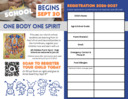
Orthodox Christian Fellowship (OCF) is the official nationwide group of Orthodox Christian college students. All of our Orthodox college students (and any others ages 18 - 23 years old) in Wichita are invited to a kick-off event for this year's OCF on Thursday, September 3, at 6:30 pm at the home of Eric & Tracy Namee (2860 N Cypress). Dinner will be provided. College students, we hope to see you there!


TEEN SOYO POOL PARTY

Our teens will be gathering at the home of Eric & Tracy Namee (2860 N Cypress) on Sunday, September 6, from 4-7 pm for a pool party and dinner. All of our teens, including our teenage catechumens, are welcome to attend. 


BOOK STUDY - THE ORTHODOX WAY

Beginning on Wednesday, September 9, following Daily Vespers each Wednesday we will have a Book Study. The book we will be using is "The Orthodox Way" by Bishop Kallistos Ware. We will also continue the Bible Study, but it will move to Thursday evenings beginning in September. If you wish to order your own copy of "The Orthodox Way" for this study from our parish bookstore, please let Eric or Nico know ASAP. You can find one or both of them in the bookstore Sundays after Liturgy.


ST MARY FEAST DAY PICNIC

The St. Mary Feast Day Picnic is September 13th following the Divine Liturgy. The location is the same as prior years - Edgemoor Recreation Center, 5815 East 9th street, Wichita. The parish will provide a main course (fried chicken); plates, utensils, cups, napkins and ice water. Parishioners attending are asked to bring a side dish, dessert, and/or beverage. The meal will start at approximately 12:30 p.m. Parishioners are also asked to bring softball equipment, if they wish to play. 


BELLES MAKING HOLY BREAD

The Belles of St Mary invite all parishioners (including men) who wish to learn or help to make holy bread to join them on Saturday, September 12, at 7:30 am as they will be making holy bread for the next few months. 


PRISON MINISTRY TRAINING

Those interested in joining Fr. Aaron in his prison ministry involvement at Winfield Correctional Facility are encouraged to attend one of the upcoming volunteer training sessions. Because paperwork and approval are required beforehand, please express interest as early as possible so there is enough time to complete the necessary forms. In addition, please contact Fr. Aaron to let him know you are planning to attend a training session. 

2026 Training Dates

  • Tuesday, September 22 — 5:30–9:30 p.m.
  • Saturday, October 10 — 7:30–11:00 a.m.
  • Tuesday, December 1 — 5:30–9:30 p.m.

For more information, contact 

Janie -   [email protected]    620-705-7051   

Lori Chrisman - [email protected]  316-300-3254


ONLINE GIVING OPTION

Many of our parishioners and friends have asked for an online option to make contributions to our parish. We now have this option on our website. You can make donations online for any reason: pledges, memorial gifts and special collections. You simply need to earmark your donation if it is for a memorial/special collection. If you choose to give online, we respectfully request you cover the associated fees. To give, you may visit the following webpage: Donate to St. Mary


TEXT UPDATES/REMINDERS

Our text message system operates through tithe.ly. We need anyone who wants to receive text messages from the church to sign up for this service (even if you had already signed up using our previous Remind system). You can join by following these quick steps: 
 
- Text the phone number 855-516-9861 with the following phrase in the message box: STMARYTEXT 
 
- Click on the link sent back to you via text and fill out your name (having your name will make it much easier for us in the future to create separate groups, such as the Parish Council, the Belles of St Mary, etc.).

- Check the box giving permission to receive texts.

- Click the "Submit" button. 

Once you have done this, you should be automatically added to our text message list. Contact Fr Aaron if you have any issues. 


Birthdays and Anniversaries

Celebrations this week

Judith Shippy (8/31).   

May God grant her many years!


Calendar

  • St. Mary Parish Calendar

    August 30 to September 14, 2026

    Sunday, August 30

    8:50AM Matins

    10:00AM Divine Liturgy

    Wednesday, September 2

    6:00PM Daily Vespers

    Thursday, September 3

    6:30PM OCF Meeting @ Namee's (2860 N Cypress)

    6:30PM Bible Study

    Saturday, September 5

    4:30PM Confession

    5:00PM Great Vespers

    Sunday, September 6

    8:50AM Matins

    10:00AM Divine Liturgy

    4:00PM Teen SOYO Pool Party (2860 N Cypress)

    Monday, September 7

    Labor Day

    6:00PM Great Vespers ~ Nativity of the Mother of God

    Tuesday, September 8

    8:00AM Divine Liturgy ~ Nativity of the Mother of God

    Wednesday, September 9

    6:00PM Daily Vespers

    6:30PM Book Study ("The Orthodox Way")

    Thursday, September 10

    5:30PM Parish Council Meeting

    6:30PM Bible Study

    Saturday, September 12

    7:30AM Belles Making Holy Bread

    4:30PM Confession

    5:00PM Great Vespers

    6:00PM Chant Class

    Sunday, September 13

    8:50AM Matins

    10:00AM Divine Liturgy w/Chrismations

    12:30PM Feast Day Celebration @ Edgemoor Park

    5:00PM Dynamic Marriage - Pre-session

    6:00PM Great Vespers w/Procession of the Cross ~ Elevation of the Cross

    Monday, September 14

    Fast Day ~ Elevation of the Cross


Saints and Feasts

August 30

The Synaxis of the Holy Hierarchs of Serbia

The Synaxis of the Holy Hierarchs of Serbia: The Saints commemorated on this day are: Sabbas, First Archbishop and enlightener of Serbia (see Jan. 14); Arsenius, his successor, a great hierarch and wonderworker; Sabbas II, son of Saint Stephen, the first-crowned King of Serbia; Nicodemus, Abott of Hilandar, later Archbishop of Serbia; Joannicius, Archbishop, later Patriarch from 1346 to 1349; Patriarch Ephraim, an ascetic, who crowned Prince Lazarus, and later left the patriarchate to live in solitude; Spyridon, Ephraim's successor, who reposed in 1388; Macarius, who printed many church books in Serbia and abroad, was very zealous in renovating and adorning churches, and reposed in 1574; Gabriel, Archbishop, who took part in the Church Council of Moscow during the patriarchate of Nicon, for which the Turks accused him of treason and hanged him in Prusa in the year 1656. Also commemorated are Eustathius, James, Daniel, Sabbas III, Gregory, Cyril (Patriarch), John, Maximus, and Nicon. Many of them labored in asceticism on the Holy Mountain, and all were "good and faithful servants, good labourers in the vineyard of the Lord".


August 31

Cyprian the Hieromartyr & Bishop of Carthage

Saint Cyprian was born of pagan parents in Carthage of Roman Africa about the year 190. An eloquent teacher of rhetoric, he was converted and baptized late in life, and his conversion from a proud man of learning to a humble servant of Christ was complete; he sold his great possessions and gave them to the poor, and because of his zeal and virtue, was ordained presbyter in 247, then Bishop of Carthage in 248. He was especially steadfast in defending the sanctity and uniqueness of the Baptism of the Church of Christ against the confusion of those who would allow some validity to the ministrations of heretics; his writings continue to guide the Church even in our own day. Having survived the persecution of Decius about the year 250, he was beheaded in confession of the Faith during the persecution of Valerian in 258, on September 14; that day being the feast of the Exaltation of the Cross, his feast is kept today.


September 01

Ecclesiastical New Year

For the maintenance of their armed forces, the Roman emperors decreed that their subjects in every district should be taxed every year. This same decree was reissued every fifteen years, since the Roman soldiers were obliged to serve for fifteen years. At the end of each fifteen-year period, an assessment was made of what economic changes had taken place, and a new tax was decreed, which was to be paid over the span of the fifteen years. This imperial decree, which was issued before the season of winter, was named Indictio, that is, Definiton, or Order. This name was adopted by the emperors in Constantinople also. At other times, the latter also used the term Epinemisis, that is, Distribution (Dianome). It is commonly held that Saint Constantine the Great introduced the Indiction decrees in A.D. 312, after he beheld the sign of the Cross in heaven and vanquished Maxentius and was proclaimed Emperor in the West. Some, however (and this seems more likely), ascribe the institution of the Indiction to Augustus Caesar, three years before the birth of Christ. Those who hold this view offer as proof the papal bull issued in A.D. 781 which is dated thus: Anno IV, Indictionis LIII -that is, the fourth year of the fifty-third Indiction. From this, we can deduce the aforementioned year (3 B.C.) by multiplying the fifty-two complete Indictions by the number of years in each (15), and adding the three years of the fifty-third Indiction. There are three types of Indictions: 1) That which was introduced in the West, and which is called Imperial, or Caesarean, or Constantinian, and which begins on the 24th of September; 2) The so-called Papal Indiction, which begins on the 1st of January; and 3) The Constantinopolitan, which was adopted by the Patriarchs of that city after the fall of the Eastern Empire in 1453. This Indiction is indicated in their own hand on the decrees they issue, without the numeration of the fifteen years. This Indiction begins on the 1st of September and is observed with special ceremony in the Church. Since the completion of each year takes place, as it were, with the harvest and gathering of the crops into storehouses, and we begin anew from henceforth the sowing of seed in the earth for the production of future crops, September is considered the beginning of the New Year. The Church also keeps festival this day, beseeching God for fair weather, seasonable rains, and an abundance of the fruits of the earth. The Holy Scriptures (Lev. 23:24-5 and Num. 29:1-2) also testify that the people of Israel celebrated the feast of the Blowing of the Trumpets on this day, offering hymns of thanksgiving. In addition to all the aforesaid, on this feast we also commemorate our Saviour's entry into the synagogue in Nazareth, where He was given the book of the Prophet Esaias to read, and He opened it and found the place where it is written, "The Spirit of the Lord is upon Me, for which cause He hath anointed Me..." (Luke 4:16-30).

It should be noted that to the present day, the Church has always celebrated the beginning of the New Year on September 1. This was the custom in Constantinople until its fall in 1453 and in Russia until the reign of Peter I. September 1 is still festively celebrated as the New Year at the Patriarchate of Constantinople; among the Jews also the New Year, although reckoned according to a moveable calendar, usually falls in September. The service of the Menaion for January 1 is for our Lord's Circumcision and for the memorial of Saint Basil the Great, without any mention of its being the beginning of a new year.


September 01

Symeon the Stylite

Our righteous Father Symeon was born about the year 390 in a certain village named Sis, in the mountain region of Cilicia and Syria. Having first been a shepherd, he entered the monastic discipline at a young age. After trying various kinds of ascetical practices, both in the monastery and then in the wilderness, he began standing on pillars of progressively greater height, and heroically persevered in this for more than forty years; the greater part of this time he spent standing upright, even when one of his feet became gangrenous, and other parts of his body gave way under the strain. He did not adopt this strange way of life out of vainglory, a charge that some of his contemporaries made against him at the first: because he was already famous for his asceticism and holiness before ascending his first pillar (in Greek, style, whence he is called "Stylite"), many pious people came to him wishing to touch his garments, either for healing or for a blessing; to escape the continual vexation they caused, he made a pillar about ten feet high, and then higher and higher, until the fourth and last was about fifty feet high. The Church historian Theodoret of Cyrrhus, an eyewitness of his exploits who wrote of him while Symeon was yet alive, called him "the great wonder of the world." God gave him the grace to persevere in such an astonishing form of asceticism that multitudes came to see him from Persia, Armenia, South Arabia, Georgia, Thrace, Spain, Italy, Gaul, and the British Isles. Theodoret says that he became so famous in Rome that the Nomadic Arabs by the thousands believed in Christ and were baptized because of him; the King of Persia sent envoys to inquire into his way of life, and the Queen asked to be sent oil that he had blessed. He also was a great defender of sound doctrine, and confirmed the Orthodoxy of the Holy Council of Chalcedon for many who had been beguiled by the teachings of the Monophysites, including the Empress Eudocia, widow of Theodosius the Younger. After a life of unheard-of achievements and struggles, he reposed in peace at the age of sixty-nine, in the year 459.


September 02

John the Abstainer, Patriarch of Constantinople

Saint John became Patriarch during the reign of Tiberius, in the year 582, governed the Church for thirteen years and five months, and reposed in peace in 595. It was during this Patriarch's reign, in the year 586, that the title "Ecumenical Patriarch," not used before this, came to be instituted.


September 04

Moses the Prophet & Godseer

The Prophet Moses-whose name means "one who draws forth," or "is drawn from," that is, from the water-was the pinnacle of the lovers of wisdom, the supremely wise lawgiver, the most ancient historian of all. He was of the tribe of Levi, the son of Amram and Jochabed (Num. 26:59). He was born in Egypt in the seventeenth century before Christ. While yet a babe of three months, he was placed in a basket made of papyrus and covered with pitch, and cast into the streams of the Nile for fear of Pharaoh's decree to the mid-wives of the Hebrews, that all the male children of the Hebrews be put to death. He was taken up from the river by Pharaoh's daughter, became her adopted son, and was reared and dwelt in the King's palace for forty years. Afterward, when he was some sixty years old, he fled to Madian, where, on Mount Horeb, he saw the vision of the burning bush. Thus he was ordained by God to lead Israel and bring it out of the land of Egypt. He led Israel through the Red Sea as it were dry land and governed the people for forty years. He wrought many signs and wonders, and wrote the first five books of the Old Testament, which are called the Pentateuch. When he reached the land of Moab, he ascended Mount Nabau, on the peak called Phasga, and there, by divine command, he reposed in the sixteenth century before Christ, having lived for some 120 years. The first two Odes of the Old Testament, "Let us sing to the Lord" and "Attend, O heaven, and I will speak," were written by him. Of these hymns, the first was chanted by the shore of the Red Sea as soon as the Israelites had crossed it; the second, in the land of Moab, a few days before his repose. The Holy High Priest Aaron was the elder brother of the Holy Prophet Moses. He was appointed by God to serve as the spokesman of Moses before the people, and also before Pharaoh, in Egypt. Afterwards, in the wilderness, he was called to the ministry of the high priesthood, as narrated in the books of Exodus, Leviticus, and Numbers in the Old Testament. The name Aaron means "enlightened."


September 05

Zacharias the Prophet & Righteous Elizabeth, parents of St. John the Baptist

According to the opinion of many Fathers of the Church, based on an ancient tradition, this is the Zacharias whom, as our Lord said, the Jews slew between the temple and the altar (Matt. 23:35), first, because even after the Virgin Mary gave birth, he continued to refer to her as virgin and number her among the virgins; second, because Zacharias' son John was not found during the slaughter of the Innocents, since the elderly Elizabeth had taken him and carefully hid him while he was yet an infant, in an unnamed place somewhere in the desert, where, according to the Evangelist, "the child grew, and waxed strong in spirit, and was in the deserts till the day of his showing unto Israel" (Luke 1:80). When the child was not found, his father was slain by Herod's command.


Weekly Bulletin Inserts


Diakonia Newsletter

BACK TO TOP